Volleyball is one of the most widely played indoor and outdoor sports worldwide. Whether you’re building a new court for a school, academy, sports complex, or professional tournament, knowing the correct volleyball court dimensions is essential for fair play, safety, and compliance with official rules.
This guide explains official volleyball court measurements, net height, free zone requirements, and court layout details as per FIVB (Fédération Internationale de Volleyball) standards.
Official Volleyball Court Dimensions (FIVB Standard)
The standard volleyball court size is the same worldwide for both men’s and women’s matches.
Standard Volleyball Court Size
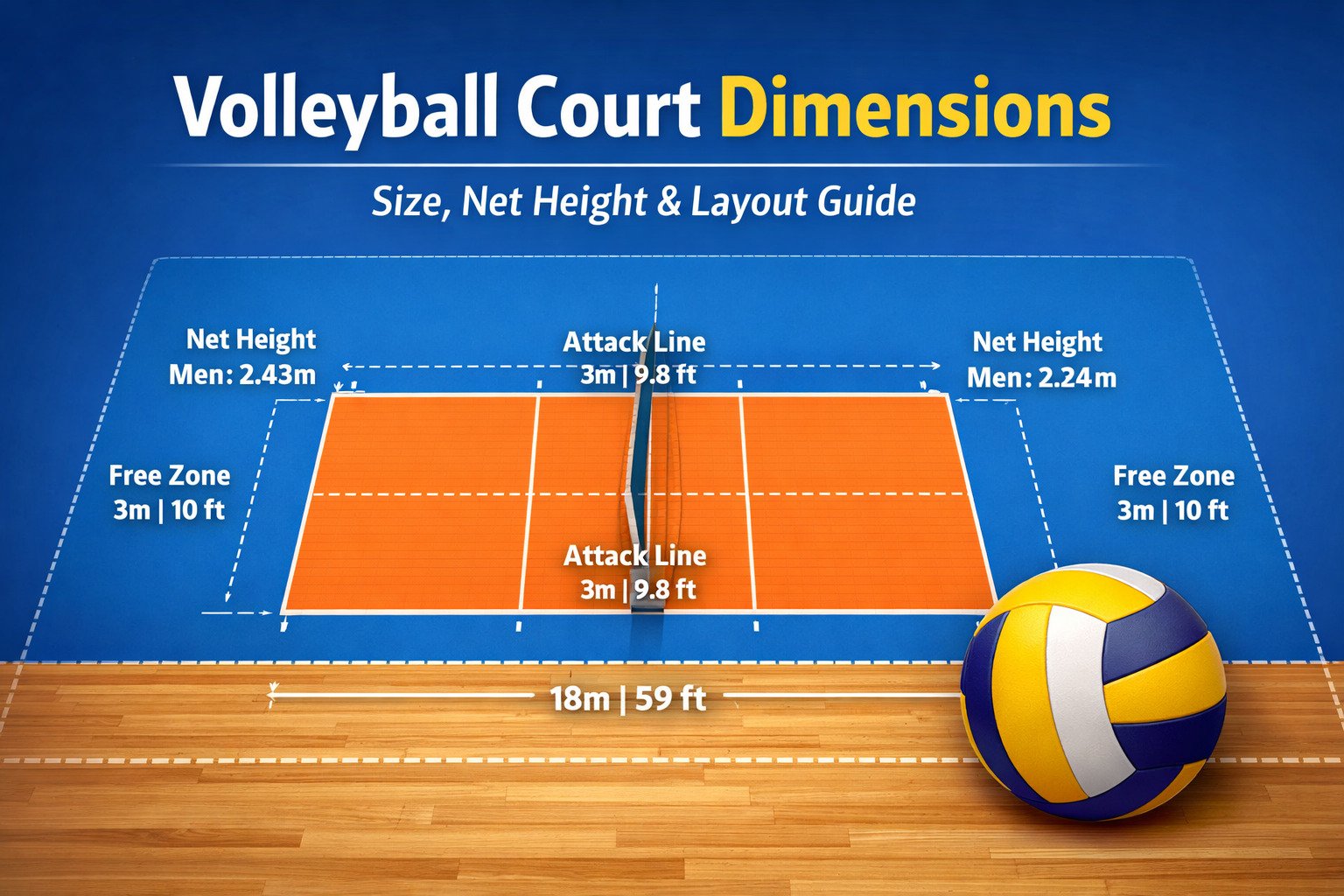
- Length: 18 meters (59 feet)
- Width: 9 meters (29.5 feet)
Total Playing Area:
18 m × 9 m = 162 sq. meters
The court is divided into two equal halves by the center line and net.
Indoor Volleyball Court Dimensions
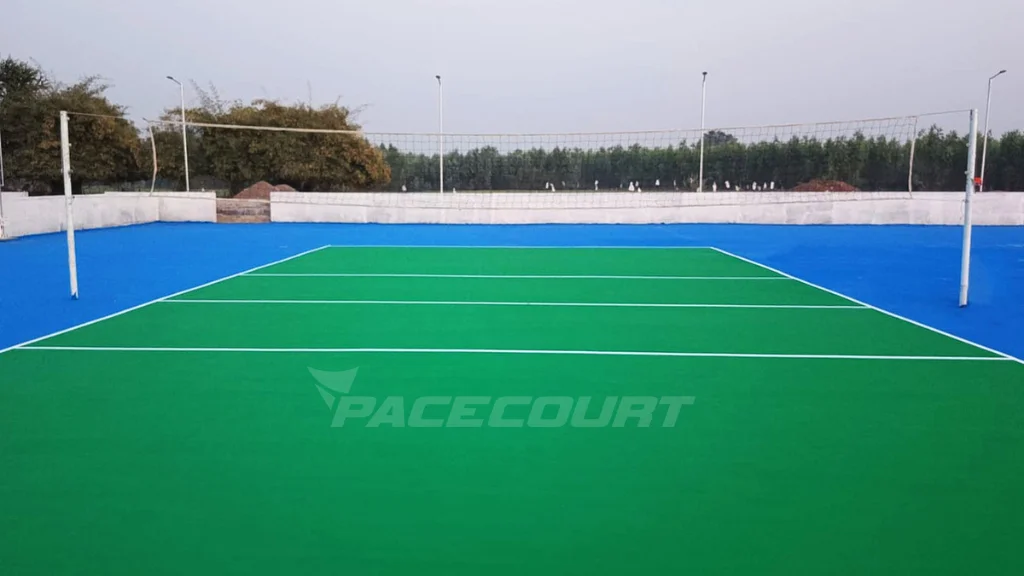
Indoor volleyball is played on a hard surface, usually wood or a synthetic material. The court is designed for six players per side, requiring enough space for complex rotations and high-speed attacks.
The Playing Area
The standard indoor volleyball court is a rectangle measuring 18 meters (59 feet) in length and 9 meters (29.5 feet) in width.
- Length: 18 meters (59 feet)
- Width: 9 meters (29.5 feet)
The court is divided into two equal square team courts by a center line, with each side measuring 9 meters by 9 meters (29.5 feet by 29.5 feet).
Key Lines and Zones
- Attack Line (10-foot line): This is one of the most critical lines in indoor volleyball. It is drawn 3 meters (9 feet 10 inches) back from the center line on both sides. This line separates the front-row players from the back-row players. Back-row players cannot attack the ball above the height of the net unless they jump from behind this line.
- Free Zone: The playing area must be surrounded by a free zone, which is a minimum of 3 meters (9 feet 10 inches) wide on all sides. For FIVB world and official competitions, the free zone must measure a minimum of 5 meters (16 feet) from the side lines and 6.5 meters (21 feet) from the end lines.
- Service Zone: This is a 9-meter (29.5 feet) wide area behind each end line. It extends to the edge of the free zone. Players can serve from anywhere within this width.
Net Height
The height of the net is measured from the center of the playing court.
- Men: 2.43 meters (7 feet 11 ⅝ inches)
- Women: 2.24 meters (7 feet 4 ⅛ inches)
What Are the Official Beach Volleyball Court Dimensions?
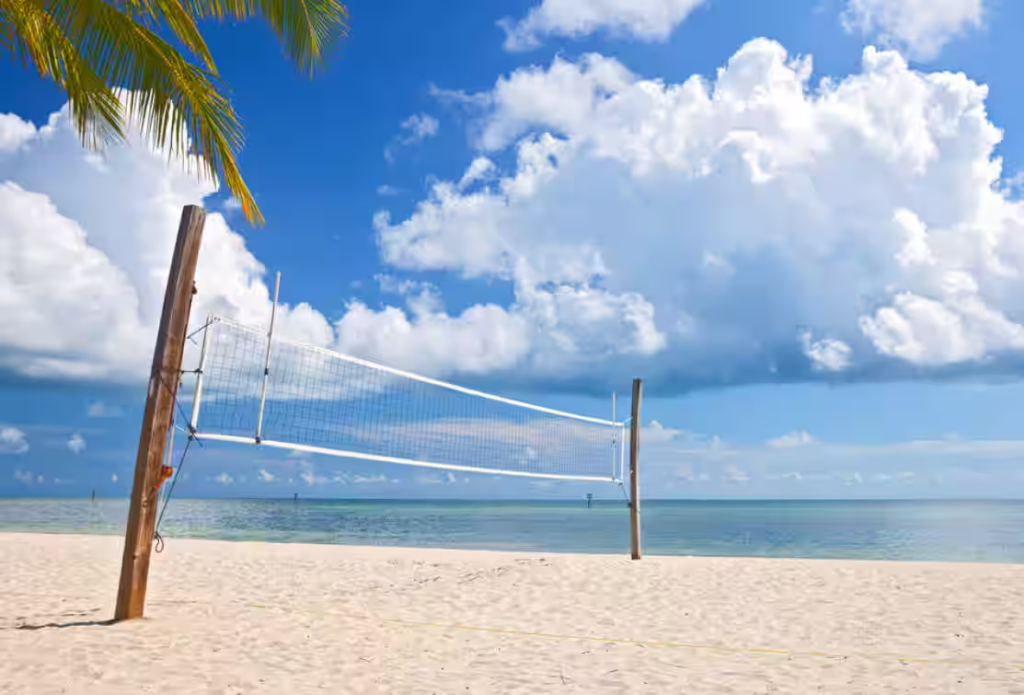
Beach volleyball is typically played with two players per side on sand. Because moving on sand is significantly harder than on a hard court, and there are fewer players to cover the area, the court is slightly smaller.
The Playing Area
A beach volleyball court is a rectangle measuring 16 meters (52.5 feet) in length and 8 meters (26.2 feet) in width.
- Length: 16 meters (52.5 feet)
- Width: 8 meters (26.2 feet)
Like the indoor version, it is divided into two equal squares, but in this case, each side measures 8 meters by 8 meters (26.2 feet by 26.2 feet).
Key Lines and Zones
- No Attack Line: Unlike indoor volleyball, beach volleyball courts do not have an attack line. Players can attack the ball from anywhere on their side of the court.
- Free Zone: The recommended free zone for recreational play is 3 meters (9 feet 10 inches). For official FIVB competitions, the free zone is a minimum of 5 meters (16 feet) and a maximum of 6 meters (20 feet) from the end lines and side lines.
- Service Zone: Players can serve from anywhere behind the rear boundary line, within the extensions of the sidelines.
Net Height
The net heights for beach volleyball are identical to indoor volleyball:
- Men: 2.43 meters (7 feet 11 ⅝ inches)
- Women: 2.24 meters (7 feet 4 ⅛ inches)
How Do Court Size and Net Height Affect Volleyball Strategy?
The seemingly small difference in size between indoor and beach courts has a massive impact on strategy.
- Movement and Coverage: The indoor court is larger (81 square meters per side vs. 64 square meters for beach). However, indoor teams have six players to cover that space, meaning each player is responsible for roughly 13.5 square meters. In beach volleyball, two players cover 64 square meters, meaning each player must defend a massive 32 square meters—while running on shifting sand. This is why the beach court is smaller; a full-sized indoor court would be nearly impossible for two players to defend effectively on sand.
- The Attack Line: The existence of the attack line in indoor volleyball creates specialized roles (liberos, outside hitters, opposites). It adds a vertical layer to the strategy, where back-row attacks are a distinct offensive weapon. In beach volleyball, the lack of an attack line simplifies the rules but increases the physical demand—every player must be a “front-row” threat and a “back-row” defender simultaneously.
- Ceiling Height: While not a floor dimension, vertical space matters. Indoor facilities generally require a minimum clearance of 7 meters (23 feet), though official competitions often require 12.5 meters (41 feet). This allows for high digs and creative saves without the ball hitting the rafters. Beach volleyball, being outdoors, has “infinite” clearance, though wind becomes the equalizer.
Common Volleyball Court Dimension Mistakes
Avoid these frequent errors:
- Incorrect attack line distance
- Insufficient free zone
- Wrong net height
- Narrow service zone
- Poor line visibility
Even small errors can affect match quality and player safety.
How to Set Up a Volleyball Court? Dimensions, Net Height & Tips
If you are setting up a court for a tournament or just for fun, accuracy matters for the integrity of the game.
- Measure Diagonals: The best way to ensure your court is a perfect rectangle and not a skewed rhombus is to measure the diagonals.
- Indoor: The diagonal measurement (corner to opposite corner) should be roughly 20.12 meters (66 feet).
- Beach: The diagonal measurement should be roughly 17.89 meters (58 feet 8 inches).
- Line Width: For official play, boundary lines should be 5 centimeters (2 inches) wide. They must be a light color distinct from the floor or sand.
- North-South Orientation: If building an outdoor beach court, orient the court North-South rather than East-West. This prevents one team from staring directly into the setting or rising sun during morning or evening games.
- Safety Zones: Never skimp on the free zone. Players often chase balls well outside the boundary
Conclusion
Understanding the correct volleyball court dimensions is essential for creating a safe, professional, and competition-ready playing environment. By following official FIVB standards including the 18 × 9 meter court size, accurate net height, proper attack line placement, and adequate free zone clearance you ensure fair gameplay, player safety, and long-term usability of the court.
Whether you are planning a volleyball court for a school, academy, sports complex, or professional tournament, accurate measurements help improve performance, reduce injuries, and meet international regulations. Investing time in proper planning and layout not only enhances the playing experience but also ensures your court is suitable for both training and competitive matches.
Frequently Asked Questions (FAQ’s)
1. What are the official volleyball court dimensions?
A standard indoor volleyball court measures 18 m × 9 m (59 ft × 29.5 ft).
2. What is the official volleyball net height?
The net is 2.43 m (7 ft 11⅝ in) for men and 2.24 m (7 ft 4⅛ in) for women.
3. How much free space is required around a volleyball court?
A minimum free zone of 3 m on all sides is required for standard FIVB competitions, with larger zones for higher-level events.
4. What are the volleyball court line markings?
Court markings include boundary lines, a centre line, attack lines and service zones.
5. What is the attack line distance in volleyball?
The attack line is 3 m (9 ft 10 in) from the centre line on each side.
6. What is the best flooring for an outdoor volleyball court?
Acrylic sports flooring is a suitable option for outdoor volleyball courts because it provides a durable, weather-resistant playing surface.
Stay Updated with Pacecourt
Discover expert insights, practical tips, and the latest industry updates from Pacecourt, covering sports flooring, tennis and multi-sport court construction, resurfacing, maintenance, court performance, and innovative sports infrastructure solutions.
Powered by Google's Preferred Sources feature