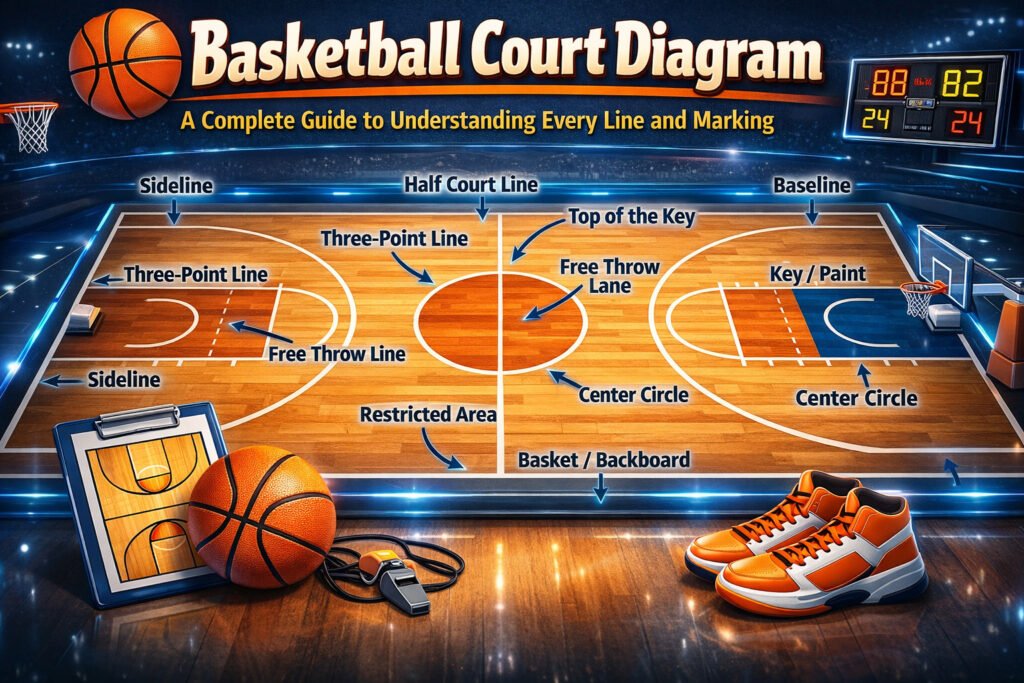
Basketball Court Diagram: A Complete Guide to Understanding Every Line and Marking
If you’ve ever looked at a basketball court diagram and thought, “Why are there so many lines?” — you’re not alone. At first glance, it might look like a maze of arcs, rectangles, and boundaries. But here’s the thing: every single line painted on that hardwood has a purpose. Nothing is random. Nothing is decorative. Each marking shapes how the game is played, how strategies unfold, and how referees enforce the rules. A basketball court diagram is essentially a blueprint of the game itself. It shows the precise layout of the playing surface — from the center circle where the game tips off, to the three-point arc that has transformed modern basketball into a fast-paced scoring spectacle. Whether you’re a player, coach, student, or simply a fan trying to understand the game more deeply, learning how to read a basketball court diagram gives you a completely new appreciation for the sport. Think of it like reading a map. If you don’t understand the symbols, you’re just staring at shapes. But once you know what they represent, suddenly you can navigate with confidence. The same goes for basketball. The diagram helps you understand spacing, positioning, rules, and tactics. In this guide, we’ll break down every major component of the basketball court diagram in detail. You’ll learn the measurements, the rules connected to each line, and how these markings influence gameplay. By the end, you won’t just recognize the lines — you’ll understand the story they tell. Let’s step onto the court. Official Basketball Court Dimensions Before diving into specific lines and markings, it’s crucial to understand the overall size of a basketball court. After all, every diagram is built around standardized measurements. And yes — those measurements vary depending on the league. In the NBA, the official court dimensions are 94 feet long and 50 feet wide. That’s about 28.65 meters by 15.24 meters. It’s a rectangular surface designed for speed, spacing, and high-level athletic performance. The length allows for fast breaks, while the width creates room for strategic movement and shooting angles. FIBA courts, which are used in international competitions, are slightly smaller. They measure 28 meters long by 15 meters wide (approximately 91.9 feet by 49.2 feet). The difference might seem minor, but even a few feet can affect spacing and defensive coverage. Players who compete internationally often notice these subtle changes. College (NCAA) courts in the United States use the same dimensions as NBA courts — 94 by 50 feet. High school courts are typically the same size as well, though some older gymnasiums may be slightly smaller. Why does size matter so much? Because basketball is a game of space. Spacing determines offensive flow, defensive pressure, and transition opportunities. A larger court demands more stamina. A slightly smaller one can feel more compact and physical. When you look at a basketball court diagram, the outer rectangle represents this full playing area. Everything else — the arcs, circles, and painted areas — fits within these boundaries. Understanding these base dimensions gives you context for every other marking we’ll discuss. It’s the foundation. And like any good blueprint, the details only make sense once you understand the frame. The Center Circle and Midcourt Line Right at the heart of the basketball court diagram sits the center circle — a simple yet symbolic marking. This is where the game begins. The opening tip-off happens here, setting the tone for everything that follows. The center circle has a radius of 6 feet in NBA courts. At the very middle lies the exact midpoint of the court, intersected by the midcourt line (also called the half-court line). This line divides the playing surface into two equal halves: the frontcourt and the backcourt. But this isn’t just about starting the game. The midcourt line plays a huge role in gameplay rules. Once the offensive team advances the ball past this line into the frontcourt, they cannot bring it back into the backcourt. Doing so results in a backcourt violation. This rule prevents teams from stalling and encourages continuous offensive action. There’s also the 8-second rule (in NBA and FIBA), which requires a team to move the ball across the half-court line within eight seconds of gaining possession. Miss that window? Turnover. Strategically, the midcourt line also influences defensive schemes. Full-court presses begin in the backcourt, aiming to trap opponents before they can cross the line. Meanwhile, offenses carefully design inbound plays to beat aggressive pressure. In a basketball court diagram, the center circle may look simple — just a circle bisected by a straight line. But don’t underestimate it. This is the dividing line between defense and attack, hesitation and commitment, control and chaos. Every possession crosses this threshold. And every game begins right here. The Three-Point Line If one line has revolutionized basketball more than any other, it’s the three-point line. On a basketball court diagram, it appears as a large arc stretching around the perimeter of the offensive half. But in reality, it represents one of the most strategic elements of modern basketball. In the NBA, the three-point line is 23 feet 9 inches from the basket at the top of the arc, and 22 feet in the corners. FIBA’s three-point line is slightly shorter at 22 feet 1.75 inches (6.75 meters). College basketball has its own measurement as well. That slight difference in distance dramatically affects gameplay. A shorter line increases shooting percentages. A longer one demands greater range and strength. Why is the three-point line so important? Because shots made beyond it are worth three points instead of two. That extra point changes everything. Teams now design entire offenses around spacing the floor to create open three-point shots. Players train specifically to extend their shooting range. Defensively, guarding the three-point arc requires quick rotations and awareness. Leave a shooter open for a split second, and you could give up three points in the blink of an eye. On the court diagram, the arc intersects with straight lines in