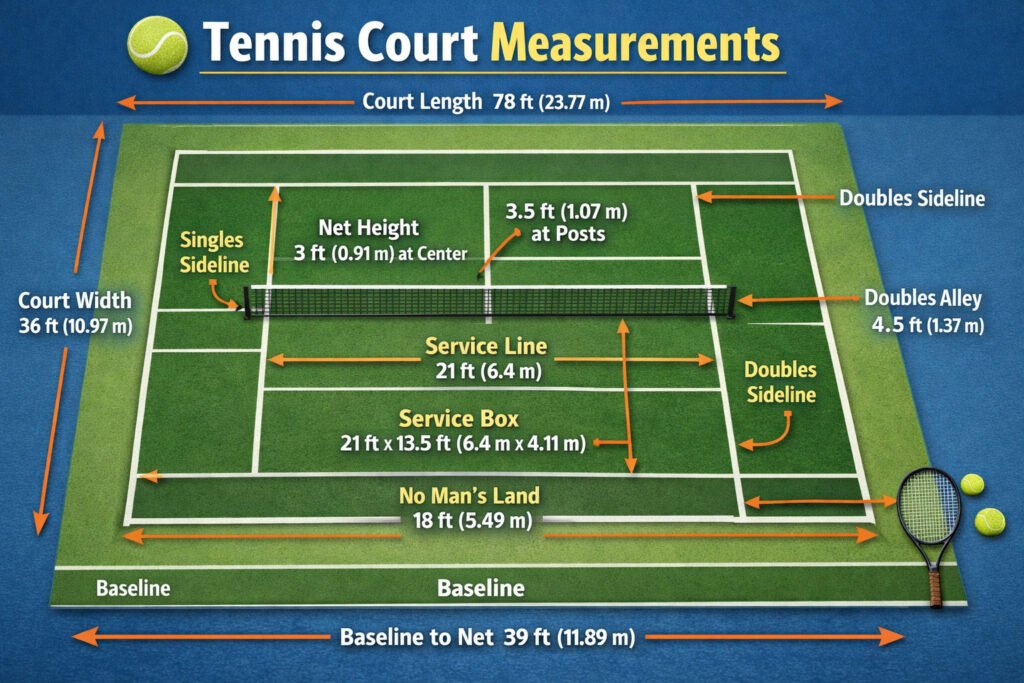
Tennis Court Measurements: The Complete Guide to Official Dimensions and Layout
If you’ve ever stood on a tennis court and wondered why everything feels so perfectly aligned—the lines crisp, the net centered, the spacing symmetrical—there’s a reason. Tennis court measurements aren’t random. Every inch is regulated, calculated, and standardized to ensure fairness, consistency, and competitive integrity across the world. Think about it. Whether you’re playing at a local park, a private club, or watching Wimbledon on TV, the court dimensions remain the same. That consistency is what allows players to transition from recreational games to professional tournaments without relearning the geometry of the sport. Tennis is a game of precision. A ball landing just millimeters outside the baseline can change the outcome of a match. Because of that, court measurements must be exact. Even a slight miscalculation in line placement can disrupt gameplay and create disputes. That’s why governing bodies like the ITF (International Tennis Federation) strictly define every dimension—from baseline to net height. But tennis court measurements aren’t just about length and width. They also include service boxes, alleys, center marks, net height, and surrounding run-off space. Each measurement has a purpose. Each line influences strategy. Each boundary shapes how the game unfolds. Whether you’re planning to build a court, mark one for a school, or simply want to understand the layout better, this guide breaks it all down in clear, practical terms. By the end, you won’t just know the numbers—you’ll understand why they matter. Let’s step onto the court and explore every detail. Official Tennis Court Dimensions (Overview) At the heart of tennis lies a simple rectangle—but don’t let that simplicity fool you. The official tennis court dimensions are precise and universally standardized. The total length of a tennis court is 78 feet (23.77 meters). This measurement applies to both singles and doubles matches. No matter the level of play, the length from baseline to baseline remains constant. The width, however, changes depending on the format: Those extra 9 feet (4.5 feet on each side) are known as the doubles alleys. They’re used only during doubles matches. Now, imagine the court divided in half by the net. Each side measures 39 feet from net to baseline. This symmetry ensures balanced play on both ends. Here’s a quick breakdown: Measurement Type Feet Meters Total Length 78 ft 23.77 m Singles Width 27 ft 8.23 m Doubles Width 36 ft 10.97 m Net Height (Center) 3 ft 0.91 m Net Height (Posts) 3 ft 6 in 1.07 m These dimensions are mandated by the ITF and used worldwide. But the playing lines themselves are also regulated. Baselines can be up to 4 inches wide, while service and center lines are typically 2 inches wide. These seemingly small details matter—especially in competitive play. The beauty of tennis court measurements lies in their balance. The proportions allow aggressive baseline rallies, strategic net play, and precise serves. Every dimension supports the sport’s rhythm. Next, let’s break down the differences between singles and doubles courts in more detail. Singles vs Doubles Court Dimensions Here’s where things get interesting. While the length of the tennis court stays the same, the width changes depending on whether you’re playing singles or doubles. In singles, the court measures 27 feet wide. In doubles, it expands to 36 feet wide. That extra 9 feet comes from two 4.5-foot-wide alleys on either side of the singles court. Why does this matter? In singles, players must cover the entire 27-foot width themselves. That narrower layout encourages precision and stamina. Angles are sharper. Cross-court shots are tighter. There’s less room to exploit. In doubles, the wider court creates more opportunities for angled shots and strategic teamwork. The alleys suddenly become valuable real estate. A well-placed shot down the line can win the point instantly. Visually, the singles court is embedded inside the doubles court. When watching a match, you’ll notice inner sidelines—that’s the singles boundary. The outermost lines mark the doubles boundary. Here’s a simple comparison: Feature Singles Doubles Width 27 ft 36 ft Length 78 ft 78 ft Alleys Used No Yes Strategically, the extra width in doubles changes everything. Players often position themselves differently—one at the net, one at the baseline. The added space supports aggressive net play and angled volleys. If you’re building a court, you’ll almost always construct a full doubles court. Why? Because it allows both singles and doubles play. You simply ignore the alleys during singles matches. Understanding this distinction is crucial when marking lines or planning construction. Next, let’s talk about the baseline and service line measurements—the lines that shape rallies and serve placement. Baseline and Service Line Measurements The baseline is where most points begin—and often where they’re won or lost. Each baseline sits at the back of the court, marking the boundary between in and out. The total court length is 78 feet, meaning there are 39 feet from the net to each baseline. Baselines can be up to 4 inches wide, making them the widest lines on the court. Why wider? Because players frequently reference them for positioning during serves and rallies. Moving forward from the baseline, you’ll find the service line, located exactly 21 feet from the net on each side. This line is critical during serves. The serve must land in the service box, which is created by: The space between the net and service line forms the service court depth. Since the net-to-baseline distance is 39 feet, and the service line sits 21 feet from the net, that leaves 18 feet between the service line and baseline. This 18-foot zone is often called “no man’s land”—a tricky area to defend because you’re too far from the net to volley comfortably and too close to react to deep groundstrokes. These measurements shape strategy. Servers aim for precision within the 21-foot boundary. Returners position themselves near the baseline for maximum reaction time. Every inch matters here. A serve that lands just beyond the service line is out. A shot landing on the baseline? That’s in. The geometry of these lines