If you’ve ever stood on a tennis court and wondered why everything feels so perfectly aligned—the lines crisp, the net centered, the spacing symmetrical—there’s a reason. Tennis court measurements aren’t random. Every inch is regulated, calculated, and standardized to ensure fairness, consistency, and competitive integrity across the world.
Think about it. Whether you’re playing at a local park, a private club, or watching Wimbledon on TV, the court dimensions remain the same. That consistency is what allows players to transition from recreational games to professional tournaments without relearning the geometry of the sport.
Tennis is a game of precision. A ball landing just millimeters outside the baseline can change the outcome of a match. Because of that, court measurements must be exact. Even a slight miscalculation in line placement can disrupt gameplay and create disputes. That’s why governing bodies like the ITF (International Tennis Federation) strictly define every dimension—from baseline to net height.
But tennis court measurements aren’t just about length and width. They also include service boxes, alleys, center marks, net height, and surrounding run-off space. Each measurement has a purpose. Each line influences strategy. Each boundary shapes how the game unfolds.
Whether you’re planning to build a court, mark one for a school, or simply want to understand the layout better, this guide breaks it all down in clear, practical terms. By the end, you won’t just know the numbers—you’ll understand why they matter.
Let’s step onto the court and explore every detail.
Table of contents
Official Tennis Court Dimensions (Overview)
At the heart of tennis lies a simple rectangle—but don’t let that simplicity fool you. The official tennis court dimensions are precise and universally standardized.
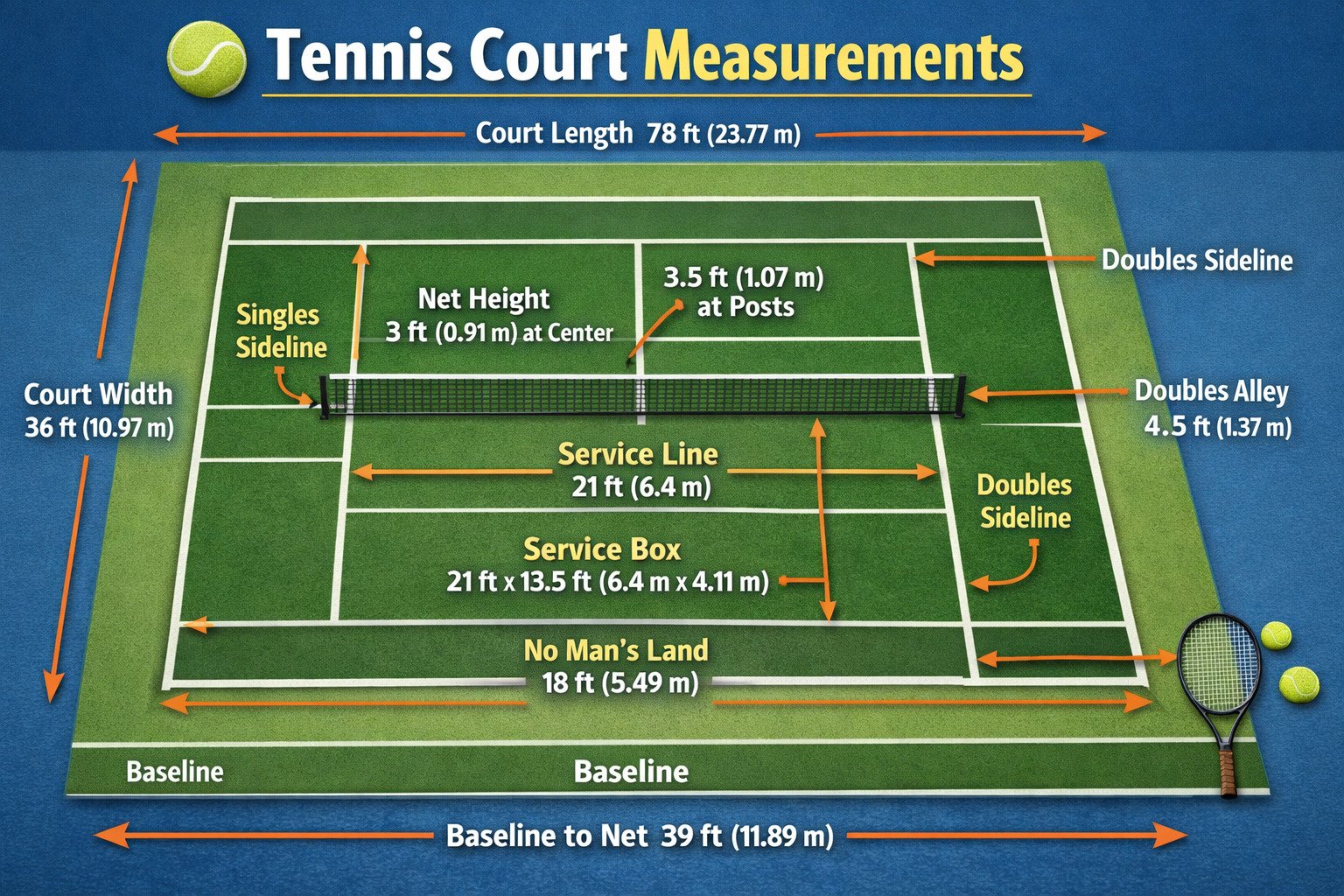
The total length of a tennis court is 78 feet (23.77 meters). This measurement applies to both singles and doubles matches. No matter the level of play, the length from baseline to baseline remains constant.
The width, however, changes depending on the format:
- Singles court width: 27 feet (8.23 meters)
- Doubles court width: 36 feet (10.97 meters)
Those extra 9 feet (4.5 feet on each side) are known as the doubles alleys. They’re used only during doubles matches.
Now, imagine the court divided in half by the net. Each side measures 39 feet from net to baseline. This symmetry ensures balanced play on both ends.
Here’s a quick breakdown:
| Measurement Type | Feet | Meters |
|---|---|---|
| Total Length | 78 ft | 23.77 m |
| Singles Width | 27 ft | 8.23 m |
| Doubles Width | 36 ft | 10.97 m |
| Net Height (Center) | 3 ft | 0.91 m |
| Net Height (Posts) | 3 ft 6 in | 1.07 m |
These dimensions are mandated by the ITF and used worldwide.
But the playing lines themselves are also regulated. Baselines can be up to 4 inches wide, while service and center lines are typically 2 inches wide. These seemingly small details matter—especially in competitive play.
The beauty of tennis court measurements lies in their balance. The proportions allow aggressive baseline rallies, strategic net play, and precise serves. Every dimension supports the sport’s rhythm.
Next, let’s break down the differences between singles and doubles courts in more detail.
Singles vs Doubles Court Dimensions
Here’s where things get interesting. While the length of the tennis court stays the same, the width changes depending on whether you’re playing singles or doubles.
In singles, the court measures 27 feet wide. In doubles, it expands to 36 feet wide. That extra 9 feet comes from two 4.5-foot-wide alleys on either side of the singles court.
Why does this matter?
In singles, players must cover the entire 27-foot width themselves. That narrower layout encourages precision and stamina. Angles are sharper. Cross-court shots are tighter. There’s less room to exploit.
In doubles, the wider court creates more opportunities for angled shots and strategic teamwork. The alleys suddenly become valuable real estate. A well-placed shot down the line can win the point instantly.
Visually, the singles court is embedded inside the doubles court. When watching a match, you’ll notice inner sidelines—that’s the singles boundary. The outermost lines mark the doubles boundary.
Here’s a simple comparison:
| Feature | Singles | Doubles |
|---|---|---|
| Width | 27 ft | 36 ft |
| Length | 78 ft | 78 ft |
| Alleys Used | No | Yes |
Strategically, the extra width in doubles changes everything. Players often position themselves differently—one at the net, one at the baseline. The added space supports aggressive net play and angled volleys.
If you’re building a court, you’ll almost always construct a full doubles court. Why? Because it allows both singles and doubles play. You simply ignore the alleys during singles matches.
Understanding this distinction is crucial when marking lines or planning construction.
Next, let’s talk about the baseline and service line measurements—the lines that shape rallies and serve placement.
Baseline and Service Line Measurements
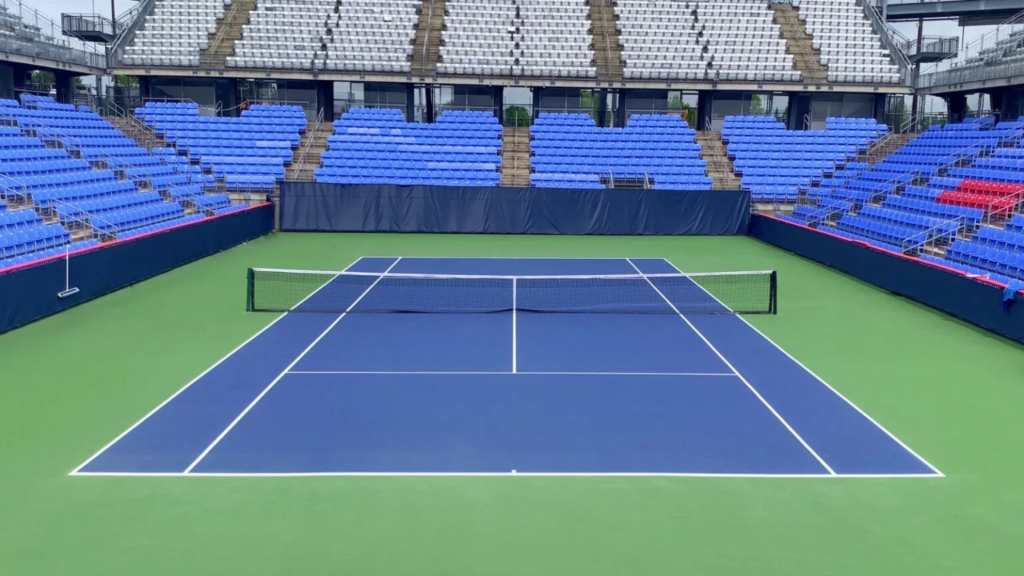
The baseline is where most points begin—and often where they’re won or lost.
Each baseline sits at the back of the court, marking the boundary between in and out. The total court length is 78 feet, meaning there are 39 feet from the net to each baseline.
Baselines can be up to 4 inches wide, making them the widest lines on the court. Why wider? Because players frequently reference them for positioning during serves and rallies.
Moving forward from the baseline, you’ll find the service line, located exactly 21 feet from the net on each side. This line is critical during serves. The serve must land in the service box, which is created by:
- The service line
- The singles sideline
- The center service line
- The net
The space between the net and service line forms the service court depth. Since the net-to-baseline distance is 39 feet, and the service line sits 21 feet from the net, that leaves 18 feet between the service line and baseline.
This 18-foot zone is often called “no man’s land”—a tricky area to defend because you’re too far from the net to volley comfortably and too close to react to deep groundstrokes.
These measurements shape strategy. Servers aim for precision within the 21-foot boundary. Returners position themselves near the baseline for maximum reaction time.
Every inch matters here. A serve that lands just beyond the service line is out. A shot landing on the baseline? That’s in.
The geometry of these lines dictates rhythm, positioning, and momentum. It’s not just paint on the ground—it’s the framework of the game.
Next, we’ll look at the net—its height, placement, and why even a half-inch matters.
The Net: Height and Placement
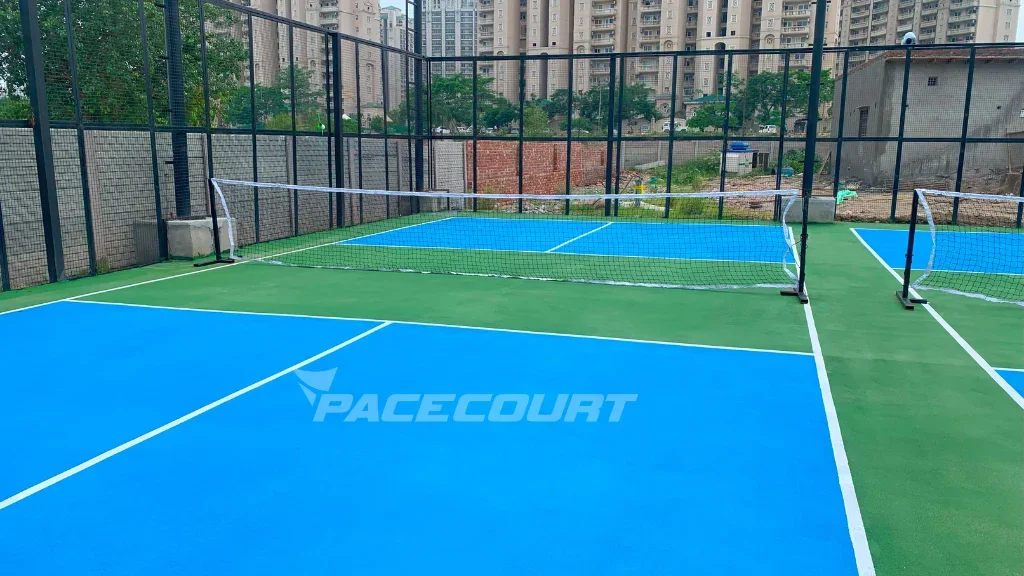
The net divides the court—and defines the challenge.
Officially, the tennis net stands 3 feet high at the center (0.91 meters) and 3 feet 6 inches high at the posts (1.07 meters). That slight dip in the center isn’t accidental. It’s carefully regulated.
The net stretches across the full width of the doubles court—36 feet. Even during singles matches, the net remains at this full width. Singles sticks are sometimes used to maintain proper net height alignment at the singles sidelines.
The posts are positioned 3 feet outside the doubles sidelines, meaning they’re 42 feet apart. For singles-only courts, posts sit 3 feet outside the singles lines.
The slight height difference between center and posts creates strategic nuance. Players often aim low over the center of the net because it’s 6 inches lower than at the posts. That tiny difference can mean the margin between a winner and an error.
The net must be tightly tensioned. A strap at the center ensures the correct 3-foot height is maintained. Loose nets can unfairly alter gameplay.
Material matters too. Nets are typically made of braided polyethylene or similar durable materials. The top band must be white and no more than 2 inches thick.
Think of the net as both barrier and invitation. It challenges players to lift the ball high enough to clear it—but not so high that it sails out.
Precision again rules the game.
Service Boxes and Center Marks
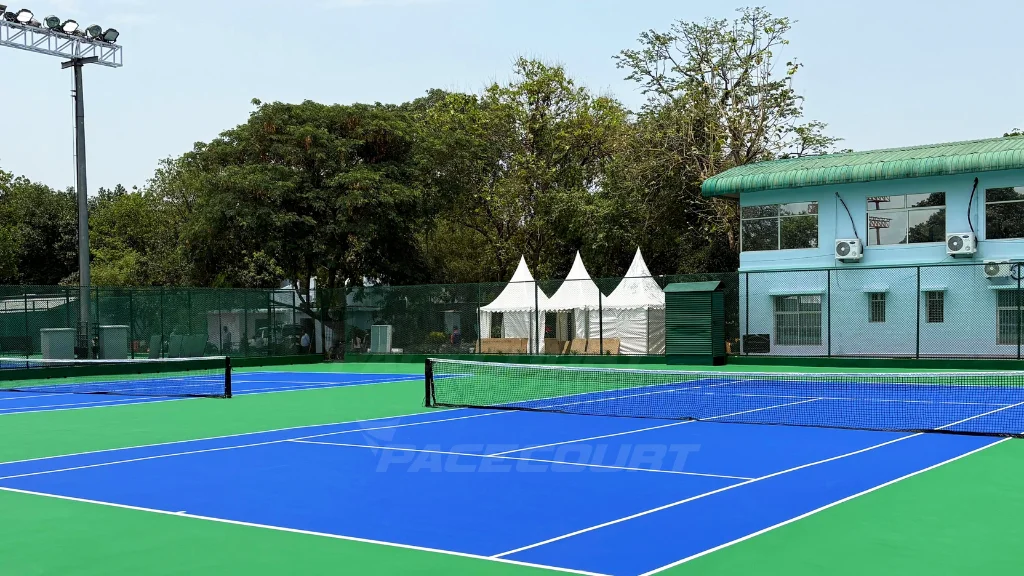
Now let’s zoom in on one of the most strategically important areas of the court—the service boxes. If the baseline is where rallies are shaped, the service box is where points are born. Every single rally starts with a serve, and that serve must land inside a precisely measured rectangle.
Each side of the court contains two service boxes—one on the left and one on the right. These are formed by the intersection of four boundaries:
- The net
- The service line (21 feet from the net)
- The center service line
- The singles sideline
The total width of the singles court is 27 feet. The center service line divides that width exactly in half, creating two service boxes that are 13.5 feet wide each. Since the service line is 21 feet from the net, each service box measures 21 feet long by 13.5 feet wide.
Simple math—but powerful implications.
When serving, players must stand behind the baseline and aim diagonally across the net into the opposite service box. That diagonal target forces accuracy. It’s not just about power—it’s geometry in motion.
And what about the center mark?
The center mark is a small but essential detail. It sits at the midpoint of each baseline and extends 4 inches into the court. Its purpose? To guide players when positioning for serves. You must stand on the correct side of the center mark while serving. Cross that invisible boundary, and it’s a foot fault.
These lines may seem minor, but they regulate fairness. They prevent confusion. They ensure both players compete within the same framework.
Next time you watch a professional match, notice how often players glance down at the center mark before serving. Even at the highest level, alignment matters.
Tennis Court Total Area and Run-Off Space
Here’s something many people overlook: the playing lines are only part of the full court area. In reality, a properly built tennis court requires significantly more space than the 78-by-36-foot rectangle.
Why?
Because players need room to move beyond the baselines and sidelines safely. This extra space is called run-off space, and it’s critical for competitive play.
According to ITF recommendations:
- Minimum run-off behind each baseline: 21 feet
- Minimum run-off on each side: 12 feet
When you include these safety margins, the total recommended area for a standard doubles court becomes approximately:
120 feet long by 60 feet wide
That’s nearly double the size of the playing rectangle.
Why so much space? Think about a player chasing down a deep lob. Or sprinting wide to return a sharp cross-court shot. Without sufficient run-off, players risk colliding with fences, walls, or spectators.
For recreational courts, the run-off area may be slightly smaller. But for professional tournaments, generous spacing is mandatory.
Here’s a quick comparison:
| Area Type | Length | Width |
|---|---|---|
| Playing Area Only | 78 ft | 36 ft |
| Recommended Total Area | 120 ft | 60 ft |
If you’re planning to build a home court, this is where many budgets and property plans get surprised. The court isn’t just the lines—it’s the breathing room around them.
A tennis court isn’t just a rectangle. It’s a performance zone.
Different Tennis Court Surfaces and Their Impact on Layout

While the measurements of a tennis court remain constant, the surface can dramatically change how the court feels—and even how it’s constructed.
There are four primary surfaces:
- Hard court
- Clay court
- Grass court
- Synthetic/turf
The dimensions don’t change. A clay court is still 78 feet long. A grass court is still 27 feet wide for singles. But the materials underneath those lines influence drainage systems, base thickness, and boundary installation.
For example:
- Clay courts require additional depth for crushed stone and clay layers.
- Grass courts need advanced irrigation and leveling.
- Hard courts require asphalt or concrete foundations.
- Synthetic courts often include shock-absorbing layers.
Surface also affects line installation. On hard courts, lines are painted. On clay courts, they’re often made of embedded tape. On grass, lines are carefully cut and rolled.
Even though the official measurements don’t shift, construction tolerances become critical. A clay court that shifts slightly due to poor drainage could distort line accuracy.
The bounce, speed, and player movement vary across surfaces—but the geometry remains sacred.
It’s like building identical houses on different terrains. The foundation changes, but the blueprint stays the same.
Indoor vs Outdoor Tennis Court Measurements
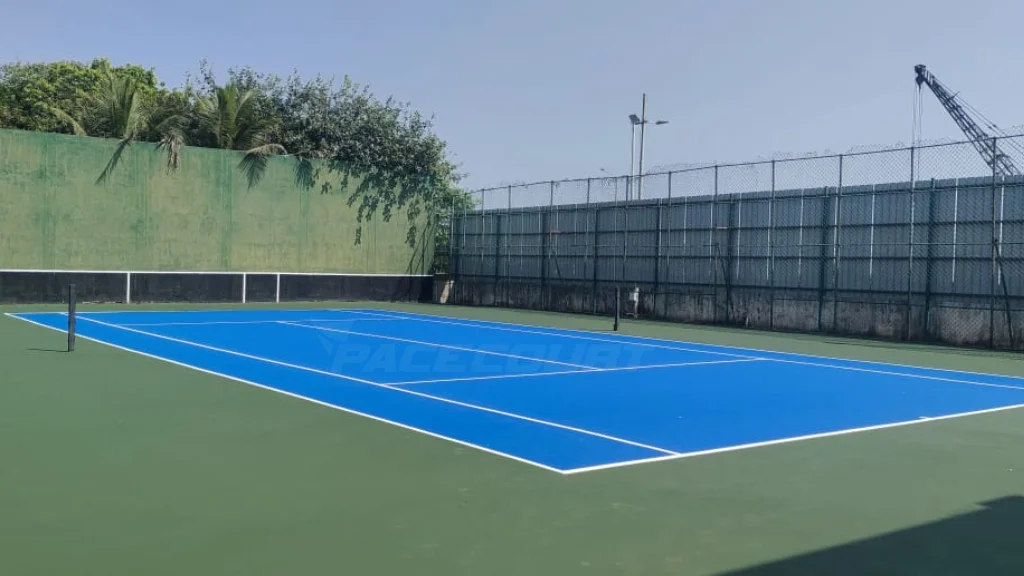
You might assume indoor and outdoor courts have different dimensions. Surprisingly, they don’t. The playing lines remain identical.
However, indoor facilities require additional overhead and side clearance that outdoor courts don’t worry about.
For indoor courts, ceiling height becomes a major factor. The ITF recommends:
- Minimum ceiling height: 29.5 feet (9 meters) above the court
Why so high? Because lobs are part of the game. If a player hits a defensive lob and it strikes the ceiling, the point ends unfairly.
Indoor courts also require space for lighting systems, HVAC units, and structural beams. So while the playing rectangle remains 78 by 36 feet, the building housing it must be significantly larger.
Outdoor courts, on the other hand, must account for fencing. Standard fencing typically stands:
- 10–12 feet high behind baselines
- 8–10 feet high along sidelines
Wind exposure, sunlight direction, and drainage slopes are also major considerations outdoors.
So the dimensions don’t change—but the environmental planning does.
Junior and Recreational Tennis Court Sizes
Not every tennis court follows full professional dimensions. For juniors and beginners, scaled-down courts are often used to develop skills progressively.
The ITF’s “Tennis 10s” program introduced modified court sizes:
Red Court (Ages 5–8)
- 36 feet long
- 18 feet wide
- Net height: 2 feet 9 inches
Orange Court (Ages 8–10)
- 60 feet long
- 21 feet wide
- Standard net height
Green Court (Ages 9–10+)
- Full length (78 feet)
- Slightly softer balls used
Why scale the court?
Because expecting a 7-year-old to cover a full 78-foot court is like asking them to sprint across a football field. Smaller courts build confidence, improve rally length, and enhance learning.
Recreational facilities sometimes adopt flexible layouts using temporary lines or blended lines.
The key idea is progression. Start small. Grow into the full dimensions.
Wheelchair Tennis Court Measurements
Here’s something fascinating: wheelchair tennis uses the exact same court dimensions as standard tennis.
The only difference? The rule allowing two bounces, where the second bounce may occur outside the court boundaries.
That’s it.
The length is still 78 feet. The width remains 27 feet for singles and 36 feet for doubles. Net height is unchanged.
This consistency ensures inclusion without redesigning the sport’s geometry. It preserves fairness and competitive alignment across all levels.
Wheelchair athletes rely heavily on court spacing for maneuverability. Therefore, smooth surfaces and adequate run-off space are even more critical.
Same court. Same dimensions. Same intensity.
ITF, USTA, and Grand Slam Regulations
All official measurements are governed by the International Tennis Federation (ITF). National organizations like the USTA in the United States follow these standards.
Grand Slam tournaments—Wimbledon, US Open, Australian Open, and Roland Garros—must adhere strictly to ITF specifications.
Even the slightest deviation in:
- Line width
- Net height
- Court slope
- Run-off area
can result in non-approval for sanctioned events.
Professional tournaments also include additional spacing for:
- Player benches
- Ball kids
- Camera crews
- Electronic line-calling systems
Precision is not optional at this level—it’s mandatory.
How to Measure and Mark a Tennis Court Step-by-Step
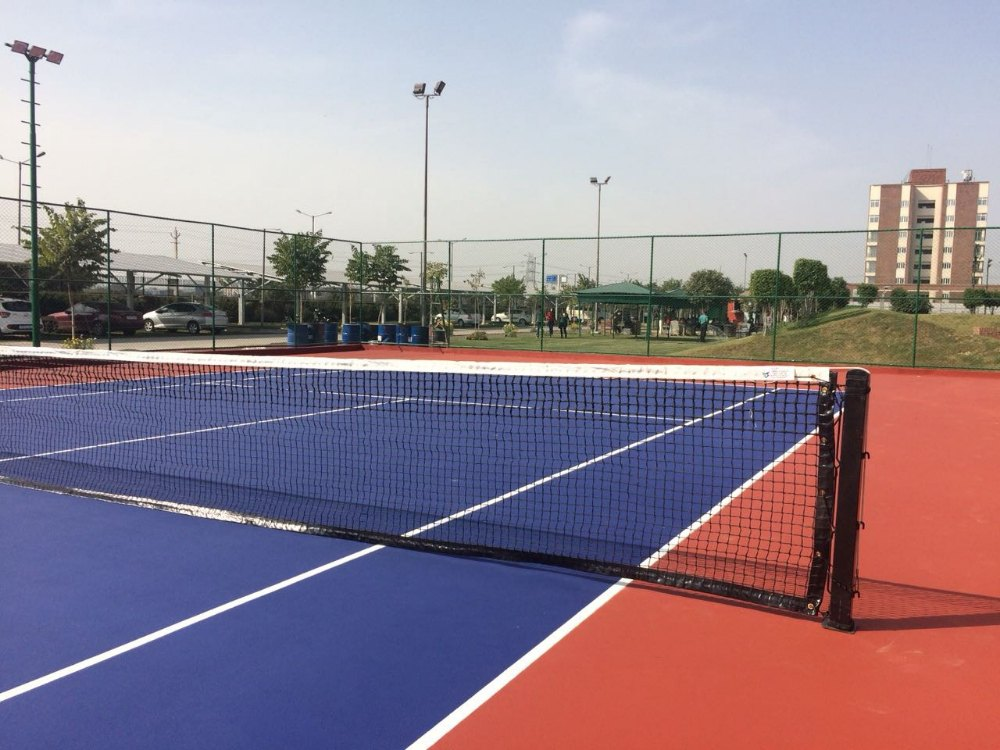
So, you’ve got the space. Maybe it’s a schoolyard, a private property, or a community park. Now comes the real challenge: measuring and marking a tennis court correctly. Sounds straightforward, right? Just draw a rectangle and call it a day? Not quite. Precision here is everything. A one-inch mistake can throw off the entire layout.
Let’s walk through this step-by-step, like we’re building it together.
Step 1: Establish the Baseline
Start by marking one baseline. Measure exactly 36 feet if you’re creating a doubles court (recommended), or 27 feet for singles-only. Use strong stakes and string to ensure a perfectly straight line.
This baseline is your anchor. Everything else will be measured from it.
Step 2: Measure the Court Length
From each corner of the baseline, measure 78 feet forward to create the second baseline. Use the diagonal method to ensure the rectangle is square:
- Measure diagonally from one corner to the opposite corner.
- Both diagonals should be equal (approximately 86 feet for a doubles court).
If the diagonals don’t match, adjust until they do.
Step 3: Mark the Singles Lines
Measure 4.5 feet inward from each doubles sideline. That gives you the 27-foot singles court width.
Step 4: Add the Service Lines
Measure 21 feet from the net line toward each baseline. Mark this line parallel to the net.
Step 5: Draw the Center Service Line
Divide the 27-foot singles width in half (13.5 feet). Draw a line from the net to the service line.
Step 6: Add the Center Marks
At the midpoint of each baseline, mark a 4-inch line extending inward.
That’s it—but take your time. Double-check everything. It’s better to measure twice than repaint an entire court.
Building a court is like baking a cake. Miss one measurement, and the whole recipe feels off.
Common Mistakes When Measuring a Tennis Court
You’d be surprised how often courts are slightly off-spec. Sometimes it’s just an inch. Other times, it’s several feet. And yes, that matters.
Here are the most common mistakes:
1. Incorrect Baseline Length
Some installers accidentally measure 36 feet total for singles instead of doubles. That eliminates flexibility for future doubles play.
2. Misplaced Net Posts
Net posts must sit 3 feet outside the doubles sidelines. Placing them directly at the sidelines changes net tension and height dynamics.
3. Uneven Surface Slope
A tennis court should have a slight slope (usually 1%) for drainage. Too steep, and balls roll unnaturally. Too flat, and water pools.
4. Inaccurate Service Line Placement
If the service line isn’t exactly 21 feet from the net, serves will feel “off.” Players may not immediately notice—but competitive play will expose the flaw.
5. Ignoring Run-Off Space
Cramming a court into a tight space without proper clearance is risky. Players need room to chase balls safely.
The truth? Small errors compound. Tennis is a precision sport. The court must match that precision.
Space Requirements for Building a Home Tennis Court
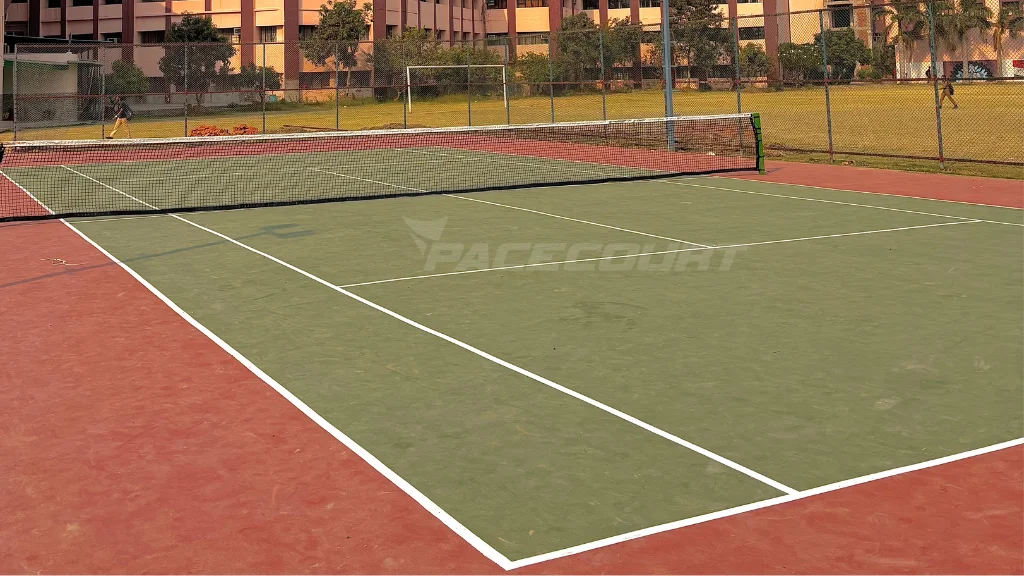
Dreaming of building your own tennis court? It’s an exciting project—but it demands serious planning.
First, let’s talk space. While the playing area is 78 by 36 feet, you should ideally have:
- 120 feet in length
- 60 feet in width
That gives you comfortable run-off space.
If your property is tighter, you might reduce side clearance slightly—but never compromise safety behind the baselines.
Next, consider orientation. Courts should ideally run north to south. Why? Because it minimizes sun glare during morning and evening matches.
Other considerations include:
- Drainage systems
- Fencing (10–12 feet high)
- Lighting poles (if night play is desired)
- Surface type
- Local zoning regulations
Building a court isn’t just about painting lines. It’s about creating an environment where the game feels natural.
Think of it as installing a swimming pool—it becomes a long-term feature of your property. Done right, it adds value. Done poorly, it becomes a headache.
Cost Implications Based on Court Size
Size directly impacts cost. The bigger the area, the more materials, labor, and maintenance involved.
Here’s a rough breakdown:
| Surface Type | Estimated Cost Range |
|---|---|
| Basic Hard Court | $25,000–$50,000 |
| Clay Court | $30,000–$60,000 |
| Grass Court | $40,000+ |
| Cushioned/Synthetic | $35,000–$70,000 |
Costs vary based on:
- Site preparation
- Drainage complexity
- Fencing
- Lighting installation
- Geographic location
A larger run-off area increases excavation and surfacing costs. Lighting adds another $10,000–$25,000 easily.
Maintenance also differs:
- Hard courts: low maintenance
- Clay courts: high maintenance
- Grass courts: very high maintenance
So yes, dimensions influence cost—not just in materials, but in long-term upkeep.
A tennis court isn’t cheap. But for avid players, it’s priceless.
Conclusion
Tennis court measurements may look simple on paper—a 78-foot rectangle divided by a net—but every line carries purpose. From the 27-foot singles width to the 36-foot doubles span, from the 21-foot service line placement to the precise 3-foot net height at the center, each measurement shapes the rhythm of the game.
These dimensions aren’t arbitrary. They’re engineered for balance—offense and defense, power and precision, endurance and agility. They ensure that whether you’re rallying at a local park or competing at Wimbledon, the geometry remains consistent.
Understanding these measurements gives you a deeper appreciation of tennis. You start seeing the court differently—not just as painted lines, but as a carefully designed arena where physics, strategy, and athleticism collide.
If you’re building a court, precision is your best friend. If you’re playing, knowledge gives you a mental edge. Either way, those numbers matter more than you might think.
Now when you step onto a court, you won’t just see lines—you’ll see structure, symmetry, and strategy built into every inch.