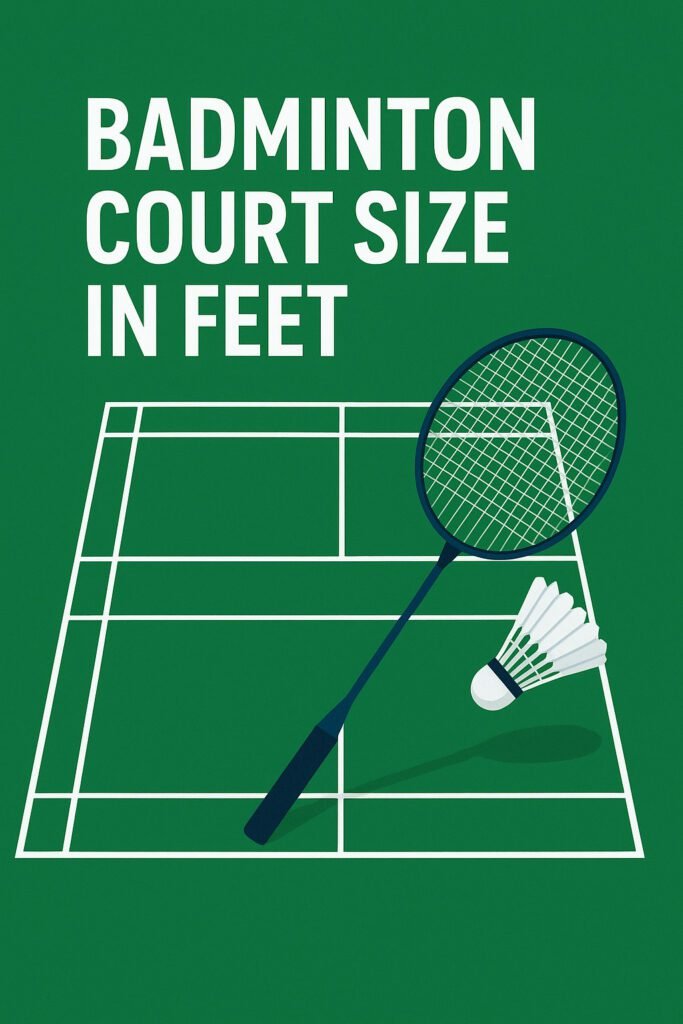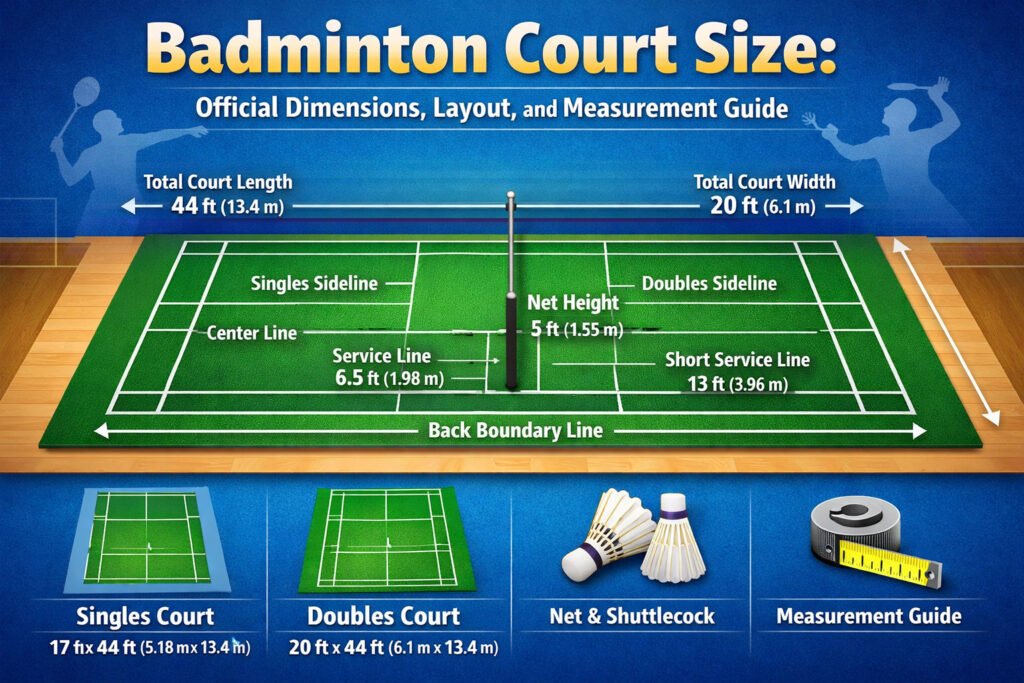
Badminton Court Size: Official Dimensions, Layout, and Measurement Guide
Badminton may look like a simple backyard game at first glance, but once you step into competitive play, you quickly realize that every inch of the court matters. The badminton court size is carefully standardized to ensure fairness, consistent gameplay, and proper movement for players. Whether you are a beginner setting up a court at home, a coach teaching young athletes, or someone curious about the technical side of the sport, understanding the official court dimensions can dramatically improve your appreciation of the game. Think of the badminton court as the stage where speed, agility, and precision come together. Players cover the court in lightning-fast movements—lunging, jumping, and smashing within seconds. Because of this, the court must be designed with exact measurements and clearly marked boundaries. Even a few centimeters of difference can affect service rules, shot placement, and player positioning. The official badminton court dimensions are defined by the Badminton World Federation (BWF), the global governing body of the sport. These measurements are used in international tournaments such as the Olympics, World Championships, and professional badminton leagues. According to BWF regulations, the court layout includes multiple boundary lines for singles and doubles matches, service areas, and net placement that divide the court into two equal halves. Another interesting aspect is that the same court is used for both singles and doubles, but with slightly different boundary rules. For example, doubles matches use the wider sidelines, while singles matches use the inner sidelines. This clever design allows one court to accommodate different game formats without needing separate courts. In this guide, you’ll explore official badminton court measurements, line markings, net dimensions, and spacing requirements. By the end, you’ll understand not just the numbers, but also the reasoning behind them. If you ever plan to build a court at home, set up one at a school, or simply understand the sport more deeply, knowing these dimensions is the perfect place to start. Understanding Badminton Court Dimensions Before diving into exact numbers, it helps to understand why badminton court dimensions are designed the way they are. The sport is built around speed and reaction time. In professional matches, the shuttlecock can travel at speeds of over 400 km/h during a smash, making badminton one of the fastest racket sports in the world. Because of this incredible pace, the court must be large enough to allow dynamic movement but small enough to keep rallies intense and strategic. The standard badminton court is rectangular and divided by a net into two equal halves. Each half contains specific service areas and boundary lines that determine whether a shot is in or out. At first glance, the number of lines may seem confusing, especially for beginners. You’ll notice inner sidelines, outer sidelines, short service lines, long service lines, and center lines. Each of these plays a specific role depending on whether the game is singles or doubles. Imagine the court like a chessboard designed for movement rather than pieces. Players constantly adjust their positioning based on the court markings. A singles player typically covers more length than width, while doubles players rely on wider angles and teamwork. That’s why singles and doubles share the same length but differ in width boundaries. Another important concept is the service court system. When serving, players must hit the shuttle diagonally into the opponent’s service box. The service lines ensure that serves are neither too short nor too long. Without these precise markings, enforcing service rules would be nearly impossible. The dimensions also consider player safety and movement efficiency. Professional courts usually include extra space around the playing area to allow athletes to chase shots without colliding with walls or spectators. This additional “run-off area” is especially important in high-level tournaments where players often dive or sprint beyond the baseline. For casual players, understanding these dimensions helps in multiple ways. It improves shot accuracy, positioning, and strategy, and it also makes setting up a practice court much easier. Once you understand how the lines interact with gameplay, the court stops looking like a maze of markings and starts making perfect sense. In the next section, we’ll break down the official badminton court size according to BWF regulations, including exact measurements for both singles and doubles play. Official Badminton Court Size (BWF Standards) When it comes to competitive badminton, there’s no guesswork involved. The Badminton World Federation (BWF) has established precise court measurements that are used worldwide in tournaments, clubs, schools, and training centers. These standardized dimensions ensure that a player competing in Tokyo, London, or New York experiences the exact same playing environment. The official badminton court length is 13.4 meters (44 feet) from one baseline to the other. This measurement remains constant for both singles and doubles matches. The difference between the two formats lies primarily in the court width and service boundaries, which slightly change depending on the game type. For doubles matches, the court is 6.1 meters (20 feet) wide, utilizing the outermost sidelines. Singles matches, however, use the inner sidelines, reducing the playing width to 5.18 meters (17 feet). This design allows a single court to accommodate two types of play without needing separate layouts. Another defining feature is the placement of service lines. The short service line is positioned 1.98 meters (6.5 feet) from the net, ensuring that serves travel a minimum distance before landing in the opponent’s service box. Doubles matches also include a long service line, which sits slightly inside the baseline to prevent overly deep serves. These carefully calculated measurements balance the game perfectly. If the court were significantly larger, rallies would become slower and more defensive. If it were smaller, rallies would end too quickly. The current dimensions create the ideal balance between speed, skill, endurance, and strategy. Professional tournaments strictly enforce these measurements using high-precision tools. Even the line thickness is regulated at 40 millimeters (about 1.57 inches), and every line must be clearly visible against the court surface. Most professional courts use bright white or yellow lines on