Top Sports Flooring Material Types, Prices & Comparison
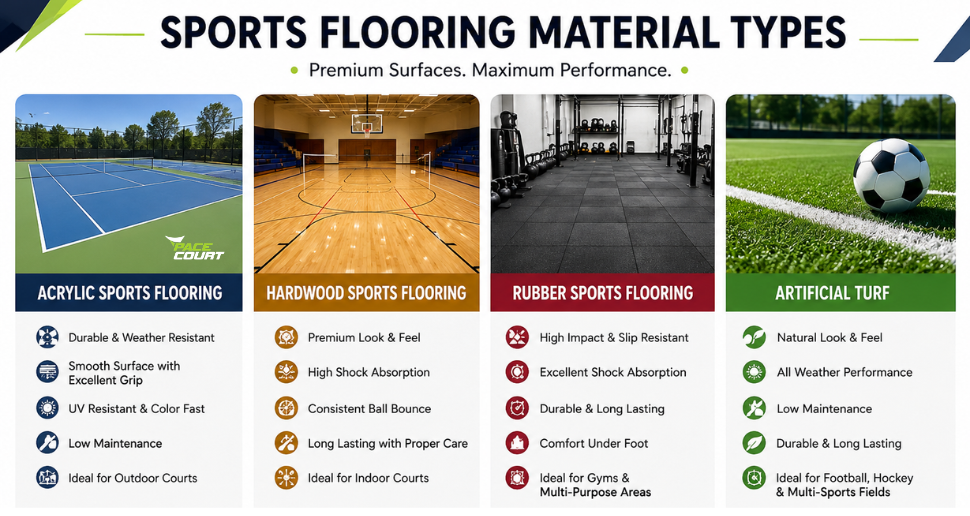
What Is Sports Flooring Material? Sports flooring material is any surface specifically engineered to support athletic performance, reduce injury risk, and withstand heavy physical use. India’s sports infrastructure sector grows rapidly in 2026, and choosing the right sports flooring material directly impacts player safety, performance output, and long-term maintenance cost. Sports flooring material is a purpose-built surface that provides grip, shock absorption, and durability for athletic activities across indoor and outdoor sports facilities. Why Sports Flooring Material Matters in India 2026 India invests heavily in world-class sports facilities across schools, stadiums, fitness centres, and multipurpose complexes. The right sports flooring material determines whether players perform at their peak or suffer preventable injuries. Poor flooring causes joint stress, slipping hazards, and early surface wear. Smart buyers evaluate material type, load rating, maintenance need, and sport compatibility before making any purchase decision in 2026. Types of Sports Flooring Material 1. Hardwood Sports Flooring Hardwood remains the gold standard for indoor basketball, volleyball, and badminton courts. Maple wood dominates this segment globally and in India. It delivers consistent ball bounce, excellent grip, and a visually premium finish. Hardwood sports flooring material requires professional installation and periodic sanding or refinishing to maintain performance. Best For: Basketball, badminton, volleyball, gymnastics 2. Synthetic Sports Flooring Material (PVC / Vinyl) PVC and vinyl-based synthetic surfaces are the fastest-growing sports flooring material category in India. They offer waterproofing, anti-slip texture, easy maintenance, and vibrant colour options. Multipurpose sports halls, school gyms, and fitness studios across Delhi, Mumbai, and Bengaluru install PVC flooring at scale. Synthetic flooring costs less than hardwood and installs faster with fewer structural requirements. Best For: Multi-sport courts, aerobics studios, school gymnasiums, indoor badminton 3. Rubber Sports Flooring Material Rubber flooring absorbs shock exceptionally well, making it the top choice for weightlifting zones, CrossFit boxes, and fitness gyms. It resists heavy equipment drops, deadlift impacts, and continuous foot traffic. Rubber sports flooring material is available in rolls, tiles, and interlocking formats. Recycled rubber variants support India’s growing sustainability goals in 2026. Best For: Weight rooms, CrossFit centres, martial arts studios, indoor running tracks 4. Polyurethane (PU) Sports Flooring Material Polyurethane or PU flooring is a seamless, poured-in-place system widely used in professional indoor sports arenas. It provides uniform resilience across the entire surface and meets international standards set by FIBA, BWF, and FIFA. PU sports flooring material integrates shock absorption layers beneath the top coat, delivering superior athlete protection. India’s new-generation indoor stadiums increasingly specify PU flooring. Best For: Professional arenas, international-level courts, multipurpose stadiums 5. Acrylic Sports Flooring Material Acrylic surfacing systems dominate outdoor and indoor tennis courts worldwide. India uses acrylic sports flooring material extensively in lawn tennis clubs, academies, and residential complexes. The material bonds directly to concrete or asphalt substrates, cures into a hard-wearing surface, and supports various cushion-level ratings. Players benefit from consistent ball behaviour and reduced joint fatigue on cushioned acrylic variants. Best For: Tennis courts, basketball outdoor courts, pickleball courts 6. Artificial Turf (Synthetic Grass) Artificial turf is a purpose-designed sports flooring material that replicates natural grass performance for football, cricket, field hockey, and rugby. India deploys FIFA-certified artificial turf in thousands of football academies and municipal grounds. Modern turf systems include infill materials such as rubber crumb or sand that regulate hardness, pace, and ball roll. Maintenance is minimal compared to natural grass. Best For: Football, field hockey, cricket practice nets, multi-sport outdoor fields 7. Sprung / Floating Floor Systems A sprung floor is not a surface material on its own but a structural system placed beneath hardwood, PVC, or rubber surfaces. It provides bounce, shock absorption, and energy return that protect knees, ankles, and hips. Dance studios, cheerleading gyms, and professional basketball arenas rely on sprung floor systems paired with premium sports flooring material on top. Best For: Dance studios, gymnastics, professional basketball Sports Flooring Material Comparison Table Material Indoor/Outdoor Shock Absorption Durability Maintenance Approx. Cost (INR/sq ft) Best Sport Hardwood (Maple) Indoor High High Medium ₹150–₹300 Basketball, Badminton PVC / Vinyl Indoor Medium High Low ₹60–₹150 Multi-sport, Gyms Rubber Indoor Very High Very High Low ₹80–₹200 Weightlifting, CrossFit Polyurethane (PU) Indoor Very High Very High Low ₹200–₹500 Professional Arenas Acrylic Both Medium High Low ₹45–₹80 Tennis, Basketball Artificial Turf Outdoor Medium High Very Low ₹120–₹350 Football, Hockey Sprung Floor System Indoor Very High High Medium ₹250–₹600 (system) Dance, Gymnastics Key Properties of Quality Sports Flooring Material Shock Absorption Quality sports flooring material absorbs foot impact energy and returns it partially to the player, reducing fatigue. Standards bodies like DIN 18032-2 and EN 14904 define minimum shock absorption thresholds. Choose flooring that absorbs at least 25% of vertical force to protect joints effectively. Ball Rebound Consistency Courts for basketball and volleyball require uniform ball rebound across every zone of the floor. Inconsistent rebound creates unpredictable play and disadvantages athletes. Certified sports flooring material passes standardised ball rebound tests before receiving international approval. Slip Resistance Every sports flooring material must deliver adequate slip resistance under both dry and wet conditions. Courts must provide enough friction to stop rapid lateral movements but not so much grip that players cannot pivot freely. International friction coefficients range between 0.4 and 0.7 for most indoor sports surfaces. Load Bearing Capacity Heavy equipment, rolling loads from bleachers, and concentrated point loads from gymnastics apparatus test flooring strength. Specify load ratings accurately during procurement to prevent floor deformation, cracking, or joint separation over time. Thermal and Moisture Stability India’s climate varies from humid coastal zones to dry northern plains. Sports flooring material must resist expansion, contraction, warping, and moisture absorption across the full temperature range. Hardwood floors require controlled humidity environments, while PU and rubber perform reliably under wider conditions. Sports Flooring Material: Detailed Information Table by Sport Sport Recommended Material Surface Standard Key Feature Required Basketball Hardwood / PU FIBA approved Ball rebound uniformity Badminton PVC / Hardwood BWF approved Anti-slip, shock absorption Tennis Acrylic / Clay / Carpet ITF certified Ball bounce consistency Football (Indoor) PU / Artificial Turf FIFA