Shuttle Court Size – Complete Guide to Badminton Court Dimensions
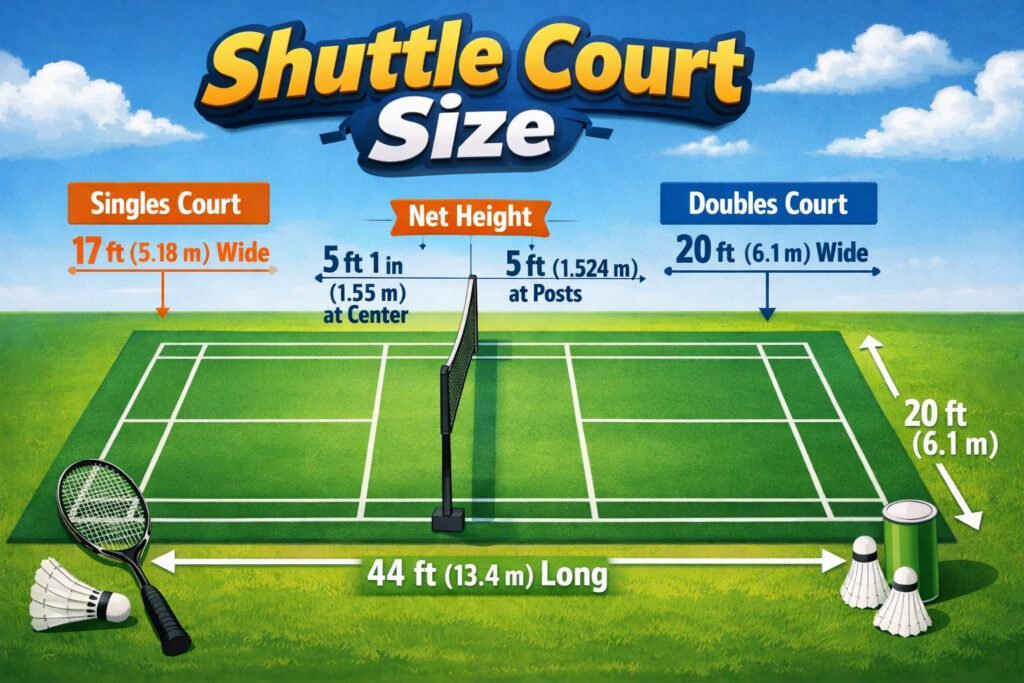
If you’ve ever stepped onto a badminton court and felt like the space was just perfectly balanced—not too big, not too small—you’re not imagining it. The shuttle court size is carefully designed to create a fast, strategic, and physically demanding game. Every inch matters. Whether you’re smashing from the baseline or rushing forward for a net kill, the dimensions of the court quietly shape every movement you make. Badminton may look simple at first glance. Two players. A net. A shuttlecock. But behind that simplicity lies precision. The court size is not random. It’s standardized by the Badminton World Federation (BWF), ensuring that whether you play in London, Tokyo, or your local sports hall, the dimensions remain consistent. That consistency keeps the sport fair and competitive. Why does this matter to you? Because playing on the correct shuttle court size affects everything—your footwork, stamina, shot placement, and even your strategy. A slightly shorter or wider court can completely change rally dynamics. It’s like driving on a road that’s either too narrow or too wide—it alters your rhythm. In this guide, we’ll break down every measurement, line, and requirement in detail. From singles and doubles differences to net height and marking techniques, you’ll get a crystal-clear understanding of shuttle court size. By the end, you won’t just know the dimensions—you’ll understand why they matter. Let’s start with the official numbers. Standard Badminton Court Dimensions When it comes to shuttle court size, precision is everything. The standard badminton court is rectangular and divided equally by a net running across the center. According to official regulations, the full court measures 13.4 meters (44 feet) in length and 6.1 meters (20 feet) in width for doubles matches. These numbers aren’t arbitrary—they’re carefully calculated to balance speed and endurance. Now here’s where it gets interesting. For singles matches, the length remains the same—13.4 meters (44 feet)—but the width changes. The singles court is narrower, measuring 5.18 meters (17 feet) wide. That difference of just under a meter dramatically changes gameplay. In singles, players don’t need to defend the wider doubles sidelines, but they must cover the entire court length alone. That demands exceptional footwork and stamina. Let’s look at it in a simple table: Match Type Length Width Singles 44 ft (13.4 m) 17 ft (5.18 m) Doubles 44 ft (13.4 m) 20 ft (6.1 m) The court lines are typically 40mm (1.6 inches) thick and must be clearly visible, usually painted white or yellow depending on the floor color. Think of the court as a chessboard for speed. The size forces players to think strategically. In doubles, wider angles create more attacking opportunities. In singles, narrower boundaries demand precision and patience. Understanding these standard dimensions is the foundation for everything else—court markings, net placement, and service areas all depend on these measurements. Get this wrong, and the entire game changes. Overall Length and Width Let’s zoom in further on the overall length and width of a shuttle court, because this is where the game truly takes shape. The full length of the court is 44 feet (13.4 meters) from baseline to baseline. This measurement remains constant whether you’re playing singles or doubles. That consistent length ensures rallies maintain their depth and intensity. When you clear the shuttle high to the back of the court, you’re sending it across the entire 44-foot stretch. That distance is what makes baseline rallies so physically demanding. Now, the width tells a different story. For doubles, the court spans 20 feet (6.1 meters) wide. That extra width opens up attacking angles. Smashes down the sideline become lethal weapons. Defensive formations also shift because two players share coverage responsibilities. For singles, however, the width shrinks to 17 feet (5.18 meters). That may not sound like a big difference, but in a fast-paced game like badminton, three feet is massive. It narrows cross-court shots and demands more accuracy. You can’t rely on wide-angle winners as much—you need smarter placement. Imagine the court like a battlefield. In doubles, you fight on a wider front. In singles, the battlefield narrows, but you’re alone. The unchanged length ensures stamina remains equally tested in both formats. Another important detail? The diagonal measurement of the doubles court is approximately 14.73 meters (48.3 feet). This affects how cross-court shots travel and explains why diagonal smashes feel longer and more dramatic. The overall dimensions are not just numbers—they’re the invisible framework shaping every rally. Once you internalize these measurements, your court awareness improves dramatically. Singles vs Doubles Court Dimensions This is where many beginners get confused. The shuttle court size changes depending on whether you’re playing singles or doubles—but not in the way most people expect. In singles, the court is long and narrow. You use the inner sidelines but the full baseline. That means shots must land within the 17-foot width but can travel the entire 44-foot length. Because you’re alone on your side, endurance becomes critical. Every drop shot pulls you forward. Every clear pushes you back. There’s no partner to save you. In doubles, the court is shorter for serves but wider overall. The width expands to 20 feet, including the outer sidelines. However, during service in doubles, players must serve within the shorter long service line (not the baseline). That subtle change adds a layer of tactical complexity. Here’s a quick comparison: Why does this matter so much? Because strategy shifts completely. In singles, you build rallies and exploit movement. In doubles, rallies are faster and more aggressive. The extra width creates sharper attacking angles, while teamwork reduces individual court coverage. Think of singles as a marathon with sprints, and doubles as a rapid-fire duel. Same court length. Different battlefield width. Different tactics. Understanding these differences ensures you mark the court correctly and adapt your game accordingly. Detailed Court Markings and Lines If the shuttle court size is the skeleton of the game, then the court markings are its nervous system. Every line has a purpose. Every boundary shapes a decision. A shuttle