High School Basketball Court Dimensions play a crucial role when building or understanding a high school basketball court, as knowing the exact measurements is essential for safety, gameplay consistency, and compliance with official rules. While professional courts follow NBA or FIBA standards, high school basketball courts have their own specific dimensions.
This guide explains high school basketball court dimensions, including length, width, key areas, markings, and differences from college or NBA courts.
Table of contents
- What is Basketball Court
- What Are the Official High School Basketball Court Dimensions?
- Key Areas & Their Dimensions
- Why Correct Dimensions Matter
- Comparison: High School vs College vs NBA Court Dimensions
- Why High School Court Dimensions Are Smaller
- High School Basketball Court Markings Explained
- Flooring Options for High School Basketball Courts
- Basketball Court Flooring Price Table (India)
- Court Construction Cost
- Final Thoughts: Choosing the Right Court Dimensions
What is Basketball Court
A basketball court is a rectangular playing surface designed for the sport of basketball, featuring a defined layout, specific markings, and standardized dimensions. It is divided into two main halves where teams compete to score by shooting the ball into the opponent’s basket.
A standard basketball court includes essential components such as hoops, backboards, free-throw lanes, three-point lines, and center-court markings. The court’s design and measurements ensure fair gameplay, player safety, and proper rule enforcement across all levels—school, college, and professional.
What Are the Official High School Basketball Court Dimensions?
According to the National Federation of State High School Associations (NFHS), the official high school basketball court dimension is:
- Length: 84 feet
- Width: 50 feet
This makes the high school court 10 feet shorter than an NBA or NCAA court, which measures 94 feet long.
Key Areas & Their Dimensions

High school courts follow NFHS specifications for all key areas. Here is a complete breakdown:
1. Free-Throw Lane (The Paint)
- Width: 12 feet
- Free-throw line distance from the backboard: 15 feet
- Lane length: 19 feet
This area is used for free throws, rebounds, and offensive plays.
2. Three-Point Line Distance
High school three-point arc distance:
- Distance from the basket: 19 feet 9 inches
This is shorter than:
- NCAA Men: 22 feet 1¾ inches
- NBA: 23 feet 9 inches
3. Basket & Backboard Dimensions
- Hoop height: 10 feet from the playing surface
- Rim diameter: 18 inches
- Backboard width: 6 feet
- Backboard height: 3.5 feet
- Distance from baseline to backboard: 4 feet
These measurements ensure uniformity across all high school gyms.
4. Center Circle
- Radius: 6 feet
Used for tip-offs and ball possession regulation.
5. Restricted Area Arc
Unlike NBA courts, high school courts generally do not have a restricted arc, unless schools follow NCAA-style markings.
6. Sidelines & Baselines
- Sideline length: 84 feet
- Baseline width: 50 feet
- Boundary line thickness: Minimum 2 inches
Proper marking helps referees maintain accurate gameplay calls.
Why Correct Dimensions Matter

For school administrators and coaches, ensuring a court meets NFHS standards is essential.
- Fair Competition: Standardized courts guarantee that visiting teams are playing on a familiar surface, ensuring no team has an unfair advantage.
- Player Development: Training on a regulation-sized court helps players develop the right skills and muscle memory. It prepares them for competition and potential advancement to higher levels of play.
- Safety and Compliance: Proper markings and clear boundaries are crucial for player safety and for hosting official games. An improperly marked court may not be eligible for sanctioned events.
To ensure compliance, schools should regularly measure and maintain their court markings. Using durable, high-quality paint and consulting NFHS guidelines during any gym renovations or construction is a practical step toward providing the best environment for student-athletes.
Ultimately, the lines on a basketball court do more than just define a playing area. They shape the game, challenge the players, and create the framework for every memorable moment on the hardwood.
Comparison: High School vs College vs NBA Court Dimensions
| Level | Length | Width | Three-Point Line |
|---|---|---|---|
| High School | 84 ft | 50 ft | 19 ft 9 in |
| NCAA | 94 ft | 50 ft | 22 ft 1¾ in |
| NBA | 94 ft | 50 ft | 23 ft 9 in |
High school courts are more compact, making them suitable for younger athletes.
Why High School Court Dimensions Are Smaller
High school athletes:
- Need a smaller playing space for safety
- Have lower sprinting endurance compared to college/pro players
- Benefit from courts that encourage faster ball movement
- Practice in multi-purpose school gyms with limited space
The reduced court length improves player development and gameplay experience.
High School Basketball Court Markings Explained
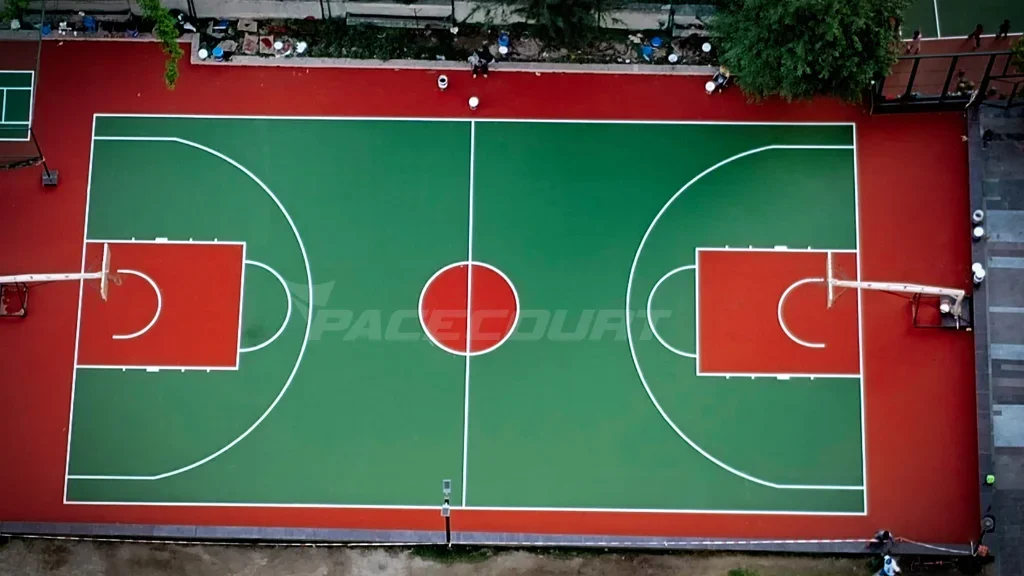
Free-Throw Circle
- Radius: 6 feet
- Top half solid, bottom half dashed
Key (Paint) Blocks
- Assigned spaces for rebound positioning
- Typically 3 feet x 2 feet per block
Three-Point Arc
- 19’9″ measured from the center of the rim
- Arc connects to straight lines running parallel to the sidelines
Midcourt Line
- Splits the court into two halves
- Includes the backcourt violation rules
Flooring Options for High School Basketball Courts
Schools may choose flooring based on budget and play frequency:
- Hardwood Maple Flooring – premium, used in most indoor gyms
- Synthetic PU Flooring – cost-effective and durable
- Vinyl Sports Flooring – good for multipurpose gyms
- Modular PP Tiles – ideal for outdoor or temporary courts
Basketball Court Flooring Price Table (India)
| Flooring Type | Price Range (₹/sq. ft) | Best For |
|---|---|---|
| Acrylic Synthetic Flooring | ₹55 – ₹130 | Outdoor courts, schools, budget courts |
| Standard Outdoor Acrylic System | ₹130 – ₹200 | High-quality outdoor courts |
| PP Interlocking Tiles | ₹130 – ₹180 | Outdoor courts, multi-purpose, quick installation |
| Synthetic Tile Flooring | ₹80 – ₹130 | Basic outdoor basketball courts |
| PU Sports Flooring | ₹250 – ₹400 | Indoor courts with heavy usage |
| Vinyl Sports Flooring | ₹200 – ₹350 | Indoor multi-purpose halls |
| Maple Hardwood Flooring | ₹310 – ₹450+ | Premium indoor professional courts |
| Rubber Flooring | ₹120 – ₹220 | Training areas, indoor gyms |
Court Construction Cost
| Court Type | Estimated Total Cost |
|---|---|
| Outdoor Acrylic Basketball Court | ₹3 – ₹8 lakh |
| Outdoor PP Tile Court | ₹4 – ₹12 lakh |
| Indoor PU Court | ₹8 – ₹18 lakh |
| Indoor Maple Wood Court | ₹15 – ₹35+ lakh |
Final Thoughts: Choosing the Right Court Dimensions
High school basketball court dimensions are standardized to ensure fair play, safety, and training consistency. Whether you’re constructing a new court, resurfacing an old one, or simply learning the layout, these measurements help maintain proper gameplay standards.