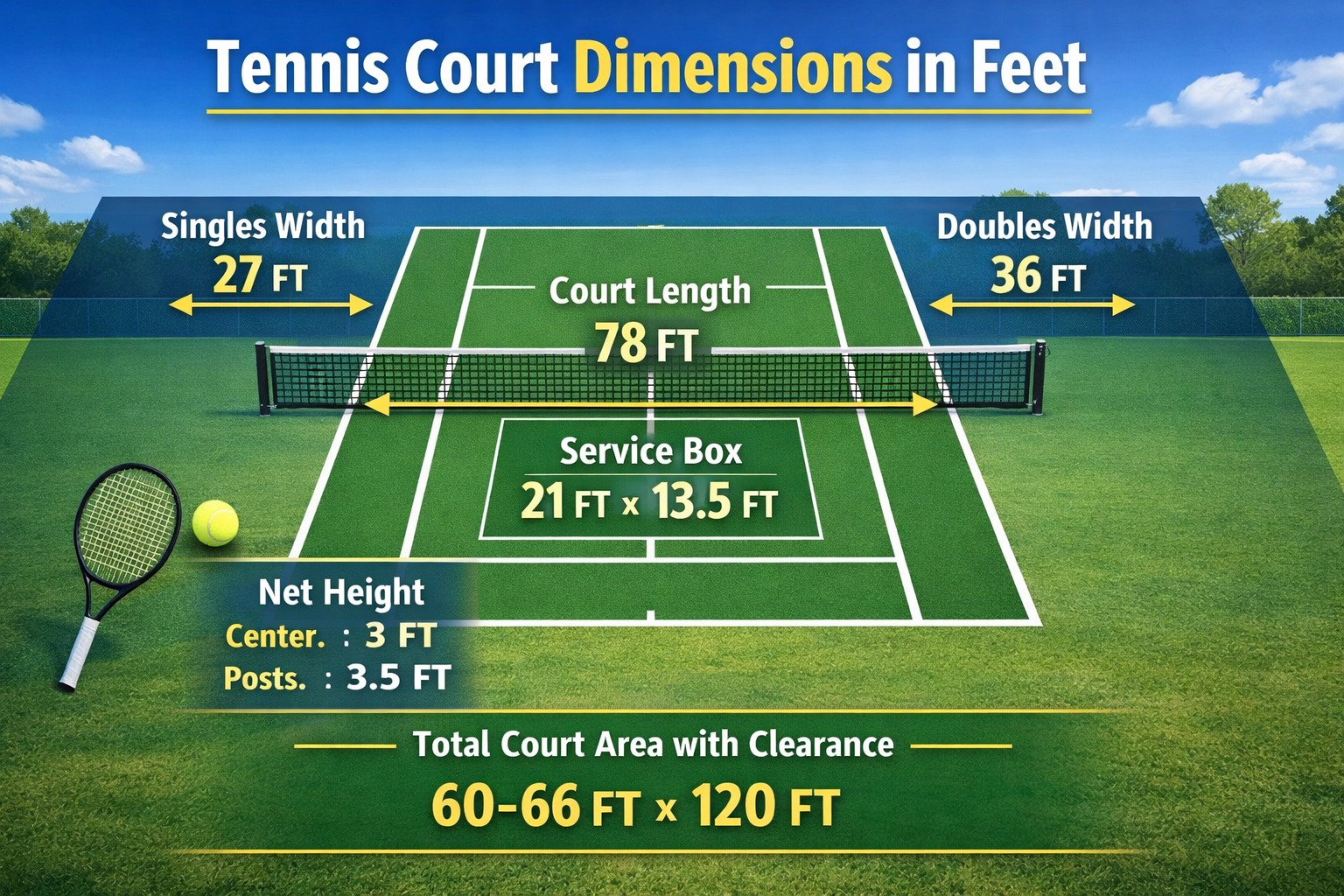
Understanding tennis court dimensions in feet is essential for players, coaches, architects, contractors, and sports facility owners. Whether you are planning to construct a new tennis court, marking an existing surface, or simply learning the official rules, accurate measurements ensure fair play and compliance with international standards.
This complete guide covers official tennis court size in feet, including singles and doubles layouts, line markings, net height, and recommended total area.
Table of contents
- What Is a Tennis Court?
- Why Standardization Matters
- Official Tennis Court Dimensions in Feet
- Singles Tennis Court Dimensions in Feet
- Doubles Tennis Court Dimensions in Feet
- Service Box Dimensions in Feet
- Tennis Net Height in Feet
- Tennis Court Line Measurements in Feet
- Total Tennis Court Area (Including Run-Off Space)
- Tennis Court Dimensions in Feet (Quick Summary)
- Why Accurate Tennis Court Measurements Matter
- Final Thoughts
What Is a Tennis Court?
A tennis court is a specially designed rectangular playing surface where the sport of tennis is played. It is marked with specific boundary lines and divided by a net in the center, allowing players to compete in singles (one player per side) or doubles (two players per side) matches under standardized rules.
Basic Definition of a Tennis Court
A tennis court is:
- A flat, rectangular area
- Divided into two equal halves by a net
- Marked with lines that define boundaries, service boxes, and play zones
- Built according to international standards set by the International Tennis Federation (ITF)
Purpose of a Tennis Court
The main purpose of a tennis court is to provide a fair and consistent playing surface so players can:
- Serve the ball correctly
- Rally within defined boundaries
- Compete under official tennis rules
- Experience predictable ball bounce and movement
Why Standardization Matters

You might wonder why these specific numbers—78 feet, 27 feet, 21 feet—were chosen. Like many sports with British origins, the measurements evolved over time from older versions of court tennis. However, standardization is vital for the integrity of the sport.
- Muscle Memory: Players develop an innate sense of where the lines are. If courts varied in size, a player’s finely tuned spatial awareness would be useless.
- Equipment Calibration: Rackets and strings are engineered to handle the specific physics of hitting a ball across a 78-foot court.
- Fitness and Pace: The dimensions dictate the pace of play. A larger court would make points impossible to finish; a smaller one would make serving too dominant. The current size offers a perfect balance between power serving and athletic defense.
Official Tennis Court Dimensions in Feet
According to the International Tennis Federation (ITF), tennis court dimensions remain the same worldwide, regardless of surface type (hard court, clay, or grass).
Standard Tennis Court Size (Singles & Doubles)
| Feature | Measurement (Feet) |
|---|---|
| Court Length | 78 feet |
| Court Width (Doubles) | 36 feet |
| Court Width (Singles) | 27 feet |
✅ The length of a tennis court remains 78 feet for both singles and doubles matches.
Singles Tennis Court Dimensions in Feet
A singles tennis court is narrower than a doubles court but uses the same overall length.
- Length: 78 feet
- Width: 27 feet
- Total Playing Area: 2,106 sq. ft.
The singles sidelines are marked 4.5 feet inside the doubles sidelines on each side.
Doubles Tennis Court Dimensions in Feet
A doubles tennis court uses the full width of the court.
- Length: 78 feet
- Width: 36 feet
- Total Playing Area: 2,808 sq. ft.
Doubles alleys (tramlines) are 4.5 feet wide on each side of the singles court.
Service Box Dimensions in Feet
Each tennis court is divided into service boxes for serving.
- Service Line Distance from Net: 21 feet
- Service Box Width: 13.5 feet
- Service Box Length: 21 feet
There are four service boxes on a tennis court—two on each side of the net.
Tennis Net Height in Feet
The tennis net height is carefully regulated for consistent gameplay.
| Location | Net Height |
|---|---|
| At the Center | 3 feet (36 inches) |
| At the Posts | 3.5 feet (42 inches) |
The net posts are placed 3 feet outside the doubles sidelines on both sides.
Tennis Court Line Measurements in Feet
All court lines must be clearly visible and evenly marked.
- Baseline Width: Up to 4 inches
- Sideline Width: Up to 2 inches
- Center Mark Length: 4 inches
- Center Service Line Width: 2 inches
All measurements are taken from the outside edge of the lines.
Total Tennis Court Area (Including Run-Off Space)
For safe movement and professional play, additional space around the court is recommended.
Minimum Recommended Area
| Area Type | Dimensions (Feet) |
|---|---|
| Recreational Play | 60 × 120 feet |
| Tournament / Professional | 66 × 120 feet |
This extra clearance improves player safety and overall playing experience.
Tennis Court Dimensions in Feet (Quick Summary)
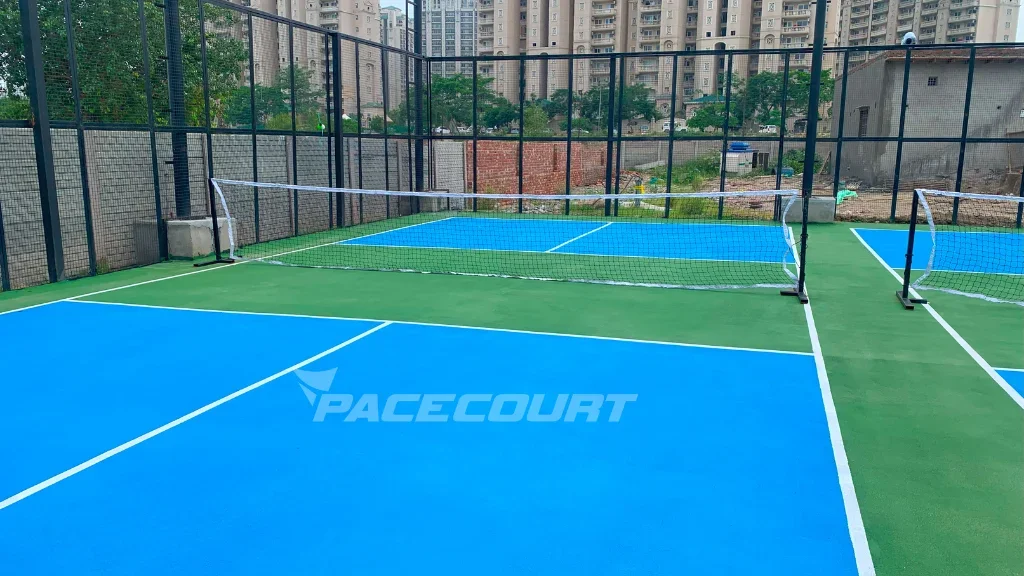
Court Length: 78 feet
Singles Width: 27 feet
Doubles Width: 36 feet
Service Box: 21 × 13.5 feet
Net Height (Center): 3 feet
Total Area (With Clearance): Up to 7,920 sq. ft.
Why Accurate Tennis Court Measurements Matter
Correct tennis court dimensions in feet are crucial for:
- Official tournament approval
- Fair gameplay
- Player safety
- Proper ball bounce
- Long-term court durability
Incorrect measurements can lead to rule violations, uneven play, and costly corrections later.
Final Thoughts
Knowing the official tennis court dimensions in feet helps ensure accuracy, professionalism, and compliance with global standards. Whether you’re a player, coach, builder, or sports authority, following these measurements guarantees a regulation-ready tennis court that delivers the best playing experience.