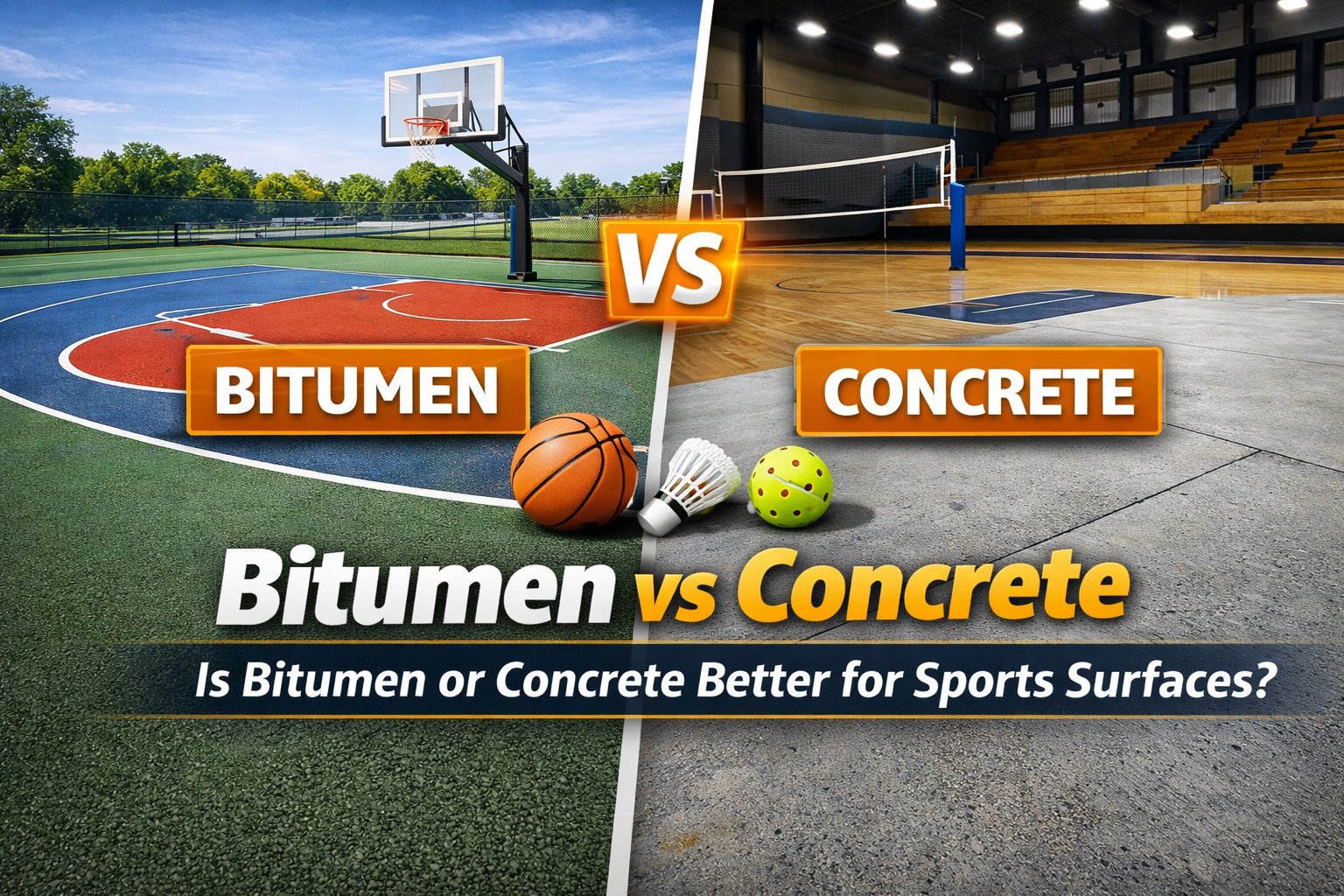
Choosing the right surface material is critical sports courts. Two of the most commonly used materials worldwide are bitumen (asphalt) and concrete. Each has its own strengths, limitations, cost implications, and performance characteristics.
In this detailed guide, we compare bitumen vs concrete across durability, cost, maintenance, climate suitability, installation, and best-use scenarios—helping you make the right decision in 2026.
Table of contents
- What Is Bitumen?
- What Is Concrete?
- Bitumen vs Concrete: Key Differences at a Glance
- Cost Comparison: Bitumen vs Concrete
- Durability & Lifespan Comparison
- Maintenance Requirements
- Climate & Weather Performance
- Installation Time & Process
- Environmental Impact
- Bitumen vs Concrete for Sports Courts
- Common Problems & Limitations
- When Should You Choose Bitumen?
- When Should You Choose Concrete?
- Bitumen vs Concrete for Roads & Highways
- Bitumen vs Concrete for Driveways & Parking Areas
- Performance Under Heavy Traffic Loads
- Safety & Skid Resistance Comparison
- Noise Reduction & Driving Comfort
- Construction Time & Traffic Disruption
- Repair & Rehabilitation Comparison
- Bitumen vs Concrete in Urban Infrastructure
- Government & Industry Trends (2026)
- Bitumen vs Concrete: Life-Cycle Cost Analysis
- Common Myths About Bitumen & Concrete
- Final Verdict: Bitumen vs Concrete – Which Is Better?
What Is Bitumen?
Bitumen is a black, sticky, petroleum-based material commonly mixed with aggregates to create asphalt. It is flexible, cost-effective, and widely used for roads, highways, and outdoor sports courts.
Key Characteristics of Bitumen
- Flexible surface material
- Faster installation time
- Lower initial cost
- Dark color absorbs heat
- Ideal for heavy traffic roads
What Is Concrete?
Concrete is a mixture of cement, sand, aggregates, and water that hardens into a rigid surface. It is known for its long lifespan, strength, and minimal deformation.
Key Characteristics of Concrete
- Rigid and strong surface
- Long service life
- Higher initial cost
- Light color reflects heat
- Suitable for heavy static loads
Bitumen vs Concrete: Key Differences at a Glance
| Feature | Bitumen | Concrete |
|---|
| Initial Cost | Lower | Higher |
| Installation Time | Fast | Slow |
| Durability | Medium | High |
| Flexibility | High | Low |
| Maintenance | Frequent | Minimal |
| Heat Resistance | Moderate | Excellent |
| Crack Resistance | Better | Can crack under stress |
| Lifespan | 10–20 years | 30–40+ years |
Cost Comparison: Bitumen vs Concrete
Bitumen Cost
- Lower upfront cost
- Faster return to use
- Ideal for budget-sensitive projects
Approximate Cost (India):
₹120 – ₹250 per sq. ft. (depending on thickness and location)
Concrete Cost
- Higher initial investment
- Lower long-term repair costs
Approximate Cost (India):
₹300 – ₹600 per sq. ft.
👉 Winner for affordability: Bitumen
👉 Winner for long-term value: Concrete
Durability & Lifespan Comparison
Bitumen Durability
Bitumen performs well under:
- Heavy traffic
- Temperature fluctuations
- Short-to-medium-term usage
However, it is prone to:
- Rutting
- Surface oxidation
- Softening in extreme heat
Average lifespan: 10–20 years
Concrete Durability
Concrete offers:
- High load-bearing strength
- Resistance to deformation
- Minimal surface wear
But it may:
- Crack under thermal expansion
- Require expansion joints
Average lifespan: 30–40 years or more
Upgrade Your Sports Court Today
Get premium synthetic acrylic flooring designed for durability, grip, and performance.
Get Free ConsultationMaintenance Requirements
Bitumen Maintenance
- Requires periodic resurfacing
- Crack sealing needed
- Surface recoating recommended every few years
Concrete Maintenance
- Minimal maintenance
- Occasional joint repair
- Cleaning and sealing every few years
👉 Winner for low maintenance: Concrete
Climate & Weather Performance
Bitumen in Different Climates
- Performs well in cold regions
- Can soften in extreme heat
- UV exposure may cause oxidation
Concrete in Different Climates
- Performs well in hot climates
- Reflects sunlight, reducing heat absorption
- Susceptible to freeze-thaw cracking in cold areas
👉 Hot climates: Concrete
👉 Cold climates: Bitumen
Installation Time & Process
Bitumen Installation
- Faster curing time
- Roads usable within 24–48 hours
- Ideal for high-traffic urban projects
Concrete Installation
- Requires curing (7–28 days)
- Longer project timelines
- Higher labor skill required
👉 Winner for quick installation: Bitumen
Environmental Impact
Bitumen Sustainability
- Can be recycled
- Petroleum-based (higher carbon footprint)
- Heat absorption contributes to urban heat islands
Concrete Sustainability
- Longer lifespan reduces replacement frequency
- Cement production has high CO₂ emissions
- Reflective surface improves urban temperatures
Both materials have environmental trade-offs depending on usage.
Bitumen vs Concrete for Sports Courts
Bitumen for Sports Courts
- Flexible base for acrylic sports flooring
- Ideal for outdoor basketball, tennis, and multipurpose courts
- Cost-effective and smooth finish
Concrete for Sports Courts
- Strong base for indoor courts
- Preferred for permanent installations
- Requires cushioning layers for player comfort
👉 Best base for acrylic courts: Bitumen
👉 Best for indoor rigid flooring: Concrete
Common Problems & Limitations
Bitumen Limitations
- Softens in high heat
- Requires more maintenance
- Shorter lifespan
Concrete Limitations
Longer downtime during curing
Upgrade Your Sports Court Today
Get premium synthetic acrylic flooring designed for durability, grip, and performance.
Get Free ConsultationHigher upfront cost
Cracking risk if poorly installed
When Should You Choose Bitumen?
Choose bitumen if:
- You want lower initial cost
- Quick installation is required
- The surface will experience frequent repairs
- You are installing outdoor sports courts
When Should You Choose Concrete?
Choose concrete if:
- Long-term durability is the priority
- Maintenance access is limited
- The project is permanent
- Heavy static loads are expected
Bitumen vs Concrete for Roads & Highways
Bitumen Roads
Bitumen is the most widely used material for roads and highways due to its flexibility and smooth driving experience.
Advantages:
- Handles heavy traffic loads
- Absorbs vibrations and road noise
- Faster repairs and resurfacing
- Lower construction time
Disadvantages:
- Susceptible to rutting in extreme heat
- Requires frequent maintenance
Concrete Roads
Concrete roads are increasingly adopted for long-life highway projects.
Advantages:
- High load-bearing capacity
- Excellent resistance to deformation
- Longer service life
- Lower life-cycle cost
Disadvantages:
More complex repairs
Higher construction cost
Longer curing time
Bitumen vs Concrete for Driveways & Parking Areas
Bitumen Driveways
- Budget-friendly option
- Quick installation
- Flexible surface reduces cracking
Best suited for residential homes and commercial parking lots with moderate traffic.
Concrete Driveways
- Premium look and finish
- Better resistance to oil spills
- Higher strength for heavy vehicles
Ideal for high-end residential properties and commercial complexes.
Performance Under Heavy Traffic Loads
Bitumen Performance
Bitumen adapts well to:
- Constant vehicle movement
- Load variations
- Minor ground settlement
However, prolonged heavy loads may cause surface deformation.
Concrete Performance
Concrete excels under:
- Continuous heavy loads
- Industrial traffic
- High-volume transport routes
This makes concrete ideal for bus lanes, freight corridors, and industrial zones.
Safety & Skid Resistance Comparison
Bitumen Safety
- Better skid resistance in wet conditions
- Smooth yet grippy surface
- Reduced glare for night driving
Concrete Safety
Requires surface grooving for skid resistance
High visibility due to light color
Can become slippery if not textured properly
Noise Reduction & Driving Comfort
Bitumen
- Quieter driving experience
- Absorbs tire noise
- Preferred in residential and urban areas
Concrete
- Higher noise levels
- Rigid structure reflects sound
- Often noisier at high speeds
👉 Winner for noise reduction: Bitumen
Construction Time & Traffic Disruption
Bitumen Projects
- Minimal traffic disruption
- Rapid laying and curing
- Ideal for emergency repairs
Concrete Projects
Requires careful planning
Longer construction periods
Extended traffic diversions
Repair & Rehabilitation Comparison
Bitumen Repairs
- Simple patchwork
- Cost-effective resurfacing
- Localized repairs possible
Concrete Repairs
Often requires slab replacement
More complex processes
Higher repair costs
Bitumen vs Concrete in Urban Infrastructure
Urban planners must consider:
- Traffic density
- Noise pollution
- Heat absorption
- Maintenance access
Urban Preference:
- Bitumen for city roads and residential areas
- Concrete for flyovers, bus corridors, and high-load zones
Government & Industry Trends (2026)
Recent infrastructure trends show:
- Increased use of concrete highways for longevity
- Continued dominance of bitumen in urban road networks
- Hybrid systems combining concrete base + bitumen top layer
This balanced approach optimizes cost, performance, and durability.
Bitumen vs Concrete: Life-Cycle Cost Analysis
| Cost Factor | Bitumen | Concrete |
|---|---|---|
| Initial Cost | Low | High |
| Maintenance Cost | High | Low |
| Repair Frequency | High | Low |
| Life-Cycle Cost | Medium | Low |
👉 Best short-term solution: Bitumen
👉 Best long-term investment: Concrete
Common Myths About Bitumen & Concrete
Myth 1: Concrete roads never crack
👉 Reality: Concrete can crack due to thermal stress and poor joints.
Myth 2: Bitumen roads are low quality
👉 Reality: High-grade bitumen performs exceptionally well when maintained properly.
Myth 3: Concrete is always expensive
👉 Reality: While initial cost is high, lifetime cost is often lower.
Final Verdict: Bitumen vs Concrete – Which Is Better?
There is no one-size-fits-all answer. The best choice depends on your project goals, budget, climate, and usage.
- Choose Bitumen for flexibility, affordability, and faster installation
- Choose Concrete for strength, longevity, and minimal maintenance
Both materials continue to dominate infrastructure and sports construction projects in 2026 due to their proven performance.
Stay Updated with Pacecourt
Discover expert insights, practical tips, and the latest industry updates from Pacecourt, covering sports flooring, tennis and multi-sport court construction, resurfacing, maintenance, court performance, and innovative sports infrastructure solutions.
Powered by Google's Preferred Sources feature