Basketball Court Dimensions in Meters

Length of a Basketball Court
Basketball Court Dimensions in Meters

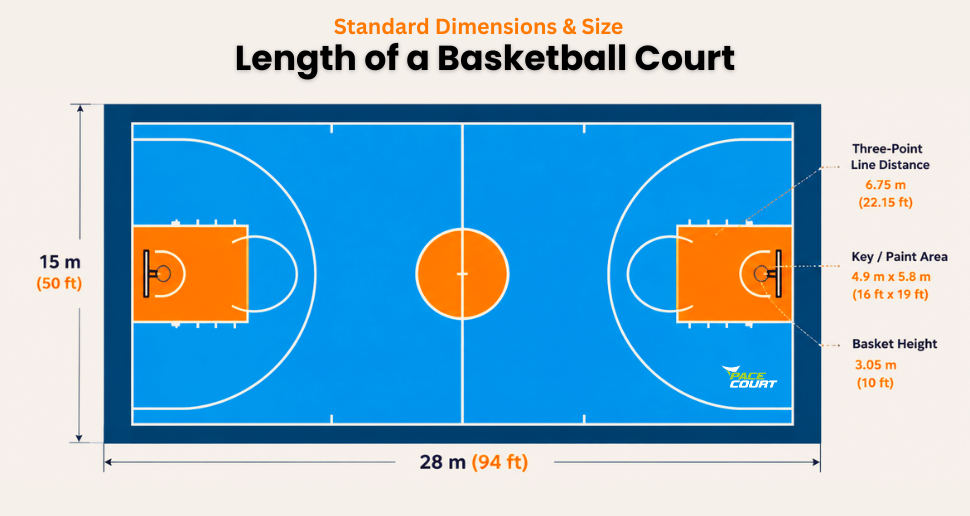
Length of a Basketball Court: Standard Dimensions & Size

If you’re building a court, coaching a team, or just settling a debate with a friend, you need the real numbers. The length of a basketball court depends on which rulebook you follow. A FIBA court, the size used across India and most of the world, measures 28 metres (91.86 feet) long. An NBA court runs a little longer, at 94 feet (28.65 metres). That gap of about 2 feet trips up a lot of first-time court builders. This guide covers the length of basketball court in feet and meters, the width. And the full layout for every level of play. So you get one clear answer instead of five different numbers from five different websites. Along with the numbers, you’ll see how each measurement is actually used on the court. Not just a list of figures to copy. Basketball Court Dimensions in Feet and Meters  Here’s the short version, covering basketball court length in meters and feet for every major standard. We’ll explain the reasoning behind each number right after. Court Type Length Width Total Area FIBA / International (India standard) 28 m (91.86 ft) 15 m (49.21 ft) 420 sq m (~4,521 sq ft) NBA 94 ft (28.65 m) 50 ft (15.24 m) 4,700 sq ft (~437 sq m) NCAA (US college) 94 ft (28.65 m) 50 ft (15.24 m) 4,700 sq ft (~437 sq m) WNBA 94 ft (28.65 m) 50 ft (15.24 m) 4,700 sq ft (~437 sq m) US high school 84 ft (25.6 m) 50 ft (15.24 m) 4,200 sq ft (~390 sq m) Half court (NBA) 47 ft (14.33 m) 50 ft (15.24 m) 2,350 sq ft (~218 sq m) Notice that width stays close to 50 feet across almost every level. Length is where the real differences show up, and that’s usually what people mean when they search for basketball court size. If you only care about basketball court size in feet, here’s the short list: 84 feet for a US high school court, 91.86 feet for FIBA, and 94 feet for NBA, NCAA, and WNBA courts. In India, schools, colleges, housing societies, and Khelo India facilities almost always build to the FIBA size of 28m x 15m. If you’re planning a court here, this is the number to work from. One small but important detail: all these measurements are taken from the inner edge of the boundary line, not the outer edge. A court builder who measures to the outer edge of the paint will end up with a court that’s a couple of inches too big on every side. Which sounds minor until the free-throw line and three-point arc no longer line up correctly. Basketball Court Length and Width Explained A basketball court is a plain rectangle, but the two sides mean different things on the floor. Basketball Court Length The length is measured along the sidelines, from one baseline (behind one basket) to the other baseline (behind the opposite basket). This is the distance players cover on a fast break, and it’s the number most people search for first. At 28 metres or roughly 94 feet, it gives enough room for a full sprint from one end to the other without the court feeling cramped. Basketball Court Width The width runs between the two sidelines, and it stays close to 15 metres (49–50 feet) at almost every level of play. This width gives players enough space to spread out for passing lanes, set screens. Drive to the basket from either side without running into the boundary line every few steps. Together, length and width create a playing surface of roughly 420 to 437 square metres, depending on which standard you’re building to. How to Measure a Basketball Court Getting accurate basketball court measurements doesn’t need fancy equipment. A few basic steps get you a precise layout, whether you’re marking out a new court or checking an existing one. Skipping the diagonal check is the most common mistake. It takes an extra two minutes and saves you from a court that plays unevenly for years. NBA vs FIBA Basketball Court Dimensions These two are the ones people compare the most, and the difference is small but real. NBA Basketball Court Dimensions An NBA court measures 94 feet long by 50 feet wide, which works out to 28.65 by 15.24 metres. The extra length compared to FIBA courts gives NBA players, who are often taller and faster than the average player, a bit more room to build speed on fast breaks. NCAA and WNBA courts follow the same 94 x 50 feet size. FIBA Basketball Court Dimensions FIBA, the International Basketball Federation, sets the court at 28 by 15 metres, which converts to about 91.86 by 49.21 feet. This is the standard for the Olympics, the FIBA World Cup, and domestic basketball in India, Europe, and most of the world outside the United States. The Basketball Federation of India follows FIBA rules for national events, so schools and academies here build to this size rather than the NBA one. The two standards aren’t just a few inches apart by accident. FIBA courts are shorter in proportion, which changes how far players stand from the basket on the three-point line. Since 2010, FIBA has also used a rectangular key instead of the old trapezoid shape, making it nearly identical in width to the NBA’s lane. We’ll get into those details in the layout section below. If you’ve ever wondered why NBA games look a touch more spread out than an Olympic match, the extra length and width, small as it is, gives professional players just enough additional room to build speed and space on every possession. Basketball Court Size in India Most competitive basketball in India runs on FIBA dimensions. That means full size basketball court dimensions come to 28 metres long by 15 metres wide, whether it’s a school playground, a college gym, a housing society court, or a Khelo India sports complex. There’s a good reason for this. Indian
Basketball Court Measurement
Basketball Court Dimensions in Meters

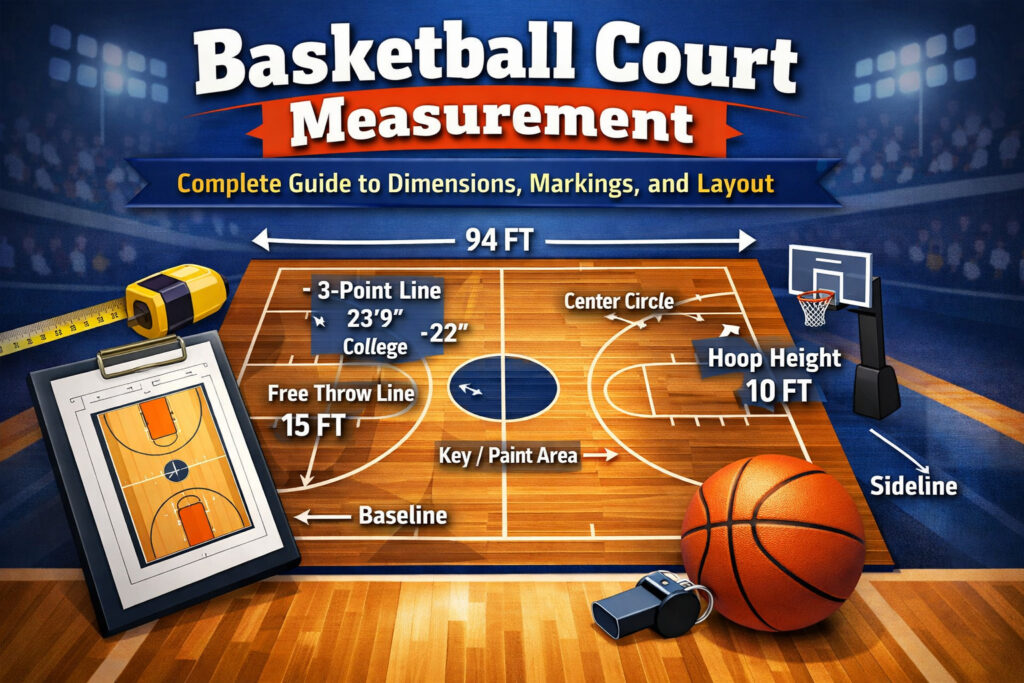
Basketball Court Measurement: Complete Guide to Dimensions, Markings, and Layout

Basketball is one of the most widely played sports in the world, from neighborhood playgrounds to massive professional arenas filled with thousands of cheering fans. While the fast-paced gameplay often steals the spotlight, the basketball court measurement itself plays a crucial role in how the game is played. Every line, arc, and boundary has a specific dimension that influences strategies, player movement, and even scoring patterns. Think of a basketball court like a carefully designed blueprint. Just as architects rely on precise measurements to build a safe structure, basketball organizations depend on standardized court dimensions to maintain fairness and consistency across games. Whether you’re watching the NBA Finals, a college tournament, or a local high school matchup, the court follows strict guidelines set by governing bodies like the NBA, FIBA, and NCAA. These measurements are not random. The distance from the three-point line, the width of the free-throw lane, and the height of the basketball rim are all carefully calculated to balance skill, athleticism, and strategy. For example, extending the three-point line even slightly can dramatically change offensive tactics, forcing teams to adjust their shooting ranges and spacing. Understanding basketball court dimensions is valuable for many reasons. Coaches use this knowledge to design effective plays, facility managers rely on it to build regulation courts, and players benefit from knowing how spacing affects their performance. Even casual fans gain a deeper appreciation of the sport when they understand how the layout shapes the game. This guide explores every important detail about basketball court measurements, including official sizes used in the NBA, FIBA, college, and high school leagues. It also breaks down court markings, hoop dimensions, surface materials, and practical tips for measuring and building a court. By the time you finish reading, you’ll have a clear understanding of how every inch of a basketball court contributes to the rhythm and excitement of the game. Understanding Standard Basketball Court Dimensions When people think about basketball court measurement, they often imagine a large rectangular floor with two hoops at opposite ends. While that description is technically correct, the reality is far more detailed. A standard basketball court includes precise measurements that regulate everything from player positioning to shooting distances. The most widely recognized court dimension comes from professional leagues such as the NBA and FIBA, where courts are designed to provide enough space for fast-paced gameplay while maintaining competitive balance. In general, a full basketball court is rectangular and divided into two equal halves by the center line. Each half contains identical markings such as the three-point arc, free-throw lane, and key area. The typical professional basketball court measures 94 feet long and 50 feet wide (28.65 × 15.24 meters) in the NBA. This size allows ten players to move freely while executing offensive and defensive plays without excessive crowding. The length of the court is especially important because it determines transition speed during fast breaks, one of the most thrilling elements of the game. Beyond the outer boundaries, several internal markings help define gameplay areas. For instance, the center circle marks where the opening tip-off occurs. The three-point arc determines which shots count for three points instead of two. The free-throw lane, often called “the paint,” is where players line up during foul shots. Here is a quick comparison of typical professional basketball court dimensions: League Court Length Court Width NBA 94 ft (28.65 m) 50 ft (15.24 m) FIBA 28 m (91.9 ft) 15 m (49.2 ft) NCAA 94 ft 50 ft High School 84 ft 50 ft Even though the differences may seem small, they significantly affect gameplay. For example, FIBA courts are slightly shorter than NBA courts, which can influence defensive spacing and offensive flow. Another interesting detail is the clearance space around the court. Professional arenas usually include additional out-of-bounds space—often several feet beyond the sidelines and baselines—to protect players when diving for loose balls. Understanding these dimensions is essential for anyone involved in basketball facility planning, coaching strategy, or sports education. Every measurement contributes to the balance between offense and defense that makes basketball such an exciting sport to watch and play. NBA Basketball Court Size The NBA basketball court is considered the global reference point for professional basketball measurements. While other leagues may adopt slightly different standards, the NBA’s dimensions are often viewed as the benchmark for elite-level competition. An official NBA court measures 94 feet in length and 50 feet in width. These dimensions create a playing surface large enough to support the incredible speed and athleticism of professional players. With athletes capable of sprinting the full court in just a few seconds, the extra length helps maintain spacing and allows for dynamic offensive plays such as fast breaks and transition scoring. The court is divided exactly in half by the midcourt line, creating two identical playing areas. At the center of this line lies the center circle, which has a diameter of 12 feet. This circle is where the game begins with the opening jump ball, one of the most iconic moments in basketball. One of the most famous features of the NBA court is the three-point line, which sits farther from the basket compared to most other leagues. In the NBA: This slight difference exists because the court width would otherwise make the corner three excessively long. Interestingly, the corner three has become one of the most strategically valuable shots in modern basketball due to its shorter distance. The free-throw lane, also known as “the key,” measures 16 feet wide in the NBA. This rectangular area sits directly under the basket and plays a crucial role in rebounding, post moves, and defensive positioning. Another critical element is the restricted area arc, which sits directly beneath the basket with a radius of 4 feet. Defenders standing inside this arc cannot draw a charging foul, encouraging more aggressive drives to the rim and reducing dangerous collisions. Altogether, the NBA court layout is carefully designed to balance shooting range, interior play, and defensive strategy. Every

basketball court dimensions in meters
Basketball Court Dimensions in Meters

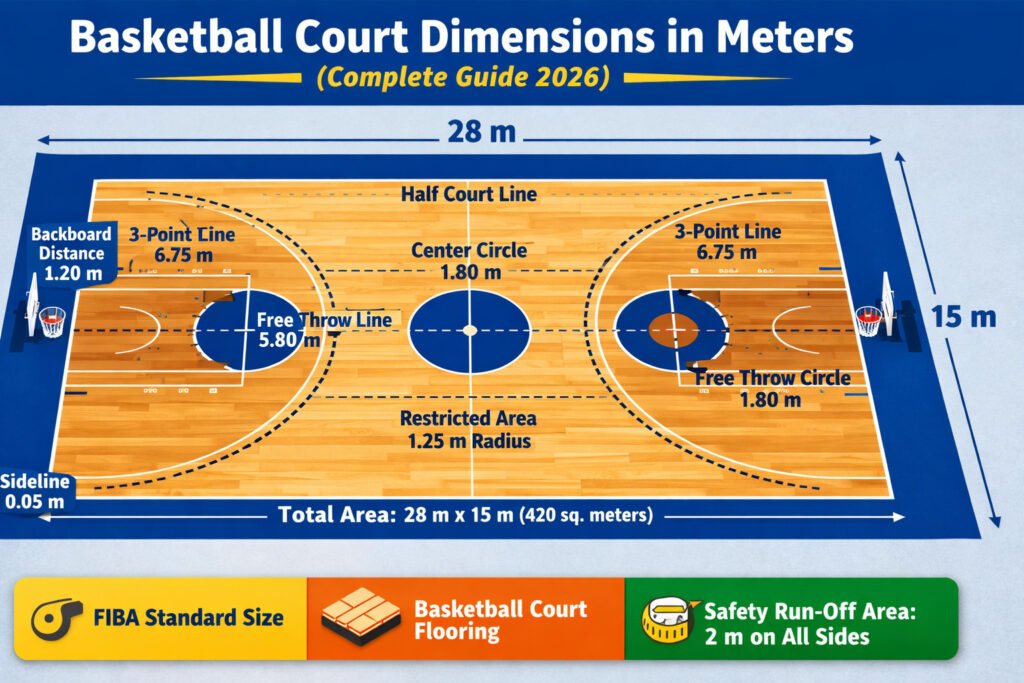
Basketball Court Dimensions in Meters (Complete Guide 2026)

Basketball is one of the most popular sports worldwide, and whether you’re building a professional arena, school playground, or indoor sports facility, understanding basketball court dimensions in meters is essential. Accurate court size ensures fair play, safety, and compliance with international standards. This detailed guide explains FIBA, NBA, and school-level basketball court dimensions, markings, and important construction considerations. Standard Basketball Court Dimensions in Meters FIBA Basketball Court Dimensions (International Standard) FIBA (International Basketball Federation) standards are followed in most countries, including India. Feature Dimension (Meters) Court Length 28 meters Court Width 15 meters Total Playing Area 420 sq. meters Centre Circle Radius 1.80 meters Free Throw Line Distance 5.80 meters Free Throw Circle Radius 1.80 meters Backboard Distance from Baseline 1.20 meters 📌 Best suited for: International tournaments, professional academies, and advanced training facilities. NBA Basketball Court Dimensions (USA Standard) Feature Dimension (Meters) Court Length 28.65 meters Court Width 15.24 meters Centre Circle Radius 1.83 meters Free Throw Line Distance 5.79 meters 📌 Slightly larger than FIBA courts and mainly used in the United States. School & Recreational Basketball Court Dimensions For schools and community courts, smaller dimensions are often used: Level Length (m) Width (m) School Level 24 – 26 13 – 14 Recreational Custom Custom These courts are easier to fit into limited spaces while maintaining gameplay quality. Key Basketball Court Markings (Meters) Three-Point Line (FIBA): 6.75 meters from the basket Restricted Area Radius: 1.25 meters No-Charge Semi-Circle Radius: 1.25 meters Sideline Width: 0.05 meters Proper markings are critical for official matches and training accuracy. Basketball Court Flooring Requirements Choosing the right basketball court flooring is just as important as correct dimensions. Flooring impacts player safety, ball bounce, and long-term durability. Best Flooring Options: 📌 Always ensure flooring provides anti-skid surface, shock absorption, and consistent bounce. Space Required Beyond the Court For safe movement and official play: This space accommodates referees, player benches, and audience movement. Indoor vs Outdoor Basketball Court Dimensions Type Dimension Standard Indoor Court FIBA / NBA exact size Outdoor Court Same size but flexible based on space Outdoor courts may allow minor size adjustments, but markings should remain accurate. Basketball Court Dimensions for India In India, FIBA dimensions (28 × 15 meters) are widely accepted for: These dimensions ensure compatibility with national and international tournaments. Basketball Court Construction Guidelines Building a basketball court requires more than just correct dimensions. Proper planning, material selection, and execution ensure long-term performance and safety. Step-by-Step Basketball Court Construction Process Basketball Court Flooring Thickness & Layers A professional basketball court usually consists of multiple layers: Layer Purpose Base Layer Structural strength Cushion Layer Shock absorption Surface Layer Grip & ball bounce Top Coat UV & wear resistance This layered system protects players from injuries and increases flooring life. Basketball Court Flooring Cost in India (Approximate) Flooring Type Price Range (₹/sq ft) Acrylic Flooring ₹150 – ₹250 Synthetic PU Flooring ₹300 – ₹600 Modular Tiles ₹350 – ₹700 Wooden Flooring ₹700 – ₹1,500 💡 Cost depends on location, surface preparation, and total court area. Drainage & Slope Requirements for Outdoor Courts Outdoor basketball courts must have proper water flow: Ignoring drainage can damage basketball court flooring within a few seasons. Lighting Requirements for Basketball Courts Proper lighting is essential for visibility and professional play. Recommended Lighting Levels: LED sports lights are preferred due to energy efficiency and uniform illumination. Basketball Court Maintenance Tips Regular maintenance keeps the court safe and visually appealing. Maintenance Best Practices: High-quality basketball court flooring requires minimal maintenance but delivers maximum durability. Common Mistakes to Avoid While Building a Basketball Court ❌ Incorrect court dimensions❌ Poor base leveling❌ Low-quality flooring materials❌ Improper line marking❌ No drainage planning Avoiding these mistakes saves repair costs and ensures better play experience. Indoor Basketball Court Ventilation Requirements Indoor courts need: Poor ventilation can damage wooden and synthetic basketball court flooring over time. Why Professional Installation Matters Hiring experienced sports flooring contractors ensures: Professional installation directly impacts performance and player safety. Conclusion A perfectly designed basketball court combines accurate dimensions, proper markings, high-quality basketball court flooring, and expert installation. Whether you are building a school court, academy, or professional sports arena, following international standards ensures durability, safety, and better gameplay. Investing in the right flooring and construction approach not only enhances performance but also reduces long-term maintenance costs.

Scroll to Top
HOMEOWNERS
BUSINESS OWNERS
ARCHITECTS
MUNICIPALITIES

Let's Build
Great Courts

ITF-certified acrylic flooring for Tennis, Basketball, Badminton, Pickleball & more shipped worldwide.

Premium Quality

World-class material & Construction

Expert Team

Experienced Professional at your Service

End-to-End Support

From concept to completions

Get In Touch

We will respond as soon as possible 

[pw_popup_form]

    Your information is secure and will never be shared

    ISO-Certificate