An official badminton court measurement is 44 feet long and 20 feet wide for doubles, and 44 feet by 17 feet for singles. Because players need free space around the lines, plan a total area of about 52 × 28 ft for one court. Outdoors, acrylic flooring over a smooth concrete base is the most practical surface.
This guide is for anyone checking their land, planning a new court or choosing a flooring surface.
Key Takeaways
- Doubles court: 44 × 20 ft (13.4 × 6.1 m)
- Singles court: 44 × 17 ft (13.4 × 5.18 m)
- Recommended total area for one court: about 52 × 28 ft (15.8 × 8.5 m)
- Net height: 5 ft at the centre, 5 ft 1 in at the posts
- Base already ready? It must be cured, level, crack-free and well drained before any surface goes on
- Best outdoor surface: Acrylic Flooring (Pacecourt)
- Best indoor surfaces: PVC/vinyl mats, PU or wooden flooring, depending on budget
What Are the Official Badminton Court Dimensions in Feet?
Pacecourt follows the Badminton World Federation (BWF) layout. All lines are measured to their outer edge, and the lines are part of the court.
| Element | Feet | Metres |
|---|---|---|
| Doubles court (length × width) | 44 × 20 ft | 13.4 × 6.1 m |
| Singles court (length × width) | 44 × 17 ft | 13.4 × 5.18 m |
| Marked area, doubles | 880 sq ft | 81.7 m² |
| Net height, centre | 5 ft | 1.524 m |
| Net height, at posts | 5 ft 1 in | 1.55 m |
| Short service line (from net) | 6 ft 6 in | 1.98 m |
| Doubles long service line (inside back line) | 2 ft 6 in | 0.76 m |
| Line width | 1.6 in | 40 mm |
Planning to Build a Badminton Court?
Choose Pacecourt for quality acrylic badminton court flooring, 800+ colour options, and sports surface solutions tailored to your project needs.
How Court Dimensions Differ in Singles and Doubles Badminton
One court serves both formats.
- Length is 44 ft for both.
- Doubles uses the outer side lines (20 ft wide).
- Singles use the inner side lines (17 ft wide).
- Net posts stand on the doubles side lines, even for singles.
So you only need to build one court. The line markings take care of the rest.
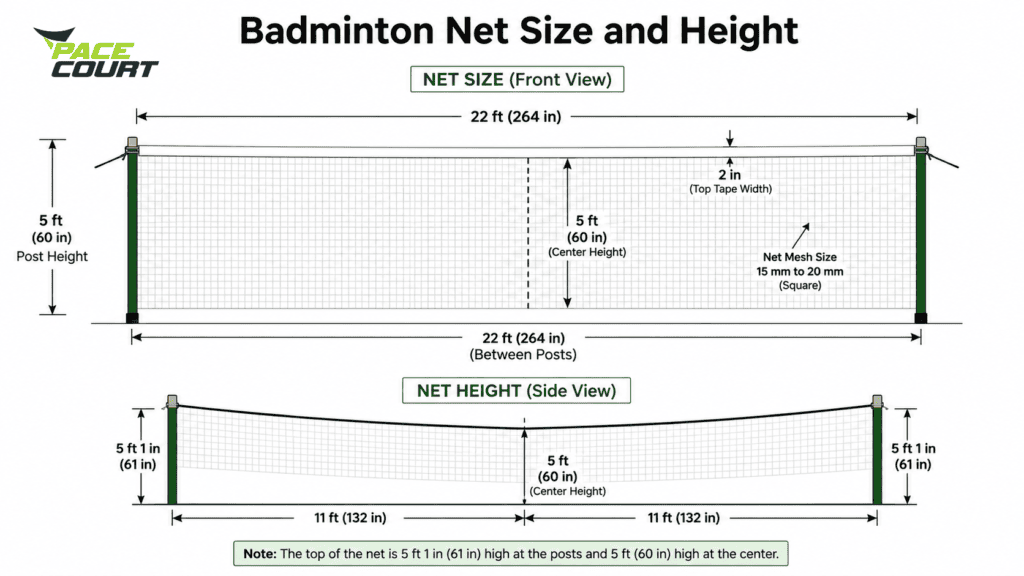
Badminton Net Size and Height
- Height at the centre: 5 ft (1.524 m)
- Height at the posts: 5 ft 1 in (1.55 m)
- Width: at least 20 ft (6.1 m), matching the doubles court width
- Depth: about 2 ft 6 in (760 mm)
- Top edge: white tape folded over a cord or cable
- Posts: placed on the doubles side lines, even for singles
- Position: exactly at the centre of the court, 22 ft from each back line
Badminton Flooring Cost Comparison (Per Sq Ft)
| Flooring Type | Relative Cost | Best For |
|---|---|---|
| Acrylic sports surface | Budget-friendly to mid-range | Outdoor courts |
| Interlocking PP tiles | Mid-range | Quick outdoor setups |
| PU flooring | Mid-range to higher | Indoor or covered courts |
| PVC / vinyl mats | Mid-range to higher | Indoor halls |
| Wooden flooring | Highest | Premium indoor halls |
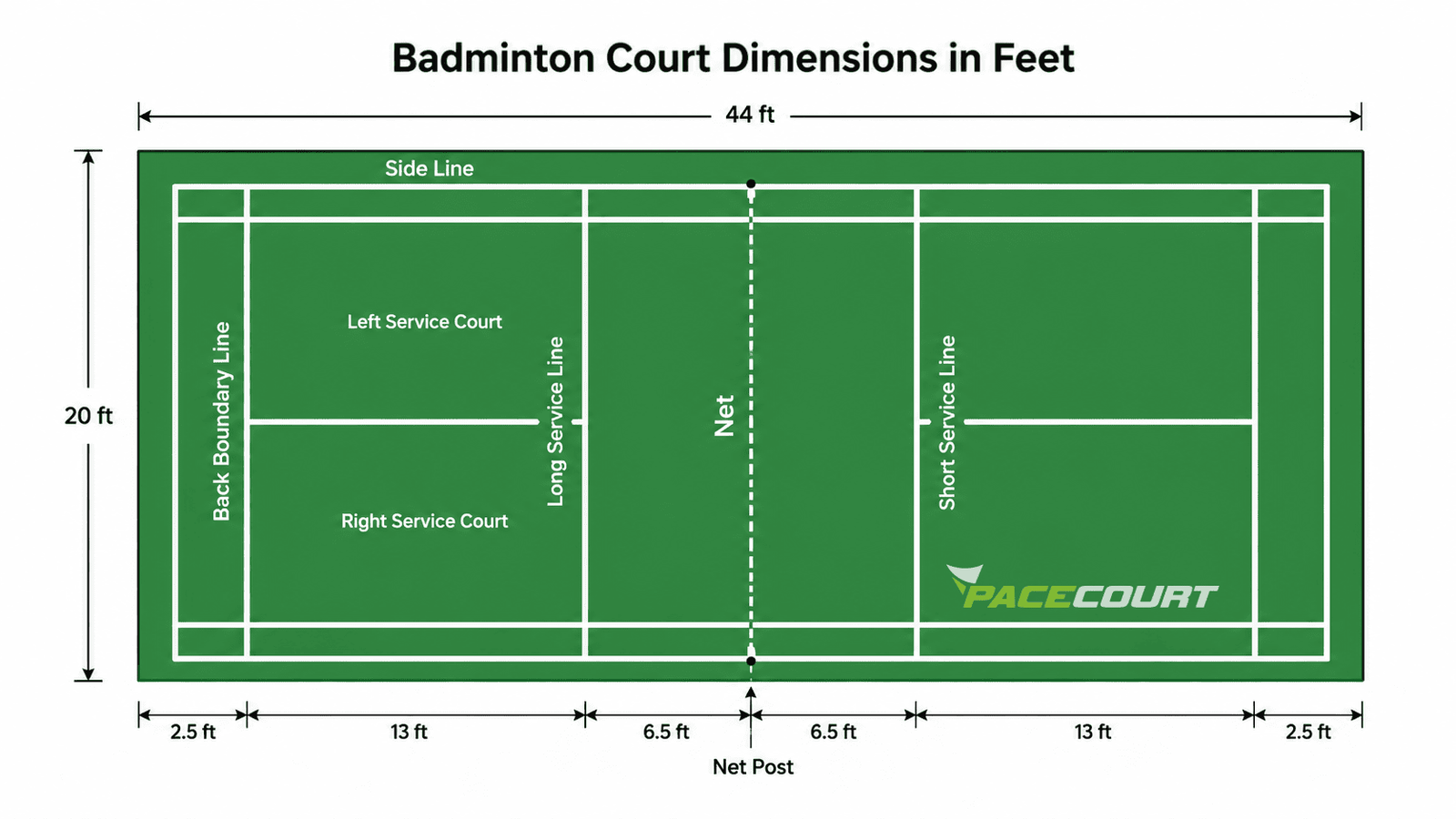
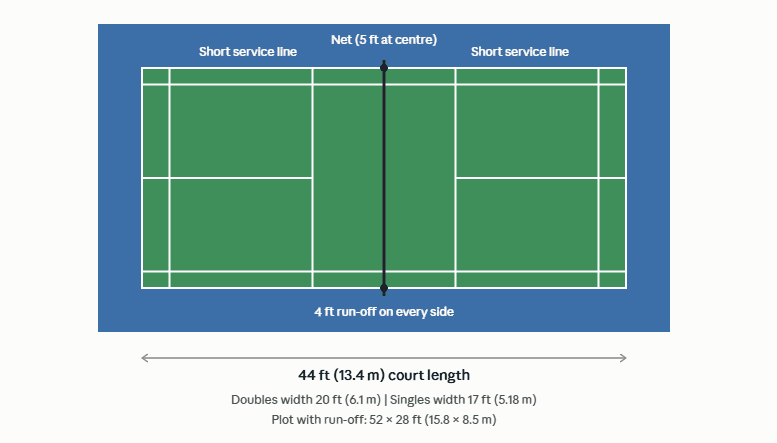
Badminton Court Diagram: Dimensions and Layout
A badminton court diagram shows court dimensions, boundary lines, service areas, and net position for accurate court layout and construction.
How Much Land Is Required to Build a Badminton Court?
The 44 × 20 ft size is only the marked area. Players overrun the baselines and side lines constantly, so a court built to exactly 880 sq ft is unsafe.
For one court, plan around 52 × 28 ft (about 1,456 sq ft). This gives roughly 4 ft of free space on every side.
Total Recommended Area, Including Surrounding Space
The extra space on each side is called run-off. Here is a simple way to plan it:
| Plan | Run-off on Each Side | Total Area (Feet) | Total Area (Metres) |
|---|---|---|---|
| Minimum (tight plot) | about 3 ft (1 m) | 50.5 × 26.5 ft | 15.4 × 8.1 m |
| Recommended | 4 ft (1.2 m) | 52 × 28 ft | 15.8 × 8.5 m |
| Comfortable / academy use | 6.5 ft (2 m) | 57 × 33 ft | 17.4 × 10.1 m |
These planning sizes are calculated by adding space around the official court. They are practical guidance and not part of the BWF rules.
Land Planning Tips for Building a Badminton Court
- Keep walls, fences, poles and drains away from the lines.
- For multiple courts, leave 3 to 5 ft (1 to 1.5 m) between courts.
- Outdoors, run the long side north to south so the sun does not face players along the length of the court.
- Wind spoils shuttle flight, so boundary fencing or windbreak netting helps.
- Keep a gentle drainage slope of around 1%.
- Two courts need about 52 × 56 ft side by side with the same run-off, so check your plot width before deciding.
Concrete Base Ready? Choose Your Badminton Court Flooring
Explore suitable acrylic flooring materials, colours, and surface systems for your badminton court with Pacecourt.
How Many Badminton Courts Fit in a Hall or Plot?
Courts are placed side by side with a 5 ft gap between them, And 4 ft of run-off on the outer sides.
| Number of Courts | Hall / Plot Size (Feet) | Hall / Plot Size (Metres) | Approx. Area |
|---|---|---|---|
| 1 court | 52 × 28 ft | 15.8 × 8.5 m | 1,456 sq ft |
| 2 courts | 52 × 53 ft | 15.8 × 16.2 m | 2,756 sq ft |
| 3 courts | 52 × 78 ft | 15.8 × 23.8 m | 4,056 sq ft |
| 4 courts | 52 × 103 ft | 15.8 × 31.4 m | 5,356 sq ft |
| 6 courts | 52 × 153 ft | 15.8 × 46.6 m | 7,956 sq ft |
For competition use, add wider gaps and walking space around the hall.
Land Ready and Concrete Base Done? Check This Before Flooring
If your concrete base is already ready, do not start with the surface. Check the base first, because every flooring system shows the flaws underneath.
Base checklist:
- Fully cured concrete (fresh concrete needs time to dry)
- Smooth and level finish, with no puddles after water testing
- Cracks and joints repaired and filled
- Proper slope for water run-off
- Clean surface, free of dust, oil and loose material
- Correct size, including run-off space around the 44 × 20 ft court
If the base passes, you can move to flooring. If there are cracks or low spots, repair them first. This costs far less than redoing a failed surface later.
Best Flooring for a Badminton Court: Which Surface Should You Choose?
The answer depends on whether the court is outdoor or indoor.
| Flooring | Best For | Feel & Grip | Maintenance | Notes |
|---|---|---|---|---|
| Acrylic sports surface | Outdoor courts, schools, societies, homes | Consistent bounce, good grip, cushioning layers possible | Low to moderate, recoat when worn | Most practical for open-air courts |
| PU (polyurethane) | Indoor or covered courts | Good cushioning | Moderate | Better under a roof than in direct sun |
| PVC / vinyl sports mat | Indoor halls | Good shock absorption | Low | Needs a flat base and indoor conditions |
| Wooden flooring | Premium indoor halls | Excellent feel | Higher | Costly and sensitive to moisture |
| Interlocking PP tiles | Quick outdoor or semi-outdoor setups | Moderate | Low | Fast to install, but feel differs from a seamless surface |
Which Flooring Is Best for an Outdoor Badminton Court?
Acrylic is usually the best choice for an outdoor court built on concrete. It handles sun and rain, gives a smooth playing surface and can be coloured and marked for badminton or other sports. When it wears, it can be recoated instead of rebuilt.
Why Choose Acrylic Flooring for Outdoor Badminton Courts?
- Made for outdoor weather
- Even surface for footwork
- Easier on joints than bare concrete
- Clear, durable line markings
- Suits multi-sport courts (badminton, basketball, volleyball, pickleball)
- Can be recoated when worn
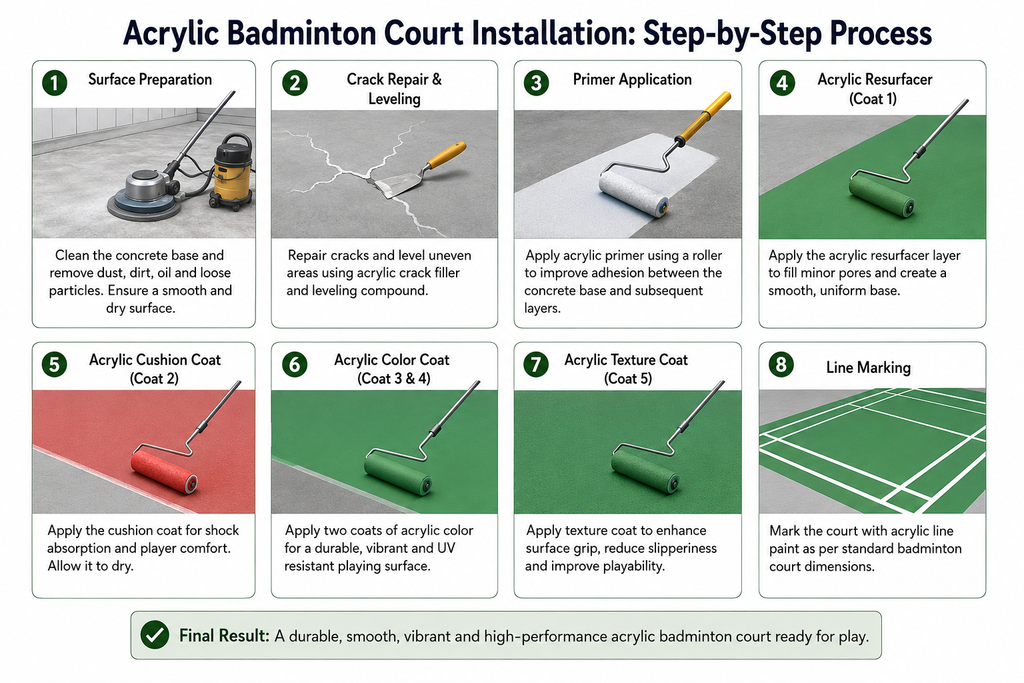
Acrylic Badminton Court Installation: Step-by-Step Process
| Step | Work Done | Why It Matters |
|---|---|---|
| 1. Base preparation | Check that the concrete or asphalt base is cured, level and clean | A weak base shows through every layer |
| 2. Crack and surface repair | Fill cracks, joints and low spots | Stops cracks from returning through the surface |
| 3. Cleaning and priming | Remove dust and oil, then apply primer | Helps the layers bond to the base |
| 4. Levelling coats | Smooth the surface and fix minor unevenness | Gives an even playing area |
| 5. Cushion or texture layers | Applied as per the surface system | Controls comfort and grip |
| 6. Color coats | Court area and run-off area in chosen colors | Gives a clean, uniform finish |
| 7. Line marking | 40 mm lines in white or yellow | Keeps lines accurate and visible |
| 8. Final inspection | Check levels, finish and markings, then set up nets | Court is ready for play |
Which Sports Flooring Manufacturer Should You Contact?
If you want to buy materials directly, look for a manufacturer that can explain coverage, layers and site preparation clearly, and can supply in the quantity you need.
Pacecourt is a manufacturer of acrylic synthetic sports surface materials for badminton, tennis, pickleball, basketball, volleyball, skating, walking tracks and multi-purpose courts. When you contact Pacecourt, you get:
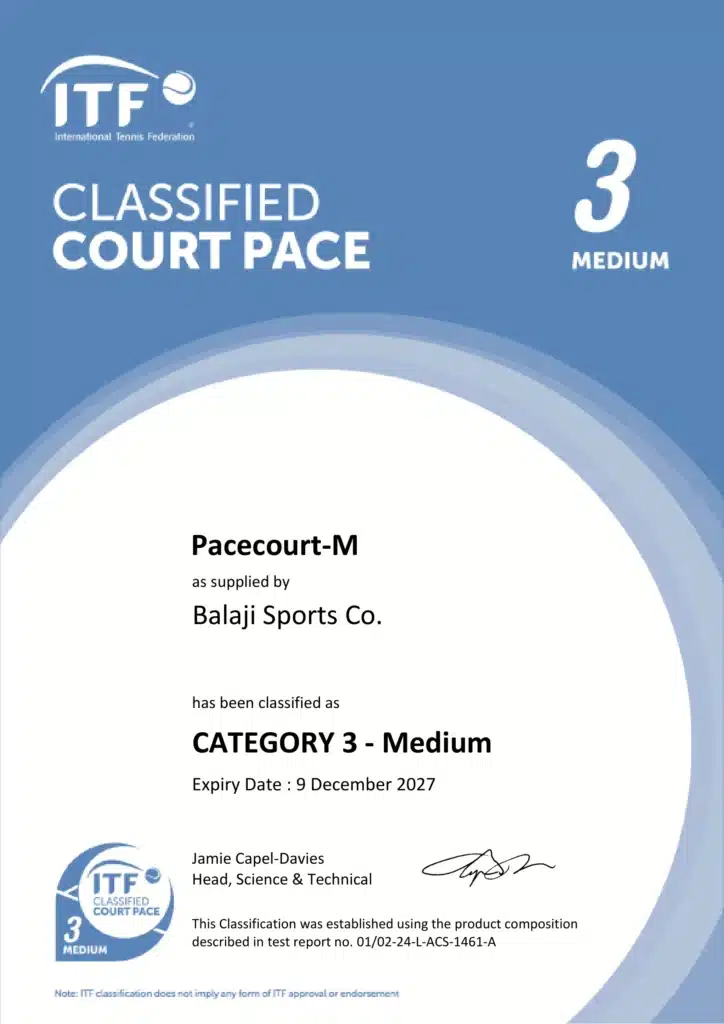
- ITF-classified acrylic surface system
- Up to 30% more coverage, so you need less material for the same area
- Less wastage on site
- Fast delivery and instant availability
- Buy-back facility
- No minimum order value, useful for a single home court as well as a larger project
Choose from 800+ Colours for Your Badminton Court
Pacecourt offers 800+ colour options for acrylic court surfaces. You can pick one colour for the playing area and another for the run-off area. This lets you match the court to your home, school or club design.
Download Your Badminton Court Design PDF
Select your colours and court size, then download a PDF of your court design. The PDF shows your chosen colour combination and court size.
You can use it to:
- Visualise the court before you start
- Share the design with your contractor or architect
- Get guidance from Pacecourt on the materials you need
Keep these details ready when you enquire:
- Plot size in feet
- Number of courts
- Base type and condition (concrete or asphalt)
- Site location
- Single-sport or multi-sport use
Common Mistakes When Planning a Badminton Court
- Building only 44 × 20 ft with no run-off space
- Placing walls or fences right next to the lines
- Applying the surface over uncured or cracked concrete
- Ignoring drainage slope
- Using the wrong line width (it should be 40 mm)
- Choosing an indoor flooring type for an open court
Conclusion
A badminton court measures 44 × 20 ft for doubles and 44 × 17 ft for singles, but plan about 52 × 28 ft of land so the court is safe to play on. If your concrete base is ready, check that it is cured, level and well drained before choosing a surface. For outdoor courts, acrylic is the practical choice.
Planning a badminton court? Contact Pacecourt with your plot size and site details to get guidance on acrylic flooring materials.
Frequently Asked Questions (FAQs)
Can I fit a badminton court in a 40 × 20 ft space?
No. The marked court alone is 44 ft long, so 40 ft is too short. Look for a plot closer to 52 × 28 ft.
Can two badminton courts be marked on one basketball court?
Often yes. A standard basketball court is about 28 × 15 m, so two badminton courts can be marked crosswise using different line colours. Check clearances before finalising.
Which direction should an outdoor badminton court face?
North to south along the length is generally preferred, so players do not face the sun directly.
Which colour works best for an acrylic badminton court?
Green and blue are common choices because white or yellow lines and the shuttle stand out clearly. Pick what suits visibility and your site’s look.
How long does it take to build an outdoor badminton court?
It depends on site condition, base work and weather. Concrete needs time to cure before the surface is applied, so ask your contractor for a day-wise schedule.
Can I add pickleball lines on the same court?
Yes. Acrylic surfaces can carry multiple sets of markings. Use different line colours so the games stay easy to read.