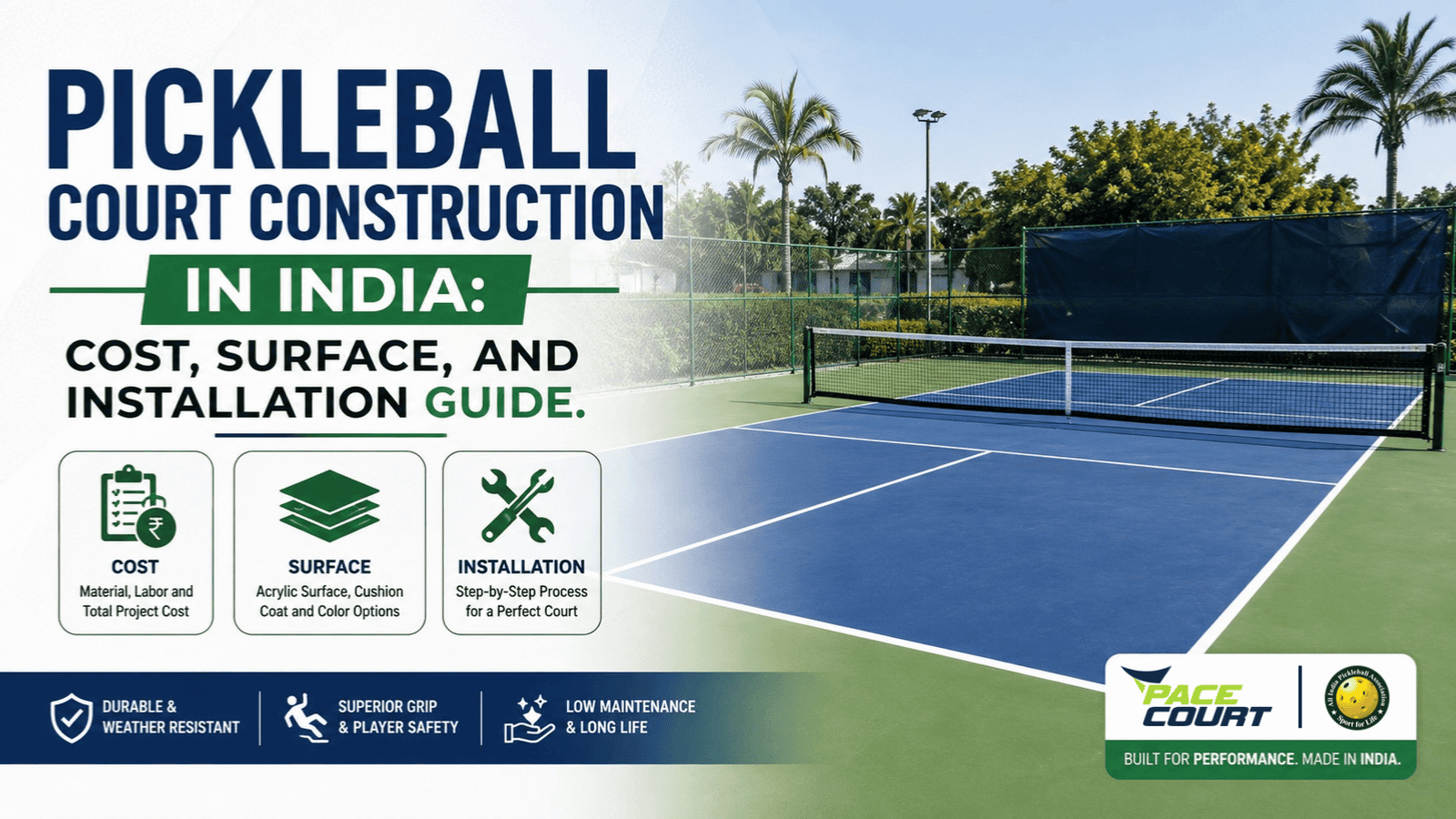
Pickleball court construction means preparing a level, well-drained base, laying a playing surface (usually acrylic in India), marking the lines, and installing the net. A standard outdoor court takes a few weeks to build, mostly because the base needs time to cure.
This guide covers court dimensions, flooring, the construction process, and the cost of a pickleball court in India. It comes from Pacecourt, an Official Partner of the All India Pickleball Association (AIPA) and a manufacturer of acrylic pickleball court surfaces.
Pickleball Court Construction: Key Stages and Requirements
Building a durable pickleball court requires proper planning, a stable base, quality sports flooring, and accurate court marking. Each stage contributes to playing performance, surface durability, and long-term maintenance.
- Site Preparation: Levelling the ground and ensuring proper drainage.
- Base Construction: Preparing a stable concrete or asphalt base.
- Acrylic Sports Flooring: Applying suitable primer, resurfacer, and color coats.
- Court Marking: Marking accurate playing lines according to standard dimensions.
- Final Installation: Setting up net posts, nets, fencing, and lighting as required.
Important: Proper base preparation and drainage are essential to reduce cracking, water accumulation, and uneven playing surfaces over time.
Pickleball Court Dimensions and Layout Diagram
A standard pickleball court size is 20 ft wide and 44 ft long (about 6.10 m x 13.41 m). The same size is used for singles and doubles.
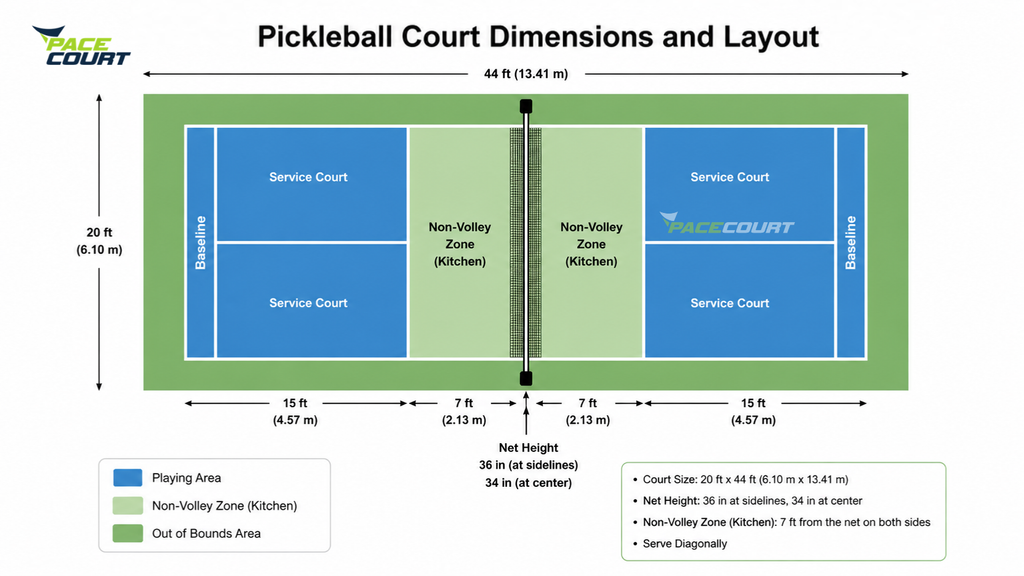
| Element | Standard measurement |
| Court | 20 ft x 44 ft |
| Non-volley zone (“kitchen”) | 7 ft from the net on each side |
| Net height | 36 inches at the posts, 34 inches at the centre |
| Recommended total area | About 30 ft x 60 ft |
Source: Pacecourt
Always plan for the full 30 x 60 ft area. Players need space behind the baseline and beside the sidelines to move safely.
Best Pickleball Court Flooring and Surface Material in India
For an outdoor pickleball court in India, an acrylic pickleball court surface over a concrete or asphalt base is the most practical choice. It handles heat, rain and UV well, gives good grip, and can be recoated when it wears.
| Surface | Best for | Things to know |
| Acrylic coating | Outdoor courts, clubs, societies, schools | Good grip and weather resistance; can be recoated |
| Bare concrete | Very low-budget temporary use | Hard on joints; wears and chips quickly |
| Asphalt (as base) | Base layer under acrylic | Not meant for play without a coating |
| Interlocking PP tiles | Terraces, indoor courts, quick installs | Easy to install; quality varies by product |
| Wooden or PVC sports flooring | Indoor halls | Higher cost; not for open-air use |
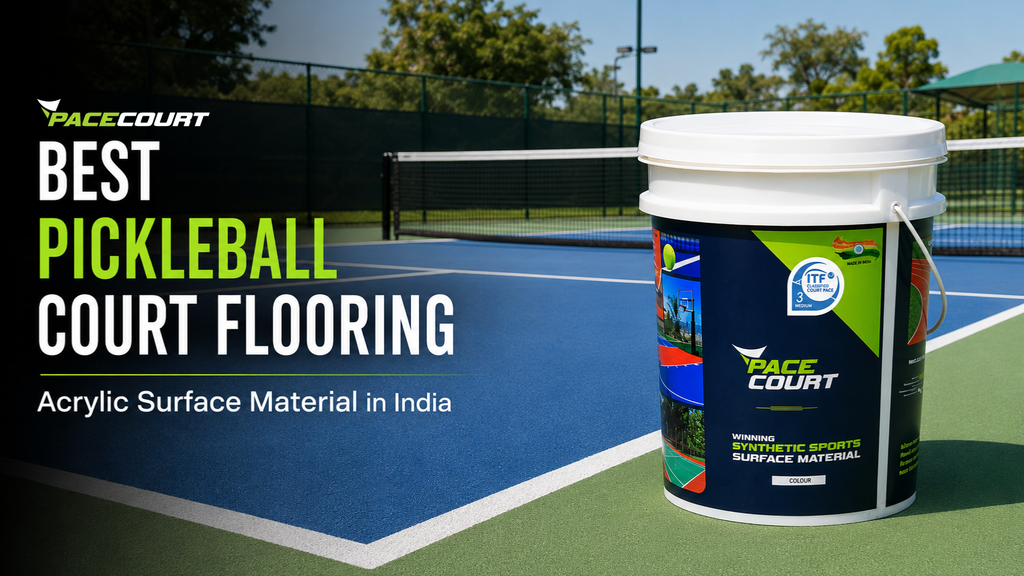
Planning a Pickleball Court? Get Surface Material and Quantity Guidance from Pacecourt
Share your court size and site details, and our team will help you choose the right acrylic system and prepare a quotation.
Why a synthetic pickleball court with acrylic works in Indian conditions
- Handles heat and heavy rain better than many alternatives
- Gives consistent bounce and controlled grip
- Colours and lines stay clear.
- Wide colour choice for the court, kitchen zone and run-off area
- Can be recoated instead of rebuilt
- Carries tennis and badminton markings on the same court
Why Choose Pacecourt for Your Pickleball Court?
The surface decides how your court looks, plays and lasts. Here is why clubs, academies, societies and homeowners choose us for pickleball court flooring.
800+ Acrylic Court Colours, Ready in Stock
Most suppliers offer only a handful of standard shades. We offer 800+ acrylic court colours with our Colour POP technology, from classic championship shades to custom colours.
- Colours are in stock and ready to dispatch
- No minimum order quantity (MOQ)
- Available even for a single bucket, so small courts and touch-ups are covered.
Where wide colour choice helps:
- Contrast between the kitchen zone and the rest of the court
- A different colour for the run-off area
- Matching club, school or society branding
- Colour-coded multi-sport courts (pickleball, tennis, badminton)
Official Partner of the All India Pickleball Association (AIPA)
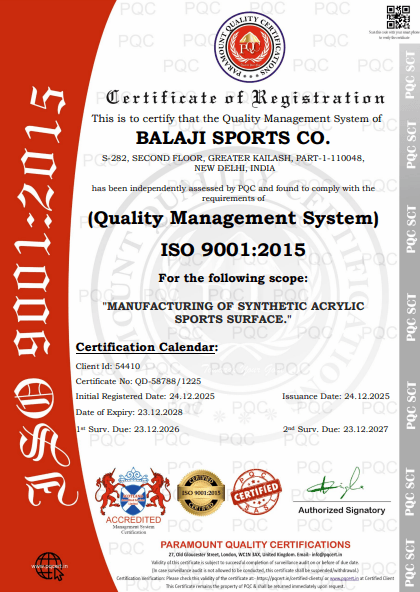
Pacecourt is an Official Partner of the All India Pickleball Association (AIPA). Our acrylic pickleball court systems are designed around performance, durability and player comfort. This is a useful trust signal if you are choosing a surface for a club, academy or competitive play.
More Reasons to Choose Us:
| What you get | What it means for your project |
| Up to 30% more coverage | The same material covers more area, so project cost can come down |
| Less wastage on site | Fewer leftover buckets and better value for money |
| Fast delivery and instant availability | Work can start on time, with no long waiting period |
| No minimum order value | Suitable for one home court or a multi-court facility |
| Buy-back facility | Unused material need not go to waste |
Planning a Pickleball Court Project? Partner with Pacecourt
Choose the right acrylic sports flooring system for your pickleball court. Get expert guidance on surface selection, material requirements, and project pricing.
Pickleball Court Construction Process: Step by Step
The pickleball court construction process has six stages: site preparation, base construction, curing, surface application, line marking and net installation.
- Choose the location: Pick a flat, open area with good drainage. Avoid spots near trees, as leaves and roots affect the court.
- Prepare the site: Clear, level, and compact the ground. Plan a gentle slope (around 1% is commonly used), so water runs off.
- Build the base: Lay concrete or asphalt to the thickness suited to your soil and usage. The base decides how long the court lasts.
- Let it cure: Concrete needs time to gain strength and release moisture. Rushing this causes cracks and peeling later.
- Apply the surface: The pickleball court installation of the acrylic system goes on in layers: crack repair, primer, resurfacer and colour coats. Each layer must dry before the next.
- Mark lines and install the net: Mark to exact dimensions, fix the posts and set the net height. Add fencing and lighting if needed.
Base Ready Court: What If You Already Have a Concrete or Asphalt Base?
A base-ready court is a site that already has a cured concrete or asphalt slab, so only the playing surface needs to be applied. This is the fastest and usually the cheapest route, but only if the base is in good condition. It is also the starting point for pickleball court resurfacing.
Check these before you start:
- Age and curing: New concrete must be fully cured and dry
- Level: No dips or high spots that hold water
- Slope: Water should drain off, not collect
- Cracks: Hairline cracks can be filled; wide or moving cracks need proper repair
- Surface condition: Remove oil, dust, loose material and old peeling paint
- Size: Confirm the slab fits the 30 x 60 ft recommended area
A simple test: pour water on the slab and watch it. Puddles that stay behind show low spots to fix before coating.
Steps for a base-ready court:
- Clean and pressure-wash the slab
- Repair cracks and fill low spots.
- Apply primer
- Apply resurfacer coats for a smooth, even finish.
- Apply colour coats
- Mark lines and install the net
Existing tennis, badminton or basketball courts can often be converted this way if the base passes inspection.
Cost of Pickleball Court in India
Pickleball court construction cost in India depends mainly on the base type, surface system, site condition and extras like fencing and lighting. Quotes from different pickleball court builders vary widely, so compare scope, not just the total.
Pickleball court cost table:
| Type of Setup / Facility | Estimated Cost (INR) |
| Single Outdoor Pickleball Court (Standard / Club Build) | ₹2,50,000 – ₹5,00,000 |
| Typical Club & Housing Society Court | ₹4,50,000 – ₹6,50,000 |
| 4-Court Multi-Court Facility | ₹14,00,000 – ₹35,00,000 |
| Indoor Pickleball Court (Flooring, Lighting & Basic Preparation) | ₹10,00,000 – ₹15,00,000 |
| Acrylic Surface-Only Installation (Existing Concrete / Asphalt Base) | ₹75,000 – ₹1,50,000 |
| Premium Cushioned Acrylic Court | ₹1,50,000 – ₹3,00,000 |
Source: Pacecourt
Costs are estimates and change with site condition, location, base type, surface system and extras. An acrylic surface-only installation on an existing base costs far less than building a new court from scratch.
What to ask pickleball court builders before accepting a quotation
- Does the price include the base, or only the surface?
- How many coats are being applied?
- Are lines, posts and net included?
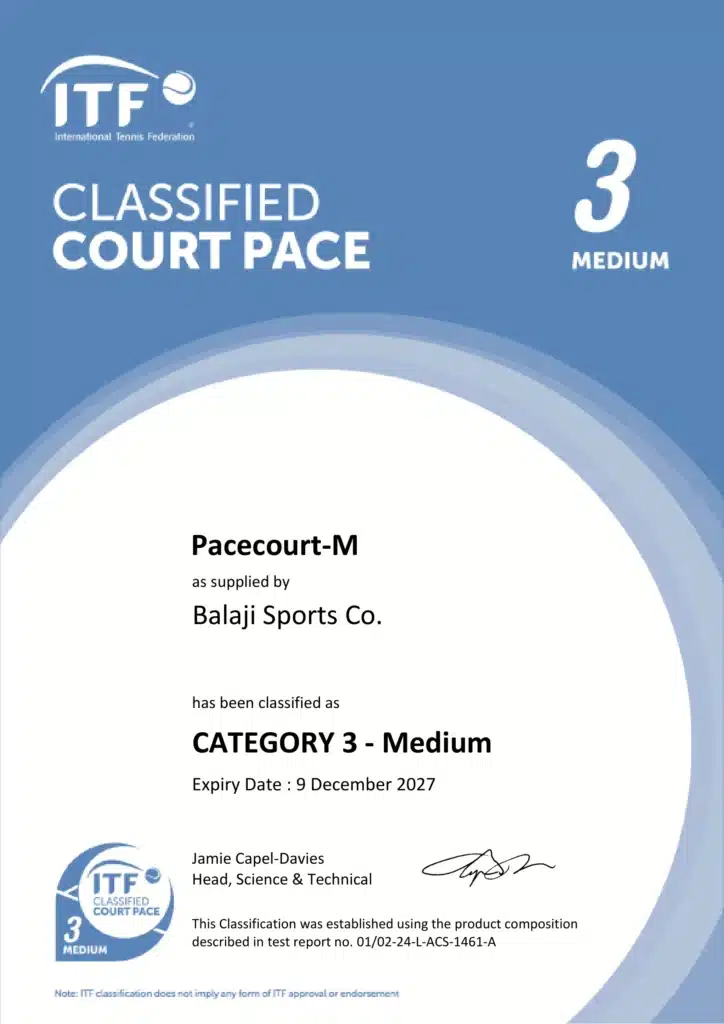
- Is the surface material ITF-classified?
- What maintenance and recoating advice is given?
How to reduce cost without cutting quality
- Use an existing slab if it passes inspection.
- Convert an unused tennis or badminton area.
- Buy surface material directly from a manufacturer. With no minimum order, you can order only what your court needs.
- Plan quantities accurately to avoid waste (the higher coverage from Pacecourt helps here)
- Add fencing and lighting later, but never skip the base.
Ready to Build or Resurface Your Pickleball Court with Pacecourt?
Get acrylic surface material, quantity planning and a quotation for your project.
Pickleball Court Maintenance Tips
- Sweep or blow off leaves and dust regularly.
- Wash with water and a mild cleaner, avoiding harsh chemicals.
- Clear standing water quickly
- Repair small cracks early.
- Check lines and nets every few months.
- Plan recoating when colour fades, or texture wears
A well-built acrylic court usually needs recoating rather than replacement.
Common Pickleball Court Construction Mistakes
- Skipping slope, leading to puddles
- Painting before the base has cured.
- Using non-sports paint instead of an acrylic sports system.
- Ignoring the extra run-off space around the court
- Wrong net height or line measurements
- Choosing only the lowest price
Conclusion
Good pickleball court construction comes down to three things: a properly built base, quality pickleball court flooring and accurate layout. Get those right, and the court will perform for years with basic upkeep.
Frequently Asked Questions (FAQs)
How long does it take to build a pickleball court?
Usually a few weeks. The surface work is quick, but the base needs curing time, and weather can add delays.
Can I convert a tennis court into pickleball courts?
Yes. A tennis court’s overall area can fit up to four pickleball courts, though layout and run-off space should be planned carefully.
Can I build a pickleball court on a terrace?
Yes, but check load capacity and waterproofing first. Interlocking tiles are often preferred because they avoid wet work on the slab.
Do I need lighting?
Only if you plan to play in the evening; plan it early so wiring can be included in the base work.
What is the best time of year to build in India?
The dry season, because moisture and rain affect curing and coating. Avoid monsoon months for surface application.
Can the same surface be used for tennis or badminton?
Yes. Acrylic surfaces can carry multiple line colours for multi-purpose courts.
How long does an acrylic pickleball court last?
It depends on base quality, climate and usage. With maintenance and timely recoating, it can stay playable for many years.
Can I get custom colours for my pickleball court?
Yes. We offer 800+ acrylic court colours in stock, including custom shades, and you can order even a single bucket.
Is there a minimum order for pickleball court surface material?
No. There is no minimum order value, so you can order for one court or many.