Basketball is one of the most widely played sports in the world, from neighborhood playgrounds to massive professional arenas filled with thousands of cheering fans. While the fast-paced gameplay often steals the spotlight, the basketball court measurement itself plays a crucial role in how the game is played. Every line, arc, and boundary has a specific dimension that influences strategies, player movement, and even scoring patterns.
Think of a basketball court like a carefully designed blueprint. Just as architects rely on precise measurements to build a safe structure, basketball organizations depend on standardized court dimensions to maintain fairness and consistency across games. Whether you’re watching the NBA Finals, a college tournament, or a local high school matchup, the court follows strict guidelines set by governing bodies like the NBA, FIBA, and NCAA.
These measurements are not random. The distance from the three-point line, the width of the free-throw lane, and the height of the basketball rim are all carefully calculated to balance skill, athleticism, and strategy. For example, extending the three-point line even slightly can dramatically change offensive tactics, forcing teams to adjust their shooting ranges and spacing.
Understanding basketball court dimensions is valuable for many reasons. Coaches use this knowledge to design effective plays, facility managers rely on it to build regulation courts, and players benefit from knowing how spacing affects their performance. Even casual fans gain a deeper appreciation of the sport when they understand how the layout shapes the game.
This guide explores every important detail about basketball court measurements, including official sizes used in the NBA, FIBA, college, and high school leagues. It also breaks down court markings, hoop dimensions, surface materials, and practical tips for measuring and building a court.
By the time you finish reading, you’ll have a clear understanding of how every inch of a basketball court contributes to the rhythm and excitement of the game.
Understanding Standard Basketball Court Dimensions
When people think about basketball court measurement, they often imagine a large rectangular floor with two hoops at opposite ends. While that description is technically correct, the reality is far more detailed. A standard basketball court includes precise measurements that regulate everything from player positioning to shooting distances.
The most widely recognized court dimension comes from professional leagues such as the NBA and FIBA, where courts are designed to provide enough space for fast-paced gameplay while maintaining competitive balance. In general, a full basketball court is rectangular and divided into two equal halves by the center line. Each half contains identical markings such as the three-point arc, free-throw lane, and key area.
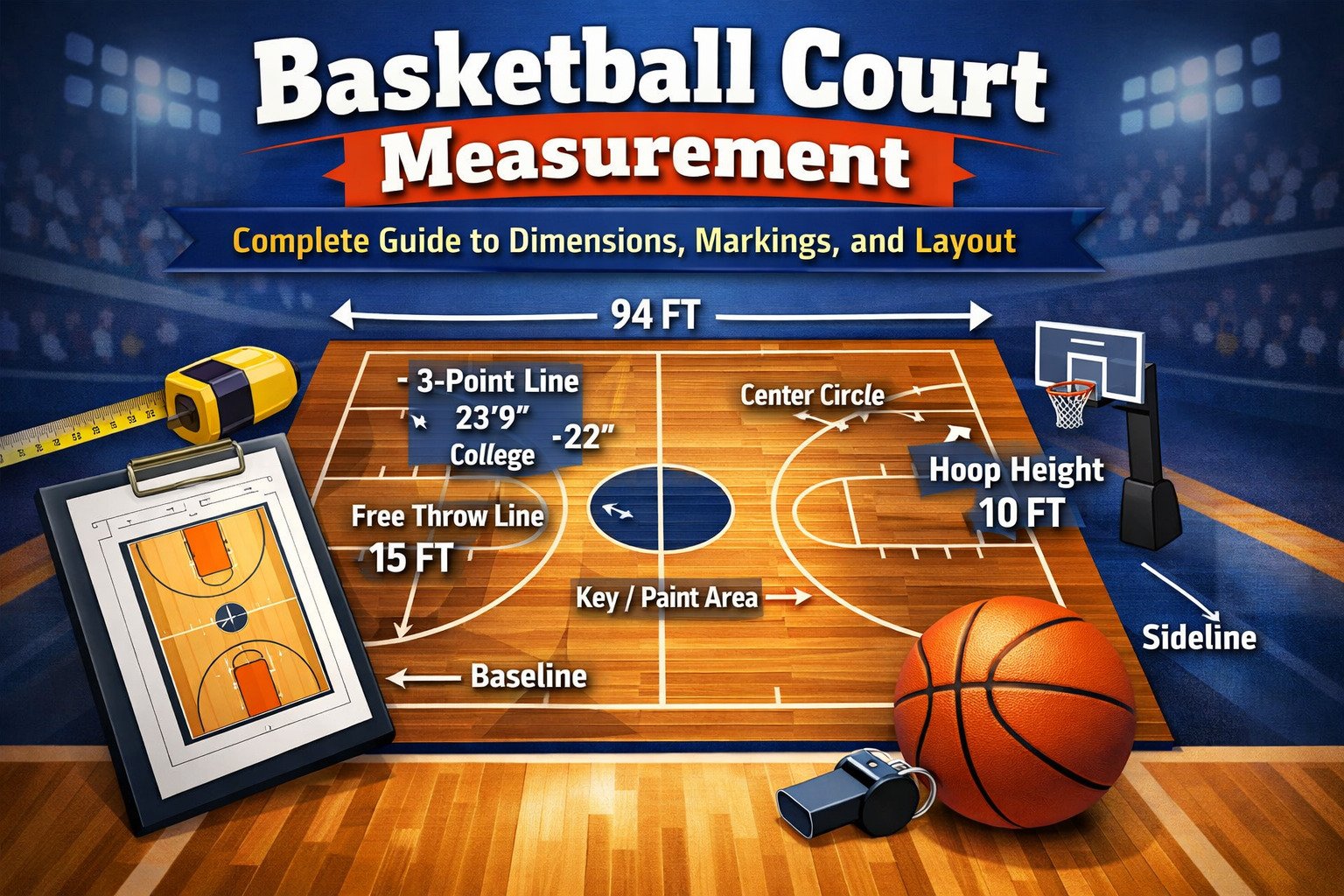
The typical professional basketball court measures 94 feet long and 50 feet wide (28.65 × 15.24 meters) in the NBA. This size allows ten players to move freely while executing offensive and defensive plays without excessive crowding. The length of the court is especially important because it determines transition speed during fast breaks, one of the most thrilling elements of the game.
Beyond the outer boundaries, several internal markings help define gameplay areas. For instance, the center circle marks where the opening tip-off occurs. The three-point arc determines which shots count for three points instead of two. The free-throw lane, often called “the paint,” is where players line up during foul shots.
Here is a quick comparison of typical professional basketball court dimensions:
| League | Court Length | Court Width |
|---|---|---|
| NBA | 94 ft (28.65 m) | 50 ft (15.24 m) |
| FIBA | 28 m (91.9 ft) | 15 m (49.2 ft) |
| NCAA | 94 ft | 50 ft |
| High School | 84 ft | 50 ft |
Even though the differences may seem small, they significantly affect gameplay. For example, FIBA courts are slightly shorter than NBA courts, which can influence defensive spacing and offensive flow.
Another interesting detail is the clearance space around the court. Professional arenas usually include additional out-of-bounds space—often several feet beyond the sidelines and baselines—to protect players when diving for loose balls.
Understanding these dimensions is essential for anyone involved in basketball facility planning, coaching strategy, or sports education. Every measurement contributes to the balance between offense and defense that makes basketball such an exciting sport to watch and play.
NBA Basketball Court Size
The NBA basketball court is considered the global reference point for professional basketball measurements. While other leagues may adopt slightly different standards, the NBA’s dimensions are often viewed as the benchmark for elite-level competition.
An official NBA court measures 94 feet in length and 50 feet in width. These dimensions create a playing surface large enough to support the incredible speed and athleticism of professional players. With athletes capable of sprinting the full court in just a few seconds, the extra length helps maintain spacing and allows for dynamic offensive plays such as fast breaks and transition scoring.
The court is divided exactly in half by the midcourt line, creating two identical playing areas. At the center of this line lies the center circle, which has a diameter of 12 feet. This circle is where the game begins with the opening jump ball, one of the most iconic moments in basketball.
One of the most famous features of the NBA court is the three-point line, which sits farther from the basket compared to most other leagues. In the NBA:
- The three-point arc radius is 23 feet 9 inches (7.24 meters) from the basket at the top of the arc.
- In the corners, the distance shortens to 22 feet (6.7 meters).
This slight difference exists because the court width would otherwise make the corner three excessively long. Interestingly, the corner three has become one of the most strategically valuable shots in modern basketball due to its shorter distance.
The free-throw lane, also known as “the key,” measures 16 feet wide in the NBA. This rectangular area sits directly under the basket and plays a crucial role in rebounding, post moves, and defensive positioning.
Another critical element is the restricted area arc, which sits directly beneath the basket with a radius of 4 feet. Defenders standing inside this arc cannot draw a charging foul, encouraging more aggressive drives to the rim and reducing dangerous collisions.
Altogether, the NBA court layout is carefully designed to balance shooting range, interior play, and defensive strategy. Every measurement—from the three-point arc to the baseline spacing—affects how teams construct offenses and defenses.
For fans watching the game, these dimensions may fade into the background. But for players and coaches, every inch of the NBA court influences decision-making, timing, and tactical execution.
FIBA Basketball Court Size
The FIBA basketball court size represents the international standard used in global competitions such as the Olympics, FIBA World Cup, and many professional leagues outside the United States. While it looks almost identical to an NBA court at first glance, subtle differences in measurements create noticeable changes in gameplay, strategy, and spacing. Understanding these variations is essential for coaches, players, and anyone interested in the global landscape of basketball.
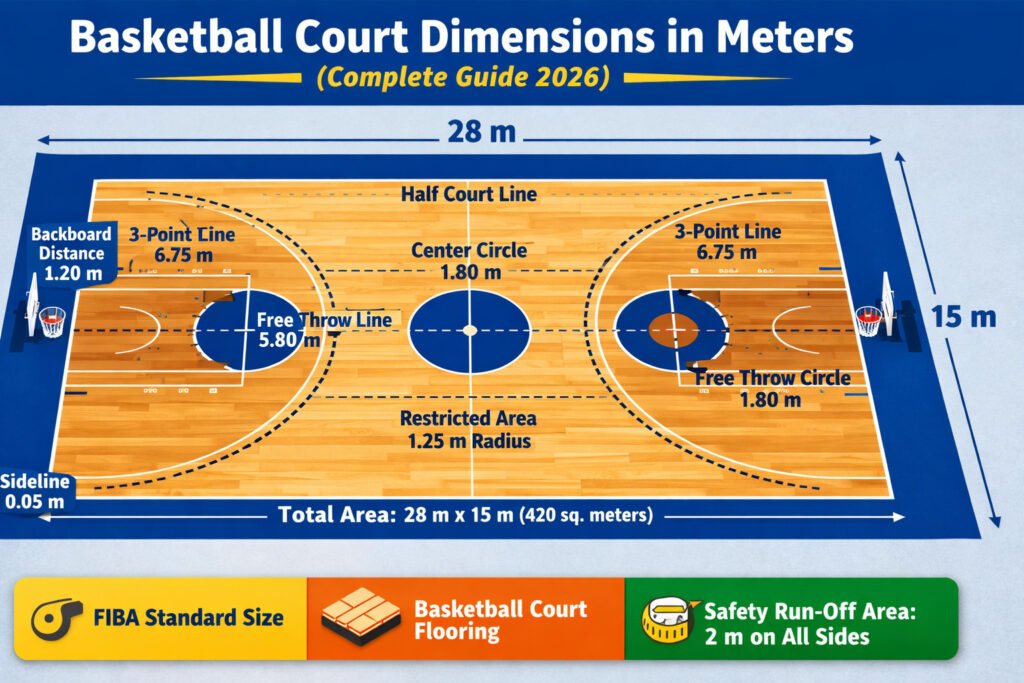
A standard FIBA basketball court measures 28 meters long and 15 meters wide, which converts to approximately 91.9 feet by 49.2 feet. Compared with the NBA’s 94-foot court, the FIBA version is slightly shorter but nearly the same width. Although this difference may seem minor, it has a real impact on how teams operate offensively and defensively. With a shorter playing area, the game often feels faster because teams transition from defense to offense more quickly.
One of the most noticeable distinctions lies in the three-point line distance. In FIBA competitions, the three-point arc is set at 6.75 meters (22.15 feet) from the center of the basket. This is shorter than the NBA’s 23 feet 9 inches distance. Because of this, players who transition from international play to the NBA often need time to adjust their shooting range. At the same time, the shorter arc encourages more perimeter shooting in international games, often increasing scoring opportunities from beyond the arc.
The free-throw lane, commonly known as “the key” or “the paint,” measures 4.9 meters wide (about 16 feet)—essentially the same width as the NBA key. This area is crucial for rebounding battles, defensive positioning, and post play. During free throws, players line up along the sides of the lane according to specific rules governing positioning.
Another important feature is the restricted area arc, located directly under the basket. In FIBA competitions, the restricted arc radius measures 1.25 meters (approximately 4.1 feet) from the center of the hoop. Similar to the NBA rule, defenders inside this arc cannot draw a charging foul, which protects offensive players driving aggressively toward the basket.
The center circle in FIBA basketball has a diameter of 3.6 meters (11.8 feet) and is used for jump balls at the start of the game. However, unlike the NBA, FIBA uses a possession arrow system after the opening tip rather than repeating jump balls for held-ball situations.
Here is a simplified comparison between NBA and FIBA measurements:
| Feature | NBA | FIBA |
|---|---|---|
| Court Length | 94 ft (28.65 m) | 91.9 ft (28 m) |
| Court Width | 50 ft (15.24 m) | 49.2 ft (15 m) |
| Three-Point Line | 23 ft 9 in | 22.15 ft |
| Free Throw Lane | 16 ft | 16 ft |
| Rim Height | 10 ft | 10 ft |
Despite the slight differences, both courts maintain the same fundamental structure and balance between offense and defense. These standardized dimensions ensure that international players can compete globally with minimal adjustments.
High School and College Basketball Court Measurements
Basketball isn’t only played in professional arenas or international tournaments. In fact, the majority of players experience the game at school and collegiate levels, where court dimensions are slightly modified to suit developing athletes and smaller facilities. Understanding high school and college basketball court measurements helps explain how the sport evolves as players progress through different competition levels.
At the college level, particularly in the NCAA (National Collegiate Athletic Association), the basketball court dimensions are nearly identical to the NBA. An NCAA court measures 94 feet long and 50 feet wide, providing the same large playing surface used by professional athletes. This similarity allows college players to transition more easily into professional basketball since they are already accustomed to the court size.
However, there are some differences in markings, particularly the three-point line distance. In men’s NCAA basketball, the three-point arc sits at 22 feet 1.75 inches (6.75 meters), which aligns with the FIBA standard rather than the NBA. Women’s NCAA basketball uses a slightly shorter three-point line at 20 feet 9 inches.
High school courts, governed by organizations such as the National Federation of State High School Associations (NFHS) in the United States, are slightly smaller. A typical high school basketball court measures 84 feet in length and 50 feet in width. The width remains the same as professional courts, but the reduced length helps accommodate school gymnasiums that may have limited space.
The high school three-point line is also shorter, usually measuring 19 feet 9 inches from the basket. This adjustment reflects the skill development stage of younger athletes, allowing them to attempt long-range shots without requiring the same strength and range as professional players.
Here is a comparison table highlighting key differences:
| Level | Court Length | Court Width | Three-Point Line |
|---|---|---|---|
| NBA | 94 ft | 50 ft | 23 ft 9 in |
| NCAA (Men) | 94 ft | 50 ft | 22 ft 1.75 in |
| NCAA (Women) | 94 ft | 50 ft | 20 ft 9 in |
| High School | 84 ft | 50 ft | 19 ft 9 in |
These gradual changes in measurements create a development pathway for players. Younger athletes begin on smaller courts with closer shooting distances, then gradually adapt to the larger professional dimensions as their strength, speed, and skills improve.
Another key difference is the shot clock, which exists in college basketball but often varies in high school leagues depending on state rules. Court size combined with time restrictions shapes the pace of the game and influences offensive strategies.
For coaches and facility planners, understanding these differences ensures that courts meet official regulations while still supporting player development.
NCAA Basketball Court Dimensions
The NCAA basketball court dimensions serve as the official standard for college basketball in the United States. Because the NCAA represents one of the most competitive amateur sports systems in the world, its court measurements are designed to closely resemble professional courts while still maintaining unique characteristics that define the college game.
An NCAA basketball court measures 94 feet in length and 50 feet in width, identical to the NBA’s playing surface. This size creates a spacious environment where players can run complex offensive sets, execute fast breaks, and apply full-court defensive pressure. The larger court also demands strong conditioning, as athletes frequently sprint from end to end throughout the game.
One of the defining features of NCAA basketball is its three-point line distance. In men’s college basketball, the three-point arc is placed 22 feet 1.75 inches from the basket. This distance was updated in 2019 to match the international FIBA standard, helping American college players better prepare for global competitions. Women’s NCAA basketball uses a slightly shorter distance of 20 feet 9 inches, though discussions about standardization continue.
The free-throw line sits 15 feet from the backboard, just like in the NBA and FIBA rules. Players take foul shots from this line after certain types of defensive infractions. Statistically, free throws account for a significant portion of scoring in college basketball. According to NCAA data, many teams score around 20–25% of their total points from free throws, highlighting the importance of accuracy at the line.
The free-throw lane, or key, measures 16 feet wide, forming a rectangular area beneath the basket. This space is crucial for post players who rely on positioning and footwork to score near the rim. Rebounding battles also take place here, making it one of the most physically demanding areas of the court.
Another important feature is the restricted area arc, which has a radius of 4 feet from the center of the hoop. Defensive players standing inside this arc cannot draw a charging foul, encouraging offensive players to attack the basket aggressively.
College courts also include designated areas for team benches, coaching boxes, and media tables, especially in larger arenas hosting nationally televised games. These additional elements transform a simple basketball floor into a fully organized competition environment.
The NCAA court layout plays a crucial role in shaping the unique style of college basketball. Games are often characterized by intense defense, strategic coaching, and emotional crowd energy, all unfolding within the carefully measured boundaries of the court.
High School Basketball Court Dimensions
High school basketball is where many athletes first experience organized competition, structured coaching, and the excitement of playing in front of a crowd. Because schools vary widely in facility size and available space, high school basketball court dimensions are slightly smaller than those used in professional or college basketball. These adjustments ensure that the game remains accessible while still maintaining official standards.
A regulation high school basketball court measures 84 feet long and 50 feet wide. While the width remains identical to NCAA and NBA courts, the length is 10 feet shorter than a college or professional court. This reduction allows schools to fit courts into standard gymnasiums without sacrificing safety or gameplay quality.
Despite the shorter court length, most key markings remain very similar to higher-level courts. The free-throw line is still positioned 15 feet from the backboard, and the basketball rim height remains 10 feet above the floor. These consistent measurements help young athletes develop shooting mechanics that will translate smoothly to higher levels of play.
One of the biggest differences lies in the three-point line distance, which measures 19 feet 9 inches in high school basketball. This shorter arc reflects the developmental stage of most players, who may not yet have the strength or consistency required to shoot from professional distances. As players mature physically and improve their shooting technique, they gradually adapt to longer ranges in college or professional leagues.
The free-throw lane, or key, typically measures 12 feet wide in many high school competitions, though some newer courts adopt the 16-foot lane used at higher levels. The narrower lane can slightly affect post play and rebounding strategies, often leading to crowded action near the basket.
High school courts also emphasize safety and flexibility. Many gymnasiums double as multipurpose spaces used for volleyball, assemblies, and other sports. As a result, courts often include additional lines for different activities, creating the colorful multi-line floors commonly seen in school gyms.
Here’s a quick summary of high school court measurements:
| Feature | Measurement |
|---|---|
| Court Length | 84 ft |
| Court Width | 50 ft |
| Rim Height | 10 ft |
| Free Throw Distance | 15 ft |
| Three-Point Line | 19 ft 9 in |
These dimensions create an environment where players can learn fundamentals, develop teamwork, and gradually build the skills needed for higher-level competition.
Key Basketball Court Markings Explained
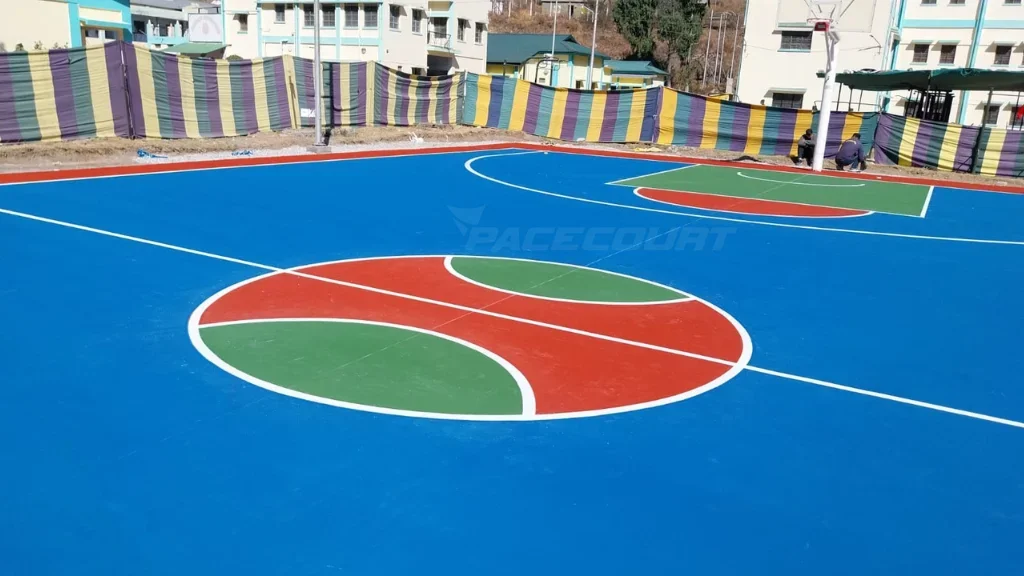
When you step onto a basketball court, the painted lines and arcs might look like simple decorations at first glance. In reality, every marking has a specific rule-based purpose that controls how the game is played. These lines define scoring zones, player positioning, and even certain violations. Without them, basketball would quickly become chaotic, with no structure guiding movement or strategy.
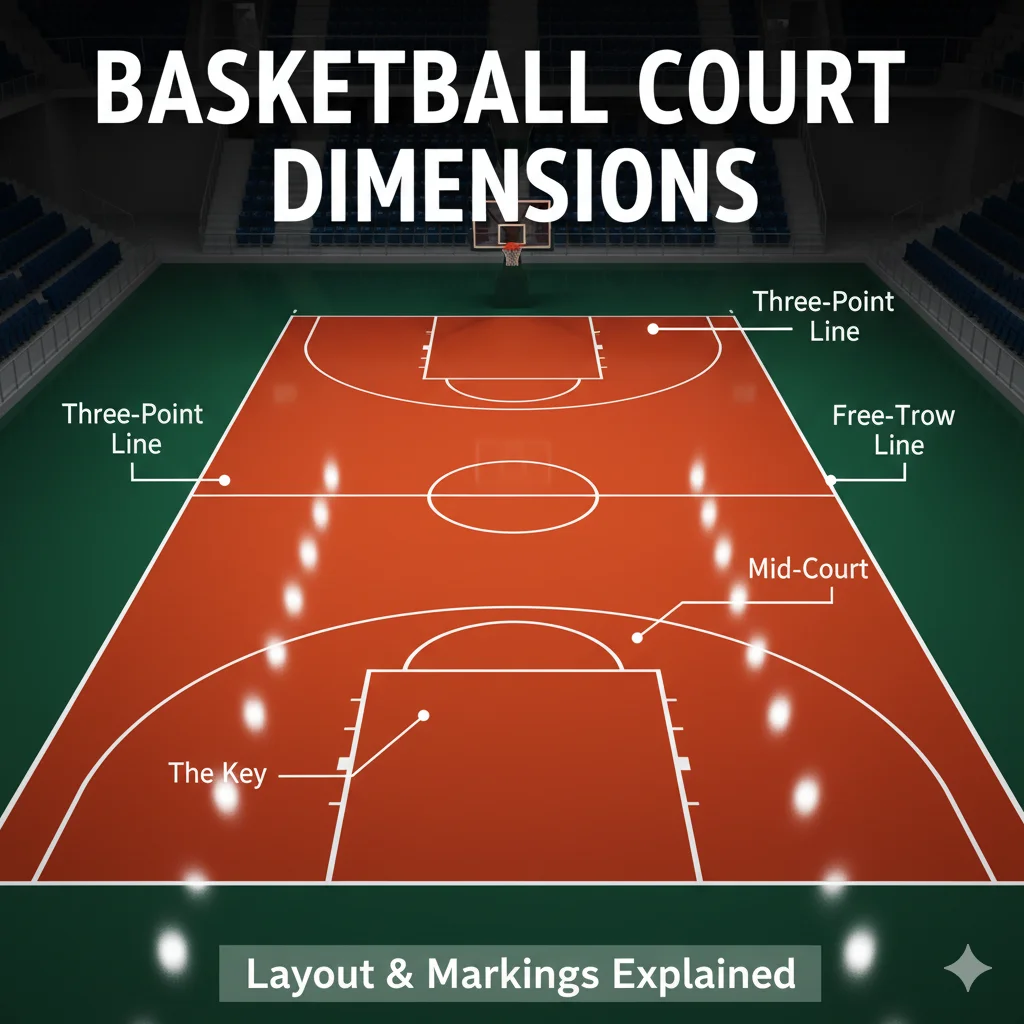
The main markings found on nearly every basketball court include the center line, center circle, free-throw lane (the key), three-point arc, sidelines, baselines, and restricted area arc. Together, these markings divide the court into different functional zones that influence how players attack, defend, and position themselves during a game.
The sidelines and baselines form the outer boundary of the court. When the ball crosses these lines, it is considered out of bounds. The sidelines run along the longer edges of the court, while the baselines sit behind each basket. These boundaries might seem simple, but they play a huge role in controlling possession and preventing players from gaining unfair advantages by stepping outside the playing area.
At the center of the court lies the midcourt line, which divides the playing surface into two equal halves. Once an offensive team crosses this line, they must remain in the frontcourt or risk committing a backcourt violation. This rule prevents teams from repeatedly retreating to avoid defensive pressure.
Another critical marking is the free-throw lane, often called “the paint.” This rectangular area sits directly beneath the basket and is the site of intense physical battles for rebounds and close-range shots. During free throws, players must line up along the lane lines in designated spaces.
Then there’s the three-point line, which revolutionized basketball strategy. Any shot taken from behind this arc counts for three points instead of two, rewarding long-range accuracy and spacing the floor for offensive plays.
Many courts also include a restricted area arc beneath the basket. This semicircle prevents defenders from drawing offensive fouls while standing directly under the rim, making drives to the basket safer and more dynamic.
These markings collectively transform a plain hardwood floor into a precisely structured competitive environment. Coaches design plays around them, referees enforce rules using them, and players constantly adjust their positioning based on them.
Understanding these markings allows fans and athletes to see the game differently. What once looked like random lines suddenly becomes a strategic map guiding every movement on the court.
Center Circle
The center circle is one of the most recognizable features on a basketball court. Positioned exactly at the midpoint of the court, this circular marking serves as the starting point for the game and symbolizes the moment when competition officially begins.
On most professional and international courts, the center circle has a diameter of 12 feet (3.6 meters). It sits directly on the midcourt line, dividing the playing surface into two equal halves. At the start of the game, two opposing players stand inside this circle for the opening jump ball.
During the jump ball, the referee tosses the ball straight upward between the two players. Each player attempts to tap the ball toward a teammate, initiating the first possession of the game. This dramatic moment often sets the tone for the entire match. Teams with taller or more athletic centers sometimes gain an early advantage by controlling the tip.
After the opening jump ball, most leagues—including FIBA and the NCAA—use a possession arrow system to determine which team gets the ball during held-ball situations. However, the center circle still remains an important visual landmark for players navigating the court.
The circle also plays a role in spacing and offensive organization. When teams bring the ball up the court, the point guard often dribbles near the center circle before initiating plays. This position allows the offense to spread out, creating space for passing lanes and cutting movements.
From a design perspective, the center circle often becomes a visual centerpiece for team branding. Many arenas feature team logos or custom graphics inside the circle, turning it into a focal point for television broadcasts and fan engagement. Think about iconic courts like the Boston Celtics’ parquet floor or the Los Angeles Lakers’ center logo—these designs become part of a team’s identity.
Even though it only occupies a small portion of the court, the center circle plays a symbolic and practical role in basketball. It represents the beginning of competition, acts as a strategic positioning area, and often serves as the artistic centerpiece of the playing surface.
Three-Point Line
Few innovations have changed basketball strategy as dramatically as the three-point line. Introduced to professional basketball in the late 1970s, this arc transformed the way teams attack the basket and forced defenses to adapt to a new era of long-range shooting.
The three-point line forms a large semicircle around the basket. Any shot taken from behind this arc counts for three points, while shots taken inside the line count for two. This simple rule created an entirely new dimension of scoring, encouraging players to develop deep shooting range.
The exact distance of the three-point line varies depending on the league:
| League | Three-Point Distance |
|---|---|
| NBA | 23 ft 9 in (top of arc) |
| FIBA | 22.15 ft |
| NCAA Men | 22 ft 1.75 in |
| High School | 19 ft 9 in |
Another interesting feature is the corner three-point line, which is shorter than the arc at the top of the key. Because the court is rectangular, the arc must flatten near the corners. In the NBA, corner threes measure 22 feet from the basket, making them one of the most efficient shots in modern basketball.
The three-point line has completely reshaped the sport. Teams now prioritize floor spacing, placing multiple shooters around the perimeter to stretch defenses. This strategy opens driving lanes for players attacking the rim and creates more opportunities for passing and ball movement.
Statistical analysis has also played a role in this evolution. Data shows that a successful three-point shot often produces more points per attempt than a mid-range shot. As a result, many teams encourage players to focus on either three-point shots or shots close to the basket, reducing mid-range attempts.
Players like Stephen Curry, Damian Lillard, and Klay Thompson have pushed the boundaries of three-point shooting, regularly scoring from distances once considered unrealistic. Their success has influenced younger players worldwide, making long-range shooting a fundamental skill in modern basketball.
The three-point line isn’t just a scoring rule—it’s a strategic tool that reshaped basketball into a faster, more perimeter-oriented game.
Free Throw Line and Key (The Paint)
The free throw line and key, often referred to as “the paint,” represent one of the most physically intense areas on the basketball court. Located directly in front of the basket, this rectangular zone is where players battle for rebounds, execute post moves, and line up during free throws.
The free throw line sits exactly 15 feet from the backboard and marks the spot where players take uncontested shots after certain fouls. Each successful free throw is worth one point, and while it might seem simple, the pressure of these shots can be enormous—especially during close games.
Statistically, free throws play a huge role in basketball scoring. Many professional teams average 20 to 25 free throw attempts per game, meaning accuracy at the line can significantly affect the final result.
Surrounding the free throw line is the key, a painted rectangular area extending from the baseline to the free throw line. In the NBA and NCAA, the key measures 16 feet wide, while some high school courts use a narrower 12-foot lane.
The key serves several purposes:
- It determines player positioning during free throws.
- It restricts offensive players from staying inside too long (the three-second violation).
- It creates a designated zone for rebounding and interior scoring.
Because the key is often painted a different color than the rest of the court, it visually stands out—hence the nickname “the paint.”
This area is dominated by centers and power forwards, players known for their size and physical strength. They use footwork, body positioning, and timing to score close to the basket or grab rebounds after missed shots.
From a strategic perspective, controlling the paint often determines which team wins the rebounding battle. Coaches frequently emphasize “protecting the paint” on defense, ensuring opponents cannot score easily near the rim.
The free throw line and key together form the heart of interior basketball, where strength, skill, and positioning collide in every possession.
Basketball Hoop and Backboard Measurements
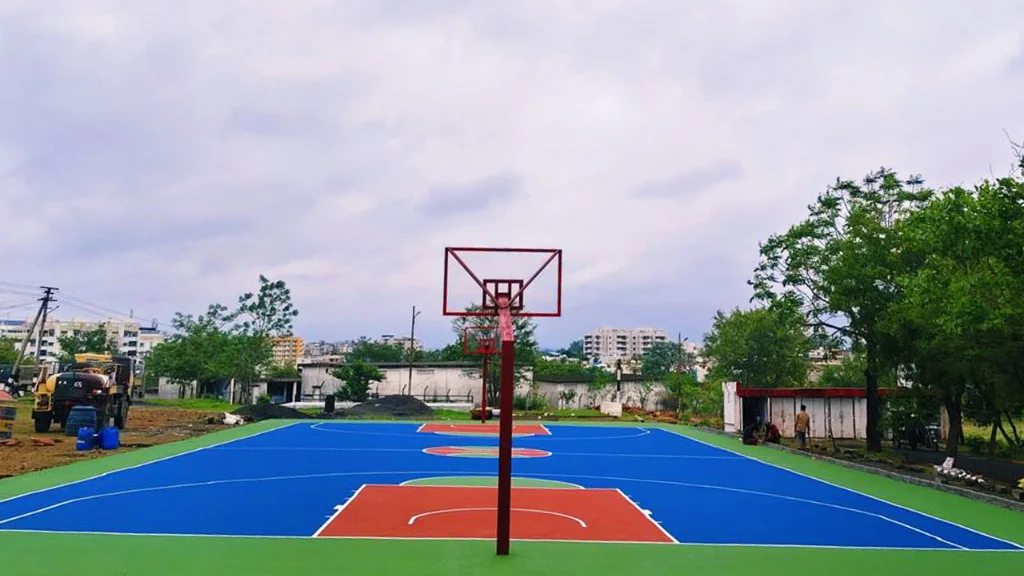
While court lines guide movement, the basketball hoop and backboard measurements define the ultimate objective of the game: scoring. Every shot, pass, and rebound revolves around this structure. Because of its importance, basketball governing bodies enforce extremely strict standards regarding the size and placement of the hoop and backboard.
The most famous measurement in basketball is the rim height, which is exactly 10 feet (3.05 meters) above the floor. This height has remained unchanged since the sport was invented by Dr. James Naismith in 1891. Despite dramatic improvements in athleticism and player height over the decades, the 10-foot rim continues to challenge players while allowing spectacular dunks and acrobatic finishes.
The rim itself has a diameter of 18 inches (45.7 cm). This size is only slightly larger than the basketball, which has a circumference of about 29.5 inches in the NBA. The narrow margin means shooters must aim with precision to score consistently.
Attached behind the rim is the backboard, a rectangular board that allows players to bank shots into the basket. Standard professional backboards measure 6 feet wide and 3.5 feet tall. At the center of the backboard is a white rectangle, often called the shooter’s square, which helps players aim bank shots more accurately.
The backboard sits 4 feet inside the baseline, ensuring players have enough space to move behind the basket without colliding with the structure.
Modern hoops also include breakaway rims, which flex downward when players dunk. This design reduces stress on the backboard and prevents injuries caused by rigid rims.
Together, the rim and backboard form the focal point of every basketball court. Every offensive strategy ultimately aims to place the ball through that 18-inch circle suspended 10 feet in the air—a deceptively simple target that has defined basketball for more than a century.
Basketball Court Layout and Zones
A basketball court is far more than a rectangle with two baskets. Its design creates a structured environment where different zones influence strategy, movement, and scoring opportunities. Understanding the basketball court layout and zones allows players, coaches, and fans to better appreciate how the game flows from one end to the other.
The court is divided into two main halves by the midcourt line. Each half includes identical markings such as the key, three-point arc, and baseline. During gameplay, teams alternate between these halves depending on whether they are attacking or defending. Once a team crosses the midcourt line with the ball, they must remain in the frontcourt or risk committing a backcourt violation, which results in a turnover.
Inside each half-court, several functional zones guide player behavior. The perimeter area, which lies outside the three-point arc, is where guards and shooters often operate. This space allows teams to stretch defenses and create passing lanes. With the rise of analytics-driven basketball, perimeter play has become increasingly important because three-point shots generate higher scoring efficiency when executed well.
Closer to the basket lies the mid-range area, the space between the paint and the three-point line. This zone was once the centerpiece of offensive basketball, dominated by players known for pull-up jump shots. While modern offenses rely more heavily on threes and layups, the mid-range shot still plays a critical role, especially when defenses guard the perimeter aggressively.
The paint, located directly under the basket, is another crucial zone. This area is typically controlled by taller players such as centers and power forwards. Inside the paint, players compete for rebounds, attempt hook shots, and execute close-range finishes. Because scoring chances are highest near the rim, defending the paint is often the top priority for defensive strategies.
Beyond the playing surface, professional courts also include out-of-bounds buffer zones for player safety. These areas provide extra space around the sidelines and baselines so athletes can chase loose balls without colliding with spectators or equipment.
The basketball court layout essentially acts as a strategic map. Coaches design offensive plays based on how players move between zones, while defenders adjust their positioning to limit high-percentage shots. Every possession becomes a dynamic puzzle of spacing, timing, and positioning across these zones.
When you start viewing the court this way, basketball becomes less about random movement and more like a carefully orchestrated dance, with each zone guiding how players interact with the space around them.
Offensive and Defensive Zones
Within the broader court layout, basketball is fundamentally structured around two primary zones: the offensive zone (frontcourt) and the defensive zone (backcourt). These zones determine how teams organize their strategies depending on whether they have possession of the ball or are trying to stop the opponent from scoring.
The offensive zone, also called the frontcourt, is the half of the court where a team attempts to score. Once the ball crosses the midcourt line into this area, the offensive team must keep it there until the possession ends. If the offense accidentally passes or dribbles the ball back into the backcourt, referees call a backcourt violation, resulting in a turnover.
Within the offensive zone, players usually spread out to maximize spacing. Guards often position themselves around the three-point line to create shooting opportunities, while forwards and centers operate closer to the basket. This distribution helps stretch the defense and opens passing lanes.
Modern offensive systems commonly rely on concepts such as:
- Pick-and-roll plays near the top of the key
- Corner three-point shooting from the perimeter
- Post-up moves inside the paint
- Cutting and off-ball movement to create open shots
Each of these tactics uses specific areas of the court to exploit defensive weaknesses.
The defensive zone, also known as the backcourt, is where a team focuses on preventing the opponent from advancing the ball. When the opposing team gains possession, defenders may apply pressure here to slow the offense before it reaches the frontcourt.
Teams often use defensive strategies like full-court press, where defenders attempt to trap ball handlers in the backcourt. This aggressive tactic can force turnovers and disrupt the opposing team’s rhythm.
As the offense moves into the frontcourt, defenders shift their positioning to protect high-value areas such as the paint and three-point line. Some teams prefer man-to-man defense, where each player guards a specific opponent. Others rely on zone defense, where players protect designated areas of the court.
These offensive and defensive zones create a constant strategic battle. Every possession becomes a test of spacing, decision-making, and teamwork as players transition rapidly between attacking and defending.
Restricted Area Arc
The restricted area arc is a small but extremely important marking located directly beneath the basketball hoop. While it may seem like just another curved line on the court, this arc plays a crucial role in maintaining player safety and fair play during drives to the basket.
The restricted area forms a semicircle under the rim with a radius of 4 feet in the NBA and NCAA, measured from the center of the basket. In FIBA competitions, the arc is slightly different but serves the same purpose. The rule associated with this arc prevents defenders from drawing a charging foul if they are standing inside the restricted area.
Before this rule existed, defenders could position themselves directly under the basket and attempt to draw offensive fouls whenever an attacking player drove toward the rim. This often resulted in dangerous collisions between players moving at high speeds. The restricted arc rule was introduced to reduce these risky situations.
Here’s how it works: if a defender is standing inside the restricted area arc when contact occurs with an offensive player driving toward the basket, the referee cannot call a charge. Instead, the defender must establish legal guarding position outside the arc to draw that offensive foul.
This rule encourages offensive players to attack the basket more aggressively, knowing that defenders cannot simply wait underneath the rim to absorb contact. As a result, the game becomes more exciting, with more dunks, layups, and athletic finishes near the basket.
The restricted area also influences defensive strategy. Coaches train players to step just outside the arc when attempting to take a charge. Positioning becomes critical—being a few inches too close to the basket can completely change the referee’s decision.
In many ways, the restricted area arc represents the balance between offense and defense. It protects players, encourages aggressive scoring attempts, and ensures that defensive positioning remains skill-based rather than purely opportunistic.
Court Surface and Flooring Specifications

The surface of a basketball court is just as important as its measurements and markings. A well-designed playing surface affects everything from player safety and ball bounce to overall game performance. Whether the court is indoors or outdoors, specific materials are chosen to provide durability, traction, and consistent ball response.
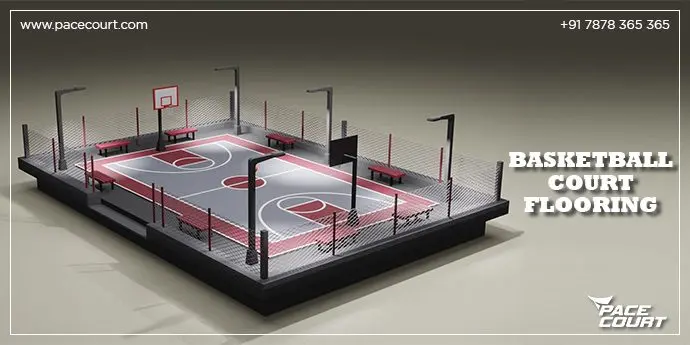
Most professional indoor basketball courts are made from hardwood flooring, particularly maple wood. Maple is widely used because it has a dense grain pattern that resists splintering and provides a smooth, uniform surface. This type of wood also offers excellent ball bounce and allows players to move quickly without excessive slipping.
A typical NBA court consists of multiple layers of wooden boards installed over a subfloor system. Beneath the hardwood surface are shock-absorbing materials designed to reduce the impact on players’ joints. Considering that professional players frequently jump, sprint, and change direction rapidly, this cushioning helps prevent injuries over the course of long seasons.
The surface is also coated with a protective polyurethane finish, which adds durability while maintaining the right amount of traction. Too much friction could cause players to stick to the floor, while too little would make the court dangerously slippery.
Outdoor courts, on the other hand, use completely different materials. Because they are exposed to weather conditions such as rain, sunlight, and temperature changes, outdoor courts are typically constructed from asphalt or concrete. These materials are extremely durable but can be harder on players’ bodies compared to indoor hardwood floors.
To improve safety, many outdoor courts include acrylic sports coatings. These coatings add color, improve grip, and protect the surface from cracking or fading over time.
Lighting also plays a major role in court design. Professional arenas use high-intensity overhead lighting systems that eliminate shadows and ensure players can clearly track the ball.
Even though fans often focus on the action above the floor, the surface itself is a carefully engineered component of basketball. The right flooring ensures that the game remains fast, safe, and consistent, whether it’s played in a neighborhood park or a world-class arena.
Differences Between Professional, College, and Youth Courts
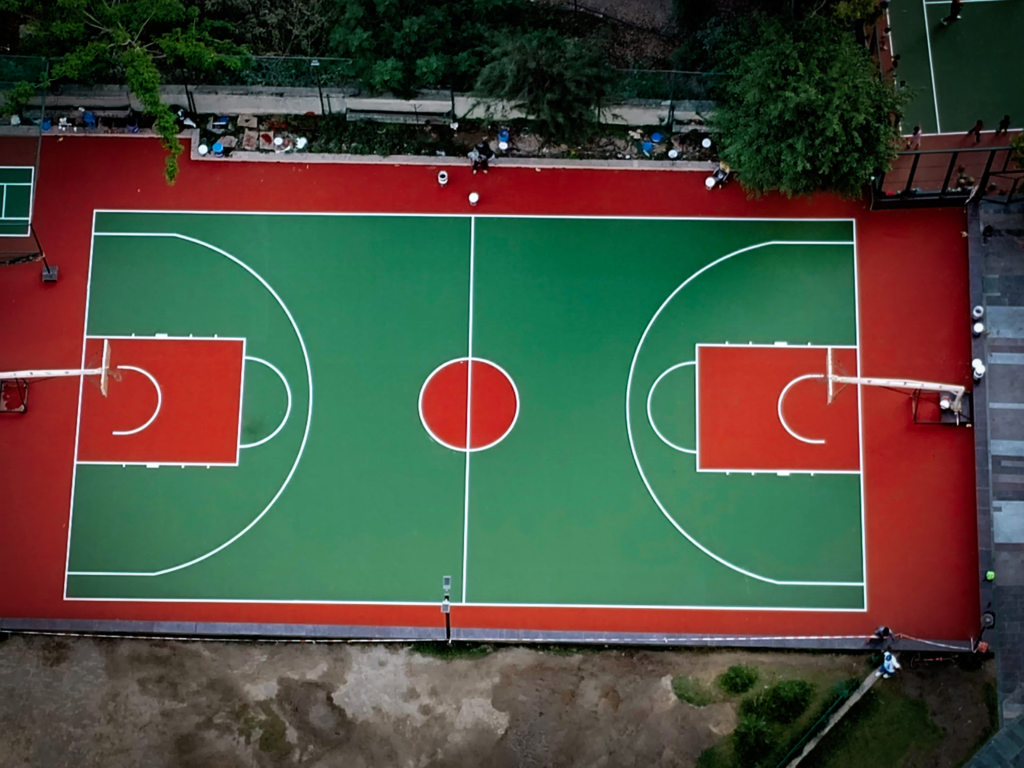
Basketball courts may look similar at first glance, but there are meaningful differences between professional, college, and youth court dimensions. These variations exist to accommodate differences in player age, physical ability, and competitive level.
Professional leagues such as the NBA use the largest courts, measuring 94 feet by 50 feet. These dimensions provide enough space for elite athletes who possess exceptional speed, strength, and shooting range.
College courts, particularly in the NCAA, share the same overall dimensions but may differ slightly in line markings such as the three-point arc. This similarity helps college players transition more easily into professional basketball.
Youth courts are often scaled down to support skill development. Younger players may use shorter court lengths, lower hoop heights, or smaller basketballs. For example, many youth leagues lower the rim to 8 or 9 feet to help children develop proper shooting techniques.
These adjustments ensure that the game remains enjoyable and accessible while still preparing players for the official dimensions used at higher levels.
How to Measure and Mark a Basketball Court
Building a basketball court requires careful planning and precise measurement. The process begins by identifying a flat rectangular area large enough to accommodate the court dimensions and surrounding safety space.
The first step is marking the outer boundaries, which determine the overall length and width of the court. After establishing these boundaries, installers measure and mark the midcourt line exactly halfway between the baselines.
Next, they add the center circle, followed by the free-throw lane, three-point arc, and restricted area arc. Each marking must be measured from the correct reference points, usually the center of the basket.
Specialized equipment such as measuring tapes, laser levels, and chalk lines helps ensure accuracy. Even small measurement errors could affect gameplay, especially when it comes to shooting distances.
Once the markings are complete, painters apply durable sports paint designed to withstand heavy foot traffic and repeated cleaning.
Common Mistakes When Designing a Basketball Court
Designing a basketball court might seem straightforward, but several common mistakes can affect gameplay and safety. One frequent issue is incorrect measurement of the three-point line, which can significantly change the difficulty of long-range shots.
Another mistake involves insufficient out-of-bounds space. Without proper buffer zones around the court, players risk colliding with walls or spectators when chasing loose balls.
Improper flooring materials can also cause problems. Using surfaces that are too slippery or too rough may increase injury risk.
Lighting, drainage (for outdoor courts), and hoop placement are other factors that must be carefully considered during the design process.
Avoiding these mistakes ensures that the finished court meets official standards and provides a safe environment for players.
Conclusion
Basketball may appear simple—just a ball, a hoop, and a rectangular court—but the measurements and layout of the court are carefully designed to shape every aspect of the game. From the overall dimensions to the smallest markings, each element contributes to the rhythm, fairness, and excitement that define basketball.
Professional leagues like the NBA use larger courts and longer three-point lines to challenge elite athletes, while high school and youth courts are slightly smaller to support player development. At the same time, features such as the free-throw lane, restricted area arc, and three-point line influence offensive and defensive strategies across all levels of play.
Understanding basketball court measurements provides a deeper appreciation of the sport. What once looked like simple painted lines becomes a strategic framework guiding movement, spacing, and scoring opportunities.
Whether you’re a player, coach, facility designer, or passionate fan, knowing the dimensions and purpose behind each part of the court allows you to see basketball from a completely new perspective.