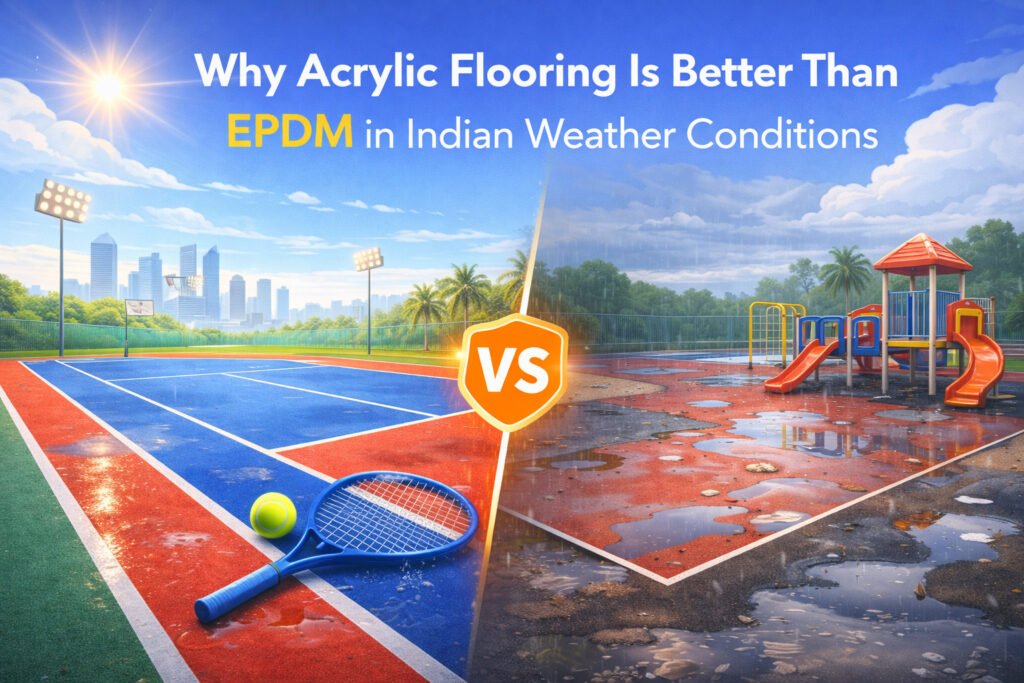
Why Acrylic Flooring Is Better Than EPDM in Indian Weather Conditions
When it comes to outdoor sports flooring in India, the weather isn’t just a background detail—it’s the main character. From scorching summers that can fry an egg on a metal surface to relentless monsoons that flood streets overnight, Indian climate conditions are intense, unpredictable, and often unforgiving. That’s exactly why Acrylic Flooring Is Better Than EPDM in such demanding environments. If you’re planning to build a tennis court, basketball court, skating rink, or multi-sport arena, the flooring choice you make isn’t just about appearance—it’s about survival. Two of the most popular options in the Indian market today are Acrylic Flooring VS EPDM (Ethylene Propylene Diene Monomer) Flooring. At first glance, both look impressive. Both promise durability. Both are marketed as ideal for sports surfaces. But here’s the real question: which one truly performs better under Indian weather conditions? Let’s think practically. In cities like Delhi, temperatures can cross 45°C in summer. In Mumbai or Chennai, humidity levels remain high almost all year. In Kerala and the Northeast, heavy rainfall is routine. Flooring that works perfectly in mild European climates may struggle in India’s aggressive environment. Acrylic flooring has steadily gained popularity across India, especially in schools, sports complexes, and residential communities. Why? Because it adapts better. It handles UV rays more efficiently. It dries faster after rain. It maintains color and texture even after years of sun exposure. EPDM, while useful in certain environments, often faces challenges under prolonged heat and heavy rainfall common in India. In this article, we’ll break down every critical factor—heat resistance, monsoon durability, maintenance, cost, safety, and long-term performance. By the end, you’ll clearly understand why acrylic flooring consistently proves to be the smarter, more weather-resilient choice for Indian conditions. Let’s dive deeper. Understanding Indian Weather Conditions India isn’t just one climate—it’s a collection of extremes. From desert-like heat in Rajasthan to coastal humidity in Goa, and from heavy monsoon zones in Kerala to cold winters in North India, flooring materials must endure a wide spectrum of environmental stress. Ignoring these realities can lead to costly repairs and premature surface failure. Let’s break down the major weather challenges that outdoor flooring faces in India. Extreme Heat and UV Exposure Indian summers are not mild. They are intense, prolonged, and often brutal. In northern and central regions, surface temperatures can rise dramatically under direct sunlight. UV radiation levels are also significantly high for extended periods of the year. Under such conditions, flooring materials can: Acrylic flooring is designed with UV-stable pigments and coatings that resist fading and degradation. EPDM, while somewhat UV resistant, can gradually harden or lose flexibility under consistent high temperatures. Think of it like sunscreen. Acrylic has a stronger protective layer against the sun’s harsh rays. Heavy Monsoon and Waterlogging India’s monsoon season is beautiful—but merciless. Sudden heavy rainfall can flood courts within minutes. Poor drainage combined with absorbent materials can cause swelling, surface lifting, and mold growth. Acrylic flooring is non-porous and dries quickly when properly installed over concrete or asphalt. EPDM surfaces, especially when used in certain installation formats, can trap moisture beneath layers, leading to long-term damage. Humidity and Moisture Challenges Coastal cities like Mumbai, Chennai, and Kolkata experience high humidity throughout the year. Moisture in the air continuously interacts with surface materials. Materials that absorb or retain moisture tend to degrade faster. Acrylic coatings are designed to resist moisture penetration, making them more suitable for humid climates. Dust, Pollution, and Temperature Fluctuations Indian cities deal with heavy dust and pollution. Add to that the temperature shift between scorching days and cooler nights. These constant expansions and contractions stress flooring materials. Acrylic systems are flexible enough to adapt to these micro-movements without cracking. In short, Indian weather is demanding. Flooring must be heat-resistant, water-resistant, UV-stable, and durable under constant stress. As we move forward, you’ll see why acrylic flooring aligns more closely with these requirements. What Is Acrylic Flooring? Before comparing, it’s important to understand what acrylic flooring actually is and why it has become a preferred option for outdoor sports surfaces across India. Acrylic flooring is a multi-layered synthetic surface system primarily used for sports courts. It is typically applied over a concrete or asphalt base and consists of several layers including primer, cushion (optional), base coat, and topcoat. But what makes it special? Composition and Material Structure Acrylic flooring is made using acrylic resins combined with silica sand and specialized pigments. These components work together to create a surface that is: Unlike rubber-based systems, acrylic coatings bond tightly with the base surface, forming a seamless and durable layer. Common Applications in India Across India, acrylic flooring is widely used in: Its popularity comes from its balance of performance, durability, and cost-effectiveness. Key Performance Features Acrylic flooring stands out because it offers: It’s like a reliable all-rounder in cricket—it may not always grab headlines, but it consistently performs under pressure. Most importantly, acrylic systems can be customized with cushioned layers for added shock absorption. This makes them suitable for professional-level play while still being practical for schools and recreational areas. As we move forward, we’ll compare this directly with EPDM to understand where the real differences lie. What Is EPDM Flooring? Before we continue the comparison, let’s clearly understand what EPDM flooring actually is. EPDM stands for Ethylene Propylene Diene Monomer—a type of synthetic rubber widely used in construction, playgrounds, and certain sports surfaces. At first glance, EPDM looks colorful, soft, and highly durable. It has a rubbery texture and is often associated with children’s play areas because of its shock-absorbing qualities. But is it truly ideal for Indian outdoor weather? Let’s break it down carefully. Composition and Material Structure EPDM flooring is made from synthetic rubber granules mixed with a polyurethane binder. These granules are typically installed over a concrete or asphalt base, and sometimes over a shock pad layer. The rubber particles are bonded together to create a seamless surface. The structure usually includes: The flexibility of rubber is what gives EPDM its cushioning effect. However,