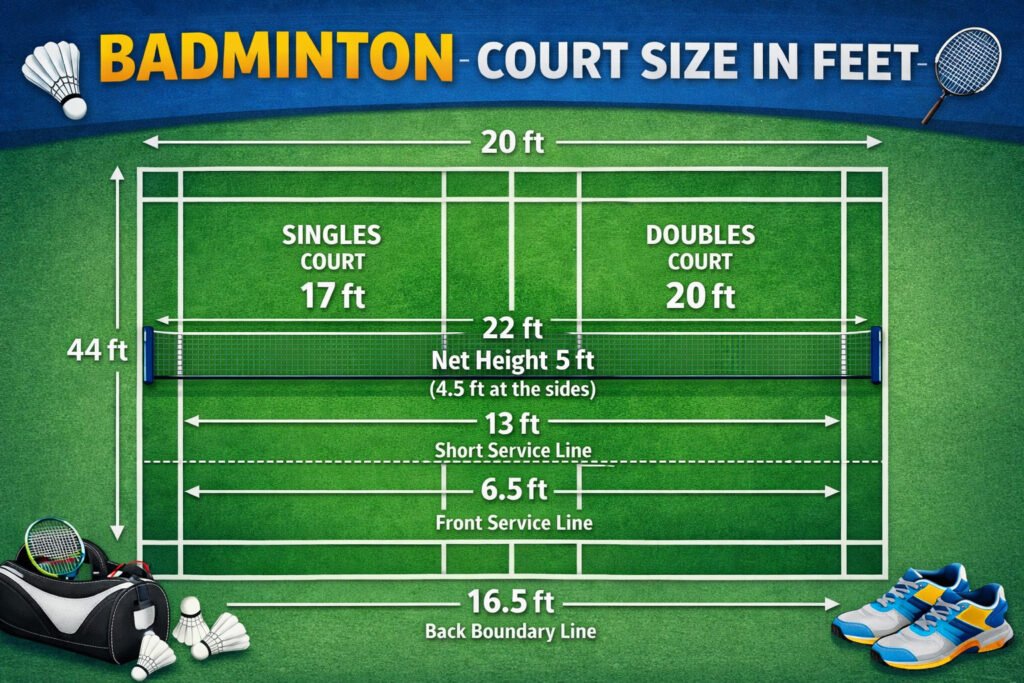
Badminton Court Size in Feet
Badminton might look like a simple backyard sport when people casually rally a shuttlecock over a net, but the official game is built around extremely precise measurements. The badminton court size in feet follows strict standards defined by the Badminton World Federation (BWF), and these measurements ensure fairness, consistency, and competitive balance in tournaments around the world. Whether you are setting up a court at home, marking lines in a school gym, or simply trying to understand the rules of the sport better, knowing the exact court dimensions is essential. A standard badminton court is rectangular and divided into different zones by a series of lines. Each line has a specific function, such as defining service areas, singles boundaries, and doubles boundaries. The fascinating part is that singles and doubles matches actually use slightly different court widths, even though the overall court is marked on the same surface. That means one court accommodates both game formats simply by using different boundary lines. If you have ever watched professional badminton, you may have noticed players hitting incredibly precise shots that land just inches inside a line. Those lines matter because every foot and inch of the court is carefully designed to influence gameplay strategy. A deeper court allows for long clears, while narrower singles sidelines encourage precision and tactical placement. Another interesting detail is that badminton courts must maintain consistent proportions regardless of location. From Olympic arenas to community recreation centers, the standard badminton court size remains 44 feet long. This uniformity allows athletes to compete anywhere without needing to adapt to new court dimensions. This guide explores everything you need to know about badminton court dimensions in feet, including singles and doubles measurements, line markings, net height, service zones, and recommended space around the court. By the end, you will have a clear picture of how a badminton court is structured and how each measurement affects gameplay strategy. Understanding the Standard Badminton Court Dimensions A badminton court may appear simple at first glance, but its design is carefully structured to support the fast-paced nature of the sport. Every measurement—from the total court length to the spacing of service lines—has been standardized by the Badminton World Federation (BWF). These regulations ensure that matches played in local gyms follow the same dimensions used in international championships. The overall badminton court size in feet is 44 feet long and 20 feet wide. This full width is used during doubles matches, while singles matches use a narrower portion of the same court. Because both formats share the same court surface, additional boundary lines are drawn inside the doubles lines to define the singles playing area. The rectangular court is split into two equal halves by a net that stretches across the center. Each side of the court measures 22 feet from the net to the baseline, meaning both players have identical playing space. This symmetry is crucial because badminton relies heavily on positioning, shot placement, and strategic movement. Several other lines divide the court into specific zones. These include the short service line, center line, doubles long service line, and sidelines. Each of these markings determines where serves must land and how rallies are judged during play. Without these markings, it would be impossible to enforce the precise rules that govern professional badminton. One fascinating aspect of badminton court design is how it balances offense and defense. The court is long enough to allow powerful clears and smashes but narrow enough to reward accuracy. Elite players often aim shots within inches of the sidelines or baseline, turning the court’s dimensions into a tactical battlefield. In professional tournaments, courts are also surrounded by additional safety space so players can chase shots without colliding with walls or spectators. Lighting, ceiling height, and flooring type are also carefully considered to ensure consistent playing conditions. Understanding these standard dimensions gives players a deeper appreciation of the sport. The next step is examining the two key measurements that define every badminton court: its official length and width in feet. Official Court Length in Feet The official badminton court length is 44 feet, and this measurement applies to both singles and doubles matches. Regardless of the level of play—from amateur leagues to the Olympic Games—this length never changes. The consistency ensures that players can develop their skills without needing to adjust to different court sizes when they compete in new venues. The 44-foot length is divided evenly by the net, creating two halves that measure 22 feet each. Each half extends from the net to the back boundary line known as the baseline. During rallies, any shuttlecock landing beyond this baseline is considered out of bounds. Because badminton shuttles slow down rapidly in the air, players must judge their shot power carefully to keep the shuttle within this limited distance. This length plays a significant role in shaping badminton strategy. For example, defensive players often use high clears, sending the shuttle deep toward the opponent’s baseline. These shots force opponents to move backward quickly, giving the defender time to recover positioning near the center of the court. On the other hand, offensive players use steep smashes that land closer to the midcourt area, making it difficult for opponents to react. The court length also affects footwork patterns. Professional players train extensively to cover the full 22-foot distance from the net to the baseline in just a few quick steps. Efficient movement across this space allows them to return shots that might otherwise seem unreachable. Interestingly, the 44-foot length has remained unchanged for decades despite many other aspects of badminton evolving. Racket materials, shuttlecock technology, and training methods have improved dramatically, but the court dimensions remain rooted in tradition. This stability allows historical comparisons between players and ensures that the fundamental nature of the game stays intact. Because the entire sport revolves around speed and precision, the exact length of the court influences every rally. A shot landing just a few inches past the baseline can mean the difference between