Tennis Court Size in Feet: Complete Dimensions, Markings & Layout Guide (2026)
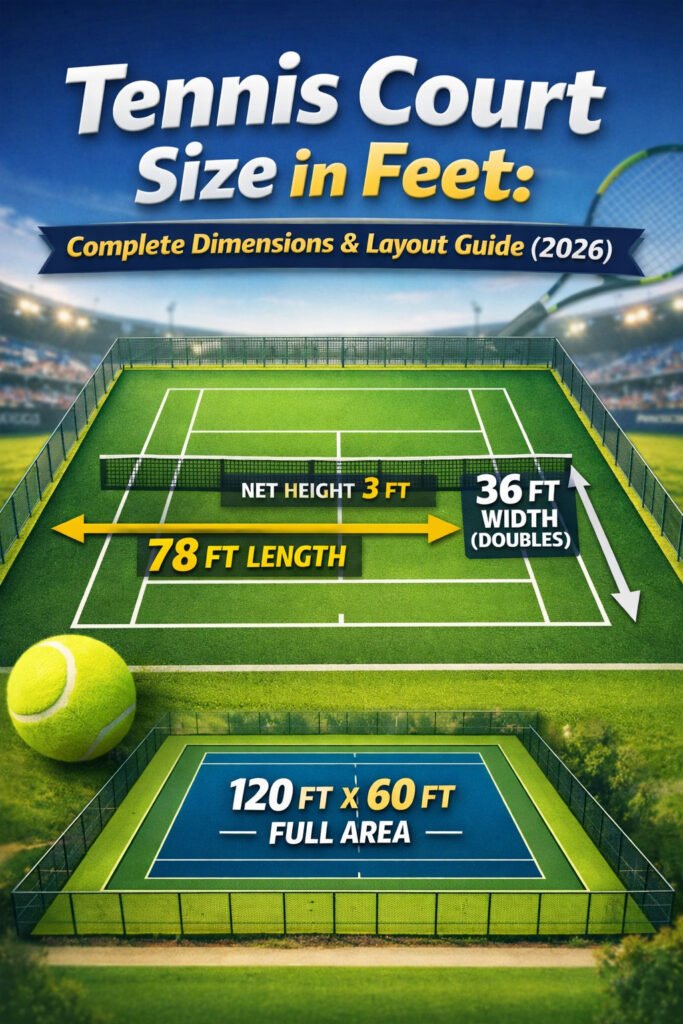
Understanding the tennis court size in feet is essential whether you’re building a new court, upgrading an old one, or simply learning the game. The official tennis court dimensions are standardized worldwide by the ITF (International Tennis Federation), ensuring consistent play across all levels—from recreational games to professional tournaments. This guide covers tennis court size in feet, layout, marking dimensions, run-off areas, and construction considerations to help you plan with accuracy. Why Standard Dimensions Matter The specific dimensions of a tennis court are fundamental to the game’s strategy and flow. The size dictates the style of play, influencing everything from serve strategy to rally dynamics. A larger court would favour players with immense stamina, while a smaller one might benefit those with quick reflexes. The current dimensions create a perfect balance between power, finesse, and athleticism. They provide enough space for epic rallies and powerful groundstrokes while demanding the precision needed for drop shots and sharp angles. Every inch matters, and now that you know the numbers, you can watch the game with a new perspective on the incredible skill required to master the court. What is Tennis Court A tennis court is a standardized rectangular playing surface used for singles and doubles tennis matches. It is designed with precise dimensions, markings, and structural elements to ensure fair, balanced, and safe play for athletes across all levels—from recreational players to professional competitors. A standard tennis court measures 78 feet in length. For singles play, the width is 27 feet, while doubles matches use the full width of 36 feet, which includes additional side areas known as doubles alleys. The court is divided into two equal halves by a net that stretches across the center. The net stands 3 feet high at the center and 3.5 feet at the posts, with a slight downward dip that affects ball bounce and play strategy. The surface of a tennis court can vary, and each surface type affects speed, bounce, and playing style. Common options include acrylic hard courts, synthetic surfaces, clay courts, grass courts, and artificial turf. Hard courts are the most widely used because they offer consistent bounce and low maintenance, while clay and grass provide distinct gameplay characteristics. A tennis court features several essential markings. These include the baselines at the back of the court, sidelines that define width, service lines, and the center service line, which divides the service boxes. These lines outline the rules for serving, ball placement, and in-play areas. The surface lines are usually 2 to 4 inches thick and painted in white for visibility. Beyond the playing area, additional space is required to allow players to move safely. This is known as the run-off area. For comfortable and safe play, especially in tournaments, a total area of around 120 feet by 60 feet is recommended. This space enables players to chase wide shots, backpedal for deep balls, and avoid injury from obstacles. Most tennis courts are surrounded by fencing ranging from 10 to 12 feet in height to prevent balls from leaving the area. Many modern facilities also install LED lighting systems for nighttime play, ensuring good visibility without glare. Accessories such as benches, umpire chairs, scoreboards, and ball baskets support organized gameplay and training. Overall, a tennis court is a carefully designed structure that combines accurate dimensions, quality surface materials, proper safety zones, and essential equipment. Whether used for recreation, coaching, or professional matches, maintaining standard measurements and surface quality is key to ensuring an optimal tennis experience. Official Tennis Court Size in Feet A standard tennis court used for singles and doubles has the following official size: ✔ Total Playing Area (Singles & Doubles) ✔ Court + Run-off Area (Recommended Full Area) To ensure safe movement around the court: This is the area required for most residential, club, and competitive courts. Detailed Tennis Court Dimensions (in Feet) Below is a breakdown of each zone on a tennis court: ✔ Baseline to Baseline: ✔ Service Line to Net: ✔ Net to Opposite Service Line: ✔ Width of Service Boxes: ✔ Doubles Alleys: ✔ Distance from Baseline to Fence/Boundary: ✔ Distance from Sideline to Fence/Boundary: Tennis Net Dimensions in Feet Net Height at Centre: 3 feet Net Height at Posts: 3.5 feet Net Width: 42 feet (for doubles court) Surface Options for a Standard Tennis Court Size Tennis court size remains the same regardless of surface type. Common surfaces include: 1. Hard Court (Acrylic / Concrete + Cushioning) 2. Clay Court 3. Synthetic Turf 4. Acrylic Coated Concrete Space Needed Based on Application Application Recommended Area (Feet) Residential Court 110 ft × 55 ft Coaching Academy 120 ft × 60 ft Tournament Level 130 ft × 65 ft Why Exact Court Measurements Matter Accurate dimensions ensure: For construction companies, using precise measurements avoids errors during layout, drainage planning, and flooring installation. Space Needed for Multi-Court Tennis Facilities No. of Courts Minimum Space Required (Feet) 1 Court 120 ft × 60 ft 2 Courts (side-by-side) 120 ft × 120 ft 3 Courts 120 ft × 180 ft 4 Courts 120 ft × 240 ft 6 Courts 120 ft × 360 ft Clubs often leave 12–15 feet between courts. Cost Factors for Building a Tennis Court While court size remains constant, cost varies by: Final Thoughts The official tennis court size in feet is 78 ft × 36 ft, with the playing area for singles being 78 ft × 27 ft. When including run-offs, the recommended total space becomes 120 ft × 60 ft, ideal for safe and comfortable play. If you’re planning to build a tennis court, understanding these exact dimensions will help you ensure professional-level accuracy and long-term performance.