Pickleball has exploded in popularity, and if you’ve been anywhere near a community park, gymnasium, or backyard gathering lately, you’ve probably heard that unmistakable “pop” of the ball. But before you grab a paddle and start smashing winners, there’s something crucial you need to understand—Pickleball Court Measurements. Whether you’re building a backyard court, converting a tennis court, or just curious about how it all fits together, understanding official Pickleball Court Measurements and knowing the exact dimensions makes all the difference.
Think of the court as the foundation of the game. Just like you wouldn’t build a house without measuring the blueprint, you shouldn’t set up a pickleball court without understanding the proper layout. Every line, every inch, and even the height of the net influences how the game is played. The spacing determines strategy. The “kitchen” changes how you attack. The baseline keeps rallies honest.
The beauty of pickleball lies in its simplicity. Unlike tennis, where courts feel massive and sometimes overwhelming, pickleball courts are compact and manageable. That’s part of why the game appeals to all ages. But don’t let the smaller size fool you—precision matters. A few inches off in measurement can change serve angles, rally positioning, and even player safety.
In this comprehensive guide, we’ll break down every single dimension you need to know. We’ll cover official standards, backyard variations, tournament-level requirements, and practical tips for setting up your own court. By the end, you won’t just know the numbers—you’ll understand how they shape the game itself.
Let’s start with the fundamentals: the standard court size.
Table of contents
- Understanding Standard Pickleball Court Dimensions
- Detailed Breakdown of Pickleball Court Lines and Markings
- The Non-Volley Zone (The Kitchen): Measurements and Rules
- Service Areas and Their Exact Measurements
- Net Specifications and Height Requirements
- Recommended Total Play Area Around the Court
- Indoor vs Outdoor Court Measurements
- Temporary vs Permanent Pickleball Court Setup
- Converting a Tennis Court into a Pickleball Court
- Backyard Pickleball Court Measurements
- Court Surface Materials and Their Impact on Play
- Pickleball Court Striping and Line Width Guidelines
- Common Measurement Mistakes to Avoid
- Official Tournament Court Requirements (USA Pickleball Standards)
- Why Accurate Pickleball Court Measurements Matter
- Conclusion
Understanding Standard Pickleball Court Dimensions
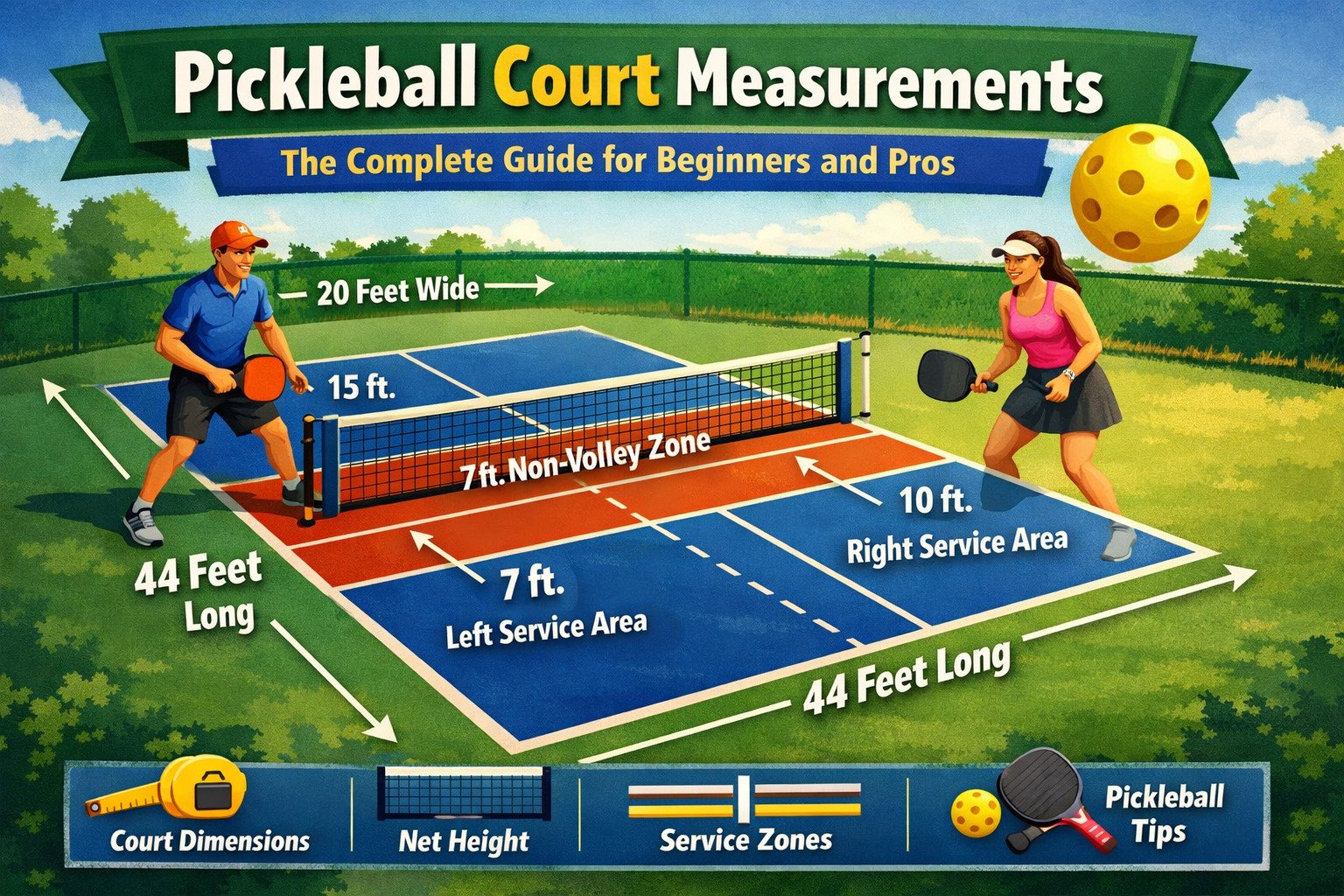
At first glance, a pickleball court might look similar to a badminton court—and that’s no coincidence. In fact, the dimensions are exactly the same as a standard doubles badminton court. The official size of a pickleball court is 20 feet wide and 44 feet long. That measurement applies to both singles and doubles play. Unlike tennis, where singles and doubles use different widths, pickleball keeps it simple.
Now, let’s visualize that. Imagine a rectangle that’s 20 feet across—roughly the width of a one-car garage—and 44 feet from baseline to baseline. Compact, right? That smaller footprint is one of the reasons pickleball is accessible to players of all ages and skill levels. You don’t need to sprint like a marathon runner to cover the court, but you still need agility and quick reflexes.
Here’s how it compares to tennis:
| Feature | Pickleball Court | Tennis Court (Doubles) |
|---|---|---|
| Width | 20 feet | 36 feet |
| Length | 44 feet | 78 feet |
See the difference? A tennis court is nearly double the length. That smaller size in pickleball leads to faster exchanges and more strategic net play.
The court is divided evenly by a net into two 22-foot halves. Each half contains specific zones, including service areas and the famous non-volley zone. These divisions aren’t random—they’re designed to encourage rallies and prevent overpowering serves from dominating the game.
Accuracy here is key. Even a slight deviation in width or length can affect tournament eligibility and gameplay fairness. If you’re marking a court yourself, always measure twice. Use a reliable tape measure and mark clear straight lines to ensure regulation compliance.
The 20-by-44-foot rectangle is the heart of pickleball. Everything else—the kitchen, service boxes, and net height—fits precisely within this framework. And that’s exactly what we’ll explore next.
Detailed Breakdown of Pickleball Court Lines and Markings
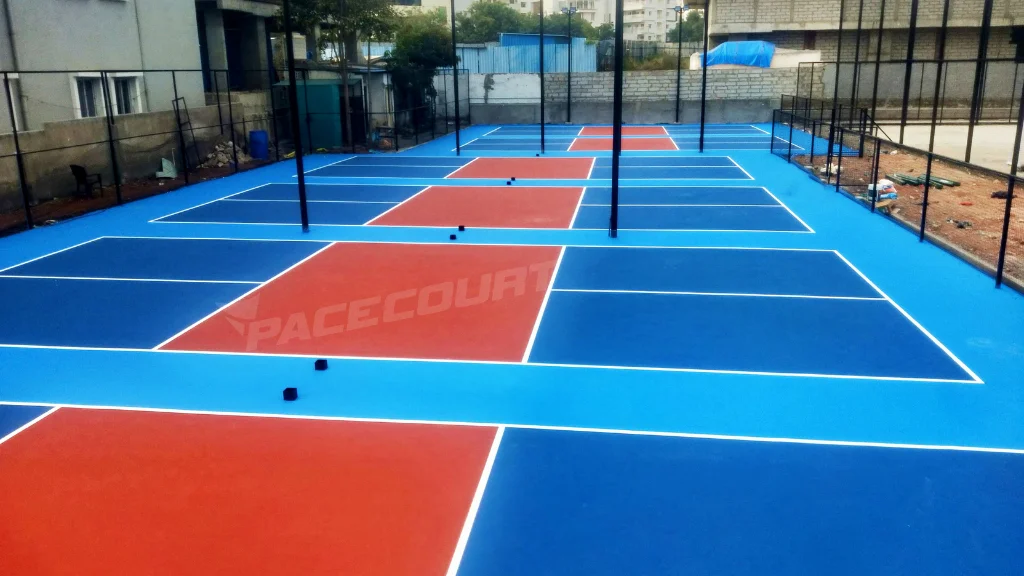
Now that we know the court measures 20 feet by 44 feet, let’s break down the lines that define how the game is played. These aren’t just random stripes painted on the ground. Each line has a purpose, and each one affects strategy.
Baselines
The baselines run along the 20-foot width at the back of each side of the court. They mark the boundary for serves and deep returns. When serving, both feet must remain behind the baseline until the ball is struck. Step on it too early? That’s a fault.
Baselines also define the depth of rallies. A ball that lands beyond the baseline is out. Because the court is only 44 feet long, baseline placement becomes critical during fast exchanges. Skilled players often aim just inches inside this line to push opponents backward.
Sidelines
The sidelines stretch the full 44-foot length of the court. They define the left and right boundaries. Unlike tennis, singles and doubles share the same sidelines in pickleball, which simplifies setup and reduces confusion.
Hitting sharp cross-court angles that kiss the sideline can be a powerful offensive strategy. That’s why accurate measurement is so important. If the sideline is even slightly misaligned, it changes how wide players can safely hit.
Centerline
The centerline divides each half of the court into two equal service areas. It runs from the non-volley zone line to the baseline. During serves, players must direct the ball diagonally into the opponent’s service court, defined by this centerline.
Non-Volley Zone Line
This line sits 7 feet from the net on each side and marks the beginning of the non-volley zone, also known as the kitchen. It stretches across the full 20-foot width.
All lines on a pickleball court should measure 2 inches wide and must be clearly visible, typically in a contrasting color from the court surface.
These lines create structure, fairness, and strategy. They turn a simple rectangle into a battlefield of angles, precision, and calculated risks. And among all these markings, none is more talked about than the kitchen.
The Non-Volley Zone (The Kitchen): Measurements and Rules
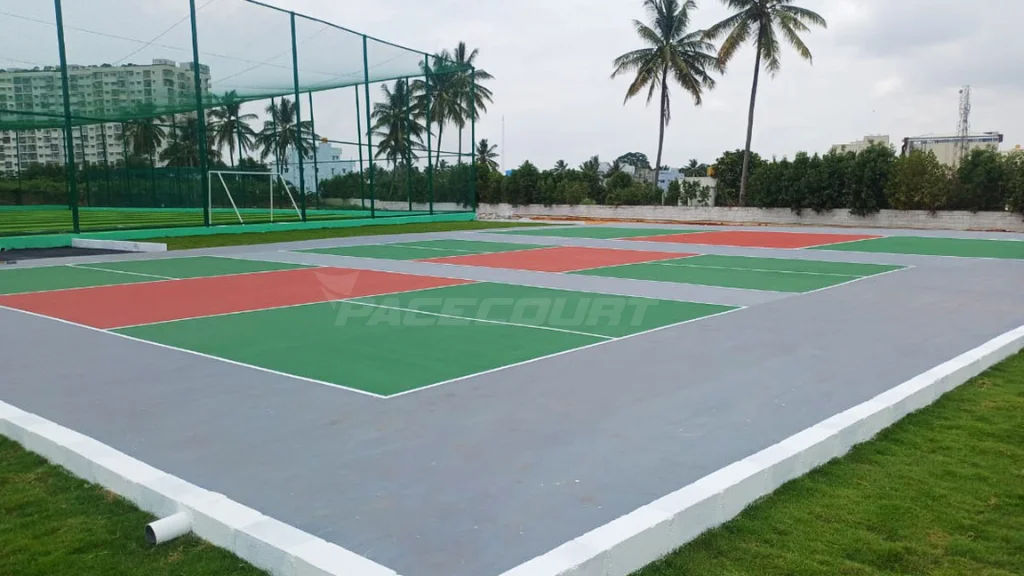
If pickleball had a personality trait, it would be the kitchen. Officially called the non-volley zone (NVZ), this 7-foot-deep area on both sides of the net changes everything about how the game is played.
Let’s start with the measurement. The non-volley zone extends 7 feet from the net toward the baseline on both sides. It spans the entire 20-foot width of the court. So essentially, picture a 7-by-20-foot rectangle hugging the net on each side.
Why 7 feet? That distance prevents players from camping at the net and smashing every shot downward. Without this rule, tall players could dominate with aggressive volleys, making rallies short and less strategic. The kitchen forces players to step back and think.
Here’s the rule: you cannot volley (hit the ball out of the air) while standing in the non-volley zone. Not only that, but your momentum can’t carry you into it after a volley. Even if your toe touches the line during a volley, it’s considered a fault. And yes—the kitchen line itself counts as part of the kitchen.
This rule creates longer rallies and emphasizes soft shots like dinks. Dinking—gently hitting the ball into your opponent’s kitchen—is one of the most strategic plays in pickleball. It forces opponents to let the ball bounce before returning it, slowing down aggressive exchanges.
The kitchen isn’t just a random area painted near the net. It’s the strategic heart of pickleball. Its precise 7-foot measurement ensures balance between offense and defense. Too shallow, and the net game becomes overpowering. Too deep, and the court feels cramped.
That 7-foot strip of space might not seem like much, but in reality, it defines the rhythm and personality of the sport.
Service Areas and Their Exact Measurements

Now let’s talk about the service areas—the zones where every rally officially begins. If the court is the stage and the kitchen is the drama, then the service areas are where the story kicks off. Every single point starts here, and the measurements must be precise for fair play.
Each side of the court is divided into two equal service courts by the centerline. These service areas sit behind the non-volley zone and extend back to the baseline. Since the full court length is 44 feet and each side is 22 feet from net to baseline, subtracting the 7-foot non-volley zone leaves 15 feet of depth for the service area.
So each service court measures:
- 10 feet wide (half of the 20-foot court width)
- 15 feet deep (from the non-volley zone line to the baseline)
That creates a 10-by-15-foot rectangle on the right and another 10-by-15-foot rectangle on the left.
When serving, the ball must travel diagonally across the net and land within the opposing service court—clearing the non-volley zone completely. If it touches the kitchen line? That’s a fault. If it lands on the centerline or baseline? That’s in, because those lines are part of the service court.
This diagonal serving requirement adds a chess-like element to the game. You’re not just hitting the ball forward—you’re targeting a specific 10-by-15-foot zone across from you. Precision matters. Placement matters. Strategy matters.
The server must stand behind the baseline and within the imaginary extension of the centerline and sideline. At least one foot must remain behind the baseline until contact is made. Step on the line too early? Fault.
Because the service areas are relatively compact, they reward controlled serves rather than sheer power. You don’t need to blast the ball. You need to place it. That’s part of what makes pickleball accessible—and addictively strategic.
Those neat 10-by-15 rectangles might look simple, but they’re the gateway to every rally. And when measured correctly, they keep the game fair, competitive, and fast-paced.
Net Specifications and Height Requirements
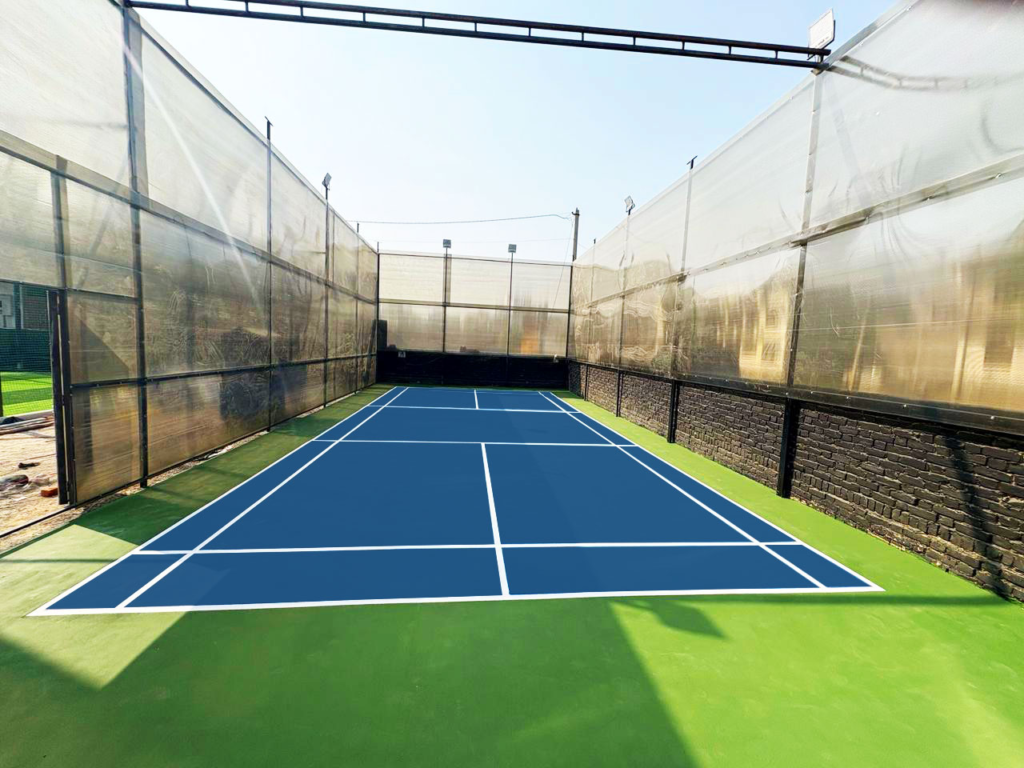
The net may seem like just a divider, but in pickleball, it’s carefully engineered to shape the flow of the game. The height isn’t arbitrary—it’s intentional, calculated, and crucial.
The official pickleball net height is:
- 36 inches at the sidelines
- 34 inches at the center
Yes, it dips two inches in the middle.
Why the difference? That slight dip encourages strategic cross-court shots and dinks. It subtly rewards players who aim for the center, where the net is lowest. Think of it as a built-in incentive for smarter shot selection.
The net stretches across the full 20-foot width of the court and should extend at least 21 feet to fully cover the sidelines. It must be taut enough to prevent sagging but flexible enough to allow safe ball impact.
Here’s a quick breakdown:
| Feature | Measurement |
|---|---|
| Net Height (Sidelines) | 36 inches |
| Net Height (Center) | 34 inches |
| Net Width | Minimum 20 feet |
The two-inch center drop might sound insignificant, but in high-level play, it’s everything. Competitive players intentionally target that center dip during fast exchanges.
Portable nets used in driveways or temporary setups must still meet these height standards to replicate authentic gameplay. Adjustable straps in the middle help maintain that 34-inch center height.
Also, net posts should be positioned outside the sidelines, not inside the court boundaries. This prevents interference with gameplay and maintains regulation width.
The net height is one of those details that seems small—until you play on an incorrectly set net. Too high, and rallies slow down dramatically. Too low, and smashes dominate the game. That precise 36-and-34-inch combination strikes the perfect balance between offense and defense.
Recommended Total Play Area Around the Court
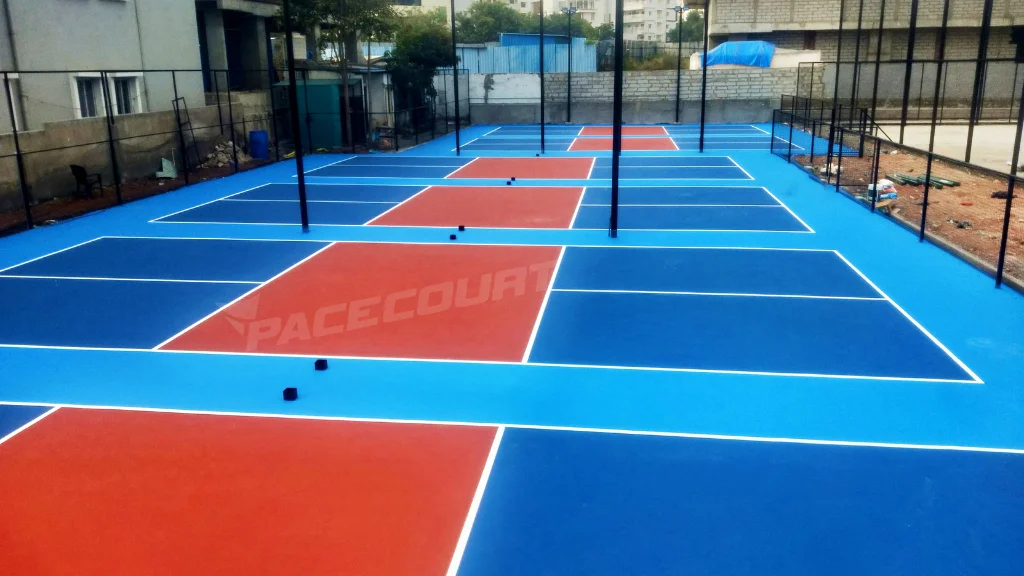
Here’s something many people overlook: the court dimensions are just part of the story. You also need surrounding space—often called the “run-off area”—to move safely and play comfortably.
While the playing court itself measures 20 by 44 feet, the recommended total play area is larger.
For recreational play, the minimum suggested space is:
- 30 feet wide
- 60 feet long
That provides about 5 feet of extra space on each side and 8 feet behind each baseline.
For tournament or professional play, USA Pickleball recommends:
- 34 feet wide
- 64 feet long
That extra breathing room allows players to chase deep lobs and wide shots without crashing into fences or walls.
Imagine trying to return a high lob with only two feet behind you. Not ideal, right? That’s why these buffer zones matter. They protect players and enhance competitive play.
Indoor facilities must also consider ceiling height. A minimum ceiling height of 18 to 20 feet is recommended to accommodate high lobs. Lower ceilings can interfere with advanced gameplay.
Outdoor courts should have proper fencing—typically 10 feet high—to contain balls and ensure safety.
Think of the extra space as your safety cushion. It’s not technically part of the court, but it’s essential for a smooth and enjoyable experience. Skimping on space can make even a perfectly measured court feel cramped.
Indoor vs Outdoor Court Measurements
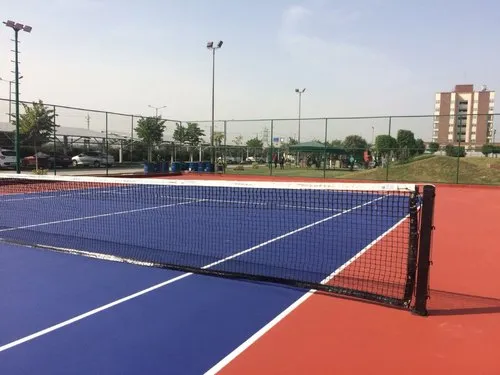
The actual court measurements—20 by 44 feet—remain the same whether indoors or outdoors. But the environment changes how those dimensions function.
Indoor Courts
Indoor courts are often found in gyms or recreation centers. Because they’re built within existing buildings, ceiling height becomes crucial. As mentioned earlier, 18 to 20 feet is ideal.
Lighting also plays a huge role. Proper overhead lighting ensures visibility without casting shadows across the kitchen or baseline.
Indoor surfaces are typically:
- Hardwood
- Sport court tiles
- Polished concrete
These surfaces provide consistent bounce but may be slightly slick, requiring non-marking athletic shoes.
Outdoor Courts
Outdoor courts are commonly built on asphalt or concrete and coated with acrylic surfacing. Wind becomes a factor outside, affecting ball movement.
Sun positioning matters too. Ideally, courts should run north to south to minimize sun glare during morning and evening play.
Drainage is another consideration. A slight slope—around 1%—helps prevent water accumulation without affecting gameplay.
While the measurements stay identical, the playing experience changes dramatically between indoor and outdoor settings. That’s why planning goes beyond just drawing lines on a surface.
Temporary vs Permanent Pickleball Court Setup
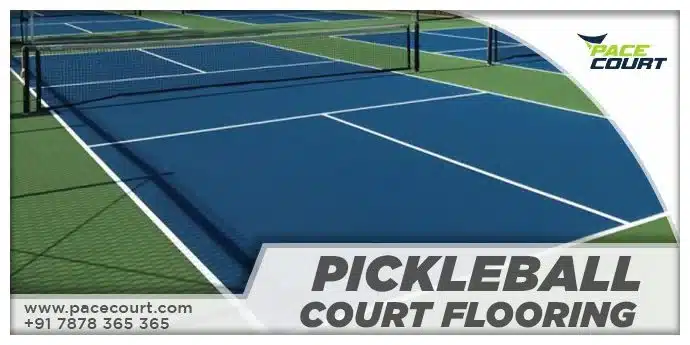
Not everyone has access to a dedicated pickleball court—and that’s okay. The sport’s flexibility is part of its charm.
Temporary Setup
You can create a temporary court using:
- Measuring tape
- Chalk or painter’s tape
- Portable net system
As long as you measure 20 by 44 feet accurately and mark the 7-foot kitchen lines, you can transform a driveway or gym floor into a playable court.
Portable nets are designed to meet official height requirements. Many come with center straps to maintain that critical 34-inch dip.
Permanent Setup
Permanent courts require:
- Asphalt or concrete base
- Acrylic surface coating
- Painted 2-inch lines
- Anchored net posts
Permanent setups offer durability and a professional feel. The surface coating also improves traction and ball bounce consistency.
Whether temporary or permanent, precision remains key. A casual chalk setup still benefits from exact measurements.
Pickleball thrives because it’s adaptable. You can go from a taped driveway to a championship-level court—and the dimensions stay the same.
Converting a Tennis Court into a Pickleball Court
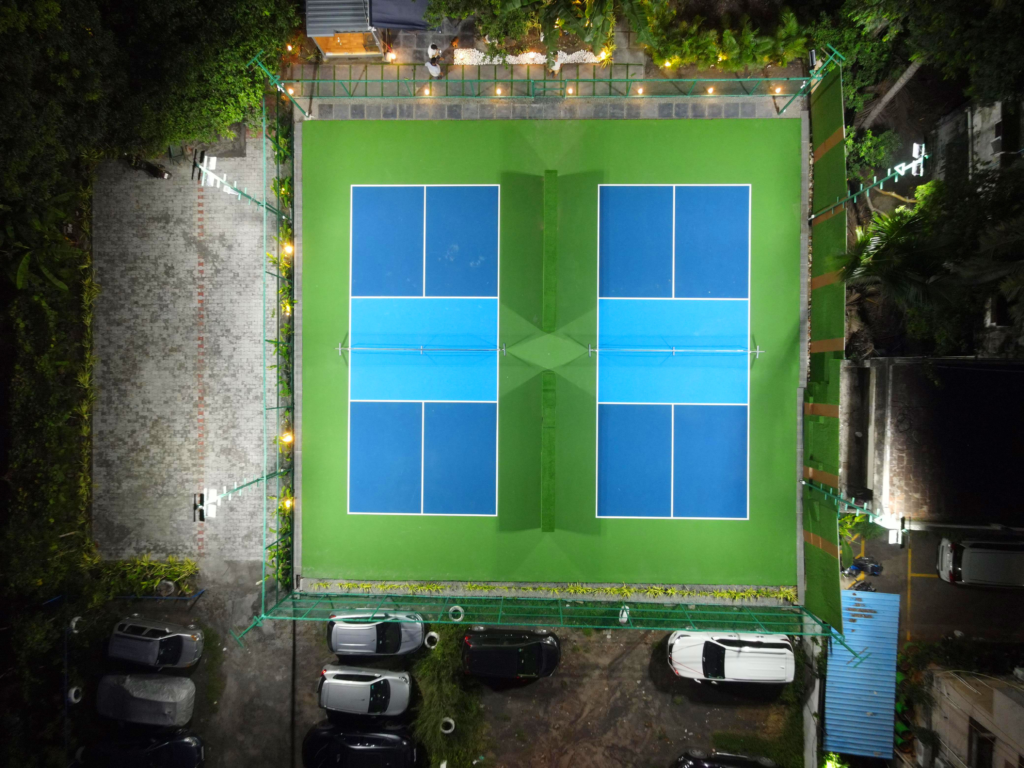
Here’s a fun fact: you can fit four pickleball courts onto one standard tennis court. That’s one reason why communities are embracing conversions.
Since a tennis court measures 78 by 36 feet (doubles), there’s plenty of room.
Common conversion layouts include:
- Two pickleball courts side-by-side across the width
- Four courts arranged in a grid
The key is ensuring each pickleball court maintains the 20-by-44-foot dimensions and proper run-off space.
Color-coded lines help prevent confusion. For example:
- White lines for tennis
- Blue or green lines for pickleball
Net adjustments are necessary. Tennis nets are 36 inches at the center, but pickleball requires 34 inches. Portable pickleball nets are often used instead.
Converting courts maximizes space and increases community access without major reconstruction.
Backyard Pickleball Court Measurements
Dreaming about stepping outside with your morning coffee, paddle in hand, ready for a quick match before work? A backyard pickleball court can turn that dream into reality. But before you start pouring concrete or rolling out tape, let’s talk measurements—because even in your own backyard, precision makes the difference between a fun rally and constant frustration.
The official court size remains 20 feet wide and 44 feet long. That doesn’t change just because it’s behind your house. However, what many homeowners forget is the surrounding space. Ideally, you want at least 30 feet by 60 feet total space to allow safe movement. If you can stretch that to 34 by 64 feet, even better. That extra room gives you freedom to chase lobs and wide returns without slamming into a fence or patio furniture.
Now, let’s be honest—most backyards aren’t perfectly rectangular, and not everyone has tournament-level space. If you’re tight on room, you can still mark the 20-by-44-foot court and reduce the run-off area slightly. Just understand that gameplay may feel more compact, and aggressive baseline shots might be limited.
Surface selection matters. Concrete is the gold standard for backyard courts because it provides durability and consistent bounce. Asphalt is another option, often slightly more affordable. Modular sport tiles are gaining popularity too—they’re easier to install and gentler on the joints.
Here’s a quick planning checklist:
- Measure and mark 20 ft x 44 ft precisely
- Add minimum 5 ft on sides and 8 ft behind baselines
- Ensure proper drainage (1% slope recommended)
- Install a net set to 36 inches at sidelines, 34 inches at center
- Paint 2-inch-wide boundary lines in high-contrast color
Lighting is another overlooked factor. If you plan to play in the evenings, install even overhead lighting to avoid shadows across the kitchen line.
A backyard court isn’t just about measurements—it’s about creating a space where memories happen. Weekend tournaments, family laughs, friendly rivalries. And when those lines are measured correctly, every game feels just right.
Court Surface Materials and Their Impact on Play
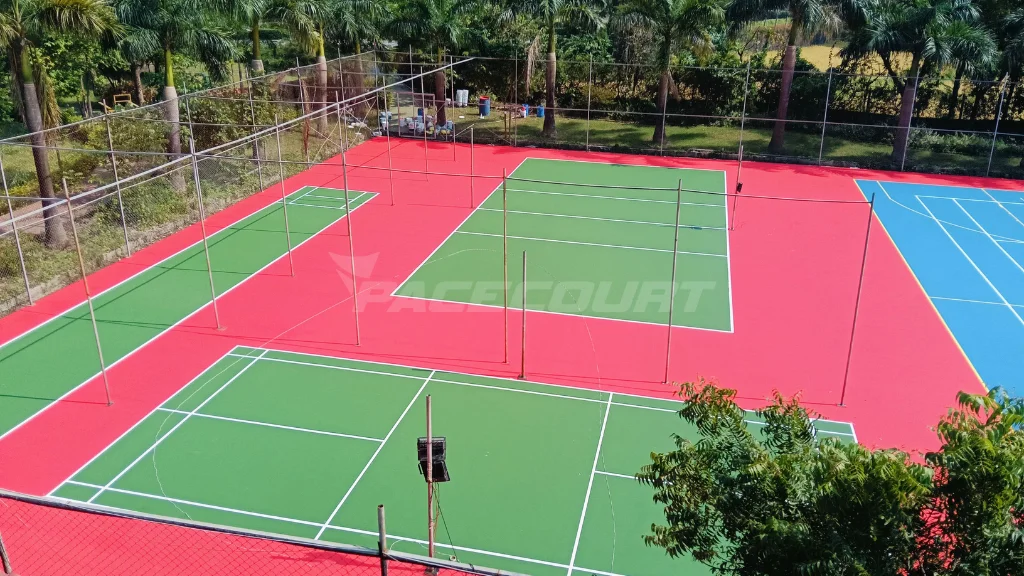
The measurements may define the court’s size, but the surface defines its personality. Think of it like this: two courts can be exactly 20 by 44 feet, but if one is concrete and the other is modular tile, they’ll play completely differently.
Concrete
Concrete is the most common surface for permanent pickleball courts. It’s durable, low maintenance, and offers consistent ball bounce. Once sealed and coated with acrylic surfacing, it provides excellent traction. The downside? It can be tough on the knees over time. Long matches on hard concrete can feel demanding, especially for older players.
Asphalt
Asphalt is slightly softer than concrete and can be more budget-friendly. However, it may require more maintenance over the years, especially in climates with extreme temperature changes. Cracks can form if not properly installed and sealed.
Modular Tiles
These interlocking tiles are becoming increasingly popular for backyard and recreational courts. They sit on top of a hard surface and offer slight cushioning. Players often describe them as easier on the joints. They also allow for quicker installation compared to pouring new concrete.
Here’s a simple comparison:
| Surface Type | Durability | Maintenance | Comfort Level | Cost |
|---|---|---|---|---|
| Concrete | Very High | Low | Moderate | Medium-High |
| Asphalt | High | Medium | Moderate | Medium |
| Modular Tiles | Medium-High | Low | High | Medium |
Regardless of surface, the lines must remain 2 inches wide and clearly visible. The bounce consistency should allow fair gameplay across the entire 20-by-44-foot court.
The surface isn’t just something you stand on—it directly affects speed, control, and injury prevention. Choosing wisely ensures your measured court performs exactly as intended.
Pickleball Court Striping and Line Width Guidelines
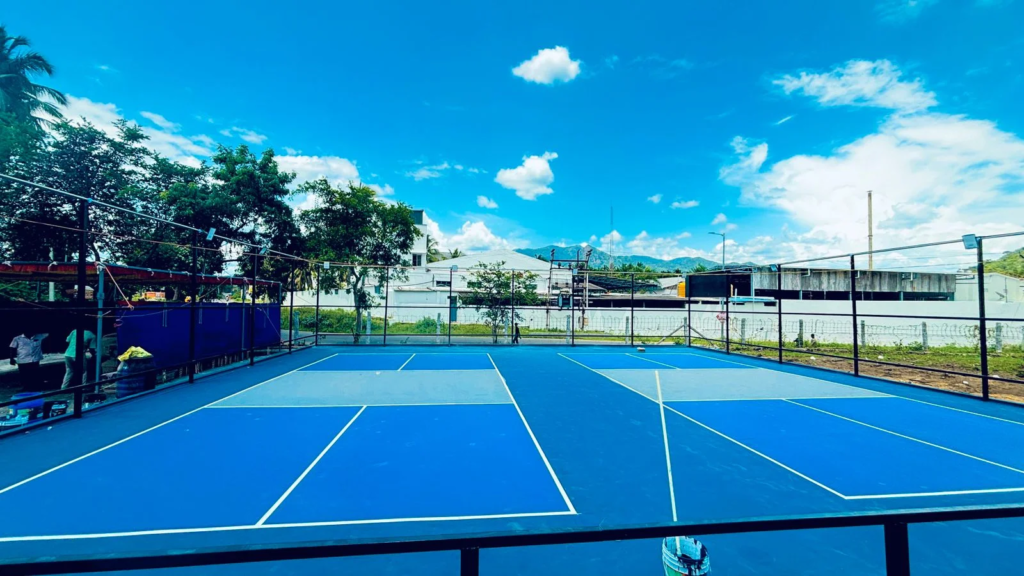
Lines are the silent referees of pickleball. They don’t argue, they don’t shout—but they decide every in-or-out call. That’s why their width and visibility are just as important as the court’s overall dimensions.
According to official standards, all pickleball court lines must be 2 inches wide. Not 1 inch. Not 3 inches. Exactly 2 inches. Why? Because consistency ensures fairness across recreational and competitive play.
Every boundary line—the baselines, sidelines, non-volley zone lines, and centerlines—must follow this standard. The lines are considered part of the area they define. That means if the ball touches the line, it’s in. This makes accurate striping essential.
Color contrast is critical. The lines should clearly stand out from the court surface. Common combinations include:
- Blue court with white lines
- Green court with white or yellow lines
- Gray court with bright white lines
When converting tennis courts, using a different color for pickleball lines prevents confusion. Imagine trying to judge a fast cross-court shot with overlapping white lines everywhere—it’s a recipe for disputes.
Proper striping steps include:
- Measure the 20-by-44-foot court carefully
- Mark kitchen lines exactly 7 feet from the net
- Divide service courts evenly with centerlines
- Use painter’s tape for straight edges
- Apply weather-resistant court paint
Clean, sharp lines not only improve gameplay but also make the court look professional. A neatly striped court feels official. It invites serious rallies and friendly competition alike.
In pickleball, inches matter. Those crisp 2-inch lines ensure that every close call is clear and every rally is fair.
Common Measurement Mistakes to Avoid
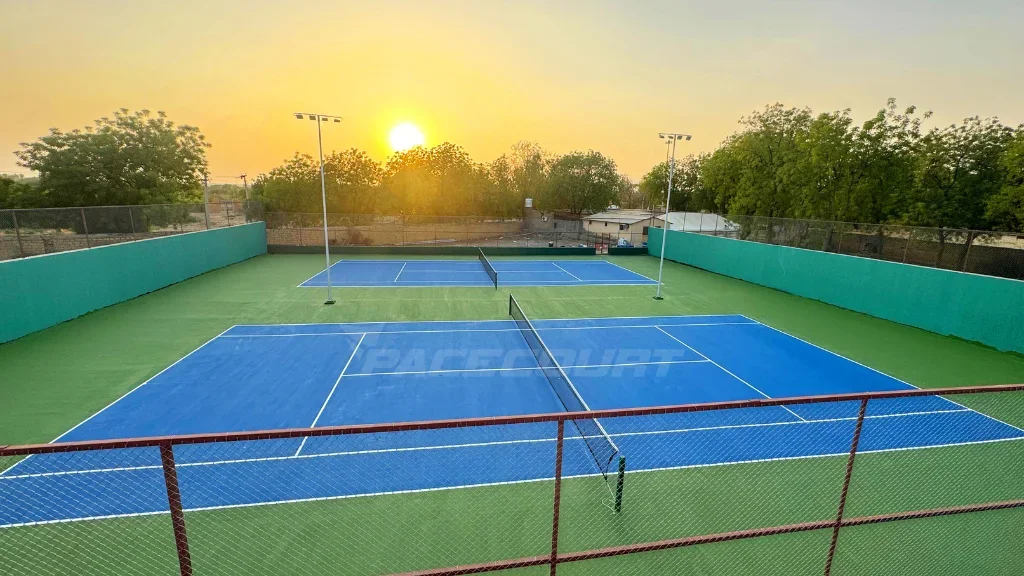
Even though pickleball court measurements are straightforward, mistakes happen more often than you’d think. And small errors can create big problems during gameplay.
One common mistake? Misplacing the non-volley zone. The kitchen must extend exactly 7 feet from the net—not from the baseline, not “about 7 feet.” Measure from the center of the net line outward toward the baseline.
Another frequent issue is incorrect net height. Many players assume the net should be 36 inches all the way across. But remember, it must dip to 34 inches at the center. Forgetting this changes the dynamic of dinks and cross-court shots.
Improper total play area spacing is also common. Squeezing a court into a tight backyard without adequate run-off space increases injury risk and limits gameplay.
Other mistakes include:
- Lines wider or narrower than 2 inches
- Uneven service court divisions
- Slanted baselines due to poor measuring techniques
- Ignoring north-south orientation for outdoor courts
Here’s a tip: always measure twice, mark once. Use high-quality measuring tape, chalk lines, and straight edges. If possible, verify diagonal measurements to ensure your rectangle is square.
Accuracy isn’t about perfectionism—it’s about preserving the integrity of the game. When the court is measured correctly, every rally feels smooth and fair.
Official Tournament Court Requirements (USA Pickleball Standards)

If you’re aiming for competitive or sanctioned play, you need to meet USA Pickleball’s official standards. While recreational courts can be flexible, tournament courts demand precision.
The core court dimensions remain:
- 20 feet wide
- 44 feet long
- Non-volley zone 7 feet deep on each side
- Net height 36 inches at sidelines, 34 inches at center
But tournaments require additional specifications:
- Minimum total play area: 34 feet by 64 feet
- High-quality acrylic surface
- Uniform lighting for indoor events
- Clearly visible 2-inch lines
- Net posts positioned outside sidelines
Outdoor courts should also be oriented north-south whenever possible. This reduces sun glare during competitive matches.
Professional tournaments often include fencing, spectator seating, and designated player areas. However, the heart of it all remains the precisely measured 20-by-44-foot playing surface.
Tournament standards ensure consistency. A player competing in Florida should experience the same court dimensions as one playing in California. That uniformity builds trust in the sport.
When measurements meet official guidelines, the court becomes more than just pavement—it becomes a legitimate competitive arena.
Why Accurate Pickleball Court Measurements Matter
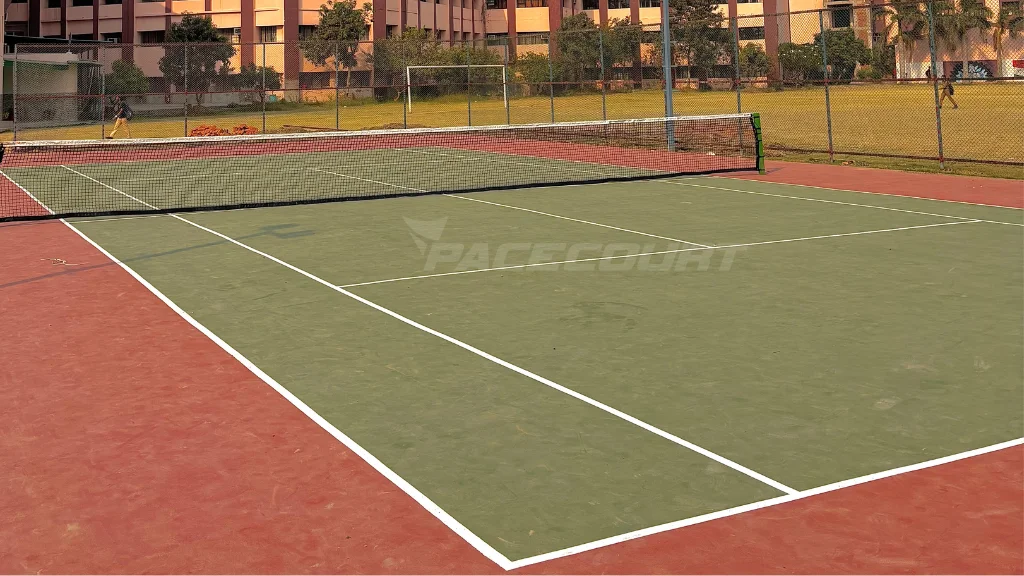
You might wonder—does a few inches really make that much difference? Absolutely.
Pickleball is a game of angles, touch, and placement. A slightly misplaced kitchen line alters dink strategies. A net set too high slows down rallies. Service courts measured unevenly create unfair advantages.
Precise measurements ensure:
- Fair gameplay
- Consistent ball bounce
- Strategic balance
- Player safety
- Tournament eligibility
Think of the court as a musical instrument. If it’s tuned correctly, the game flows beautifully. If not, something feels off—even if you can’t immediately pinpoint why.
Accurate dimensions also preserve the sport’s integrity. As pickleball continues growing worldwide, standardized courts guarantee that players everywhere share the same experience.
In short, measurements aren’t just numbers—they’re the foundation of everything that makes pickleball exciting, competitive, and fun.
Conclusion
Pickleball court measurements may seem simple at first glance—just a 20-by-44-foot rectangle, right? But as you’ve seen, every inch carries purpose. The 7-foot kitchen shapes strategy. The 34-inch center net height encourages finesse. The 10-by-15-foot service courts demand precision. Even the 2-inch lines quietly govern every rally.
Whether you’re building a backyard oasis, converting a tennis court, or preparing for tournament play, accuracy matters. Proper measurements create balance between power and control, offense and defense, speed and strategy.
Pickleball’s magic lies in its thoughtful design. The compact court keeps players engaged. The non-volley zone extends rallies. The carefully calibrated net height rewards smart shot placement.
Measure carefully. Build thoughtfully. Play passionately.
Because when the court is right, the game just feels right.