If you’ve ever stepped onto a badminton court and felt like the space was just perfectly balanced—not too big, not too small—you’re not imagining it. The shuttle court size is carefully designed to create a fast, strategic, and physically demanding game. Every inch matters. Whether you’re smashing from the baseline or rushing forward for a net kill, the dimensions of the court quietly shape every movement you make.
Badminton may look simple at first glance. Two players. A net. A shuttlecock. But behind that simplicity lies precision. The court size is not random. It’s standardized by the Badminton World Federation (BWF), ensuring that whether you play in London, Tokyo, or your local sports hall, the dimensions remain consistent. That consistency keeps the sport fair and competitive.
Why does this matter to you? Because playing on the correct shuttle court size affects everything—your footwork, stamina, shot placement, and even your strategy. A slightly shorter or wider court can completely change rally dynamics. It’s like driving on a road that’s either too narrow or too wide—it alters your rhythm.
In this guide, we’ll break down every measurement, line, and requirement in detail. From singles and doubles differences to net height and marking techniques, you’ll get a crystal-clear understanding of shuttle court size. By the end, you won’t just know the dimensions—you’ll understand why they matter.
Let’s start with the official numbers.
Standard Badminton Court Dimensions
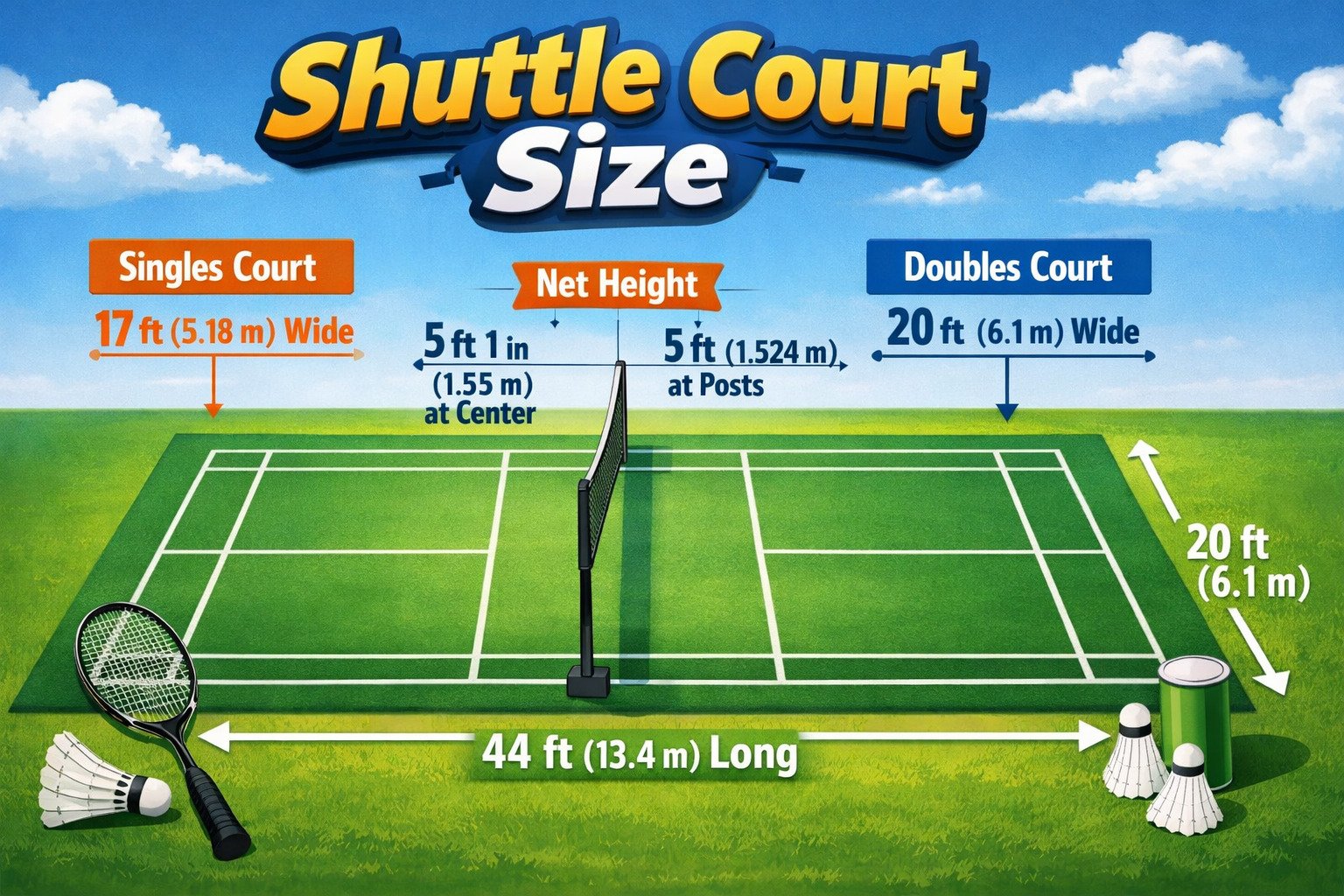
When it comes to shuttle court size, precision is everything. The standard badminton court is rectangular and divided equally by a net running across the center. According to official regulations, the full court measures 13.4 meters (44 feet) in length and 6.1 meters (20 feet) in width for doubles matches. These numbers aren’t arbitrary—they’re carefully calculated to balance speed and endurance.
Now here’s where it gets interesting. For singles matches, the length remains the same—13.4 meters (44 feet)—but the width changes. The singles court is narrower, measuring 5.18 meters (17 feet) wide. That difference of just under a meter dramatically changes gameplay. In singles, players don’t need to defend the wider doubles sidelines, but they must cover the entire court length alone. That demands exceptional footwork and stamina.
Let’s look at it in a simple table:
| Match Type | Length | Width |
|---|---|---|
| Singles | 44 ft (13.4 m) | 17 ft (5.18 m) |
| Doubles | 44 ft (13.4 m) | 20 ft (6.1 m) |
The court lines are typically 40mm (1.6 inches) thick and must be clearly visible, usually painted white or yellow depending on the floor color.
Think of the court as a chessboard for speed. The size forces players to think strategically. In doubles, wider angles create more attacking opportunities. In singles, narrower boundaries demand precision and patience.
Understanding these standard dimensions is the foundation for everything else—court markings, net placement, and service areas all depend on these measurements. Get this wrong, and the entire game changes.
Overall Length and Width
Let’s zoom in further on the overall length and width of a shuttle court, because this is where the game truly takes shape.
The full length of the court is 44 feet (13.4 meters) from baseline to baseline. This measurement remains constant whether you’re playing singles or doubles. That consistent length ensures rallies maintain their depth and intensity. When you clear the shuttle high to the back of the court, you’re sending it across the entire 44-foot stretch. That distance is what makes baseline rallies so physically demanding.
Now, the width tells a different story. For doubles, the court spans 20 feet (6.1 meters) wide. That extra width opens up attacking angles. Smashes down the sideline become lethal weapons. Defensive formations also shift because two players share coverage responsibilities.
For singles, however, the width shrinks to 17 feet (5.18 meters). That may not sound like a big difference, but in a fast-paced game like badminton, three feet is massive. It narrows cross-court shots and demands more accuracy. You can’t rely on wide-angle winners as much—you need smarter placement.
Imagine the court like a battlefield. In doubles, you fight on a wider front. In singles, the battlefield narrows, but you’re alone. The unchanged length ensures stamina remains equally tested in both formats.
Another important detail? The diagonal measurement of the doubles court is approximately 14.73 meters (48.3 feet). This affects how cross-court shots travel and explains why diagonal smashes feel longer and more dramatic.
The overall dimensions are not just numbers—they’re the invisible framework shaping every rally. Once you internalize these measurements, your court awareness improves dramatically.
Singles vs Doubles Court Dimensions
This is where many beginners get confused. The shuttle court size changes depending on whether you’re playing singles or doubles—but not in the way most people expect.
In singles, the court is long and narrow. You use the inner sidelines but the full baseline. That means shots must land within the 17-foot width but can travel the entire 44-foot length. Because you’re alone on your side, endurance becomes critical. Every drop shot pulls you forward. Every clear pushes you back. There’s no partner to save you.
In doubles, the court is shorter for serves but wider overall. The width expands to 20 feet, including the outer sidelines. However, during service in doubles, players must serve within the shorter long service line (not the baseline). That subtle change adds a layer of tactical complexity.
Here’s a quick comparison:
- Singles:
- Narrow width (17 ft)
- Full length (44 ft)
- Emphasis on stamina and placement
- Doubles:
- Wider width (20 ft)
- Slightly shorter service area length
- Emphasis on speed and teamwork
Why does this matter so much? Because strategy shifts completely. In singles, you build rallies and exploit movement. In doubles, rallies are faster and more aggressive. The extra width creates sharper attacking angles, while teamwork reduces individual court coverage.
Think of singles as a marathon with sprints, and doubles as a rapid-fire duel. Same court length. Different battlefield width. Different tactics.
Understanding these differences ensures you mark the court correctly and adapt your game accordingly.
Detailed Court Markings and Lines
If the shuttle court size is the skeleton of the game, then the court markings are its nervous system. Every line has a purpose. Every boundary shapes a decision. A shuttle landing one inch outside a line can mean the difference between victory and frustration. So let’s slow down and really understand what these lines mean and why they matter.
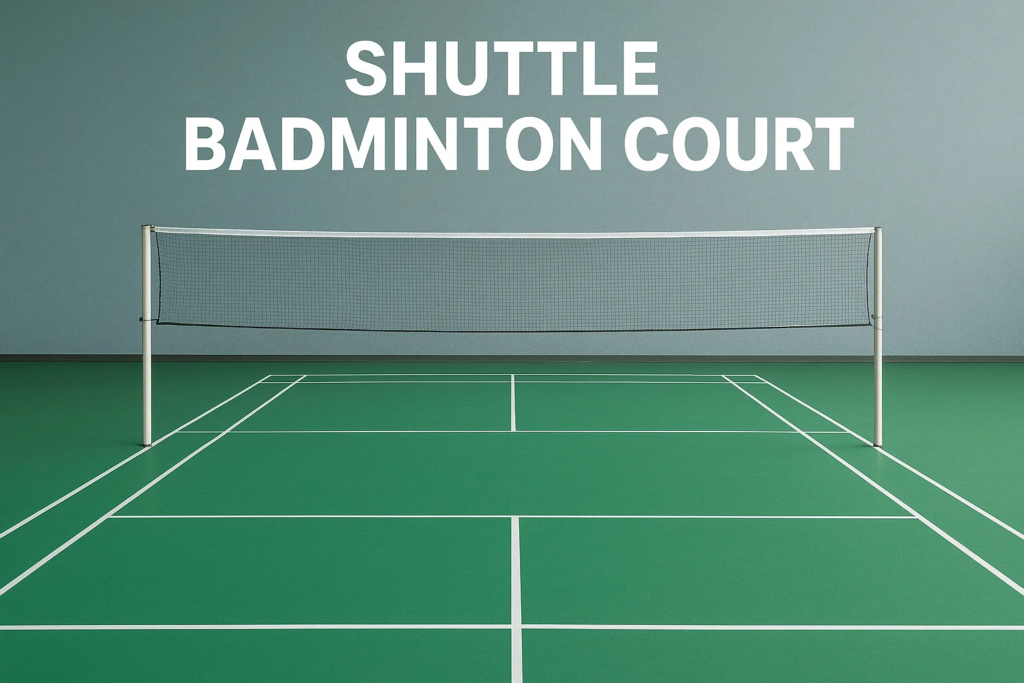
A standard badminton court is marked with lines that are 40 mm (1.6 inches) thick, and here’s something many casual players overlook: the lines are part of the court. That means if the shuttle touches the line, it’s considered in. This small rule dramatically changes close calls during intense rallies.
The court includes:
- Two baselines
- Two sidelines (inner and outer)
- A center line
- A short service line
- A long service line for doubles
These lines divide the court into service courts and boundary zones. They control how the game flows. Without them, badminton would feel chaotic—like playing chess without squares.
The markings also create psychological pressure. Players constantly aim for the edges, trying to paint the lines with smashes and drop shots. The closer you hit to the line, the harder it is for your opponent to return the shuttle. That’s why professionals train to develop razor-sharp accuracy.
When marking your own court, precision is essential. Even a few centimeters off can distort gameplay. Imagine practicing on a slightly wider court and then competing on a regulation one—you’d misjudge your angles all the time.
Court markings are not decorative. They are the rules drawn on the floor. Once you truly understand them, you stop just playing the game—you start mastering space.
Baseline and Sidelines
The baseline is the back boundary line of the court. There are two baselines, one on each end. They mark the full 44-foot (13.4-meter) length of the court. In both singles and doubles, the baseline defines the back limit of play during rallies.
When you hit a deep clear shot, you’re aiming for the baseline. Why? Because pushing your opponent all the way back stretches their positioning and opens up the front court. The baseline isn’t just a boundary—it’s a tactical weapon.
Now let’s talk sidelines.
There are two sets of sidelines:
- Inner sidelines – used for singles matches
- Outer sidelines – used for doubles matches
In singles, the shuttle must land inside the inner sideline. In doubles, the outer sideline becomes active, increasing the width from 17 feet to 20 feet.
This difference transforms gameplay. In doubles, wide-angle smashes become far more dangerous because you have extra width to work with. In singles, accuracy becomes critical because you have less horizontal margin.
It’s like painting on a canvas. In singles, the canvas is narrower. In doubles, it expands slightly. That extra three feet creates more offensive opportunities but also demands better defensive coordination.
The sidelines also influence footwork patterns. Singles players move in long diagonal strides. Doubles players move in quick lateral bursts.
Baselines and sidelines together form the outer frame of badminton. They define the battlefield. Mastering how to use them strategically can elevate your game from reactive to dominant.
Short Service Line
The short service line sits 1.98 meters (6 feet 6 inches) from the net. It runs parallel to the net and plays a crucial role during serves. When serving, the shuttle must travel over the net and land beyond this line in the opponent’s service court.
Why is this important? Because without this line, players could just tap the shuttle gently over the net, making serves too easy and predictable. The short service line forces you to deliver a proper serve with enough depth.
In doubles especially, low serves that barely cross the net and land just past the short service line are considered ideal. They reduce the opponent’s attacking options. If the serve is too short and lands before this line, it’s a fault.
Think of the short service line as a minimum distance checkpoint. It ensures fairness and prevents overly soft serves.
Psychologically, this line also creates tension. During high-pressure moments, players sometimes serve too short because of nerves. Even experienced athletes occasionally misjudge by a fraction.
The short service line may look simple, but it’s essential for maintaining balance between offense and defense right from the start of each rally.
Long Service Line for Doubles
Here’s where things get interesting. In doubles matches, there’s an additional line called the long service line for doubles. It’s located 0.76 meters (2 feet 6 inches) inside the baseline.
This means that during a doubles serve, the shuttle cannot land all the way at the baseline. It must land before this shorter boundary. However, during regular rallies (after the serve), the baseline becomes active again.
Why this rule? Because doubles games are faster and more aggressive. If players were allowed to serve all the way to the baseline, serves would become overly defensive and reduce attacking excitement. The shorter service area keeps rallies intense.
In singles, there is no separate long service line. Players can serve all the way to the baseline.
This difference often confuses beginners. Many recreational courts are marked for both singles and doubles, creating multiple lines that look overwhelming at first glance.
But once you understand the logic, it makes sense:
- Singles: long and narrow
- Doubles: wide but slightly shorter on serve
It’s a clever design choice that maintains game balance.
Center Line
The center line runs perpendicular from the short service line to the baseline, dividing each side of the court into left and right service courts.
During serves, this line determines where the shuttle must land depending on the score. If your score is even, you serve from the right service court. If it’s odd, you serve from the left.
The center line ensures fairness and rotation in serving positions. Without it, players could serve from anywhere, creating confusion.
Strategically, this line also influences return angles. Skilled players aim serves close to the center line to limit the opponent’s attacking options.
It may seem like a small marking, but the center line plays a vital role in maintaining order and competitive structure.
Net Height and Net Placement
Now let’s talk about the heart of the shuttle court—the net.
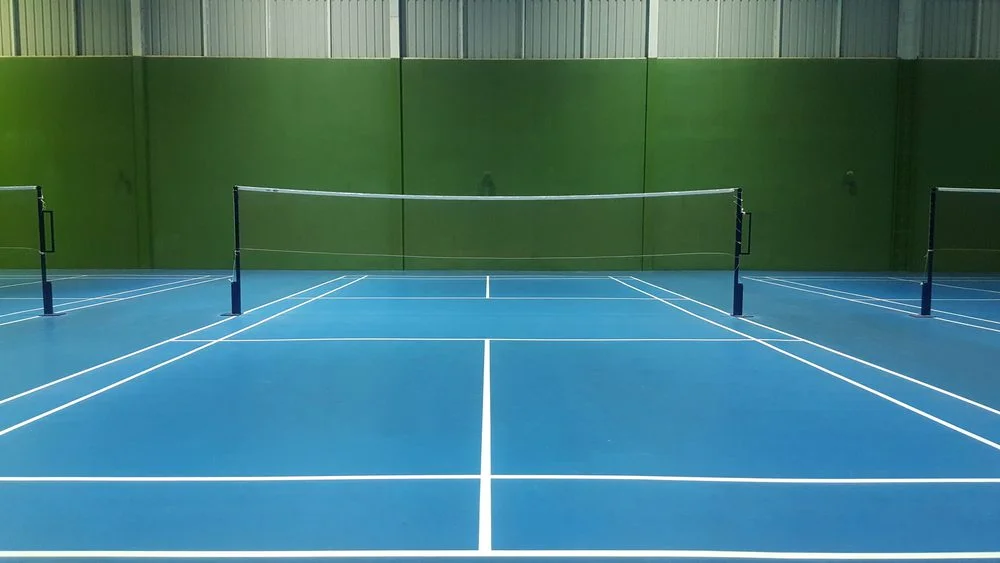
The net height is precisely regulated:
- 1.55 meters (5 feet 1 inch) at the posts
- 1.524 meters (5 feet) at the center
Notice the slight dip in the middle. That’s intentional. The net is pulled tight but naturally sags slightly at the center.
This height creates the perfect balance between offense and defense. Too high, and smashing becomes ineffective. Too low, and rallies become too aggressive and short.
The net stretches across the full width of the doubles court—20 feet (6.1 meters). The posts are placed on the doubles sidelines, even during singles matches.
This detail surprises many players. Even when playing singles, the net posts remain in the doubles position.
The net itself is typically 760 mm deep and made of dark-colored mesh with a white tape border at the top.
Why so precise? Because even a few centimeters difference in net height can impact gameplay dramatically.
The net is more than a divider. It’s the obstacle every rally must overcome.
Court Surface Requirements
Shuttle court size is meaningless without the right surface. Badminton is a fast sport that demands quick direction changes, jumps, and lunges. The surface must support these movements safely.
Indoor Court Surfaces
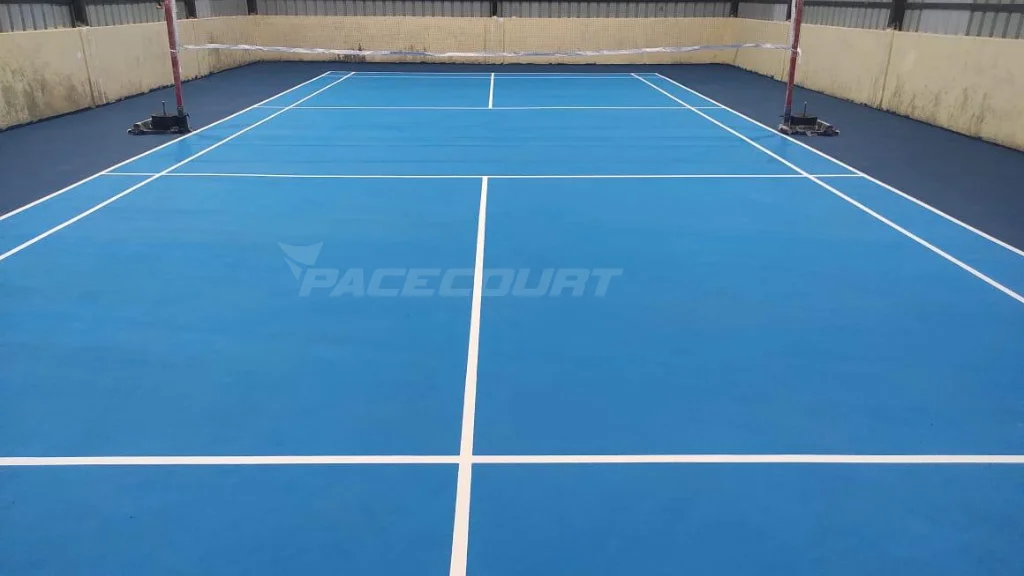
Professional badminton is played indoors on synthetic mats or wooden flooring. These surfaces provide:
- Shock absorption
- Grip for quick footwork
- Reduced injury risk
Most tournament courts use PVC or polyurethane mats laid over wooden floors. The texture prevents slipping while allowing smooth movement.
Concrete surfaces are strongly discouraged for serious play because they increase injury risk.
Outdoor Court Considerations
Outdoor badminton isn’t standard for professional play due to wind interference, but recreational courts may exist outdoors.
If building one, ensure:
- Flat, even ground
- Non-slippery material
- Proper drainage
However, wind can drastically affect shuttle movement, which is why official games remain indoors.
The surface directly influences performance. It’s like running on sand versus a track—your speed and stamina change instantly.
Ceiling Height and Space Requirements
When people think about shuttle court size, they usually focus only on length and width. But here’s the truth: vertical space matters just as much as horizontal space. Badminton is one of the few sports where players regularly hit the shuttle extremely high—sometimes nearly touching the ceiling. If the overhead clearance isn’t sufficient, the entire flow of the game collapses.
The recommended minimum ceiling height for a standard badminton court is 9 meters (30 feet). For international tournaments, it’s often even higher. Why so tall? Because of high clears and defensive lobs. When a player is under pressure, they may send the shuttle soaring deep into the opponent’s court. If the ceiling is too low, those shots become impossible—or worse, the shuttle hits the ceiling and results in a fault.
And it’s not just about height. Adequate space around the court is equally important. Ideally, there should be at least:
- 2 meters (6.5 feet) of space on the sides
- 2 meters (6.5 feet) behind the baselines
This buffer zone prevents players from crashing into walls during intense rallies. Badminton involves explosive lunges and full-speed recovery runs. Without proper clearance, injuries become far more likely.
Think of it like driving a sports car. The car might fit perfectly within the lanes, but you still need shoulders and safety margins for protection. The same logic applies here.
Poor ceiling height changes strategy, too. Players avoid high clears and instead rely on flatter shots, which alters the rhythm of the game. That’s why professional arenas invest heavily in vertical space.
So yes, shuttle court size isn’t just measured across the floor—it extends upward and outward, shaping how freely the game can be played.
Lighting Standards for Badminton Courts
Lighting might not seem directly connected to shuttle court size, but it profoundly impacts visibility and performance. Badminton is fast—really fast. The shuttlecock can travel over 300 km/h in professional smashes. If lighting isn’t adequate, players lose precious reaction time.
Official indoor courts require uniform lighting across the entire playing area. The recommended illumination level for competitive play is at least 500 lux, while international tournaments may demand up to 1000 lux.
Why such brightness? Because the shuttlecock is small and moves quickly against varying backgrounds. Shadows or glare can make it nearly invisible mid-flight.
Lighting should be:
- Evenly distributed
- Positioned to avoid glare
- Installed high above the court
Glare is a huge problem. If lights are placed directly above the center line without proper shielding, players looking upward for high clears will struggle.
Imagine tracking a tiny white object against bright, uneven lights. It’s exhausting. Proper lighting ensures fairness and reduces eye strain.
Also, wall colors matter. Darker backgrounds help players see the shuttle clearly. That’s why professional courts often use dark green or blue walls.
In short, shuttle court size defines the playing area, but lighting defines how well you can use that area. Without proper lighting, even a perfectly measured court feels inadequate.
Measurement Conversions (Feet to Meters)
Badminton is a global sport, so measurements are expressed in both feet and meters. Depending on where you live, you might prefer one over the other. Let’s simplify everything in one easy reference table.
| Court Feature | Feet | Meters |
|---|---|---|
| Full Length | 44 ft | 13.4 m |
| Doubles Width | 20 ft | 6.1 m |
| Singles Width | 17 ft | 5.18 m |
| Short Service Line from Net | 6 ft 6 in | 1.98 m |
| Long Service Line (Doubles) from Baseline | 2 ft 6 in | 0.76 m |
| Net Height at Posts | 5 ft 1 in | 1.55 m |
| Net Height at Center | 5 ft | 1.524 m |
Understanding both units is helpful, especially if you’re marking a court yourself. Some measuring tapes use feet; others use meters. Accuracy is crucial.
A small miscalculation—say, confusing 5.18 meters with 5.8 meters—can widen the court significantly and affect gameplay. Always double-check.
Think of these numbers like a recipe. Baking a cake requires precise measurements. Too much flour, and it’s dry. Too little, and it collapses. The same applies to court dimensions.
Master the conversions, and you’ll never be confused again.
Court Dimensions for Professional Tournaments
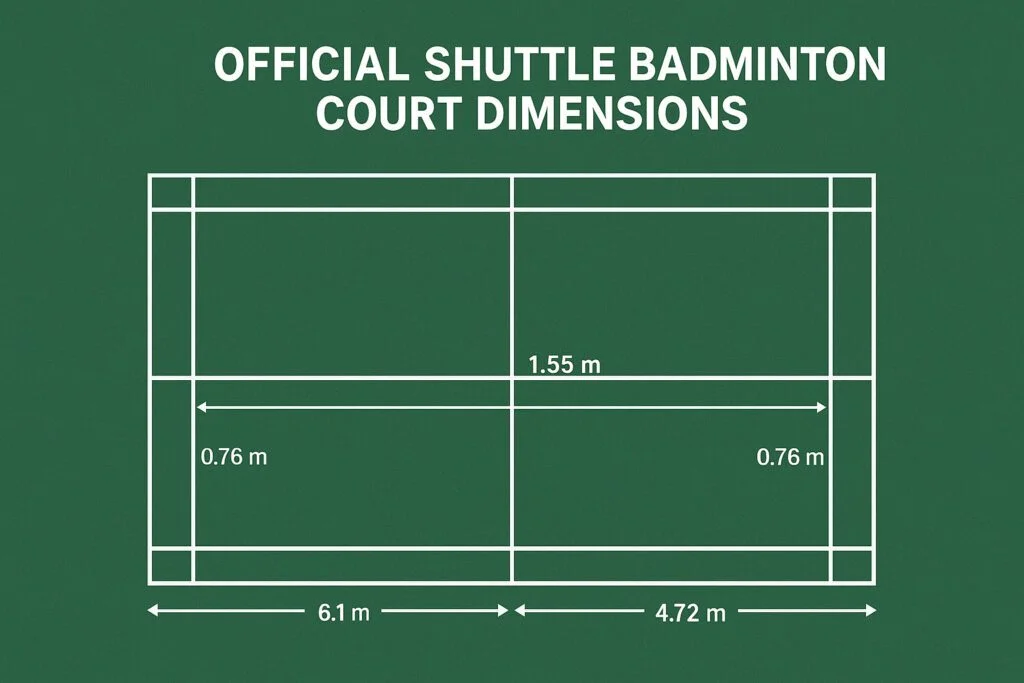
Professional tournaments follow strict guidelines set by the Badminton World Federation (BWF). While the playing area dimensions remain the same, the total arena setup includes much more.
In international competitions, organizers must ensure:
- Standard court size (13.4m x 6.1m)
- Approved flooring materials
- Adequate ceiling height (9m or more)
- Proper lighting standards
- Minimum run-off space around courts
Multiple courts may be installed side-by-side, especially in large tournaments. In such cases, extra spacing is required between courts to prevent interference.
Additionally, tournament courts often use specialized mats with anti-slip properties and shock absorption layers. These mats are typically green or blue to improve shuttle visibility on television broadcasts.
Televised matches also require consistent lighting angles to avoid shadows on camera.
Professional-level precision ensures that no player gains an unfair advantage due to environmental factors. The shuttle court size is standardized worldwide so athletes can compete under identical conditions.
Consistency is the foundation of fairness.
Backyard and Recreational Shuttle Court Size
Not everyone needs a tournament-grade setup. If you’re building a backyard or community court, you can follow official dimensions but adjust based on available space.
Ideally, stick to:
- 44 ft length
- 20 ft width
However, if space is limited, some recreational courts slightly reduce dimensions while keeping proportions similar.
For casual play:
- Mark lines using durable outdoor paint
- Use portable net systems
- Ensure flat ground
Keep in mind that outdoor play introduces wind, which affects shuttle movement significantly. Plastic shuttlecocks are often better outdoors because they’re heavier and more stable.
Even if you can’t match professional standards perfectly, staying close to official shuttle court size ensures a better playing experience.
It’s like practicing on a smaller basketball hoop—fun, but not ideal for serious improvement.
If possible, prioritize accurate width and length over decorative elements. Gameplay quality always comes first.
Common Mistakes When Marking a Shuttle Court
Marking a badminton court might seem straightforward, but many people make costly mistakes. A few centimeters off can distort angles and strategy.
Common errors include:
- Confusing singles and doubles sidelines
- Misplacing the long service line for doubles
- Incorrect net height measurement
- Uneven line thickness
- Ignoring proper run-off space
One frequent mistake is measuring from the wrong side of the line. Remember: the outer edge of the line defines the boundary.
Another issue is failing to ensure a perfectly rectangular shape. If corners aren’t square (90 degrees), diagonal shots won’t feel accurate.
Using a chalk line, measuring tape, and right-angle tool can prevent these problems.
Accuracy matters more than speed during setup. Take your time. Double-check every measurement.
A poorly marked court leads to arguments, frustration, and inconsistent practice results.
Precision equals professionalism—even in recreational settings.
Step-by-Step Guide to Marking Your Own Shuttle Court
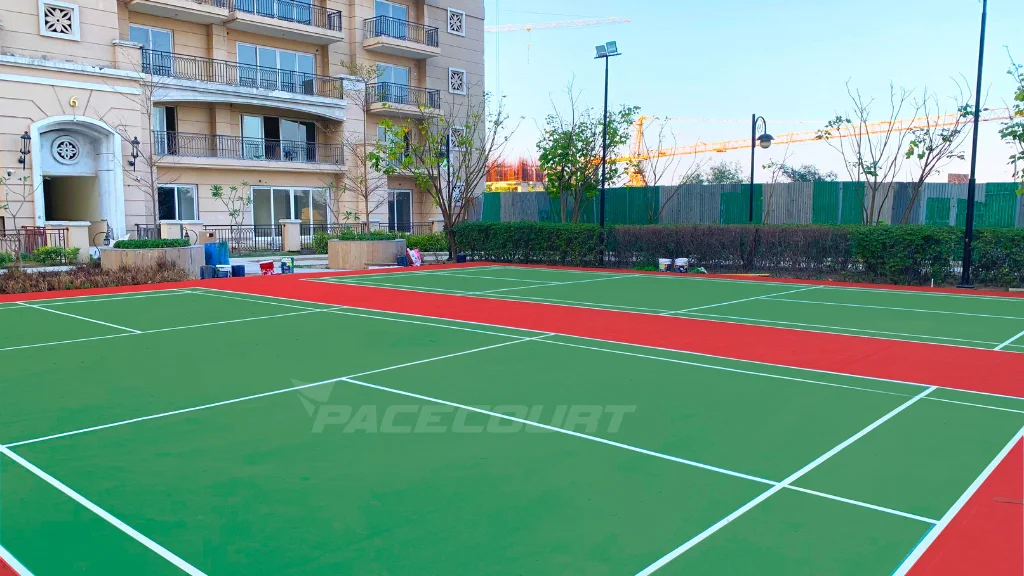
If you’re ready to mark your own shuttle court, here’s a simple process:
- Measure and mark the full length (44 ft).
- Mark the doubles width (20 ft).
- Confirm right angles using a carpenter’s square.
- Draw baselines and outer sidelines first.
- Mark inner singles sidelines.
- Measure 6 ft 6 in from the net for the short service line.
- Add the center line dividing service courts.
- Measure 2 ft 6 in inside the baseline for doubles long service line.
Use durable paint or court tape depending on surface type.
Recheck everything before finalizing. Accuracy is everything.
Once completed, you’ll have a regulation-ready badminton court that mirrors professional standards.
Importance of Accurate Court Size in Performance
You might wonder—does a small difference really matter? Absolutely.
Badminton is a game of millimeters and milliseconds. A slightly wider court changes defensive coverage. A slightly shorter one reduces stamina demands.
Players develop muscle memory based on standard shuttle court size. If dimensions vary, timing and positioning suffer.
Think of it like practicing piano on a keyboard with uneven keys. When you switch to a proper piano, everything feels off.
Accurate court size ensures:
- Fair competition
- Proper skill development
- Strategic consistency
- Injury prevention
Precision builds confidence. When you trust the court dimensions, you play freely.
Comparing Shuttle Court Size with Other Racquet Sports
Let’s put things in perspective.
| Sport | Length | Width |
|---|---|---|
| Badminton | 44 ft | 20 ft |
| Tennis (Doubles) | 78 ft | 36 ft |
| Pickleball | 44 ft | 20 ft |
Interestingly, a badminton doubles court has the same dimensions as a pickleball court. However, badminton feels faster due to lighter equipment and higher net.
Compared to tennis, badminton courts are much smaller—but rallies can be just as intense because of speed and reaction time.
Each sport’s court size reflects its playing style. Badminton prioritizes agility and precision over raw distance.
Maintenance and Court Care Tips
A properly sized court must also be well maintained.
For indoor courts:
- Clean surfaces regularly
- Check net tension
- Inspect line visibility
For outdoor courts:
- Repaint faded lines
- Remove debris
- Ensure proper drainage
Worn-out surfaces reduce grip and increase injury risk.
Regular maintenance preserves the integrity of shuttle court size and gameplay quality.
Conclusion
Understanding shuttle court size isn’t just about memorizing numbers. It’s about appreciating how every measurement shapes the game. From the 44-foot length to the 20-foot doubles width, from net height to service lines, each detail contributes to balance, fairness, and excitement.
When dimensions are accurate, the sport flows naturally. Movement feels right. Strategy makes sense. Competition stays fair.
Whether you’re building a backyard court or preparing for professional play, precision matters.
Master the space—and you master the game.