When people talk about the floor of a tennis court, they are usually referring to the playing surface or the court surface. This surface plays a major role in how the game feels, how fast the ball moves, and how safe the players are. Each surface type has unique characteristics, and knowing the correct terms helps players, coaches, and court builders understand the game better.
Table of contents
- Types of Tennis Court Flooring Materials
- Why Synthetic Acrylic Flooring Stands Out
- Tennis Court Floor Surface Matters
- How Synthetic Acrylic Courts Compare To Other Surfaces
- Summary Table: Acrylic vs Other Court Surfaces
- Why Choose Pacecourt for the Floor of Your Tennis Court?
- Industry-Leading Synthetic Acrylic Flooring System
- Built for Indian Weather Conditions
- Long-Lasting Durability (8–10+ Years)
- Conclusion
Types of Tennis Court Flooring Materials
Tennis court flooring materials come in various types, each offering unique characteristics that affect the speed of play, maintenance requirements, and player comfort. Here are the most common types of tennis court flooring materials:
1. Hard Courts
- Material: Asphalt or concrete with an acrylic surface coating.
- Characteristics:
- Medium-paced surface.
- Durable and low maintenance.
- Offers consistent ball bounce.
- Examples: Used in tournaments like the US Open and Australian Open.
2. Clay Courts
- Material: Crushed stone, brick, or shale.
- Characteristics:
- Slower-paced surface, favoring baseline players.
- Requires regular maintenance (watering, rolling, and brushing).
- Softer on joints and reduces player fatigue.
- Examples: Red clay (used in the French Open) and green clay (Har-Tru).
3. Grass Courts
- Material: Natural grass grown on a firm soil base.
- Characteristics:
- Fast-paced surface with low, unpredictable ball bounce.
- Requires high maintenance (mowing, watering, and reseeding).
- Soft and easy on players’ joints.
- Examples: Used in Wimbledon.
4. Carpet Courts
- Material: Synthetic or removable materials like artificial turf or textile.
- Characteristics:
- Medium to fast-paced surface.
- Often used for indoor courts or temporary setups.
- Requires minimal maintenance.
- Examples: Found in some indoor facilities.
5. Acrylic or Synthetic Courts
- Material: Layers of acrylic or synthetic materials over a base (concrete or asphalt).
- Characteristics:
- Customizable speed and cushioning.
- Durable and weather-resistant.
- Popular for recreational and professional use.
6. Artificial Turf Courts
- Material: Synthetic grass with sand infill.
- Characteristics:
- Mimics the feel of grass courts.
- Low maintenance compared to natural grass.
- Slower than natural grass but still offers good playability.
7. Rubberized Courts
- Material: Rubber or cushioned synthetic materials.
- Characteristics:
- Provides excellent shock absorption and player comfort.
- Ideal for multi-sport facilities.
- Requires periodic cleaning and maintenance.
Each type of tennis court flooring has its pros and cons, and the choice often depends on factors like climate, budget, and the level of play (recreational or professional).
Why Synthetic Acrylic Flooring Stands Out
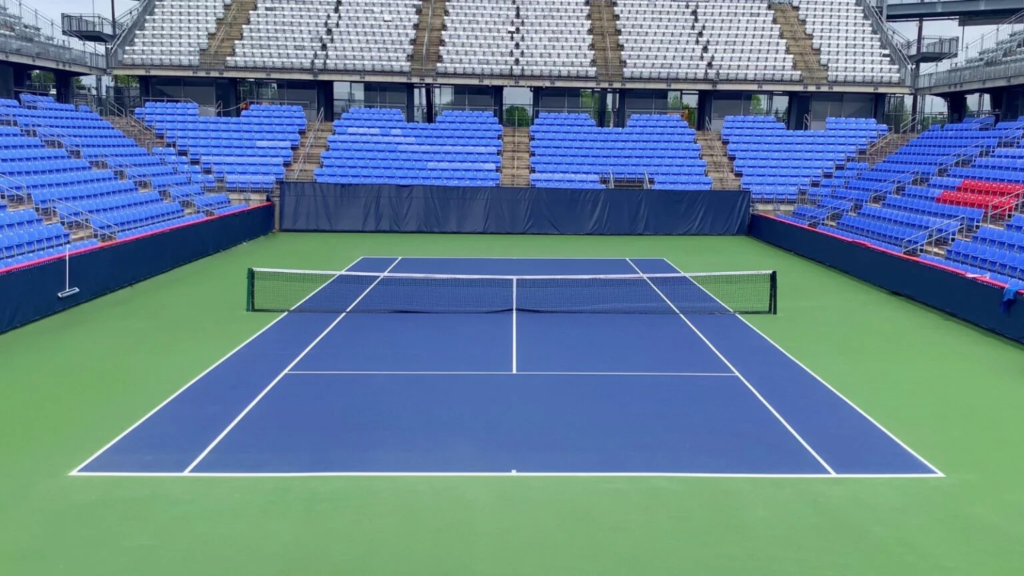
Synthetic acrylic flooring is a popular choice for tennis courts, and it stands out for several reasons. Here’s why it’s a preferred option for both recreational and professional use:
1. Versatility
- Customizable Speed: Acrylic surfaces can be tailored to provide different levels of speed and bounce, making them suitable for players of all skill levels.
- Multi-Sport Use: Beyond tennis, these courts can also accommodate other sports like basketball or pickleball, adding to their versatility.
2. Durability
- Weather Resistance: Acrylic surfaces are designed to withstand harsh weather conditions, including UV rays, rain, and temperature fluctuations.
- Long Lifespan: With proper maintenance, synthetic acrylic courts can last for years without significant wear and tear.
3. Low Maintenance
- Easy to Clean: The smooth surface makes it easy to remove dirt, debris, and stains.
- Minimal Repairs: Unlike clay or grass courts, acrylic courts don’t require frequent resurfacing or daily upkeep.
4. Consistent Playability
- Even Ball Bounce: The uniform surface ensures predictable ball behavior, which is crucial for competitive play.
- Medium Pace: Acrylic courts offer a balanced speed, making them ideal for a wide range of playing styles.
5. Player Comfort
- Cushioned Options: Some acrylic systems include cushioned layers that reduce impact on players’ joints, minimizing fatigue and injury risk.
- Non-Slip Surface: The textured finish provides excellent grip, even in wet conditions.
6. Aesthetic Appeal
- Custom Colors: Acrylic courts can be painted in a variety of colors, allowing for branding, team colors, or unique designs.
- Professional Look: The sleek, polished finish gives the court a high-end, professional appearance.
7. Cost-Effectiveness
- Affordable Installation: Compared to grass or clay courts, acrylic surfaces are more budget-friendly to install.
- Low Long-Term Costs: The minimal maintenance requirements and durability make it a cost-effective choice over time.
8. Eco-Friendly Options
- Many acrylic systems are now made with environmentally friendly materials, reducing their carbon footprint.
Where It’s Used
- Professional Tournaments: Acrylic courts are used in major tournaments like the US Open and Australian Open, showcasing their quality and reliability.
- Recreational Facilities: They are a go-to choice for schools, clubs, and community centers due to their durability and low upkeep.
In summary, synthetic acrylic flooring stands out because it combines performance, durability, and cost-effectiveness, making it a top choice for tennis courts worldwide. Whether for casual play or professional tournaments, it delivers a consistent and enjoyable playing experience.
Tennis Court Floor Surface Matters
The tennis court surface influences:
✔ Player performance
Some players perform better on clay, others on grass or hard courts.
✔ Ball behaviour
Speed, bounce height, and spin reaction vary by surface.
✔ Player safety
High-quality flooring reduces injuries and improves support during quick movements.
✔ Maintenance needs
Hard courts need less maintenance compared to clay or grass.
How Synthetic Acrylic Courts Compare To Other Surfaces
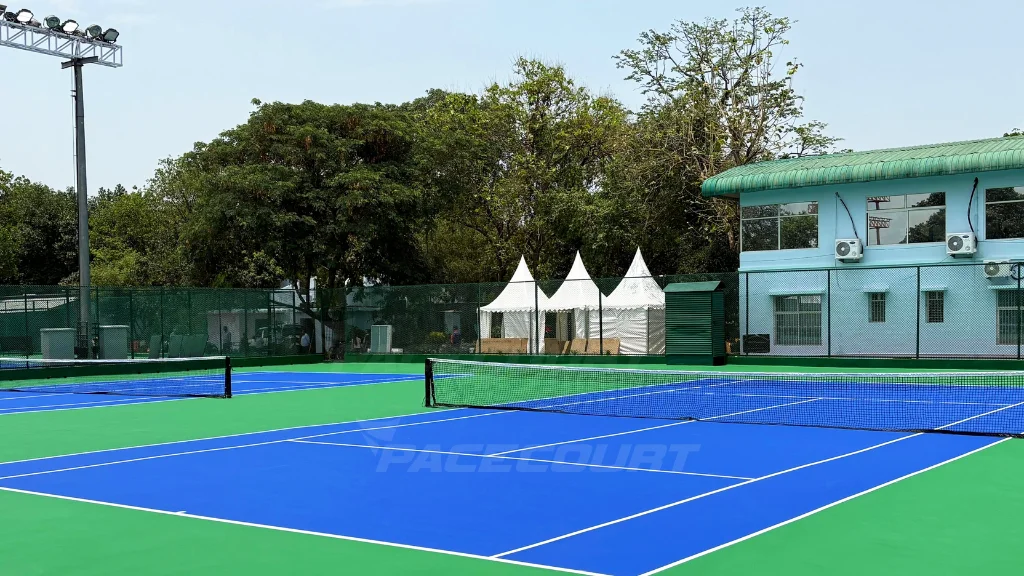
Tennis court surfaces significantly impact performance, safety, and maintenance. Among all modern flooring options, synthetic acrylic courts have become one of the most popular choices for clubs, academies, residential spaces, and professional players. But how do they actually compare to other surfaces like clay, grass, turf, and concrete?
This guide breaks down the differences clearly so you can understand why synthetic acrylic courts stand out.
1. Synthetic Acrylic vs Clay Courts
Acrylic Court Advantages
- Faster surface → ideal for modern fast-paced play
- Consistent bounce → reduces unpredictability
- Low maintenance → no watering, rolling, or clay refilling
- All-weather compatible
Clay Court Advantages
- Slower pace → great for baseline rallies
- Natural sliding → many players enjoy this
- Softer on joints
Which Is Better?
Synthetic acrylic is better for training efficiency and match consistency, while clay is preferred for long rallies and technical players.
2. Synthetic Acrylic vs Grass Courts
Acrylic Court Advantages
- Much lower maintenance
- More durable and long-lasting
- Predictable bounce
- Usable year-round
Grass Court Advantages
- Fastest surface
- Classic, premium feel
- Soft underfoot
Which Is Better?
Grass is enjoyable but impractical due to high maintenance. Acrylic courts are more economical, durable, and predictable.
3. Synthetic Acrylic vs Concrete Courts
Acrylic Court Advantages
- Shock-absorbing layers → reduces injury risk
- Controlled speed & bounce
- Non-slippery texture
- Better for player joints
Concrete Court Advantages
- Extremely durable
- Very low construction cost
Which Is Better?
Concrete without acrylic coating is too hard, leading to injuries. Acrylic-coated concrete courts are the modern standard.
4. Synthetic Acrylic vs Artificial Grass/Turf Courts
Acrylic Court Advantages
- Consistent bounce
- No infill problems (rubber/sand displacement)
- Better ball control
- Preferred for competitive play
Artificial Turf Advantages
- Very comfortable surface
- Suitable for multipurpose sports
- Softer for beginners and recreational players
Which Is Better?
Acrylic courts are better for serious tennis training & tournaments, while turf is ideal for recreational multi-sport use.
5. Synthetic Acrylic vs Carpet Courts (Indoor)
Acrylic Court Advantages
- Outdoor-friendly
- More durable
- Uniform friction
Carpet Court Advantages
- Very fast surface
- Easy installation indoors
Which Is Better?
Carpet courts are niche; acrylic is far more versatile and widely used.
Summary Table: Acrylic vs Other Court Surfaces
| Surface Type | Speed | Bounce | Maintenance | Durability | Best For |
|---|---|---|---|---|---|
| Synthetic Acrylic | Medium-Fast | Consistent | Low | High | Training, clubs, tournaments |
| Clay | Slow | High | High | Medium | Baseline play, technique training |
| Grass | Fast | Low | Very High | Low-Medium | Premium clubs, tournaments |
| Concrete (Uncoated) | Fast | Hard | Very Low | Very High | Budget courts |
| Artificial Turf | Medium | Moderate | Medium | Medium | Recreational play |
| Carpet | Very Fast | Low | Low | Medium | Indoor facilities |
Why Choose Pacecourt for the Floor of Your Tennis Court?
Choosing the right flooring for a tennis court is one of the most important decisions for any academy, sports complex, school, club, or homeowner. The quality of the surface directly affects performance, safety, durability, and long-term maintenance costs.
Among all tennis flooring brands in India, Pacecourt stands out as a trusted and highly preferred name. Here’s why Pacecourt is the ideal choice for the floor of your tennis court.
Industry-Leading Synthetic Acrylic Flooring System
Pacecourt specializes in premium multi-layer synthetic acrylic systems that offer:
- Medium-fast play speed
- Consistent and true ball bounce
- Superior grip and anti-slip texture
- Shock absorption for injury prevention
- Smooth, seamless finish
This makes Pacecourt courts suitable for professional training, tournaments, and recreational play.
Built for Indian Weather Conditions
Indian climates can be harsh — extreme heat, monsoons, dust, and UV exposure.
Pacecourt’s surfaces are engineered to withstand:
- High temperatures
- Heavy rainfall
- Direct sunlight
- High foot traffic
The result? A long-lasting, fade-resistant, and weather-proof tennis court floor.
Long-Lasting Durability (8–10+ Years)
Pacecourt surfaces use high-quality acrylic resins, rubberized cushioning, and UV-stable pigments.
These materials help ensure:
- No cracking
- No peeling
- No colour fading
- Minimal maintenance
This durability makes Pacecourt a cost-efficient investment over time.
Conclusion
The “floor” of a tennis court is properly known as the tennis court surface. It can be made of hard acrylic, clay, grass, artificial turf, or carpet, and each type creates a different playing experience.
Understanding the court surface helps players, builders, and clubs choose the best option for performance, durability, and safety.