Tennis Court vs Pickleball Court

Pickleball Court Vs Tennis Court
Tennis Court vs Pickleball Court

Pickleball Court Vs Tennis Court: Which Should You Build?

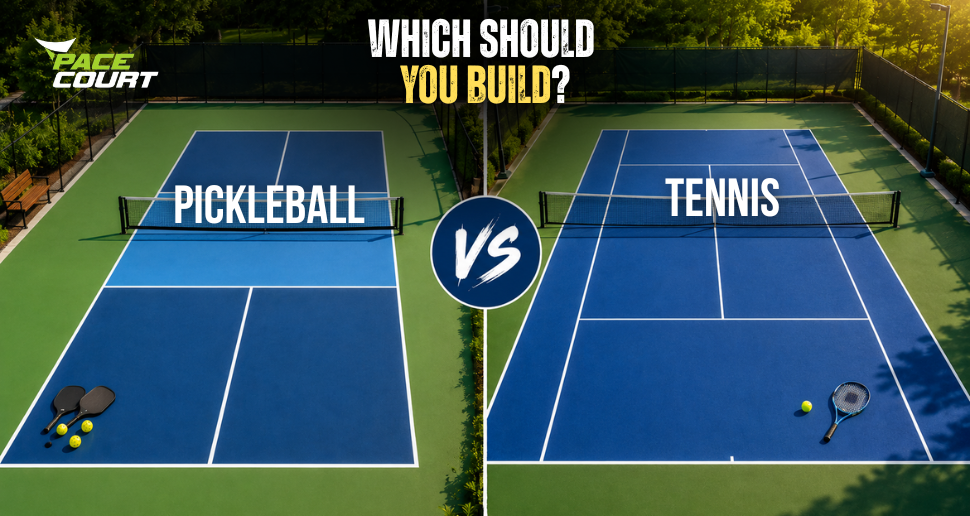
A pickleball court measures just 20 feet by 44 feet, while a full tennis court spans 78 feet by 36 feet – nearly four times the space. This one difference drives almost everything else that separates the two sports: construction cost, land requirement, gameplay speed, equipment price, and even injury risk. This guide compares pickleball court vs tennis court on every parameter that matters in 2026, using updated India-specific construction costs, equipment prices, and participation data, so you can pick the right court for your budget, property, and fitness goals. Pickleball Court Vs Tennis Court: Quick Comparison Table Parameter Pickleball Court Tennis Court Playing area 20 ft × 44 ft (6.10m × 13.41m) – same for singles and doubles 78 ft × 27 ft (singles) or 78 ft × 36 ft (doubles) Total land with run-off space ~30 ft × 60 ft (1,800 sq ft) ~120 ft × 60 ft (7,200 sq ft) Net height 36 inches at the posts, 34 inches at the center 42 inches at the posts, 36 inches at the center Special zone 7-foot non-volley zone (“the kitchen”) on both sides No non-volley zone Courts per equal footprint Up to 4 pickleball courts fit inside one tennis court 1 tennis court Outdoor construction cost (India, 2026) ₹3 lakh – ₹9 lakh ₹8 lakh – ₹25 lakh Indoor construction cost (India, 2026) ₹10 lakh – ₹15 lakh ₹25 lakh and above Typical construction time 4–5 weeks 4–7 weeks Entry-level equipment cost ₹2,000 – ₹8,000 (paddle) ₹2,000 – ₹15,000 (racket) Approx. calories burned per hour 400–450 500–580 Growth in India (2024–2026) Explosive – several-fold rise in players and courts Steady and institutionally established What Is a Pickleball Court? A pickleball court construction is a compact, rectangular playing surface that measures 20 feet by 44 feet, uses the same dimensions for singles and doubles, and includes a low net with a no-volley zone near it called the kitchen. Builders mark it with 2-inch-wide lines, and the smaller footprint makes it one of the easiest racquet-sport courts to fit into Indian residential societies, schools, and rooftops. Pickleball Court Dimensions and Layout The playing surface stays fixed at 20 ft × 44 ft regardless of whether players compete in singles or doubles, unlike tennis, which adds extra width for doubles alleys. Builders typically recommend a minimum total footprint of 30 ft × 60 ft, or roughly 1,800 square feet, once you add safety run-off space around the perimeter. Indoor courts need at least 5.5 meters of ceiling clearance, since lower ceilings cause lob shots to strike the roof. The Non-Volley Zone (“The Kitchen”) Explained Each side of the net carries a 7-foot no-volley zone, popularly called the kitchen, and players cannot strike the ball out of the air while standing inside it. This rule slows down aggressive net play, forces longer rallies near the net, and gives the sport its distinctive, strategy-heavy character. Tennis has no equivalent zone, so players can volley from anywhere on the court, including right against the net. Net Height and Court Markings A pickleball net stands 36 inches high at the sidelines and dips to 34 inches at the center, which is lower than a tennis net at every point. All lines on the court, including the baseline and sidelines, measure 2 inches wide, keeping the layout simple and easy to paint even on converted surfaces. What Is a Tennis Court? A tennis court build is a larger rectangular playing surface that runs 78 feet long and spans 27 feet wide for singles or 36 feet wide for doubles, separated by a net that sits higher than a pickleball net at every point. The extra width for doubles alleys, the taller net, and the larger service boxes together demand nearly four times the land a pickleball court needs. Tennis Court Dimensions: Singles Vs Doubles Singles matches use a 78 ft × 27 ft court, while doubles matches use the full 78 ft × 36 ft width, adding a doubles alley on each side. Builders generally plan for a total footprint of about 120 ft × 60 ft, or roughly 7,200 square feet, once run-off areas behind the baseline and beside the sidelines are included. Net Height, Service Boxes and Court Lines A tennis net measures 42 inches at the posts and drops to 36 inches at the center, giving it a more pronounced curve than a pickleball net. Service boxes sit close to the net on each side, and the baseline can measure up to 4 inches wide, while other lines must be at least 2 inches wide under ITF standards. Surface Types Common in India Acrylic-coated concrete dominates Indian tennis courts because it handles monsoon rain, summer heat, and UV exposure reliably at a manageable cost. Synthetic clay and cushioned acrylic systems appear at premium academies and clubs, while natural grass courts remain extremely rare across the country due to high maintenance demands. Pickleball Court Vs Tennis Court: Space and Land Requirement Land scarcity in Indian cities makes this comparison especially relevant for residential societies, schools, and sports clubs. A pickleball court needs only about 1,800 square feet of buildable area, while a tennis court needs close to 7,200 square feet – nearly four times as much. This gap explains why so many gated communities and rooftop facilities in Gurugram, Bengaluru, and Mumbai now choose pickleball over tennis: the smaller court fits spaces where a tennis court simply cannot. Because one tennis court occupies the same footprint as four pickleball courts, facility owners with existing tennis infrastructure often add pickleball lines rather than acquiring new land. This flexibility gives pickleball a structural cost advantage that goes beyond construction pricing alone. Construction Cost Comparison in India (2026) Construction cost remains the deciding factor for most builders comparing pickleball court vs tennis court projects in India. Both sports use similar acrylic-on-concrete construction methods, but the smaller pickleball footprint reduces nearly every cost component, from base preparation to fencing. Pickleball Court Cost in India (2026) A standard

Pickleball Court Dimensions vs Tennis Court
Tennis Court vs Pickleball Court

Pickleball Court Dimensions vs Tennis Court: Key Differences Explained

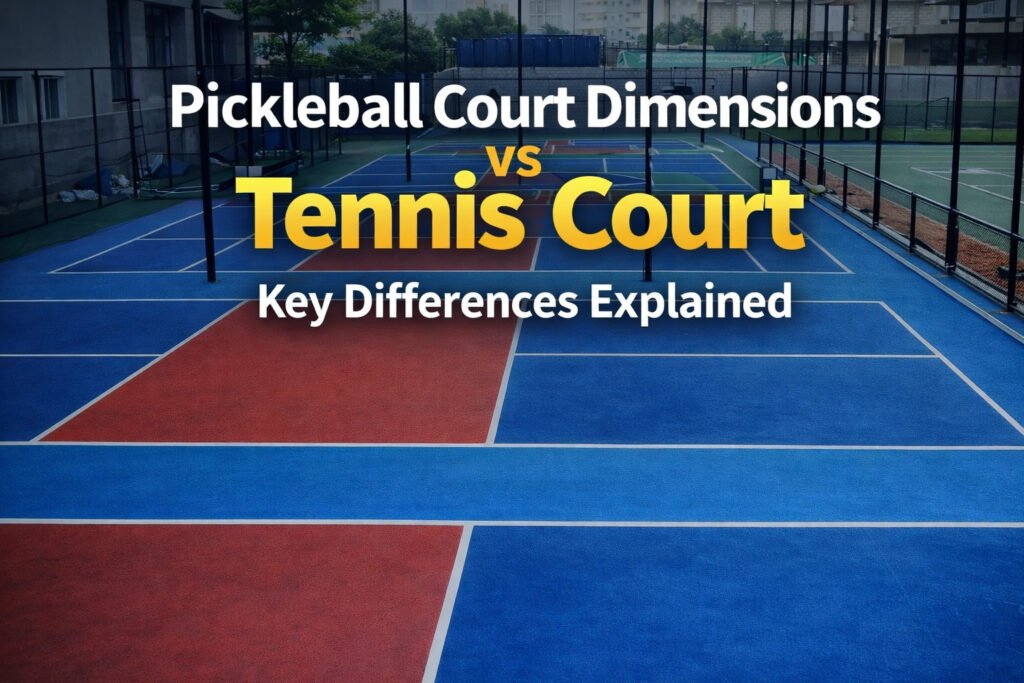
Introduction to Pickleball and Tennis Courts The Rising Popularity of Pickleball If you’ve stepped anywhere near a community park, gym, or even a converted driveway lately, chances are you’ve heard the unmistakable pop of a pickleball paddle. This fast-growing sport has exploded in popularity across the United States and beyond, attracting players of all ages. What makes pickleball so appealing? It’s simple to learn, easy on the joints, and incredibly social. But one of the most interesting aspects—especially for beginners—is how its court compares to the much larger tennis court. Pickleball courts are often described as “mini tennis courts,” but that comparison only scratches the surface. The dimensions, layout, and even the way space is used differ in ways that significantly impact gameplay. You might assume a smaller court just means less running, but it actually creates a faster-paced, more strategic game where reflexes matter just as much as endurance. That’s why understanding court dimensions isn’t just a technical detail—it shapes how the game feels. Across recreational centers, many facilities are converting unused tennis courts into multiple pickleball courts. This trend highlights not just pickleball’s growth but also how adaptable its court design is. Unlike tennis, which requires a large dedicated space, pickleball can fit into tighter areas, making it more accessible in urban environments. This flexibility has fueled its rapid rise and made it a favorite among beginners and seasoned athletes alike. So before you grab a paddle or racket, it’s worth digging into what really sets these courts apart. The differences go beyond size—they redefine how each sport is played. Tennis: A Timeless Classic While pickleball might be the new kid on the block, tennis remains one of the most respected and globally recognized sports. With a history stretching back centuries, tennis courts have been standardized to support high-level competition, from local clubs to Grand Slam tournaments. When you step onto a tennis court, you’re entering a space designed for power, precision, and endurance. Tennis courts are significantly larger than pickleball courts, which immediately changes the physical demands of the game. Players cover more ground, hit with greater force, and rely heavily on stamina and footwork. The larger dimensions allow for a wider variety of shots—deep baseline rallies, angled cross-court hits, and powerful serves that can reach impressive speeds. In contrast to pickleball’s tight, reactive gameplay, tennis feels expansive and physically demanding. Another defining feature of tennis courts is their versatility in surface types. From clay to grass to hard courts, each surface introduces unique playing conditions. A clay court slows the ball down and emphasizes long rallies, while grass courts speed things up and favor aggressive play. This diversity adds another layer of complexity that pickleball courts, which are typically uniform, don’t emphasize as much. Despite the rise of pickleball, tennis courts remain a staple in sports complexes worldwide. However, their large footprint has also made them prime candidates for conversion. It’s not uncommon to see a single tennis court repurposed into multiple pickleball courts, which speaks volumes about how space efficiency plays into modern sports trends. Understanding tennis court dimensions isn’t just about numbers—it’s about appreciating how the design supports a completely different style of play. And when you compare it to pickleball, the contrast becomes even more fascinating. Standard Pickleball Court Dimensions Court Size and Layout A standard pickleball court measures 20 feet wide by 44 feet long, and here’s the surprising part—it’s the same size whether you’re playing singles or doubles. That alone sets it apart from tennis, where court dimensions change depending on the format. This uniformity simplifies the game and makes it more accessible, especially for beginners who don’t want to memorize multiple layouts. To put things into perspective, a pickleball court is roughly one-quarter the size of a tennis court. That smaller footprint dramatically changes how the game is played. Instead of relying on long sprints and powerful serves, players focus more on control, placement, and quick reactions. It’s a bit like playing chess on a smaller board—every move counts, and there’s less room for error. The court is divided into two equal halves by a net, with clearly marked service areas on each side. Each half contains a right and left service box, similar to tennis, but smaller and more compact. These service boxes dictate where serves must land, adding a layer of strategy even before a rally begins. Because the court is smaller, players often find themselves engaged in rapid-fire exchanges at the net, which can be both thrilling and challenging. Another important aspect is the baseline and sideline boundaries, which define the playable area. The compact dimensions mean that balls go out of bounds more quickly, so precision becomes crucial. A slight miscalculation can end a rally instantly, which keeps players on their toes. This smaller, more contained environment is one of the reasons pickleball has gained such widespread appeal. It lowers the barrier to entry while still offering a competitive and engaging experience. Whether you’re playing casually or in a tournament, the court’s dimensions ensure a fast-paced, exciting game every time. Non-Volley Zone (Kitchen) Explained One of the most unique features of a pickleball court—and something you won’t find in tennis—is the non-volley zone, commonly known as the “kitchen.” This area extends 7 feet from the net on both sides and plays a crucial role in shaping the game’s strategy. At first glance, it might seem like just another marked section of the court, but it fundamentally changes how players approach rallies. The kitchen exists to prevent players from dominating the net with aggressive volleys. In tennis, players often rush the net to finish points with powerful smashes. If that were allowed in pickleball without restriction, the smaller court would make rallies extremely short and less strategic. By prohibiting volleys within this zone, the game encourages more thoughtful play and longer exchanges. Players can enter the kitchen, but they must let the ball bounce before hitting it. This rule creates a delicate balance between offense and

Pickleball court, Tennis Court vs Pickleball Court

Tennis Court vs Pickleball Court

Pickleball has gained popularity across the nation and is a hybrid of badminton and tennis. It’s on the verge of becoming everybody’s favourite sport. To accommodate their new passion, many pickleball enthusiasts are even converting or adapting old tennis courts into pickleball courts. Tennis and pickleball are both played on courts that are roughly rectangular in shape with a net running down the middle, but there are some differences. Tennis courts are more significant than pickleball court size, so pickleball courts are more affordable. Additionally, you can choose the colour of your court because pacecourt allows you to customise the colour of your court. People can convert tennis courts to pickleball courts. For any customer who wants to build a tennis or pickleball court or is unsure of what court will look good and where to purchase it, this blog is for you, so let us now discuss Tennis Court vs Pickleball Court Differentiating Tennis Court vs Pickleball Court Tennis courts are more significant, which is the most noticeable distinction between the two sports. A much smaller court is used for pickleball. Tennis courts are 60 feet wide and 120 feet long, whereas pickleball courts are 20 feet wide and 44 feet long, which is roughly the same size as badminton courts. A regular tennis court can accommodate four pickleball courts.  Pickleballs and tennis balls are as dissimilar as they come—the only thing they have in common is colour! tennis balls have soft, fabric-like finishes and white, curved lines, making them almost identical to regular tennis balls in appearance. The correct compression level (which is 25% less than a tennis ball) indicated by large green dots on standard tennis balls. Conversely, pickleball resembles a wiffle ball in that they made of polymer and have holes all over the ball. Tennis Court Flooring Tennis is a very popular sport that is played both competitively and for fun. The game has a lot of back-and-forth action, which keeps the players’ attention constantly. Tennis is incredibly beneficial for the body and mind because it promotes wellness. Whatever the reason, a sport like a game of tennis, which calls for a high degree of precision as well as intense physical and mental strength, needs a good playing surface or infrastructure., There are 8 tennis court flooring colours. Throughout the world, Pacecourt provides the finest synthetic flooring. Some considerations to make when selecting tennis court flooring material Pickleball Court Flooring It’s essential to have a thorough understanding of pickleball court flooring whether you’re building a new pickleball court from scratch, converting an existing tennis or badminton court into a pickleball court, or building a multisports court. Additionally, you must consider and modify the typical pickleball court flooring size to suit your needs. The following other differences between Tennis Court vs Pickleball Court: Netting. The net on a pickleball court is 34 inches wide in the centre, whereas the net on a tennis court is the same height at 36 inches. volleyball area. In pickleball, there is a no-volley zone that is seven feet from the net and three and a half feet on each side.  Double and single courts. Teams of two can use the “doubles alleys” on each side of the tennis courts. The size of a pickleball court is the same for singles and doubles play. The markings on each court are comparable to one another.  Pickleball scoring is as distinctive as the sport’s name. Three numbers used to indicate the score: 1) the serving team score, 2) the receiving team score, and 3) the server number (one or two). The first server positioned to the left, and the second server positioned to the right. Pickleball has a special rule where the server on the right initiates play, which is why you call zero-zero-two. The server would call “zero-zero-two” to begin a pickleball game, and the score would increase by one for each goal scored by each team. Pop tennis has the same rules for scoring as regular tennis court flooring, unlike pickleball. Each score is as follows: love (zero points), 15, 30, 40, and game points. The server calls the score before the ball is hit. Tennis Court And Pickleball Court Tennis and pickleball are both enjoyable sports for anyone who wants to be physically fit all around. The games are a great way to meet new people and are very social. Whether you select one, the other, or both, you’ll discover that you’re having a blast, meeting new people, and generally loving life. The best thing about these two sports is that players of all ages and athletic abilities can enjoy and participate in them. These multiplayer games designed to engage the entire community, including family and friends. You can reach Pacecourt at any time to place an order for materials, whether they are for a pickleball court or a tennis court.

Scroll to Top
HOMEOWNERS
BUSINESS OWNERS
ARCHITECTS
MUNICIPALITIES

Let's Build
Great Courts

ITF-certified acrylic flooring for Tennis, Basketball, Badminton, Pickleball & more shipped worldwide.

Premium Quality

World-class material & Construction

Expert Team

Experinced Proffectionals at your Service

End-to-End Support

From concept to completions

Get In Touch

We will respond as soon as possible 

[pw_popup_form]

    Your information is secure and will never be shared

    ISO-Certificate