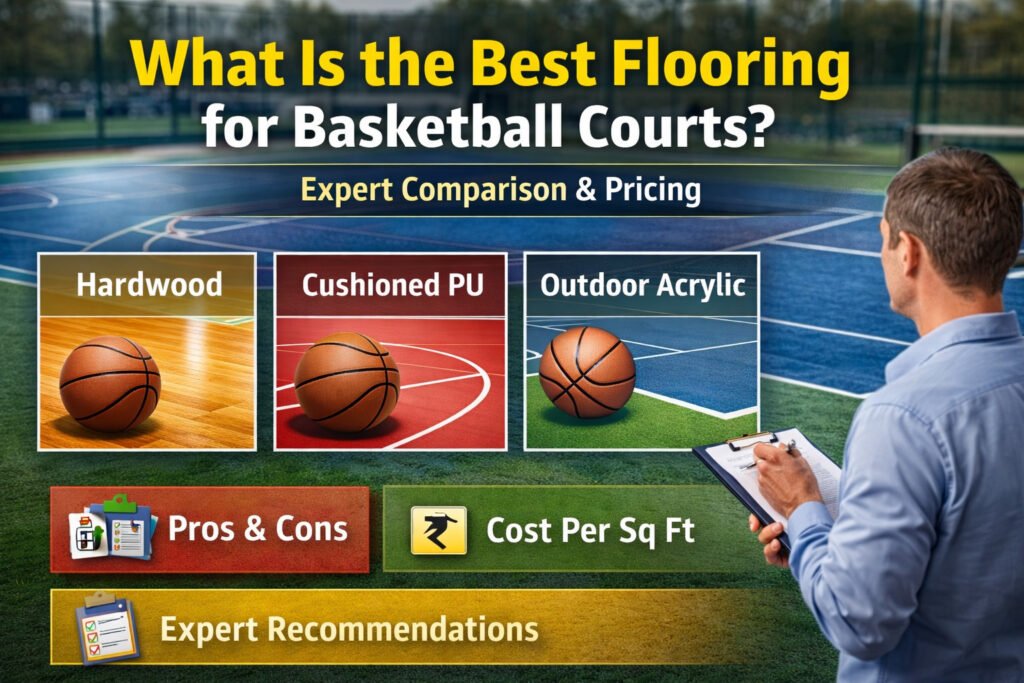
What Is the Best Flooring for Basketball Courts? Expert Comparison & Pricing
Basketball court flooring isn’t just something you play on—it’s something that plays with you. Every sprint, jump, pivot, and hard landing sends force straight through your feet, ankles, knees, and hips. The type of surface beneath you decides whether that force is absorbed safely or fired right back into your joints like a loaded spring. That’s why flooring is one of the most overlooked yet critical aspects of basketball performance and long-term health. For beginners, the wrong flooring can turn learning the game into a painful experience. Slippery surfaces kill confidence, while rock-hard courts punish joints and muscles that aren’t conditioned yet. Intermediate players start to feel the difference more clearly. As speed increases and movements become sharper, flooring quality starts influencing reaction time, balance, and even shooting rhythm. Advanced players? They demand perfection. A slight inconsistency in bounce or grip can throw off elite-level play. There’s also the injury factor. Poor flooring contributes to ankle sprains, knee stress, shin splints, and lower back pain. Over time, these issues stack up. A good basketball floor reduces fatigue, improves movement efficiency, and allows players to train longer without breaking down physically. It’s like wearing the right shoes versus running barefoot on gravel—same athlete, wildly different outcome. In short, basketball flooring isn’t a background detail. It’s a silent teammate that either supports your game or slowly sabotages it. Understanding this is the first step toward choosing the best basketball court flooring for your skill level. The Science Behind Basketball Court Flooring At first glance, a basketball court might just look flat and hard. But beneath that surface lies a carefully engineered system designed to manage energy, friction, and impact. Good basketball flooring is a blend of physics, biomechanics, and material science working together. Shock absorption is the big one. Every time a player jumps and lands, several times their body weight crashes into the floor. High-quality flooring absorbs a portion of that impact, reducing stress on joints and muscles. Hardwood and polyurethane systems excel here, while concrete does almost nothing to protect the body. Over time, that difference can mean healthy knees—or chronic pain. Ball bounce consistency is another critical factor. Basketball is a rhythm-based game. Dribbling relies on predictable rebound height and speed. Uneven or overly soft surfaces kill that rhythm, forcing players to adjust constantly. Professional-grade flooring ensures uniform ball response across the entire court, allowing players to focus on skill instead of compensation. Traction is where things get interesting. Too little grip and players slip, risking injury. Too much grip and the foot sticks while the body twists, which is a recipe for knee injuries. The best basketball flooring finds that sweet spot—enough traction for explosive movement without locking the foot in place. All these elements—shock absorption, ball response, and traction—must work together. When they do, the floor almost disappears from the player’s awareness. And that’s exactly the goal: a surface that supports performance without demanding attention. Types of Basketball Court Flooring Before choosing the best flooring, it helps to understand the full landscape of basketball court surfaces. Think of this section as zooming out and looking at the map before picking a route. Not all basketball courts are built for the same purpose, environment, or player level, and flooring options reflect that diversity. The first major divide is indoor vs outdoor basketball flooring. Indoor courts prioritize performance, comfort, and consistency. They’re protected from weather, which allows for materials like hardwood, vinyl, and polyurethane that would never survive rain or UV exposure. Outdoor courts, on the other hand, are built to endure heat, cold, moisture, and constant wear. Durability often wins over comfort outside, which is why concrete and asphalt are still common—despite their drawbacks. Next comes permanent vs modular flooring systems. Permanent flooring is installed once and intended to stay for decades. Hardwood courts and poured polyurethane systems fall into this category. They require professional installation and higher upfront costs but offer elite performance. Modular systems, usually interlocking tiles, are more flexible. They can be installed, removed, and relocated, making them popular for home courts, schools, community centers, and temporary events. Finally, there’s natural vs synthetic surfaces. Natural wood, especially maple, has been the gold standard for decades. Synthetic materials like vinyl, rubber, acrylic, and PU are engineered alternatives designed to mimic or enhance certain properties of wood while reducing maintenance or cost. Understanding these categories helps narrow your options fast. A beginner setting up a driveway hoop doesn’t need the same surface as a competitive indoor league. Once you know where and how the court will be used, the “best” flooring choice becomes much clearer. Hardwood Basketball Flooring: The Gold Standard When people picture a “real” basketball court, they almost always imagine polished hardwood. That’s not an accident. Hardwood—specifically maple wood—has earned its reputation through decades of elite-level play. Maple is dense, durable, and incredibly consistent. It provides excellent ball bounce, controlled traction, and natural shock absorption. This is why professional leagues, including the NBA and NCAA, rely on maple hardwood courts. The surface responds predictably, which allows players to move instinctively without hesitation. The pros are hard to ignore: But hardwood isn’t perfect. It’s expensive—not just to install, but to maintain. Regular cleaning, refinishing, humidity control, and occasional repairs are part of the deal. Moisture is its enemy, which makes hardwood unsuitable for outdoor courts or poorly ventilated spaces. So who should choose hardwood? Advanced players, competitive leagues, professional training facilities, and schools with long-term budgets. For beginners or casual users, hardwood is often overkill. It’s like buying a race car to learn how to drive. Incredible—but not always practical. Synthetic Basketball Court Flooring Options Synthetic flooring has come a long way. Today’s materials aren’t cheap knockoffs of hardwood—they’re purpose-built solutions designed to solve specific problems like cost, maintenance, or multi-sport use. Polyurethane (PU) flooring is one of the most popular indoor alternatives to hardwood. It’s poured or layered over a prepared subfloor, creating a seamless surface with excellent shock absorption. PU floors are forgiving