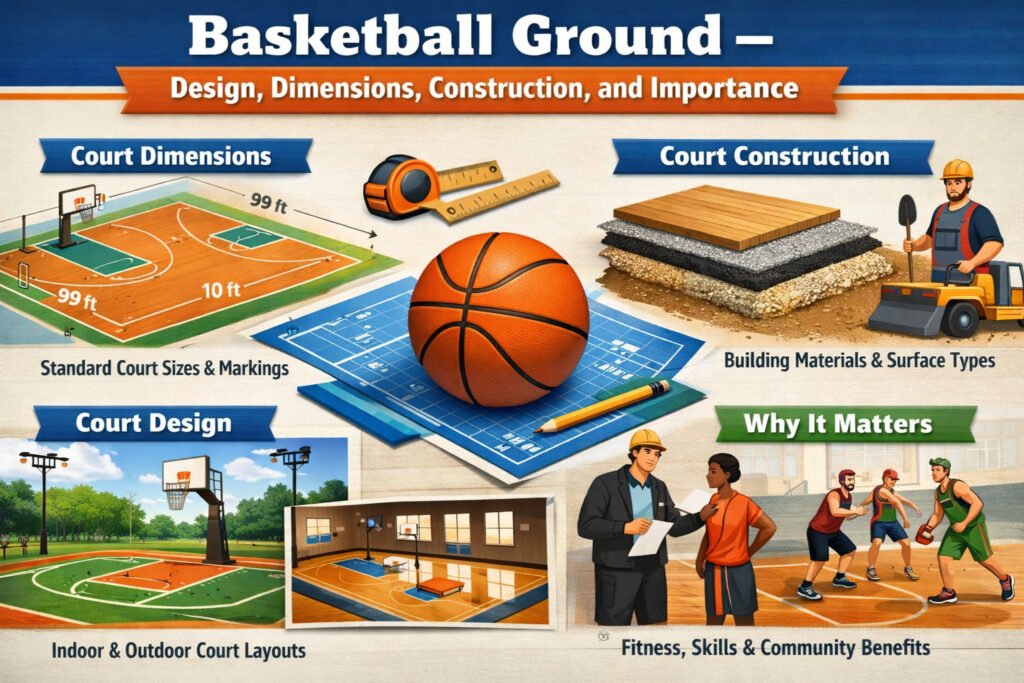
Basketball Ground – Design, Dimensions, Construction, and Importance
What Is a Basketball Ground? A basketball ground, often called a basketball court, is the dedicated playing area where the sport of basketball takes place. At first glance, it might seem like just a flat surface with two hoops at opposite ends. In reality, a properly designed basketball ground is a carefully planned sports facility with specific dimensions, markings, equipment, and safety features. Every line painted on the court has a purpose, every measurement influences gameplay, and every surface material affects performance. Think of a basketball ground as the stage for one of the fastest and most exciting sports in the world. Whether it’s a neighborhood pickup game, a school tournament, or an NBA playoff match, the court is where strategy, skill, and athleticism collide. The design of the ground ensures fair play, smooth movement, and consistent gameplay for everyone involved. Basketball grounds can exist in many environments. Some are indoor courts, usually located in gyms, arenas, or sports complexes. These courts often feature polished wooden floors that provide excellent grip and ball bounce. Others are outdoor courts, commonly found in parks, schools, and residential communities. Outdoor courts typically use materials like asphalt or concrete to withstand weather conditions. Beyond simply hosting games, basketball grounds serve an important role in community engagement and youth development. Many young athletes take their first shots on a local outdoor court, dreaming of becoming professional players one day. Public basketball courts often become social hubs where friendships form and communities connect through sport. Another interesting aspect of a basketball ground is how it balances precision and simplicity. The game itself is easy to understand—put the ball through the hoop—but the court’s layout ensures fairness and structure. Specific zones like the free-throw lane, three-point arc, and key area guide the flow of the game. In short, a basketball ground is far more than a playing surface. It is a carefully structured environment that supports athletic performance, competitive fairness, and community interaction. Without the proper design and layout of a basketball court, the sport simply wouldn’t function the way fans and players expect. Basic Concept of a Basketball Playing Area At its core, the basketball playing area is a rectangular court with a hoop at each end, designed to allow two teams to compete by scoring points through baskets. While that sounds simple, the concept of a basketball ground actually revolves around creating a balanced space where offense and defense can interact smoothly. Imagine the court as a strategic battlefield where every inch of space matters. Players sprint across the floor, pivot, pass, and shoot within clearly defined zones. The boundaries ensure the ball remains in play, while the various lines help referees enforce rules and guide player positioning. A standard basketball ground is divided into two equal halves by a center line, with a center circle marking the starting point of the game. Each team defends one basket while attempting to score on the opposite one. This symmetrical design ensures fairness because both teams have equal opportunities on the same playing surface. One of the most distinctive areas on a basketball ground is the key, also known as the paint. This rectangular or trapezoidal area near the basket is where many crucial plays occur. Players often drive into this zone to attempt close-range shots or draw fouls. Because it’s such a high-traffic area, strict rules govern how long offensive players can remain there. Another defining feature is the three-point arc. This curved line creates an exciting dynamic in modern basketball. Shots made from beyond this line are worth three points instead of two, encouraging players to develop long-range shooting skills. Over the past decade, this area has become increasingly important as teams emphasize perimeter shooting. The concept of a basketball playing area also involves player safety and performance. Courts must provide proper traction to prevent slipping, and the bounce of the basketball must remain consistent across the entire surface. Even small variations in flooring can affect how the ball moves or how athletes land after jumping. From professional arenas to simple neighborhood courts, the basic concept remains the same: a structured space that enables fast-paced competition while maintaining fairness and safety. The beauty of basketball lies in how this relatively simple court design supports an incredibly complex and thrilling game. Why a Proper Basketball Ground Matters A properly designed basketball ground is essential for both performance and safety. While casual players might enjoy shooting hoops on almost any flat surface, the difference between an improvised playing area and a well-constructed basketball court is enormous. The quality of the ground can directly influence how the game is played and how athletes perform. First and foremost, a professional basketball ground ensures consistent ball bounce. Basketball relies heavily on dribbling, and if the surface is uneven or poorly constructed, the ball may bounce unpredictably. This not only disrupts gameplay but can also make it difficult for players to develop proper ball-handling skills. Safety is another critical factor. A good basketball ground is built with shock-absorbing materials that reduce the impact on players’ joints when they run, jump, and land. According to sports medicine research, athletes in high-impact sports like basketball experience significant stress on their knees and ankles. Quality court surfaces help minimize injuries by providing the right combination of grip and cushioning. A well-maintained basketball ground also ensures clear visibility of court markings. Lines such as the three-point arc, free-throw line, and boundary lines guide both players and referees during the game. Without accurate markings, enforcing rules becomes difficult and gameplay loses its structure. There is also a psychological element. Playing on a proper court often boosts motivation and confidence. When athletes step onto a clean, professionally marked basketball ground, it signals that the game is serious and competitive. This environment encourages players to perform at their best. For schools, universities, and community centers, basketball grounds offer additional benefits. They become multi-purpose sports facilities that host tournaments, training sessions, and recreational games. These courts often serve