How Long Is a Basketball Court? Full Dimensions, Measurements & Layout Guide
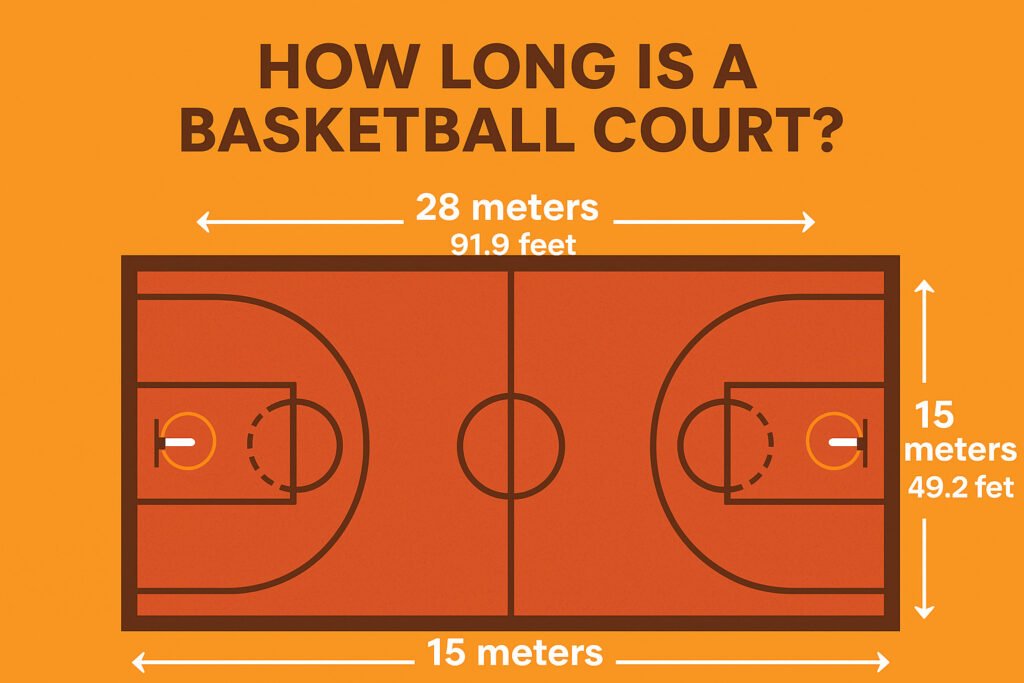
How long is a basketball court? Basketball is one of the most popular sports in the world, and the size of the court plays a major role in fair play, performance, and player safety. Whether you’re planning to build a new court for a school, society, academy, club, or sports complex, understanding the exact measurements is essential. In this guide, we answer the question “How long is a basketball court?” and explain all official dimensions according to FIBA (International), NBA, and NCAA standards. Professional Basketball: NBA and FIBA Standards At the highest level of professional basketball, two main governing bodies set the standards: the National Basketball Association (NBA) and the International Basketball Federation (FIBA). NBA Court Dimensions: FIBA Court Dimensions:Used for international competitions like the Olympics and the FIBA Basketball World Cup, these courts have slight but important differences. The NBA’s larger court and longer three-point line reflect a style of play that emphasizes space, speed, and long-range shooting. The FIBA court, being slightly smaller, can lead to more physical and congested games. College and High School Court Dimensions As you move from the professional ranks to amateur levels, the courts generally become smaller. This adjustment accommodates the varying physical development and skill levels of the players. NCAA (College) Court Dimensions:College basketball in the United States, governed by the NCAA, uses the same overall court dimensions as the NBA: 94 feet long by 50 feet wide. However, the markings within the court differ. High School (NFHS) Court Dimensions:Courts at the high school level, regulated by the National Federation of State High School Associations (NFHS), are noticeably smaller. The Evolution and Purpose of Court Dimensions These dimensions were not decided overnight. They evolved over decades to balance the game. When basketball was invented in 1891, there were no standard court sizes. The game was often played in whatever gym or hall was available. As the sport became more organized, the need for standardization grew. The lane, or paint, was widened over time (from 6 feet to 12 feet in the 1950s and then to 16 feet in the NBA) to prevent dominant big men like George Mikan from permanently camping under the basket. This led to the creation of the three-second violation. The three-point line was a later addition, popularized by the American Basketball Association (ABA) in the 1960s and adopted by the NBA in 1979. Its purpose was to add another layer of strategy, reward long-range shooting, and create space on the floor. The distance has been adjusted over the years to find the right balance between a makeable shot and a challenging one. How Dimensions Impact Gameplay Court dimensions directly influence strategy and player roles. From the local gym to the NBA finals, the lines on a basketball court are a fundamental part of the game. They shape the action, define the challenge, and provide the framework for the incredible athletic displays we love to watch. Basketball Court Layout & Markings (Complete Breakdown) Understanding the measurements beyond court length is equally important when building a court. 🔸 Key Layout Dimensions Court Component FIBA Measurement NBA Measurement Free-throw line distance from backboard 4.6 m (15 ft) 15 ft (4.57 m) 3-point line (from basket) 6.75 m 23.75 ft (7.24 m) Rim height 3.05 m (10 ft) 3.05 m (10 ft) Backboard size 1.8 × 1.05 m 6 ft × 3.5 ft Restricted zone radius 1.25 m 4 ft Minimum Playing Area Required When constructing a basketball court, space for runoff and player safety must be added beyond the playing boundary. Type Total Area Required Standard FIBA Court 32 m × 19 m Standard NBA Court 35.66 m × 20.12 m Half Court (Practice / Residential) 15 m × 14 m minimum Full Court vs Half Court — Which Should You Choose? Type Best For Advantages Full Court Schools, academies, clubs, sports complexes, societies Professional training, tournaments, team play Half Court Bungalows, private homes, small societies, rooftop areas Less space required, lower cost, quick installation If space or budget is limited, a half-court basketball court is an excellent choice for practice and recreation. Ideal Flooring for Basketball Court Construction Choosing the right flooring affects performance, safety, and durability. Flooring Type Indoor Outdoor Pros Acrylic Synthetic ❌ ✔ Weatherproof, economical PU Flooring ✔ ❌ High cushioning, premium finish PP Interlocking Tiles ✔ ✔ Fast installation, portable Wooden Flooring ✔ ❌ Professional indoor arenas Cost to Construct a Basketball Court (Indicative) Type Approx. Cost in India Outdoor Synthetic Court ₹6 – ₹12 lakh Indoor Wooden Court ₹20 – ₹45 lakh PP Interlocking Tiles ₹8 – ₹15 lakh Half Court Practice Setup ₹3 – ₹7 lakh Conclusion Understanding how long a basketball court is is essential for anyone planning to build, renovate, or compare different court layouts. While dimensions vary slightly based on the governing body, the standard full-size court is approximately 28–28.65 meters (92–94 feet) long and 15 meters (49–50 feet) wide. Whether it’s a school, sports academy, society, club, or professional arena, using the correct measurements ensures fair gameplay, player safety, and a true basketball experience. From layout planning to flooring selection, pole installation, markings, and accessories — every detail contributes to a durable and high-performance court. With the right guidance and materials, you can build a basketball court that supports both professional play and long-term enjoyment. If you’re looking to construct a basketball court and need expert assistance, flooring recommendations, or cost estimation, feel free to reach out — the right basketball court begins with accurate dimensions and smart planning.