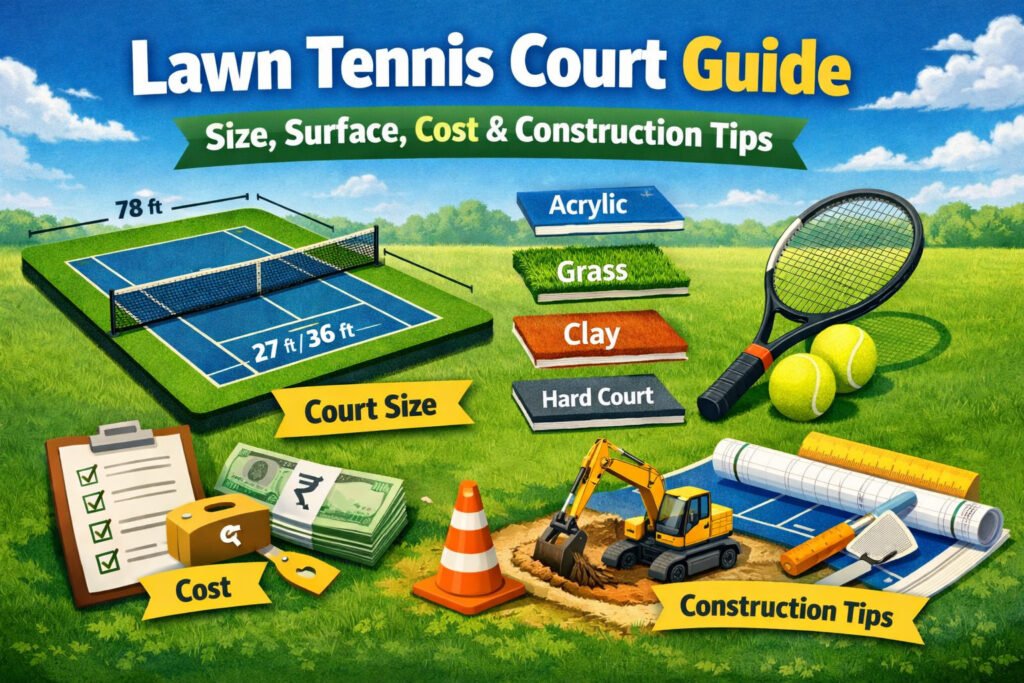
Lawn Tennis Court: Complete Guide to Size, Surface, Construction & Maintenance
A lawn tennis court is the foundation of the game, designed to deliver speed, precision, and consistent bounce. Whether you are planning to build a tennis court for a school, sports academy, club, or residential property, understanding the court dimensions, surface types, construction process, and maintenance is essential. This complete guide explains everything you need to know about a lawn tennis court in a simple and professional way. What Is a Lawn Tennis Court? A lawn tennis court is a rectangular playing area divided by a net, used for playing tennis in singles or doubles formats. While the original game was played on natural grass, modern lawn tennis courts are now built using synthetic, acrylic, clay, or hard court surfaces for better durability and lower maintenance. From Monasteries to Manicured Lawns: A Brief History The roots of tennis stretch back to 12th-century France, where monks played a game called jeu de paume (game of the palm). They used their hands to strike a ball against monastery walls. As the game gained popularity among nobility, gloves and eventually rackets were introduced. However, “Lawn Tennis” as we know it emerged much later. In 1873, Major Walter Clopton Wingfield patented a game called Sphairistikè (Greek for “ball playing”) in Wales. He designed it to be played outdoors on hourglass-shaped grass courts. His boxed sets, which included nets, posts, rackets, and balls, helped spread the game rapidly across Britain. The All England Croquet Club in Wimbledon adopted the sport in 1877, holding the first Lawn Tennis Championship. They rectified the court shape to a rectangle and established many of the rules still in use today. While “lawn” tennis originally referred specifically to grass courts, the term stuck even as surfaces diversified into clay, hard, and carpet courts over the 20th century. Surface Science: How The Ground Changes the Game The surface underfoot dictates the speed of the ball, the height of the bounce, and the movement of the player. Here are the three primary surfaces found in professional and recreational tennis. 1. Grass Courts This is the traditional surface, most famously used at Wimbledon. 2. Clay Courts Synonymous with the French Open (Roland Garros), clay is dominant in Europe and South America. 3. Hard Courts The most common surface in the US and Australia, used for the US Open and Australian Open. Lawn Tennis Court Dimensions (Official Size) Standard Tennis Court Measurements Area Measurement Court Length 23.77 meters (78 feet) Singles Court Width 8.23 meters (27 feet) Doubles Court Width 10.97 meters (36 feet) Total Playing Area (Doubles) 260.87 sq. meters Recommended Run-off Area 6.4 m (back), 3.66 m (sides) Net Height These measurements follow ITF (International Tennis Federation) standards. Lawn Tennis Court Surface Types Choosing the right surface impacts gameplay, player safety, and maintenance cost. 1. Synthetic Acrylic Tennis Court 2. Natural Grass Tennis Court 3. Clay Tennis Court 4. Hard Court Tennis Surface Lawn Tennis Court Construction Process Step 1: Site Preparation Step 2: Base Construction Step 3: Surface Installation Step 4: Line Marking Step 5: Net & Accessories Net posts, umpire chair, fencing, lighting Tennis net with center strap Lawn Tennis Court Flooring Cost in India The cost depends on surface type, base work, and location. Surface Type Approx Cost (₹ / sq. ft.) Synthetic Acrylic ₹300 – ₹600 Natural Grass ₹800 – ₹1500 Clay Court ₹400 – ₹700 Hard Court ₹350 – ₹650 Prices may vary based on site condition and material quality. Lawn Tennis Court Maintenance Tips Clean surface regularly to avoid dust buildup Repair cracks immediately Repaint lines every 2–3 years Ensure proper drainage during monsoon Check net height and tension regularly Proper maintenance increases the court’s lifespan and player safety. Benefits of a Lawn Tennis Court Encourages fitness and professional training Increases property and facility value Suitable for schools, clubs, and residential societies Can be used for national and international tournaments Long-term investment with high durability Lawn Tennis Court for Schools & Academies Schools and sports academies prefer synthetic acrylic lawn tennis courts because they: The Role of Courts in the Tennis Ecosystem Tennis courts are more than just playing fields; they are community hubs and stages for drama. In the professional realm, surface homogenization has been a hot topic. In the 1990s, the speed difference between grass and clay was massive. Today, grass courts have been slowed down (via soil composition changes), and hard courts have varying speeds, bringing the surfaces closer together. This has allowed players like Novak Djokovic and Rafael Nadal to dominate across all surfaces, something that was much harder in previous eras. For recreational play, public hard courts remain the backbone of the sport. They are accessible, durable, and free or cheap to use. However, the rise of “soft” courts (synthetic clay or cushioned hard courts) in private clubs reflects an aging demographic of players who want to protect their knees and hips while enjoying the game for a lifetime. Conclusion A lawn tennis court is more than just a playing area—it’s an investment in sports, fitness, and professional performance. By choosing the right court size, surface, construction method, and maintenance plan, you can ensure long-lasting performance and international-level play. If you are planning to build a lawn tennis court, always follow ITF standards and work with experienced professionals for best results.