Length of Tennis Court: Official Dimensions for Singles & Doubles (Complete Guide)
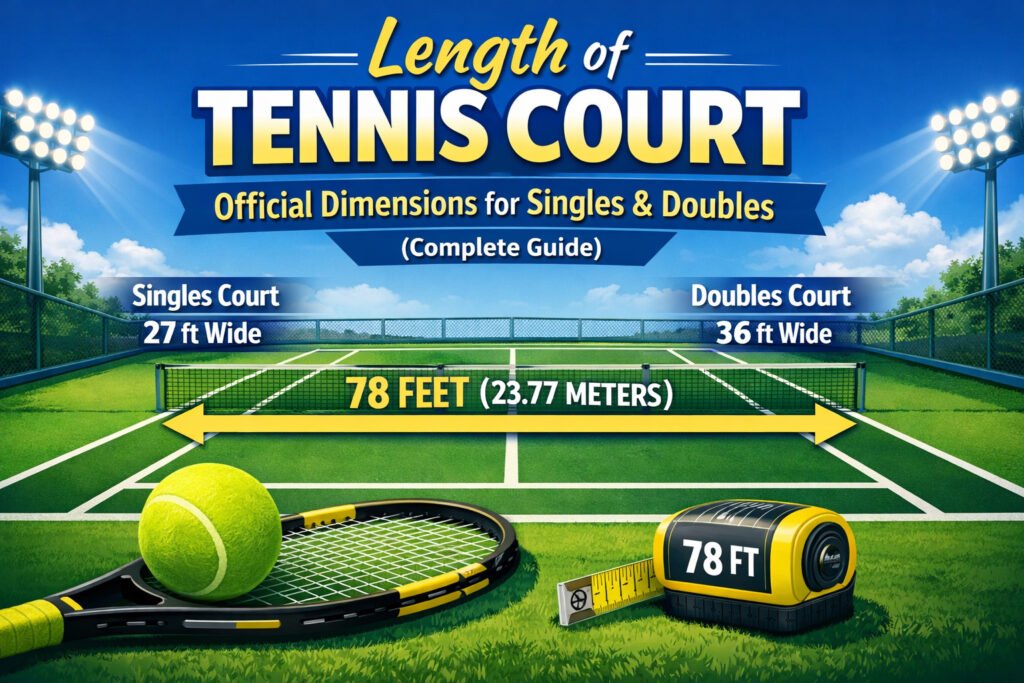
Understanding the length of tennis court is essential for players, coaches, architects, sports authorities, and anyone planning to construct a professional or recreational tennis court. Whether you are building a court, learning the rules, or upgrading sports infrastructure, knowing the exact measurements helps ensure compliance with international standards. This guide covers official tennis court length, differences between singles and doubles courts, total playing area, and layout standards approved by the International Tennis Federation (ITF). What Is the Official Length of a Tennis Court? The official length of a tennis court is 78 feet (23.77 meters).This measurement is fixed and universal for all formats of tennis, including: Unlike width, the length of a tennis court remains the same for both singles and doubles. Length of Tennis Court in Different Units Measurement Unit Tennis Court Length Feet 78 feet Meters 23.77 meters Yards 26 yards This length is measured from one baseline to the opposite baseline. Singles vs. Doubles: Key Differences While the court’s length is constant, the width is the primary difference between singles and doubles matches. This distinction has a significant impact on strategy and player positioning. Singles Court Boundaries In a singles match, one player competes against another. The play is contained within the singles sidelines. If a player hits the ball into one of the doubles alleys during a rally, the ball is considered “out,” and they lose the point. The only time the full width of the court is relevant is for the net posts’ placement. Doubles Court Boundaries In a doubles match, two players team up against another pair. The game utilizes the full 36-foot width of the court. The doubles alleys, which are out of bounds in singles, are now in play. This extra space opens up new angles for shots and requires different court coverage strategies. Teamwork and communication become essential to effectively defend the wider area. Interestingly, the service boxes remain the same for both singles and doubles. Serves must still land within the same 21-foot by 13.5-foot area, regardless of how many players are on the court. How Court Dimensions Impact Gameplay The layout of a tennis court isn’t arbitrary. The dimensions directly influence how the game is played, from serving strategy to rally dynamics. Serving Strategy The 21-foot distance from the net to the service line creates a challenging target. Players must hit the ball with enough power to clear the net but with enough topspin or slice to bring it down into the service box. The 3-foot height at the center of the net offers a small but valuable target for flat, powerful serves. Serving out wide in the deuce court (the right side) or down the “T” (the center line) in the ad court (the left side) are common strategies that exploit the box’s geometry. Baseline Rallies The 78-foot length of the court provides ample space for powerful baseline exchanges. Players often stand a few feet behind the baseline to give themselves more time to react to deep, fast shots from their opponent. Hitting deep shots that land near the opponent’s baseline is a key tactic, as it can push them back and force a weaker return. The Importance of Angles In doubles, the addition of the alleys dramatically changes the game. Players can hit sharp-angled cross-court shots that pull their opponents wide, opening up the rest of the court for their partner to attack. The ability to defend these wide shots and counter-attack down the line is a hallmark of strong doubles play. Even in singles, using angles to move an opponent from side to side is a fundamental strategy for creating openings. Net Play and Court Coverage The distance from the baseline to the net is 39 feet. When a player decides to approach the net, they must cover this distance quickly to get into a good volleying position. A slow approach gives the opponent too much time to hit a passing shot or a lob. Understanding these distances helps players make better decisions about when to stay back and when to move forward. Total Area and Run-Off Space While the playing lines define the court’s boundaries, additional space around the court is necessary for player safety and movement. This is often called the “run-off” area. The International Tennis Federation (ITF) recommends the following minimum clearances: This extra room allows players to safely chase down wide shots or deep lobs without risking injury. For professional tournaments, these spaces are often even larger. The total recommended area for a single tennis court, including run-off, is 120 feet (36.57 meters) by 60 feet (18.29 meters). Why Tennis Court Length Is Fixed The tennis court length has remained unchanged for decades to ensure: All international tennis matches follow ITF-approved dimensions, making the game globally uniform. Line Markings Related to Court Length Important markings along the length include: All markings must follow ITF thickness standards (usually 5 cm or 2 inches). Common Mistakes While Measuring Tennis Court Length Measuring beyond run-off area instead of baseline to baseline Confusing total area length with playing length Incorrect net positioning affecting half-court distance Professional court installation avoids these errors using laser or precision tools. Tennis Court Length for Different Surfaces The length remains 78 feet regardless of surface type: Only surface materials and cushioning layers change—not the dimensions. Final Thoughts The length of a tennis court is always 78 feet (23.77 meters), regardless of singles or doubles play. This fixed dimension is a core rule of tennis and is followed worldwide for professional, recreational, and training courts. If you’re planning to build or renovate a tennis court, ensuring accurate length measurement is critical for performance, safety, and official compliance.