Pickleball Court Size – Official Dimensions, Layout, and Setup Guide
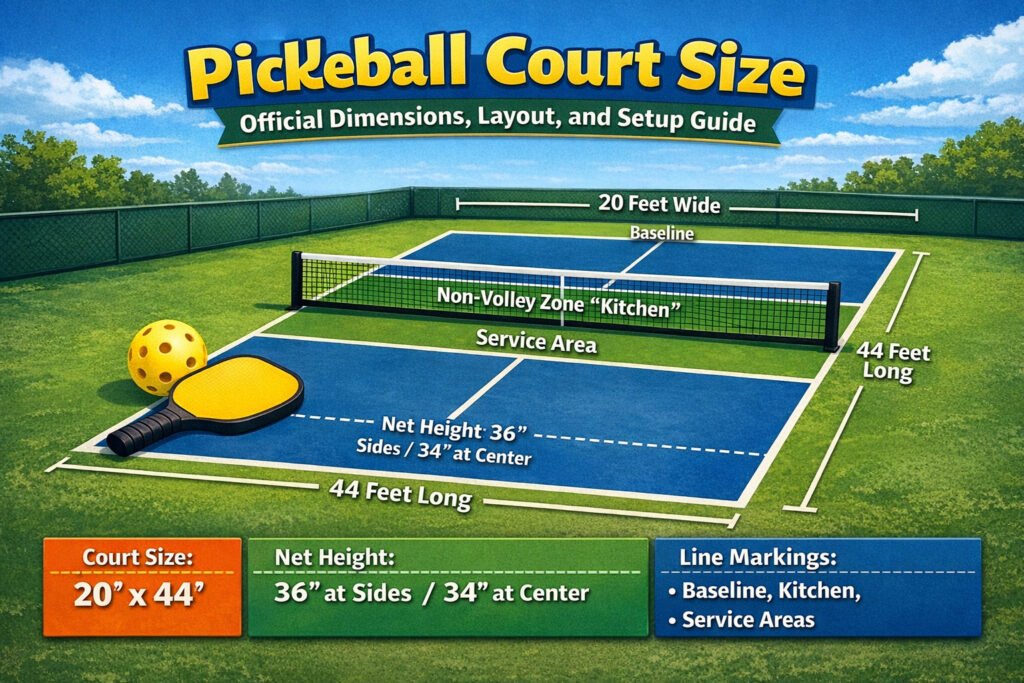
Understanding the Standard Pickleball Court Size Pickleball has exploded in popularity over the past decade, becoming one of the fastest-growing sports in North America and rapidly spreading worldwide. One of the reasons for its massive appeal is how simple the court setup is compared to many other racquet sports. The pickleball court size is intentionally compact, making the game accessible to players of all ages and skill levels. Whether you’re planning to build a court in your backyard, mark one on a gym floor, or simply want to understand the layout before playing, knowing the official dimensions is essential. At first glance, a pickleball court might remind you of a smaller tennis court, but the differences go beyond just scale. The compact design encourages quick reactions, strategic shot placement, and fast-paced rallies rather than relying solely on power. Because of this, the sport has become especially popular among recreational players, seniors, and families who want a competitive game without needing a large playing field. The standard pickleball court is designed to accommodate both singles and doubles play, and interestingly, the dimensions remain exactly the same regardless of the number of players. This differs from sports like tennis, where singles and doubles use different sidelines. In pickleball, the same boundaries apply for every match, simplifying court design and making it easier to convert existing spaces like tennis courts, basketball courts, or driveways into playable pickleball areas. Another reason the court size matters is safety and gameplay balance. A court that is too small limits movement and strategy, while one that is too large disrupts the pacing that makes pickleball exciting. The official measurements established by governing bodies ensure that players everywhere—from local parks to professional tournaments—experience consistent gameplay. Understanding the standard court size is the first step toward appreciating how the game is structured. Once you grasp the basic dimensions, it becomes much easier to visualize where serves land, how rallies unfold, and why specific zones—like the famous “kitchen”—play such a critical role in strategy. Official Dimensions According to USA Pickleball When discussing the official pickleball court size, the primary authority is USA Pickleball (USAP), the governing organization responsible for establishing rules and standards for the sport. According to the official rulebook, a regulation pickleball court measures 20 feet wide by 44 feet long. This dimension applies to both singles and doubles matches, which is somewhat unique among racquet sports. No matter how many players are on the court, the playing boundaries remain identical. To visualize this size, imagine a rectangular playing surface that is roughly the size of a badminton doubles court. The width of 20 feet stretches across the court from sideline to sideline, while the 44-foot length runs from baseline to baseline. Each half of the court is therefore 22 feet long, separated by the net in the center. However, the playing surface itself isn’t the only measurement that matters. For comfortable movement and safe gameplay, official guidelines recommend additional space around the court. Tournament facilities typically provide a minimum total playing area of 30 feet by 60 feet. This extra buffer zone allows players to chase balls, recover from shots, and avoid collisions with fences or walls. Another crucial part of the official layout involves dividing the court into functional zones. Each side includes a non-volley zone (the kitchen), service courts, and boundary lines. These markings control how serves are delivered, where volleys are allowed, and how players position themselves during rallies. Without these carefully measured zones, pickleball would lose much of the tactical depth that makes the sport so engaging. Professional tournaments strictly adhere to these specifications to maintain fairness. If even a few inches are off, it can influence how shots bounce or how much space players have to maneuver. Recreational courts sometimes allow minor variations, especially when retrofitting existing spaces like tennis courts or school gyms. Knowing these official measurements helps players practice under authentic conditions. Whether you’re a casual weekend player or aspiring tournament competitor, learning the standard court dimensions ensures you’re playing the game exactly as it was designed. Why Pickleball Courts Are Smaller Than Tennis Courts Many first-time players are surprised by how compact a pickleball court looks compared to a tennis court. This isn’t accidental—it’s a deliberate design choice that shapes the entire experience of the game. The smaller playing area is one of the key reasons pickleball has become so widely accessible and easy to learn. A standard tennis court measures 78 feet long and 36 feet wide for doubles, which is significantly larger than the 44-by-20-foot pickleball court. In fact, you can fit up to four pickleball courts inside a single tennis court with careful layout planning. This efficiency has helped parks, gyms, and recreational facilities quickly adopt the sport without requiring large new construction projects. But the reduced court size isn’t just about saving space—it fundamentally changes the style of play. Pickleball uses a solid paddle and a perforated plastic ball, which moves slower through the air compared to a tennis ball. Because the ball travels at a more controlled speed, a smaller court keeps rallies dynamic and engaging. If the court were as large as a tennis court, the game would feel slow and require far more running. Another benefit of the smaller court is accessibility. Players don’t need elite athletic conditioning to compete effectively. Strategy, positioning, and shot placement often matter more than raw speed or power. This makes the sport appealing to a broad audience—from teenagers to retirees—who can enjoy competitive play without the intense physical demands of larger racquet sports. The compact design also encourages social interaction. Because players stand closer together, communication and quick exchanges become part of the fun. Doubles matches often involve fast reflex volleys near the net, creating exciting rallies that spectators love to watch. So while the pickleball court may look small at first glance, its dimensions are carefully engineered. The size balances movement, strategy, and accessibility, creating a game that feels energetic without being overwhelming. That