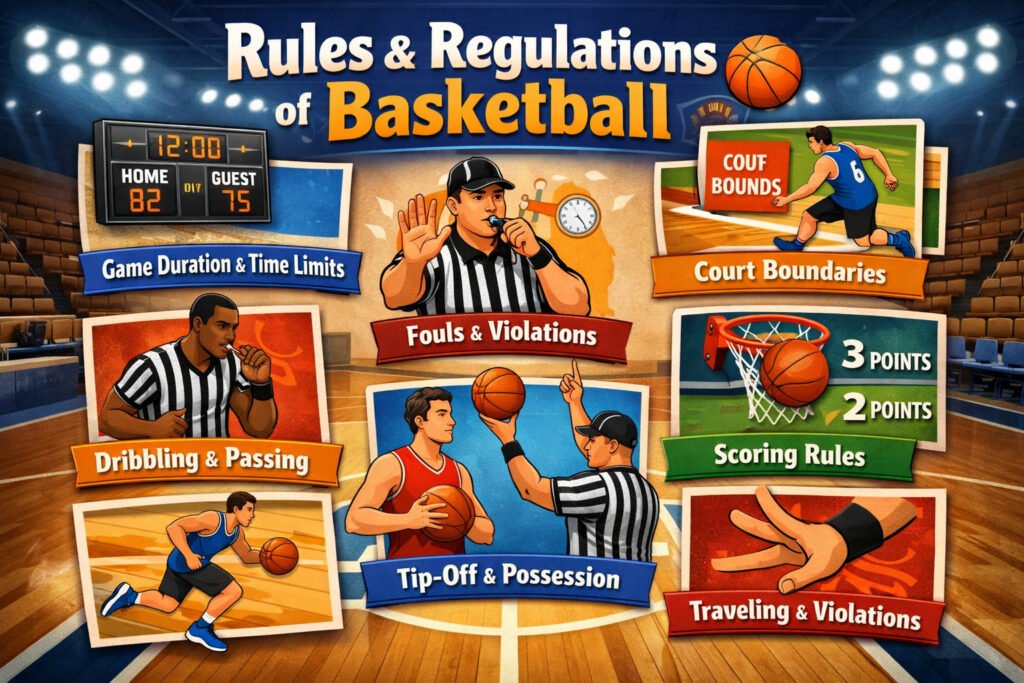
Rules and Regulations of Basketball
Basketball is one of the most popular sports in the world, played by millions of people across schools, professional leagues, and recreational courts. At first glance, the game may seem simple: two teams trying to score points by putting a ball into a hoop. Yet behind that simple idea lies a carefully designed set of Rules and Regulations of Basketball that keep the game fair, fast, and exciting. These Rules and Regulations of Basketball govern everything—from how players move with the ball to how long a team has to shoot. 🏀 Think of basketball rules as the invisible framework holding the sport together. Without them, the game would quickly turn chaotic. Players might run endlessly with the ball, block the basket physically, or stall the game indefinitely. Instead, structured rules ensure strategy, skill, teamwork, and athleticism are the deciding factors. Modern basketball rules are standardized by organizations such as the National Basketball Association (NBA), the International Basketball Federation (FIBA), and the National Collegiate Athletic Association (NCAA). While minor variations exist between these organizations, the core principles remain remarkably consistent. Whether you’re watching an NBA finals game, a college tournament, or a pickup match at a neighborhood court, the essential rulebook is the same. The regulations cover several critical aspects of the game: court dimensions, player positions, scoring methods, time restrictions, fouls, and referee authority. Each component plays a specific role in shaping how the game unfolds. For example, the shot clock forces teams to attack rather than stall, while foul limits discourage overly aggressive defense. Basketball is often described as a game of rhythm. The rules act like the tempo of a song, guiding the pace and flow. Once players understand these rules, they can fully appreciate the beauty of the sport—quick passes, clever plays, and dramatic last-second shots. Understanding the rules and regulations of basketball isn’t just important for referees or professional athletes. Fans, coaches, and casual players all benefit from knowing how the game truly works. It deepens appreciation for every play and decision on the court. Introduction to Basketball Rules If you’ve ever watched a basketball game and wondered why the referee suddenly blows the whistle, chances are a specific rule has been broken. The rules of basketball are designed to create balance between offense and defense while ensuring player safety and fair competition. They provide a clear framework that allows the game to move quickly while preventing unfair advantages. Basketball is played between two teams of five players each on a rectangular court with a hoop at each end. The main objective is simple: score more points than the opposing team by shooting the ball through the opponent’s basket. However, achieving that objective requires players to follow numerous guidelines related to movement, time, contact, and gameplay structure. For example, players cannot simply run across the court holding the ball. They must dribble, which means bouncing the ball continuously while moving. If they stop dribbling and start again, it results in a violation called double dribble. Similarly, players must avoid taking too many steps without dribbling, or they’ll be called for traveling. Another important aspect of the rules involves time management. Basketball is a fast-paced sport, and rules such as the 24-second shot clock (NBA and FIBA) ensure teams attempt a shot within a limited time. Without this rule, a team could simply hold the ball and avoid scoring opportunities. Safety is also a major focus. Basketball is a physical game, but excessive contact leads to personal fouls. If a player commits too many fouls in a game, they are disqualified. This discourages rough play and protects athletes from unnecessary injuries. Beyond the technical aspects, the rules also shape the strategy of the game. Coaches design plays based on the rule structure—how long they have to shoot, how substitutions work, and how fouls accumulate. Understanding these rules transforms basketball from a random flurry of movement into a structured, tactical sport where every action has meaning. Origins of the Basketball Rulebook The basketball rulebook has a fascinating history that dates back to 1891. The sport was invented by Dr. James Naismith, a Canadian physical education instructor working at the YMCA Training School in Springfield, Massachusetts. He was tasked with creating an indoor activity to keep students active during the winter months. Naismith developed a simple concept: players would throw a soccer ball into peach baskets nailed to a gym balcony. To organize the game, he created the original 13 rules of basketball, which formed the foundation of the modern rulebook. Those early rules were surprisingly straightforward. Players were not allowed to run with the ball, physical contact was limited, and goals were scored by throwing the ball into the basket. However, the game was quite different from today’s version. For instance, after each score, someone had to climb a ladder to retrieve the ball from the peach basket. As basketball spread across schools and athletic clubs in the United States, the rules gradually evolved. By the early 1900s, organizations began formalizing standardized regulations. Backboards were introduced to prevent spectators from interfering with shots, and dribbling became an essential part of gameplay. Over time, governing bodies such as FIBA (founded in 1932) and the NBA (founded in 1946) introduced additional rules to improve the sport’s pace and fairness. One of the most revolutionary changes was the shot clock, introduced in the NBA in 1954. Before this rule, teams could stall the game by holding the ball indefinitely. The introduction of the three-point line in 1979 also transformed basketball strategy. Suddenly, long-distance shooting became a powerful scoring weapon, forcing defenses to adapt. Today’s basketball rulebook is far more detailed than Naismith’s original 13 rules. It includes guidelines covering everything from player conduct and replay reviews to equipment specifications and officiating mechanics. Yet despite all these changes, the spirit of Naismith’s invention remains the same: a dynamic team sport built on skill, speed, and strategy. Why Rules Matter in Basketball Imagine a basketball game without rules. Players could shove opponents