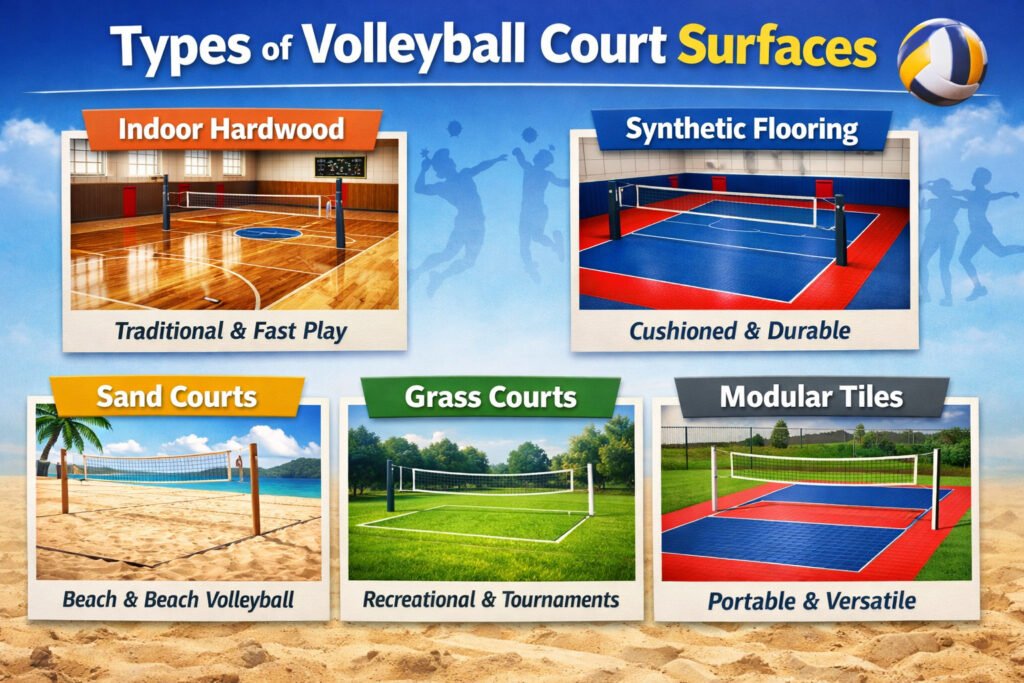
Types of Volleyball Court Surfaces (Sand, Concrete, Synthetic)
Volleyball might look like a simple game of hitting a ball over a net, but when you start exploring the Types of Volleyball Court Surfaces, you realize the surface you play on quietly shapes everything—from how high you jump to how safely you land. If you’ve ever switched from beach volleyball to an indoor court, you already know it feels like playing two entirely different sports. That’s not your imagination; it’s physics, traction, and shock absorption all working behind the scenes. Court surfaces are more than just a foundation—they influence speed, agility, endurance, and even injury risk. Professional organizations like the FIVB (Fédération Internationale de Volleyball) have strict standards for surfaces used in competitions, highlighting just how critical the ground beneath your feet really is. Whether it’s soft sand, unforgiving concrete, or engineered synthetic flooring, each surface comes with its own personality. Think of it like driving different cars on different terrains. A sports car thrives on smooth asphalt but struggles on gravel. Similarly, volleyball players adapt their movements based on the surface. On sand, every step sinks slightly, demanding more energy. On concrete, the bounce is predictable but harsh on joints. Synthetic courts aim to strike a balance, offering consistency with some level of cushioning. Choosing the right surface isn’t just about preference—it’s about purpose. Are you playing recreationally at the beach, practicing at school, or competing at a professional indoor arena? Each scenario demands a different type of court. Understanding these surfaces in depth helps players, coaches, and facility owners make smarter decisions that enhance both performance and safety. Why Surface Type Matters in Volleyball The type of surface you play on doesn’t just change how the game feels—it directly affects how the game is played. Imagine trying to sprint on loose sand versus a polished indoor court. Your muscles, balance, and timing all adjust automatically, often without you realizing it. That adjustment is exactly why surface type matters so much in volleyball. Different surfaces influence ball behavior, which can completely alter gameplay. On a synthetic indoor court, the ball rebounds quickly and predictably, allowing for fast-paced rallies and precise sets. On sand, however, the ball slows down slightly due to environmental factors like wind and softer footing, leading to longer, more strategic rallies. This is why beach volleyball often emphasizes endurance and tactical placement over sheer power. Another critical factor is player movement and energy expenditure. Studies suggest that moving on sand can require up to 1.6 times more energy compared to hard surfaces. That means players fatigue faster, which changes substitution strategies and pacing during matches. On concrete, movement is faster and more efficient, but the trade-off is increased stress on joints like knees and ankles. Safety is where surface choice becomes even more important. Hard surfaces like concrete offer little to no shock absorption, increasing the risk of injuries such as stress fractures or ligament damage. In contrast, sand provides a natural cushion that reduces impact but introduces instability, which can lead to sprains if players aren’t careful. Synthetic surfaces attempt to balance these factors by offering controlled cushioning and grip. Ultimately, the surface defines the rhythm of the game. Fast or slow, explosive or endurance-based, safe or risky—it all starts from the ground up. Once you understand this, you start to see volleyball not just as a sport, but as an interaction between athlete and environment. How Surface Impacts Player Performance and Safety If you’ve ever wondered why some players dominate indoors but struggle on the beach, the answer often lies beneath their feet. The surface plays a huge role in determining how efficiently a player can perform basic actions like jumping, diving, and changing direction. It’s almost like the surface becomes an invisible opponent—or ally—depending on how well you adapt to it. On sand courts, performance is heavily tied to strength and endurance. Because the surface shifts with every step, players must engage stabilizing muscles constantly. This leads to improved lower-body strength over time but also reduces jump height compared to harder surfaces. A spike that would normally be explosive indoors may feel slightly muted on sand. However, this same softness significantly reduces impact forces, making it easier on the joints during dives and falls. Concrete courts tell a completely different story. They offer maximum stability and allow for quick, explosive movements. Players can jump higher and move faster because there’s no energy loss from surface deformation. But here’s the catch: the lack of shock absorption means your body absorbs nearly all the impact. Over time, this can lead to chronic injuries, especially if proper footwear and conditioning are ignored. Synthetic courts aim to combine the best of both worlds. With engineered layers designed for shock absorption and grip, these surfaces support high-performance play while minimizing injury risks. Many indoor professional leagues use synthetic flooring because it provides consistent bounce and traction, which are essential for competitive gameplay. According to sports flooring experts, high-quality synthetic courts can reduce injury risk by up to 30% compared to hard concrete surfaces. Safety also depends on how predictable the surface is. Uneven sand or poorly maintained concrete can increase accident risks. Synthetic courts, on the other hand, are designed for uniformity, ensuring players can trust every step they take. At the end of the day, performance and safety are two sides of the same coin. The better the surface supports your movement, the more confidently—and safely—you can play. Sand Volleyball Courts Characteristics of Sand Courts Sand volleyball courts are probably the most iconic version of the game, instantly bringing to mind sunny beaches, diving saves, and long rallies under open skies. But beyond the aesthetics, sand courts have very specific physical characteristics that define how the game is played. Unlike hard surfaces, sand is loose, granular, and constantly shifting, which makes movement both challenging and dynamic at the same time. A standard beach volleyball court uses sand that is carefully selected and maintained. It’s not just any sand you find on a random beach. Professional