Understanding the Standard Pickleball Court Size
Pickleball has exploded in popularity over the past decade, becoming one of the fastest-growing sports in North America and rapidly spreading worldwide. One of the reasons for its massive appeal is how simple the court setup is compared to many other racquet sports. The pickleball court size is intentionally compact, making the game accessible to players of all ages and skill levels. Whether you’re planning to build a court in your backyard, mark one on a gym floor, or simply want to understand the layout before playing, knowing the official dimensions is essential.
At first glance, a pickleball court might remind you of a smaller tennis court, but the differences go beyond just scale. The compact design encourages quick reactions, strategic shot placement, and fast-paced rallies rather than relying solely on power. Because of this, the sport has become especially popular among recreational players, seniors, and families who want a competitive game without needing a large playing field.
The standard pickleball court is designed to accommodate both singles and doubles play, and interestingly, the dimensions remain exactly the same regardless of the number of players. This differs from sports like tennis, where singles and doubles use different sidelines. In pickleball, the same boundaries apply for every match, simplifying court design and making it easier to convert existing spaces like tennis courts, basketball courts, or driveways into playable pickleball areas.
Another reason the court size matters is safety and gameplay balance. A court that is too small limits movement and strategy, while one that is too large disrupts the pacing that makes pickleball exciting. The official measurements established by governing bodies ensure that players everywhere—from local parks to professional tournaments—experience consistent gameplay.
Understanding the standard court size is the first step toward appreciating how the game is structured. Once you grasp the basic dimensions, it becomes much easier to visualize where serves land, how rallies unfold, and why specific zones—like the famous “kitchen”—play such a critical role in strategy.
Official Dimensions According to USA Pickleball
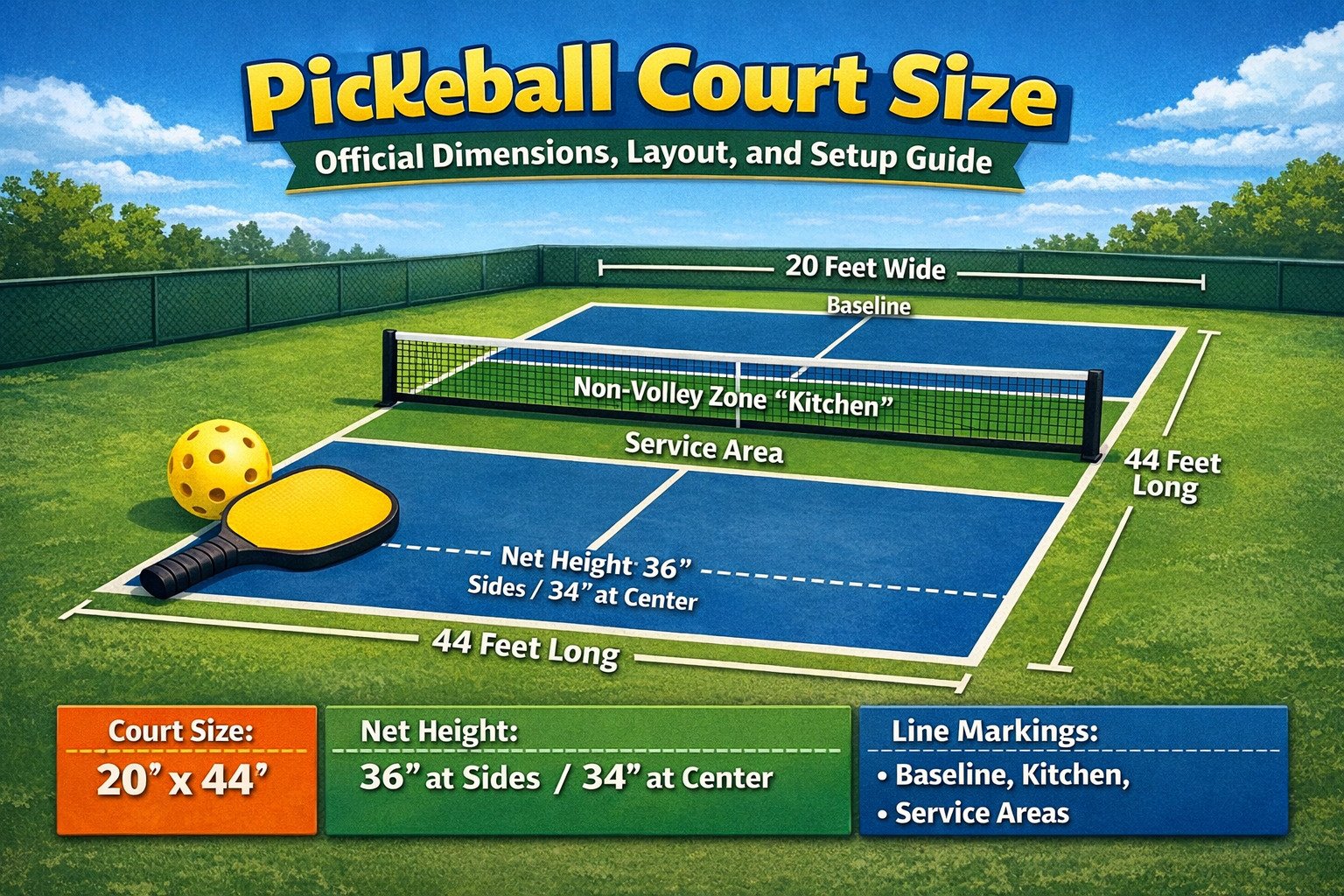
When discussing the official pickleball court size, the primary authority is USA Pickleball (USAP), the governing organization responsible for establishing rules and standards for the sport. According to the official rulebook, a regulation pickleball court measures 20 feet wide by 44 feet long. This dimension applies to both singles and doubles matches, which is somewhat unique among racquet sports. No matter how many players are on the court, the playing boundaries remain identical.
To visualize this size, imagine a rectangular playing surface that is roughly the size of a badminton doubles court. The width of 20 feet stretches across the court from sideline to sideline, while the 44-foot length runs from baseline to baseline. Each half of the court is therefore 22 feet long, separated by the net in the center.
However, the playing surface itself isn’t the only measurement that matters. For comfortable movement and safe gameplay, official guidelines recommend additional space around the court. Tournament facilities typically provide a minimum total playing area of 30 feet by 60 feet. This extra buffer zone allows players to chase balls, recover from shots, and avoid collisions with fences or walls.
Another crucial part of the official layout involves dividing the court into functional zones. Each side includes a non-volley zone (the kitchen), service courts, and boundary lines. These markings control how serves are delivered, where volleys are allowed, and how players position themselves during rallies. Without these carefully measured zones, pickleball would lose much of the tactical depth that makes the sport so engaging.
Professional tournaments strictly adhere to these specifications to maintain fairness. If even a few inches are off, it can influence how shots bounce or how much space players have to maneuver. Recreational courts sometimes allow minor variations, especially when retrofitting existing spaces like tennis courts or school gyms.
Knowing these official measurements helps players practice under authentic conditions. Whether you’re a casual weekend player or aspiring tournament competitor, learning the standard court dimensions ensures you’re playing the game exactly as it was designed.
Why Pickleball Courts Are Smaller Than Tennis Courts
Many first-time players are surprised by how compact a pickleball court looks compared to a tennis court. This isn’t accidental—it’s a deliberate design choice that shapes the entire experience of the game. The smaller playing area is one of the key reasons pickleball has become so widely accessible and easy to learn.
A standard tennis court measures 78 feet long and 36 feet wide for doubles, which is significantly larger than the 44-by-20-foot pickleball court. In fact, you can fit up to four pickleball courts inside a single tennis court with careful layout planning. This efficiency has helped parks, gyms, and recreational facilities quickly adopt the sport without requiring large new construction projects.
But the reduced court size isn’t just about saving space—it fundamentally changes the style of play. Pickleball uses a solid paddle and a perforated plastic ball, which moves slower through the air compared to a tennis ball. Because the ball travels at a more controlled speed, a smaller court keeps rallies dynamic and engaging. If the court were as large as a tennis court, the game would feel slow and require far more running.
Another benefit of the smaller court is accessibility. Players don’t need elite athletic conditioning to compete effectively. Strategy, positioning, and shot placement often matter more than raw speed or power. This makes the sport appealing to a broad audience—from teenagers to retirees—who can enjoy competitive play without the intense physical demands of larger racquet sports.
The compact design also encourages social interaction. Because players stand closer together, communication and quick exchanges become part of the fun. Doubles matches often involve fast reflex volleys near the net, creating exciting rallies that spectators love to watch.
So while the pickleball court may look small at first glance, its dimensions are carefully engineered. The size balances movement, strategy, and accessibility, creating a game that feels energetic without being overwhelming. That thoughtful design is a big reason why pickleball courts are popping up in parks, community centers, and backyards around the world.
Complete Pickleball Court Layout Explained
Understanding the pickleball court size is only part of the picture. To truly grasp how the game works, you also need to understand the layout of the court and how its various sections interact during play. Each line painted on the surface serves a purpose, guiding where players stand, where serves must land, and where certain shots are allowed or restricted.
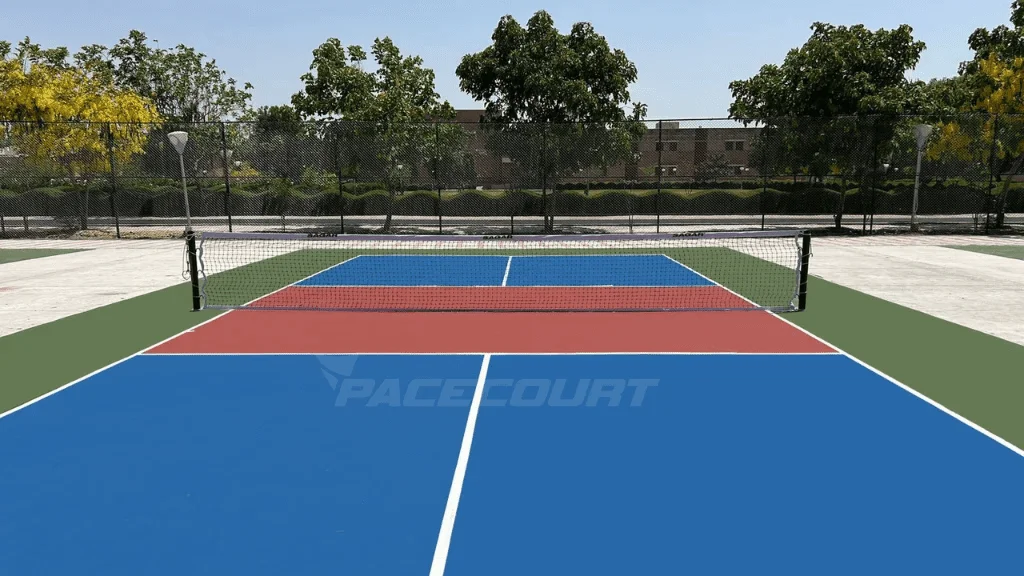
The court is divided into two equal halves by a net that stretches across the width. On each side of the net, several boundary lines and zones create the structure that governs gameplay. These include baselines, sidelines, service courts, the centerline, and the famous non-volley zone, often called “the kitchen.” Together, these lines shape the rhythm and tactics of every rally.
At the far ends of the court are the baselines, which run parallel to the net and mark the back boundary of the playing area. Players often begin rallies near this line when serving or returning. Running along the length of the court are the sidelines, which define the left and right boundaries. Any ball landing outside these lines is considered out of bounds.
Between the baseline and the kitchen lies the service area, divided into two halves by the centerline. These sections determine where serves must land during the opening shot of each rally. A proper serve must travel diagonally across the net and land within the opponent’s correct service box.
The layout may appear simple, but it introduces fascinating tactical layers. Players must constantly decide when to stay near the baseline, when to move toward the net, and how to control shots so they land precisely within these boundaries. Because the court is compact, even small adjustments in positioning can dramatically influence the outcome of a rally.
Learning the court layout transforms how you approach the game. Instead of just hitting the ball back and forth, you begin to see the court like a chessboard—every zone representing an opportunity or a potential trap for your opponent.
Baselines, Sidelines, and Centerlines
If you’ve ever watched a pickleball match or stepped onto a court for the first time, the lines painted on the surface might look simple, but each one plays a critical role in how the game unfolds. The baselines, sidelines, and centerline form the structural backbone of the pickleball court layout. Without them, players wouldn’t know where to serve, where to stand, or how to determine whether a shot is in or out.
Let’s start with the baselines, which run horizontally across the back of each side of the court. These lines mark the furthest boundary from the net and are located exactly 22 feet from the net on each side, completing the full 44-foot court length. Players typically stand behind the baseline when serving because the rules require that the serve be struck without stepping on or over this line. During rallies, players often retreat toward the baseline to defend against deep shots or powerful drives from their opponents.
Next come the sidelines, which run vertically along both sides of the court. These lines define the 20-foot width of the playing area. Any ball that lands outside these lines is considered out of bounds. Unlike tennis, where singles and doubles courts use different sidelines, pickleball keeps things simple—the same sidelines apply to both singles and doubles play. This simplicity makes court design easier and helps players quickly understand the boundaries regardless of the match format.
Running down the center of each side of the court is the centerline, which divides the service area into two equal halves. This line is crucial during serves because pickleball rules require that every serve travel diagonally across the net into the opposite service court. For example, if you serve from the right side of your court, the ball must land in the opponent’s left service box.
These lines may seem like basic markings, but they create the framework for strategy. Skilled players constantly aim for the edges—hitting deep shots near the baseline or sharp angles toward the sidelines to force opponents into difficult returns. The centerline, meanwhile, helps organize positioning during doubles matches, preventing confusion over who should take a shot.
In essence, these boundary lines turn a simple rectangular space into a structured playing field. Once you become familiar with them, reading the court becomes second nature, allowing you to focus on strategy, placement, and timing rather than worrying about where the boundaries lie.
The Non-Volley Zone (Kitchen) Dimensions
One of the most unique features of pickleball—and often the most talked about—is the non-volley zone, commonly known as the “kitchen.” This section of the court dramatically shapes how the game is played and is one of the main reasons pickleball rallies feel strategic rather than purely power-driven.
The kitchen extends 7 feet from the net on both sides of the court, running the full 20-foot width between the sidelines. This creates a rectangular area measuring 7 feet by 20 feet directly in front of the net. The boundary line that marks the edge of this zone is called the non-volley line, and it is just as important as the zone itself.
Here’s the key rule: players cannot volley the ball while standing inside the non-volley zone. A volley means hitting the ball out of the air before it bounces. If any part of a player’s foot touches the kitchen or its boundary line during a volley, it’s considered a fault and the point goes to the opponent.
Why does this rule exist? Without the kitchen, players could simply stand at the net and smash every ball downward, ending rallies almost instantly. The non-volley zone forces players to rely on finesse shots, controlled drops, and strategic positioning instead of pure aggression.
This area is also where one of pickleball’s most famous techniques happens: the dink shot. A dink is a soft shot that barely clears the net and lands inside the opponent’s kitchen. Because players cannot volley from within this zone, they must let the ball bounce before returning it, which slows the pace and creates long, tactical exchanges near the net.
Despite the name, players are allowed to step into the kitchen, just not while volleying. If the ball bounces in the kitchen, you can move in and return it after the bounce. Many advanced players frequently move in and out of this zone during rallies.
Think of the kitchen as the sport’s “strategy zone.” It transforms pickleball from a simple paddle sport into a game of patience, touch, and positioning. Once players learn how to control the kitchen, their overall gameplay improves dramatically.
Pickleball Court Measurements in Feet and Meters
When discussing pickleball court size, most official guidelines in the United States use feet, but many countries and international organizations prefer meters. Understanding both units is useful, especially if you’re planning to build or mark a court outside the U.S.
Here’s a quick comparison of the main measurements:
| Court Feature | Feet | Meters |
|---|---|---|
| Court Length | 44 ft | 13.41 m |
| Court Width | 20 ft | 6.10 m |
| Non-Volley Zone Depth | 7 ft | 2.13 m |
| Net Height (Center) | 34 in | 0.86 m |
| Net Height (Sidelines) | 36 in | 0.91 m |
The simplicity of these measurements is one reason pickleball courts are relatively easy to construct. Unlike some sports with complex dimensions, pickleball uses straightforward numbers that builders and recreational players can easily measure and mark.
The 20-by-44-foot court remains the standard worldwide, regardless of whether the measurements are expressed in feet or meters. This consistency ensures that a player from the United States can travel to Europe, Asia, or Australia and still feel comfortable playing on any regulation court.
Another important measurement is the service court, which is formed by dividing each side of the court using the centerline and the non-volley line. Each service box measures 10 feet wide by 15 feet long. These dimensions ensure that serves must travel a reasonable distance while still landing within a controlled area.
For players building courts at home, converting these measurements into meters can make planning easier when working with international construction tools or contractors. Many backyard courts and recreational facilities around the world rely on these conversions to maintain accurate dimensions.
Understanding these measurements in both systems helps players, coaches, and builders ensure that courts meet official standards. It also highlights how thoughtfully designed the court really is—every measurement supports the pace, strategy, and accessibility that define pickleball.
Full Court Size
The full pickleball court size is one of the sport’s defining characteristics. Measuring 20 feet wide and 44 feet long, the court is compact compared to other racquet sports, yet perfectly balanced for fast-paced rallies and strategic play. These dimensions apply equally to both singles and doubles matches, simplifying the rules and eliminating the need for separate boundary lines.
Each side of the net measures 22 feet in length, giving players enough room to move, return deep shots, and set up strategic plays. Despite the smaller footprint, the court still allows for a wide variety of shot types, including drives, lobs, drops, and dinks.
The total playing area becomes larger when you include the recommended safety space around the court. Most official guidelines suggest a minimum overall area of 30 feet by 60 feet. This additional space allows players to chase balls without colliding with fences, walls, or spectators.
Professional tournaments often go even further, providing 34 feet by 64 feet or more for optimal movement and camera placement. This extra space becomes especially important in high-level matches where players sprint and dive to keep rallies alive.
Another fascinating aspect of the court size is how efficiently it fits into existing sports spaces. For example, a standard tennis court can accommodate four pickleball courts when properly lined. This flexibility has allowed communities to quickly expand pickleball facilities without constructing entirely new venues.
The relatively small court size also encourages closer player interaction, especially in doubles matches. Players often move together toward the kitchen line, creating intense volley exchanges that can last dozens of shots. These quick reflex rallies are one of the most exciting parts of the sport.
In many ways, the 20-by-44-foot court represents the perfect balance between movement and control. It’s large enough to challenge players but small enough to keep the action constant and engaging.
Service Area Dimensions
The service areas of a pickleball court are where every rally begins, making their dimensions extremely important. Each side of the court contains two service boxes, divided by the centerline. These areas determine where serves must land and help maintain fairness during gameplay.
Each service court measures 10 feet wide and 15 feet long. The width comes from splitting the total court width of 20 feet into two equal halves, while the length is determined by the distance between the baseline and the non-volley line.
During a serve, the ball must travel diagonally across the net and land inside the opponent’s corresponding service box. If it lands outside this area—whether beyond the baseline, outside the sideline, or inside the kitchen—it results in a fault.
The service boxes also help organize player positioning. In doubles matches, each player typically covers their half of the court during serves and returns. This division ensures that players communicate effectively and prevents confusion over who should take a particular shot.
Another interesting rule related to the service area is the two-bounce rule. After the serve, the receiving team must allow the ball to bounce before returning it, and then the serving team must also let it bounce before hitting their next shot. This rule prevents players from rushing the net immediately and helps establish balanced rallies.
The dimensions of the service area might seem straightforward, but they create the foundation for pickleball’s tactical opening exchanges. Skilled servers aim for deep corners of the service box, forcing opponents into difficult returns and setting up their team to control the rally from the start.
Net Height at the Sidelines and Center
The net is one of the most important components of a pickleball court, and its height plays a major role in how rallies develop. Unlike tennis, where the net height varies more dramatically across the width, pickleball uses a slightly lower and more consistent net to maintain the sport’s fast-paced yet controlled gameplay. Understanding the official net dimensions helps players appreciate why certain shots—like dinks, drops, and drives—work so effectively.
According to official USA Pickleball regulations, the net height measures 36 inches (91.44 cm) at the sidelines and 34 inches (86.36 cm) at the center. This two-inch difference may sound small, but it significantly influences how players approach their shots. Because the net dips slightly in the middle, many players aim their shots toward the center of the court to take advantage of the lower clearance.
This subtle design encourages strategic placement. For example, when players hit soft dink shots or third-shot drops, targeting the middle area increases the chance that the ball clears the net while still landing in a controlled position. Professional players often use this small height difference to their advantage during tight net exchanges.
The net also spans the full 20-foot width of the court, connecting to two posts positioned just outside the sidelines. These posts hold the net securely in place and maintain proper tension so the net does not sag too much in the middle. Proper tension is important because a loose net can alter how balls bounce off the tape or affect the fairness of play.
Another detail worth noting is the net tape, the white strip that runs across the top of the net. This tape not only protects the net from wear but also improves visibility for players. During intense rallies near the kitchen line, players often rely on this visual guide to judge whether a shot will clear the net.
The relatively low net height is one of the reasons pickleball rallies are so engaging. It allows players to hit controlled shots with precision rather than relying solely on power. The design encourages creativity, quick reflexes, and smart placement—qualities that define the sport at every level.
Proper Net Installation and Positioning
Installing a pickleball net correctly is essential for maintaining the official pickleball court size and playing conditions. Even a small mistake in placement or tension can change how the game feels and potentially affect competitive play. Whether you’re setting up a temporary net in a driveway or installing a permanent court in a sports facility, following proper guidelines ensures the court meets regulation standards.
The net should run directly across the center of the 44-foot court, dividing it into two equal halves of 22 feet each. The posts that hold the net are typically positioned slightly outside the sidelines, usually about 12 inches beyond the edge of the court. This placement prevents the posts from interfering with the playing area while still providing strong support for the net.
When installing the net, the height must be carefully measured. As mentioned earlier, the net should be 36 inches high at the sidelines and 34 inches at the center. Many permanent nets include a center strap that pulls the net downward slightly in the middle to achieve this exact measurement. Without this strap, the net might remain too high or sag unevenly.
Portable pickleball nets have also become extremely popular, especially for recreational players. These nets are designed to be assembled quickly and can be used in driveways, gyms, or temporary courts. Most high-quality portable nets include pre-measured frames that automatically adjust to the correct height, making setup easier for beginners.
Surface alignment is another factor to consider. The net should be positioned perfectly perpendicular to the sidelines so that each side of the court remains symmetrical. If the net is angled even slightly, the court halves become uneven, which can affect serves and shot placement.
Many community parks and recreation centers use multi-use courts, where pickleball lines are added on top of existing tennis or basketball surfaces. In these cases, portable nets allow players to transform the space into a regulation pickleball court within minutes.
When the net is installed correctly, it ensures that every rally unfolds exactly as the game was designed. Proper net height and alignment maintain fairness, encourage strategic play, and help players develop skills that translate to any official court they encounter.
Comparing Pickleball Court Size vs Other Sports Courts
One of the reasons pickleball has grown so quickly around the world is its efficient court size. Compared to other racquet sports, pickleball requires far less space, making it easier for communities, schools, and homeowners to build courts. This efficiency allows existing sports facilities to convert or share space without major construction projects.
When people first see a pickleball court, they often ask how it compares to courts used in sports like tennis, badminton, or paddle tennis. While these games share some similarities, the differences in court dimensions significantly influence how each sport is played.
For example, tennis courts are designed for powerful serves and long-distance rallies, which requires much more space. Badminton courts are closer in size to pickleball courts but still differ in layout and net height. These variations affect everything from movement patterns to shot selection.
Understanding these differences helps players transitioning from other sports adapt their strategies more quickly. A tennis player, for instance, might initially rely on strong baseline shots but soon learns that pickleball emphasizes touch, control, and net play.
The compact design also explains why pickleball courts can be installed in many unconventional places—community centers, school gyms, converted tennis courts, and even residential driveways. This flexibility has contributed significantly to the sport’s rapid expansion.
To better understand these differences, it helps to compare pickleball courts directly with other sports courts.
Pickleball vs Tennis Court
The most common comparison people make is between pickleball and tennis courts, mainly because both sports involve nets, paddles or racquets, and similar scoring concepts. However, the size difference between the two courts is substantial.
A standard tennis court measures 78 feet long and 36 feet wide for doubles play, which equals 2,808 square feet of playing space. In contrast, a pickleball court measures just 44 feet by 20 feet, totaling 880 square feet. This means a tennis court is more than three times larger than a pickleball court.
Here is a simple comparison:
| Feature | Pickleball Court | Tennis Court |
|---|---|---|
| Length | 44 ft | 78 ft |
| Width | 20 ft | 36 ft |
| Total Area | 880 sq ft | 2,808 sq ft |
| Net Height (Center) | 34 in | 36 in |
Because of this large difference, a single tennis court can accommodate up to four pickleball courts. Many recreational facilities have taken advantage of this by repainting tennis courts with pickleball lines and adding portable nets.
The smaller pickleball court also changes how the game is played. Tennis players often rely on powerful serves and long rallies from the baseline. In pickleball, the shorter distances make quick reactions and soft shots near the net far more important.
Another difference is the equipment. Tennis uses a pressurized rubber ball that travels at high speeds, while pickleball uses a lightweight plastic ball with holes, which slows the game slightly and allows for more precise control.
For athletes transitioning from tennis, pickleball often feels more strategic and less physically demanding. The smaller court reduces the amount of running required while still delivering fast-paced action.
Pickleball vs Badminton Court
Many people are surprised to learn that the pickleball court size is actually identical to a badminton doubles court. Both courts measure 20 feet wide and 44 feet long, which means the playing surface is exactly the same size. This similarity has made it easy for indoor gyms to convert badminton courts into pickleball courts with minimal adjustments.
Despite the identical dimensions, the two sports feel very different because of their equipment and net specifications. Badminton uses a shuttlecock instead of a ball, which behaves differently in the air and slows dramatically after each hit. The badminton net is also significantly higher, measuring about 5 feet (60 inches) at the center, compared to the 34-inch pickleball net.
These differences create entirely different playing styles. Badminton involves more overhead smashes and aerial shots because the shuttlecock can travel high above the net. Pickleball, on the other hand, emphasizes low, controlled shots that skim just above the net.
Another key difference lies in the non-volley zone, which exists only in pickleball. Badminton does not have a kitchen area restricting volleys near the net, so players frequently attack aggressively at the front of the court.
Because the court sizes match perfectly, many indoor sports facilities host both sports on the same surface. Temporary nets and removable line markers allow gyms to switch between badminton and pickleball depending on scheduling needs.
This shared court size has played a major role in pickleball’s expansion, especially in schools and recreation centers where badminton courts were already available.
Space Required to Build a Pickleball Court
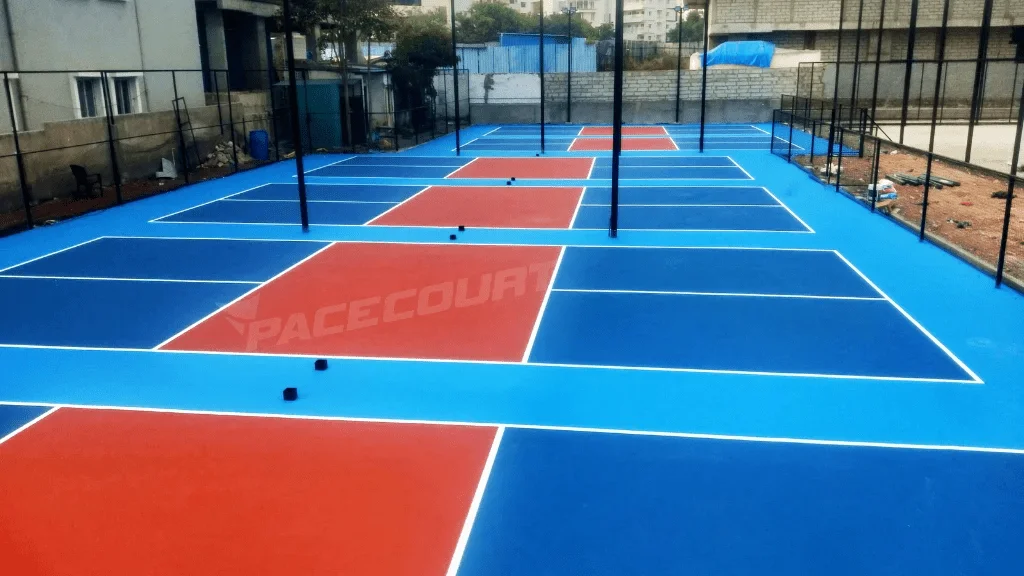
Building a pickleball court involves more than just marking the 20-by-44-foot playing area. To ensure safe and enjoyable gameplay, additional surrounding space is necessary. This buffer area allows players to chase balls, recover from shots, and move freely without obstacles.
The minimum recommended total space for a pickleball court is 30 feet wide by 60 feet long. This adds about 5 feet of clearance on each side and 8 feet behind each baseline. For casual play, this amount of space is usually sufficient.
Professional or tournament-level courts often require even more room. Many facilities provide 34 feet by 64 feet or larger to accommodate competitive play, spectator areas, and camera setups. Extra space is especially important during fast-paced matches where players might sprint beyond the baseline to return deep shots.
Surface material is another important consideration when building a court. Most outdoor courts use acrylic-coated concrete or asphalt, similar to tennis courts. These surfaces provide consistent ball bounce and good traction for players.
Indoor courts, on the other hand, are commonly installed on wooden gym floors or specialized sports flooring. Temporary tape lines and portable nets make it easy to convert existing spaces into pickleball courts.
Proper lighting, fencing, and drainage are also important factors for outdoor installations. Well-designed courts ensure that games can continue safely during evening hours and that rainwater does not collect on the playing surface.
With the sport’s rapid growth—reportedly exceeding 36 million players in the United States according to the Sports & Fitness Industry Association (SFIA)—many communities are investing in new pickleball facilities to meet demand.
Indoor vs Outdoor Pickleball Court Dimensions
Interestingly, the dimensions of a pickleball court remain exactly the same whether the game is played indoors or outdoors. The playing surface still measures 20 feet wide by 44 feet long, and the non-volley zone, service boxes, and net heights follow the same regulations.
The differences between indoor and outdoor courts mainly involve surface materials, lighting, and environmental conditions. Outdoor courts typically use durable surfaces like asphalt or concrete coated with acrylic paint. These surfaces are designed to withstand weather changes while providing consistent bounce.
Indoor courts often feature wood or synthetic sports flooring, which is softer and slightly more forgiving on players’ joints. Because indoor facilities are protected from wind and sunlight, gameplay can feel more controlled compared to outdoor courts.
Wind can significantly affect outdoor pickleball matches, especially because the plastic ball is lightweight. Even a mild breeze can change the ball’s trajectory, adding an extra layer of challenge for players.
Lighting is another factor. Indoor courts rely on overhead lighting systems, while outdoor courts may require tall light poles to support evening games.
Despite these differences, the core dimensions never change. This consistency ensures that players can move seamlessly between indoor gyms and outdoor parks without needing to adjust their strategies or positioning.
Tips for Marking and Setting Up a Pickleball Court
Setting up a pickleball court is surprisingly simple, which is part of the sport’s charm. If you have access to a flat surface like a driveway, parking lot, or gym floor, you can create a playable court with just a measuring tape, some tape or paint, and a portable net.
Start by measuring the 44-foot length and 20-foot width of the court. Mark the baselines and sidelines clearly. Next, measure 7 feet from the net on both sides to create the non-volley zone. Finally, add the centerline to divide each side into two service courts.
Many recreational players use temporary court tape, which can be applied and removed without damaging surfaces. This method works especially well in gyms or shared recreational spaces.
Portable pickleball nets are another popular solution. These nets typically come with lightweight frames that can be assembled in minutes and adjusted to the official height.
If you’re marking a permanent court, using acrylic sports paint ensures durability and visibility. Bright colors like blue, green, or red are often used for the playing surface, with white or yellow lines marking the boundaries.
Proper measurements are crucial because even small mistakes can affect gameplay. Taking time to measure carefully ensures that your court matches official standards and provides the best possible playing experience.
Conclusion
The pickleball court size is one of the key reasons the sport has become so widely popular. Measuring 20 feet wide by 44 feet long, the court strikes a perfect balance between accessibility and competitive gameplay. Its compact dimensions allow players to enjoy fast-paced rallies without needing the large spaces required by sports like tennis.
The court layout—including baselines, sidelines, service areas, and the non-volley zone—creates a unique combination of strategy and precision. Features like the 7-foot kitchen and the slightly lowered net center encourage controlled shots, clever placement, and exciting net exchanges.
Another advantage of the court size is flexibility. Pickleball courts can be installed in parks, gyms, schools, and even residential driveways. In many cases, existing tennis courts can be converted to host multiple pickleball courts, making it easier for communities to meet the growing demand for the sport.
Whether you’re planning to build a court, learning the game, or simply curious about the layout, understanding the official dimensions helps you appreciate the thoughtful design behind pickleball. Every measurement—from the service boxes to the net height—plays a role in shaping the dynamic and social experience that players love.
As pickleball continues to grow worldwide, its simple yet strategic court design will remain one of the reasons millions of people keep picking up a paddle and stepping onto the court.