Basketball Court Measurement: Complete Guide to Dimensions, Markings, and Layout
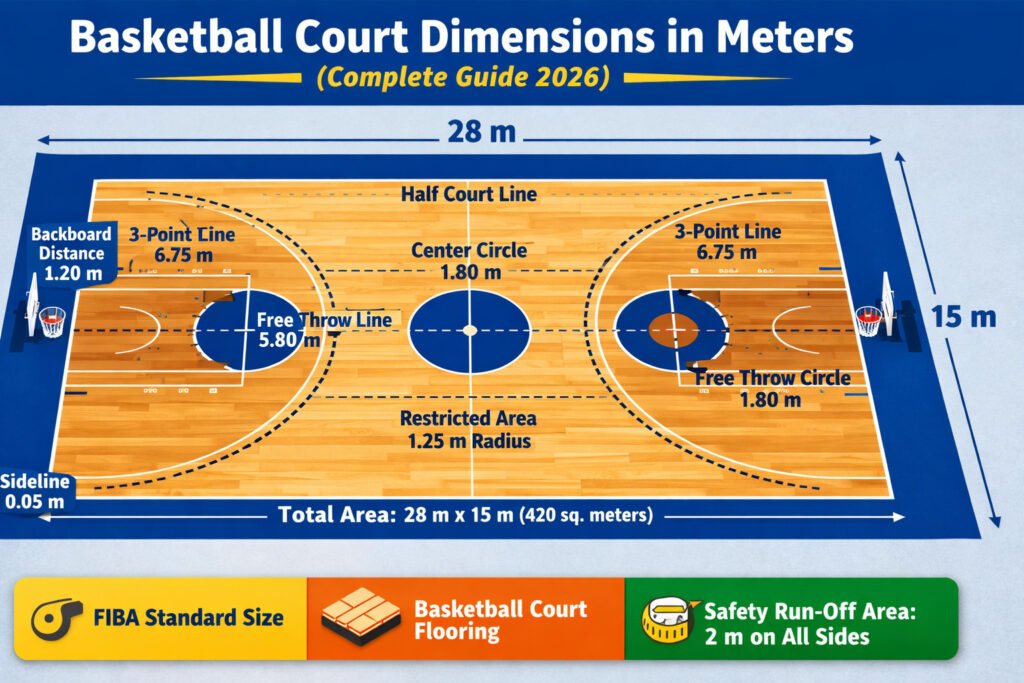
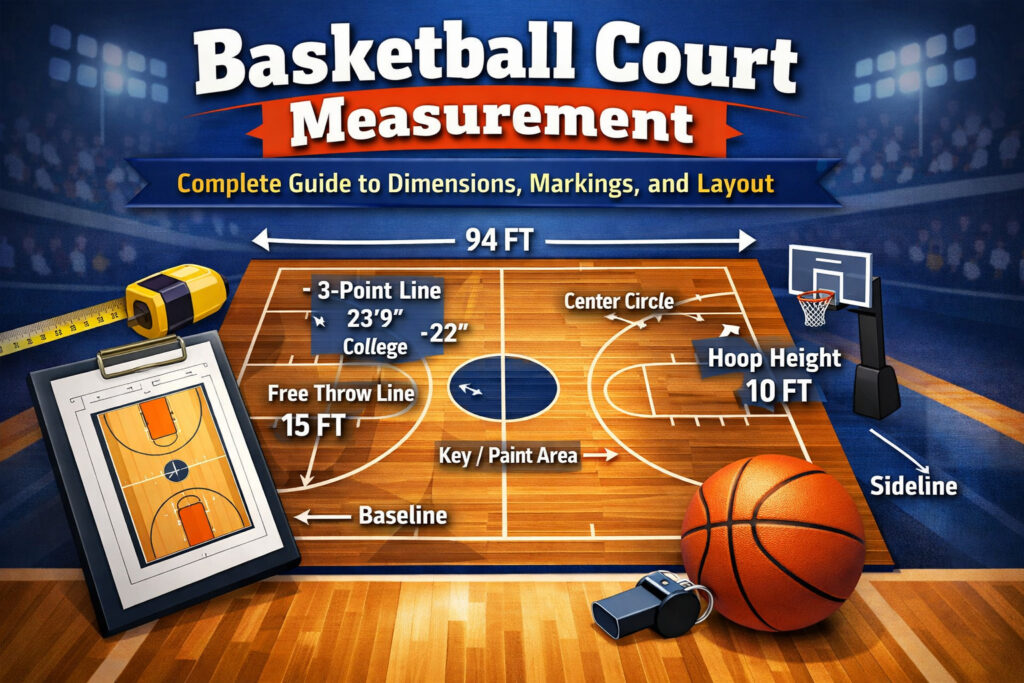
Basketball is one of the most widely played sports in the world, from neighborhood playgrounds to massive professional arenas filled with thousands of cheering fans. While the fast-paced gameplay often steals the spotlight, the basketball court measurement itself plays a crucial role in how the game is played. Every line, arc, and boundary has a specific dimension that influences strategies, player movement, and even scoring patterns. Think of a basketball court like a carefully designed blueprint. Just as architects rely on precise measurements to build a safe structure, basketball organizations depend on standardized court dimensions to maintain fairness and consistency across games. Whether you’re watching the NBA Finals, a college tournament, or a local high school matchup, the court follows strict guidelines set by governing bodies like the NBA, FIBA, and NCAA. These measurements are not random. The distance from the three-point line, the width of the free-throw lane, and the height of the basketball rim are all carefully calculated to balance skill, athleticism, and strategy. For example, extending the three-point line even slightly can dramatically change offensive tactics, forcing teams to adjust their shooting ranges and spacing. Understanding basketball court dimensions is valuable for many reasons. Coaches use this knowledge to design effective plays, facility managers rely on it to build regulation courts, and players benefit from knowing how spacing affects their performance. Even casual fans gain a deeper appreciation of the sport when they understand how the layout shapes the game. This guide explores every important detail about basketball court measurements, including official sizes used in the NBA, FIBA, college, and high school leagues. It also breaks down court markings, hoop dimensions, surface materials, and practical tips for measuring and building a court. By the time you finish reading, you’ll have a clear understanding of how every inch of a basketball court contributes to the rhythm and excitement of the game. Understanding Standard Basketball Court Dimensions When people think about basketball court measurement, they often imagine a large rectangular floor with two hoops at opposite ends. While that description is technically correct, the reality is far more detailed. A standard basketball court includes precise measurements that regulate everything from player positioning to shooting distances. The most widely recognized court dimension comes from professional leagues such as the NBA and FIBA, where courts are designed to provide enough space for fast-paced gameplay while maintaining competitive balance. In general, a full basketball court is rectangular and divided into two equal halves by the center line. Each half contains identical markings such as the three-point arc, free-throw lane, and key area. The typical professional basketball court measures 94 feet long and 50 feet wide (28.65 × 15.24 meters) in the NBA. This size allows ten players to move freely while executing offensive and defensive plays without excessive crowding. The length of the court is especially important because it determines transition speed during fast breaks, one of the most thrilling elements of the game. Beyond the outer boundaries, several internal markings help define gameplay areas. For instance, the center circle marks where the opening tip-off occurs. The three-point arc determines which shots count for three points instead of two. The free-throw lane, often called “the paint,” is where players line up during foul shots. Here is a quick comparison of typical professional basketball court dimensions: League Court Length Court Width NBA 94 ft (28.65 m) 50 ft (15.24 m) FIBA 28 m (91.9 ft) 15 m (49.2 ft) NCAA 94 ft 50 ft High School 84 ft 50 ft Even though the differences may seem small, they significantly affect gameplay. For example, FIBA courts are slightly shorter than NBA courts, which can influence defensive spacing and offensive flow. Another interesting detail is the clearance space around the court. Professional arenas usually include additional out-of-bounds space—often several feet beyond the sidelines and baselines—to protect players when diving for loose balls. Understanding these dimensions is essential for anyone involved in basketball facility planning, coaching strategy, or sports education. Every measurement contributes to the balance between offense and defense that makes basketball such an exciting sport to watch and play. NBA Basketball Court Size The NBA basketball court is considered the global reference point for professional basketball measurements. While other leagues may adopt slightly different standards, the NBA’s dimensions are often viewed as the benchmark for elite-level competition. An official NBA court measures 94 feet in length and 50 feet in width. These dimensions create a playing surface large enough to support the incredible speed and athleticism of professional players. With athletes capable of sprinting the full court in just a few seconds, the extra length helps maintain spacing and allows for dynamic offensive plays such as fast breaks and transition scoring. The court is divided exactly in half by the midcourt line, creating two identical playing areas. At the center of this line lies the center circle, which has a diameter of 12 feet. This circle is where the game begins with the opening jump ball, one of the most iconic moments in basketball. One of the most famous features of the NBA court is the three-point line, which sits farther from the basket compared to most other leagues. In the NBA: This slight difference exists because the court width would otherwise make the corner three excessively long. Interestingly, the corner three has become one of the most strategically valuable shots in modern basketball due to its shorter distance. The free-throw lane, also known as “the key,” measures 16 feet wide in the NBA. This rectangular area sits directly under the basket and plays a crucial role in rebounding, post moves, and defensive positioning. Another critical element is the restricted area arc, which sits directly beneath the basket with a radius of 4 feet. Defenders standing inside this arc cannot draw a charging foul, encouraging more aggressive drives to the rim and reducing dangerous collisions. Altogether, the NBA court layout is carefully designed to balance shooting range, interior play, and defensive strategy. Every