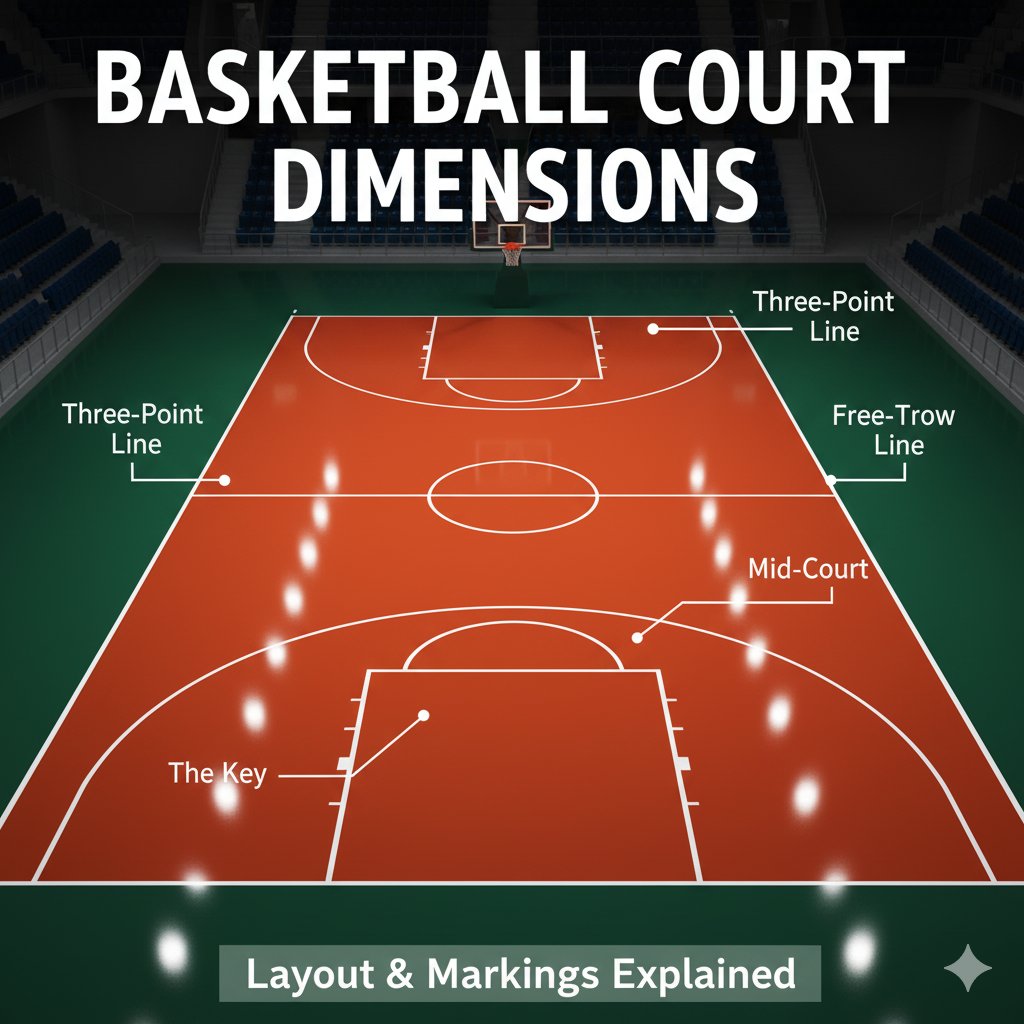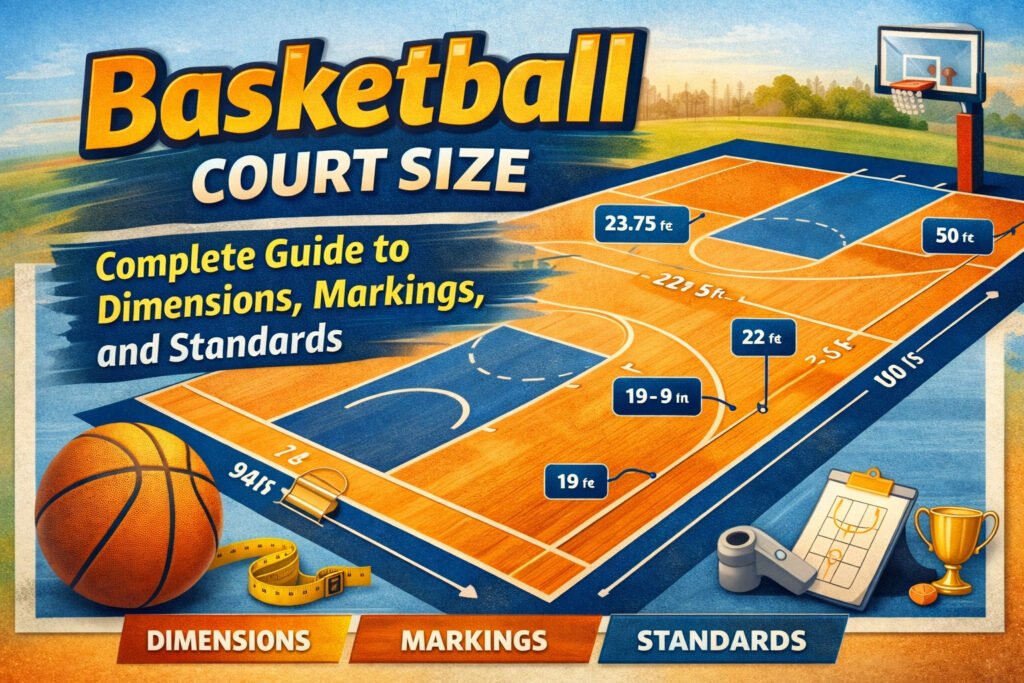
Basketball Court Size: Complete Guide to Dimensions, Markings, and Standards
Basketball court size plays a defining role in how the game is played, experienced, and enjoyed at every level. From professional arenas filled with roaring crowds to quiet backyard courts designed for family fun, court dimensions influence player movement, strategy, spacing, and overall performance. We often underestimate how much precision goes into designing a basketball court, yet every line, angle, and measurement exists for a reason. Standardization ensures fairness, safety, and consistency, whether the game is played in a global championship or a local school gymnasium. Understanding basketball court dimensions is essential for players, coaches, architects, facility managers, and enthusiasts alike. A correctly measured court supports proper gameplay, reduces injury risks, and aligns with official regulations. While casual players may focus on shooting hoops, professionals rely on exact court layouts to execute plays with pinpoint accuracy. Even a slight deviation in markings or spacing can change how the game flows. Basketball courts are governed by different organizations, each with its own standards. The NBA, FIBA, NCAA, and NFHS establish precise rules for court size and markings. These variations, though subtle, significantly impact gameplay. Knowing the differences helps in designing courts that meet specific competitive or recreational needs. As basketball continues to grow globally, understanding these standards becomes increasingly valuable for modern facilities and aspiring players worldwide. History and Evolution of Basketball Court Sizes The evolution of basketball court size reflects the growth and professionalization of the sport itself. When basketball was invented in 1891, games were played in small gymnasiums with improvised layouts. There were no standardized dimensions, and court sizes varied widely depending on available space. As basketball gained popularity, the need for consistent playing conditions became evident, prompting the establishment of formal measurements. Early courts were often smaller, leading to congested gameplay and limited movement. As athleticism increased and strategies evolved, larger courts became necessary to accommodate faster pacing and dynamic playstyles. The introduction of dribbling, fast breaks, and perimeter shooting influenced how courts were designed. Over time, governing bodies introduced precise regulations to maintain fairness and enhance the spectator experience. Professional leagues further refined court dimensions to showcase elite athletic performance. The NBA introduced wider lanes and longer three-point lines to balance scoring and defense. International organizations like FIBA adopted slightly different measurements to suit global play styles and facility constraints. These changes reflect ongoing efforts to optimize the game while preserving its core principles. Today’s basketball courts represent decades of refinement. Each measurement is the result of testing, feedback, and adaptation. Understanding this evolution helps us appreciate why modern basketball courts are designed with such exacting standards and why adherence to these dimensions remains critical for competitive integrity. Standard Basketball Court Size Overview A standard basketball court is rectangular, designed to provide ample space for movement, strategy, and fair competition. While dimensions vary slightly depending on governing bodies, the overall structure remains consistent. The court includes a playing area, boundary lines, and clearly defined zones that dictate gameplay rules. Professional courts are typically 94 feet long and 50 feet wide, offering maximum space for elite competition. Amateur and recreational courts may be smaller, but they still follow proportional layouts to maintain a balanced playing experience. These dimensions ensure players can perform fundamental actions such as passing, shooting, and defending without spatial limitations. Standardization benefits players at all levels by creating familiarity. When athletes transition from school-level play to professional leagues, consistent court layouts reduce adaptation time. Facility designers rely on these standards to build courts that meet regulatory approval and enhance usability. Beyond length and width, standard courts also specify distances for key markings, including the free throw line, three-point arc, and center circle. Each element contributes to the rhythm and structure of the game. A well-designed court supports smooth gameplay, accurate officiating, and an enjoyable experience for players and spectators alike. NBA Basketball Court Dimensions Explained NBA basketball courts represent the gold standard of professional play. The official NBA court size is 94 feet long and 50 feet wide, providing the largest playing surface among major basketball organizations. This expansive layout supports fast-paced gameplay, spacing for perimeter shooting, and dynamic offensive strategies. The free throw lane, commonly known as the key, measures 16 feet wide, allowing room for post play and rebounding battles. The three-point line extends 23 feet 9 inches from the basket at the top of the arc, while the corners measure 22 feet, creating strategic shooting zones. These measurements influence shot selection and defensive coverage. The center circle has a 12-foot diameter, facilitating fair jump ball situations. The restricted area, marked by a semicircle under the basket, helps officials determine charging and blocking fouls. Every line on an NBA court is precisely measured and painted to exact specifications. NBA courts also feature consistent line widths, typically 2 inches, ensuring visibility and uniformity. These details may seem minor, but they contribute to the professional polish and fairness expected at the highest level of basketball competition. FIBA Basketball Court Size and Specifications FIBA basketball courts serve as the international standard, used in global competitions and most countries outside North America. A FIBA court measures 91.86 feet long and 49.21 feet wide, slightly smaller than an NBA court. These dimensions accommodate international facilities while maintaining competitive integrity. The three-point line in FIBA competitions is set at 22 feet 1.75 inches, encouraging balanced scoring between perimeter and interior play. The free throw lane remains 16 feet wide, similar to NBA standards, ensuring consistency in post play. The center circle measures 11.81 feet in diameter, slightly smaller but functionally equivalent. FIBA courts emphasize versatility and accessibility. Their dimensions allow for efficient use of space in multi-purpose arenas and community facilities. Despite minor differences, FIBA courts uphold the same principles of fairness, safety, and performance optimization. Understanding FIBA specifications is crucial for international tournaments, training facilities, and players competing across borders. These standards ensure seamless transitions between domestic and global competitions. NCAA and High School Basketball Court Dimensions College and high school basketball courts are designed to