Basketball Court Size

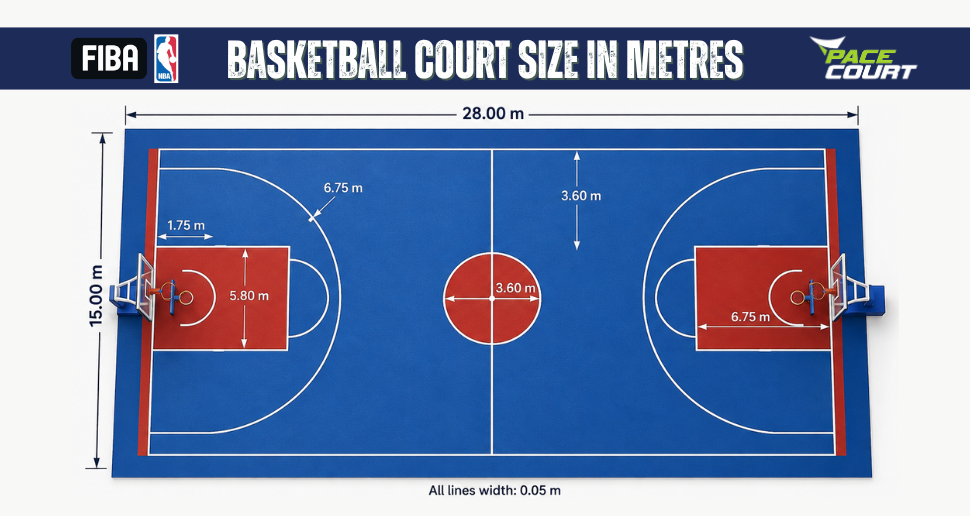
Basketball court size in metres
Basketball Court Size

Basketball Court Size in Metres: Complete Guide (FIBA, NBA & India Standards)

The standard basketball court size in metres under FIBA rules measures 28 metres long by 15 metres wide. This international standard applies across India, the Olympics, World Cup events, and most professional leagues outside the NBA. The NBA court runs slightly larger at 28.65 m × 15.24 m. Both keep the rim height at a universal 3.05 m. This guide delivers accurate, up-to-date dimensions for 2026, clear comparisons, marking details, half-court options, and practical notes for Indian facilities. You get skimmable tables, active-voice explanations, and direct answers ready for search snippets. Official Basketball Court Size in Metres (2026) FIBA sets the global benchmark. India follows these rules for national competitions, schools, colleges, academies, and most new constructions. FIBA / International / India Standard NBA Standard These sizes have remained stable into 2026. FIBA equipment rules effective October 2026 refine backboards, rings, and flooring but leave the court footprint unchanged. Feature FIBA / India (m) NBA (m) Difference Length 28.00 28.65 +0.65 m Width 15.00 15.24 +0.24 m Total Area 420 ~436.6 +16.6 m² Rim Height 3.05 3.05 Same Three-Point Arc 6.75 7.24 +0.49 m Three-Point Corner 6.60–6.75 6.70 Minor Free-Throw Line 4.60 4.57 Nearly same Key / Paint Width 4.90 4.88 Nearly same Centre Circle Diameter 3.60 3.66 Minor No-Charge Semi-Circle 1.25 radius 1.22 radius Minor The FIBA court gives slightly tighter spacing. The NBA floor adds room for isolation plays and longer threes. Why Basketball Court Size in Metres Matters Court dimensions control spacing, defensive help, transition speed, and three-point volume. A 0.65 m length difference changes how quickly teams advance the ball. The shorter FIBA three-point line (6.75 m) rewards efficient outside shooting and suits the international style. NBA spacing rewards elite isolation creators. In India, FIBA dimensions ensure national teams and state championships prepare correctly for Asian and Olympic competition. Builders who mark to 28 × 15 m future-proof facilities for official events. Detailed Court Markings in Metres Every line measures 5 cm wide and contrasts clearly with the floor. Boundary Lines Sidelines run the full 28 m length. Baselines/end lines run the 15 m width. Measure from the inner edge of the lines. Centre Line and Circle The centre line divides the court into two equal 14 m halves. The centre circle has a 1.80 m radius (3.60 m diameter). Restricted Area (The Key or Paint) The key is a rectangle 4.90 m wide. The free-throw line sits 5.80 m from the baseline (approximately 4.60 m from the face of the backboard). A free-throw circle of 1.80 m radius sits on the free-throw line. Three-Point Line FIBA places the arc at a uniform 6.75 m from the centre of the basket. The line meets the sidelines at right angles. NBA uses 7.24 m at the top of the key and shortens to 6.70 m in the corners. No-Charge Semi-Circle A 1.25 m radius arc under the basket protects offensive players driving to the rim. Defenders cannot draw charges inside this zone. Backboard and Rim Placement The backboard sits 1.20 m from the baseline. Its face measures 1.80 m wide by 1.05 m high. The rim hangs exactly 3.05 m above the floor and measures 45 cm in diameter. Half-Court, 3×3 and Youth Sizes Full courts demand space. Many Indian schools, societies, and clubs install practical alternatives. Court Type Length (m) Width (m) Notes Full FIBA 28 15 National & international standard Half-Court FIBA 14 15 Single basket, popular for clubs 3×3 Official 15 11 Fastest-growing format in India School / Recreational 24–26 13–14 Scaled for limited space Mini-Basketball Variable Variable Proportional reduction for under-12 A half-court still includes a free-throw line, three-point arc, and key so players practice real game shots. 3×3 courts use one basket and follow FIBA 3×3 rules with a 12-second shot clock. Indoor vs Outdoor Courts in India (2026 Context) Indoor courts usually use maple or synthetic hardwood for consistent bounce and player safety. Outdoor courts rely on acrylic, asphalt, or concrete with UV-resistant coatings. Both must meet the same dimensional standards. Indian climate considerations favour acrylic outdoor surfaces for societies and school grounds. These systems drain well, resist heat, and require less maintenance than wood. Professional indoor venues follow FIBA Level 1 flooring requirements for rebound and shock absorption. Clearance around the court remains essential. FIBA recommends at least 2 m of unobstructed runoff on all sides. Ideal total footprint reaches roughly 32 m × 19 m when benches, officials, and safety zones are included. Ceiling height for indoor Level 1 events must clear 7 m. How India Applies These Standards in 2026 Basketball Federation of India and state associations adopt FIBA rules. New government sports complexes, Khelo India projects, and private academies mark 28 × 15 m courts. Half-courts and 3×3 setups appear frequently in residential societies and smaller schools because land costs remain high in cities. When you construct or renovate, confirm the intended level of play. A school court can scale slightly smaller while keeping proportional markings. Any facility aiming for state or national events must hit exact FIBA dimensions and markings. Practical Tips for Measuring and Building Measure from the inner edge of all boundary lines. Use laser tools or certified survey equipment for accuracy. Paint lines only after the surface cures fully. Install backboards so the rim sits precisely 3.05 m above the finished floor. Test ball bounce across the entire surface before final acceptance. Run-off zones prevent injuries. Lighting must eliminate shadows on the key and three-point arc. For outdoor courts in monsoon regions, ensure proper slope and drainage so water does not pool on the playing surface. Comparison of Key Playing Zones Zone FIBA Measurement Purpose Restricted Area (Key) 4.90 m wide × 5.80 m deep Three-second violation zone Free-Throw Line 4.60 m from backboard face One-point free throws Three-Point Arc 6.75 m from basket centre Three-point field goals No-Charge Semi-Circle 1.25 m radius Protects drivers from charges Centre Circle 1.80 m radius Jump-ball and restart location These zones create the strategic map
Basketball Court Size

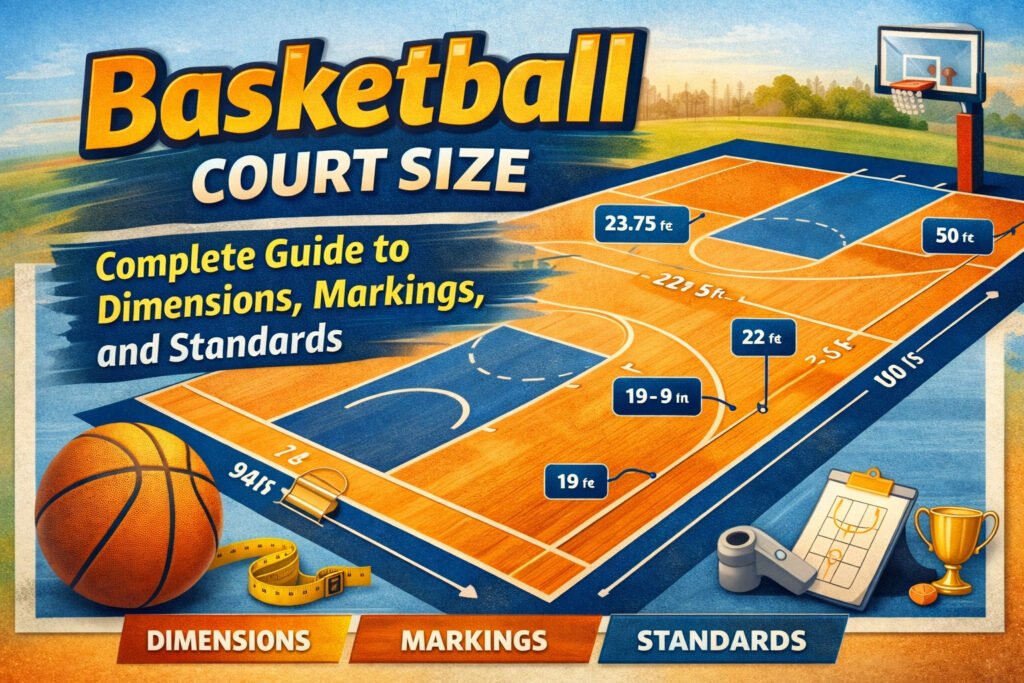
Basketball Court Size: Complete Guide to Dimensions, Markings, and Standards

Basketball court size plays a defining role in how the game is played, experienced, and enjoyed at every level. From professional arenas filled with roaring crowds to quiet backyard courts designed for family fun, court dimensions influence player movement, strategy, spacing, and overall performance. We often underestimate how much precision goes into designing a basketball court, yet every line, angle, and measurement exists for a reason. Standardization ensures fairness, safety, and consistency, whether the game is played in a global championship or a local school gymnasium. Understanding basketball court dimensions is essential for players, coaches, architects, facility managers, and enthusiasts alike. A correctly measured court supports proper gameplay, reduces injury risks, and aligns with official regulations. While casual players may focus on shooting hoops, professionals rely on exact court layouts to execute plays with pinpoint accuracy. Even a slight deviation in markings or spacing can change how the game flows. Basketball courts are governed by different organizations, each with its own standards. The NBA, FIBA, NCAA, and NFHS establish precise rules for court size and markings. These variations, though subtle, significantly impact gameplay. Knowing the differences helps in designing courts that meet specific competitive or recreational needs. As basketball continues to grow globally, understanding these standards becomes increasingly valuable for modern facilities and aspiring players worldwide. History and Evolution of Basketball Court Sizes The evolution of basketball court size reflects the growth and professionalization of the sport itself. When basketball was invented in 1891, games were played in small gymnasiums with improvised layouts. There were no standardized dimensions, and court sizes varied widely depending on available space. As basketball gained popularity, the need for consistent playing conditions became evident, prompting the establishment of formal measurements. Early courts were often smaller, leading to congested gameplay and limited movement. As athleticism increased and strategies evolved, larger courts became necessary to accommodate faster pacing and dynamic playstyles. The introduction of dribbling, fast breaks, and perimeter shooting influenced how courts were designed. Over time, governing bodies introduced precise regulations to maintain fairness and enhance the spectator experience. Professional leagues further refined court dimensions to showcase elite athletic performance. The NBA introduced wider lanes and longer three-point lines to balance scoring and defense. International organizations like FIBA adopted slightly different measurements to suit global play styles and facility constraints. These changes reflect ongoing efforts to optimize the game while preserving its core principles. Today’s basketball courts represent decades of refinement. Each measurement is the result of testing, feedback, and adaptation. Understanding this evolution helps us appreciate why modern basketball courts are designed with such exacting standards and why adherence to these dimensions remains critical for competitive integrity. Standard Basketball Court Size Overview A standard basketball court is rectangular, designed to provide ample space for movement, strategy, and fair competition. While dimensions vary slightly depending on governing bodies, the overall structure remains consistent. The court includes a playing area, boundary lines, and clearly defined zones that dictate gameplay rules. Professional courts are typically 94 feet long and 50 feet wide, offering maximum space for elite competition. Amateur and recreational courts may be smaller, but they still follow proportional layouts to maintain a balanced playing experience. These dimensions ensure players can perform fundamental actions such as passing, shooting, and defending without spatial limitations. Standardization benefits players at all levels by creating familiarity. When athletes transition from school-level play to professional leagues, consistent court layouts reduce adaptation time. Facility designers rely on these standards to build courts that meet regulatory approval and enhance usability. Beyond length and width, standard courts also specify distances for key markings, including the free throw line, three-point arc, and center circle. Each element contributes to the rhythm and structure of the game. A well-designed court supports smooth gameplay, accurate officiating, and an enjoyable experience for players and spectators alike. NBA Basketball Court Dimensions Explained NBA basketball courts represent the gold standard of professional play. The official NBA court size is 94 feet long and 50 feet wide, providing the largest playing surface among major basketball organizations. This expansive layout supports fast-paced gameplay, spacing for perimeter shooting, and dynamic offensive strategies. The free throw lane, commonly known as the key, measures 16 feet wide, allowing room for post play and rebounding battles. The three-point line extends 23 feet 9 inches from the basket at the top of the arc, while the corners measure 22 feet, creating strategic shooting zones. These measurements influence shot selection and defensive coverage. The center circle has a 12-foot diameter, facilitating fair jump ball situations. The restricted area, marked by a semicircle under the basket, helps officials determine charging and blocking fouls. Every line on an NBA court is precisely measured and painted to exact specifications. NBA courts also feature consistent line widths, typically 2 inches, ensuring visibility and uniformity. These details may seem minor, but they contribute to the professional polish and fairness expected at the highest level of basketball competition. FIBA Basketball Court Size and Specifications FIBA basketball courts serve as the international standard, used in global competitions and most countries outside North America. A FIBA court measures 91.86 feet long and 49.21 feet wide, slightly smaller than an NBA court. These dimensions accommodate international facilities while maintaining competitive integrity. The three-point line in FIBA competitions is set at 22 feet 1.75 inches, encouraging balanced scoring between perimeter and interior play. The free throw lane remains 16 feet wide, similar to NBA standards, ensuring consistency in post play. The center circle measures 11.81 feet in diameter, slightly smaller but functionally equivalent. FIBA courts emphasize versatility and accessibility. Their dimensions allow for efficient use of space in multi-purpose arenas and community facilities. Despite minor differences, FIBA courts uphold the same principles of fairness, safety, and performance optimization. Understanding FIBA specifications is crucial for international tournaments, training facilities, and players competing across borders. These standards ensure seamless transitions between domestic and global competitions. NCAA and High School Basketball Court Dimensions College and high school basketball courts are designed to

Basketball Court Size

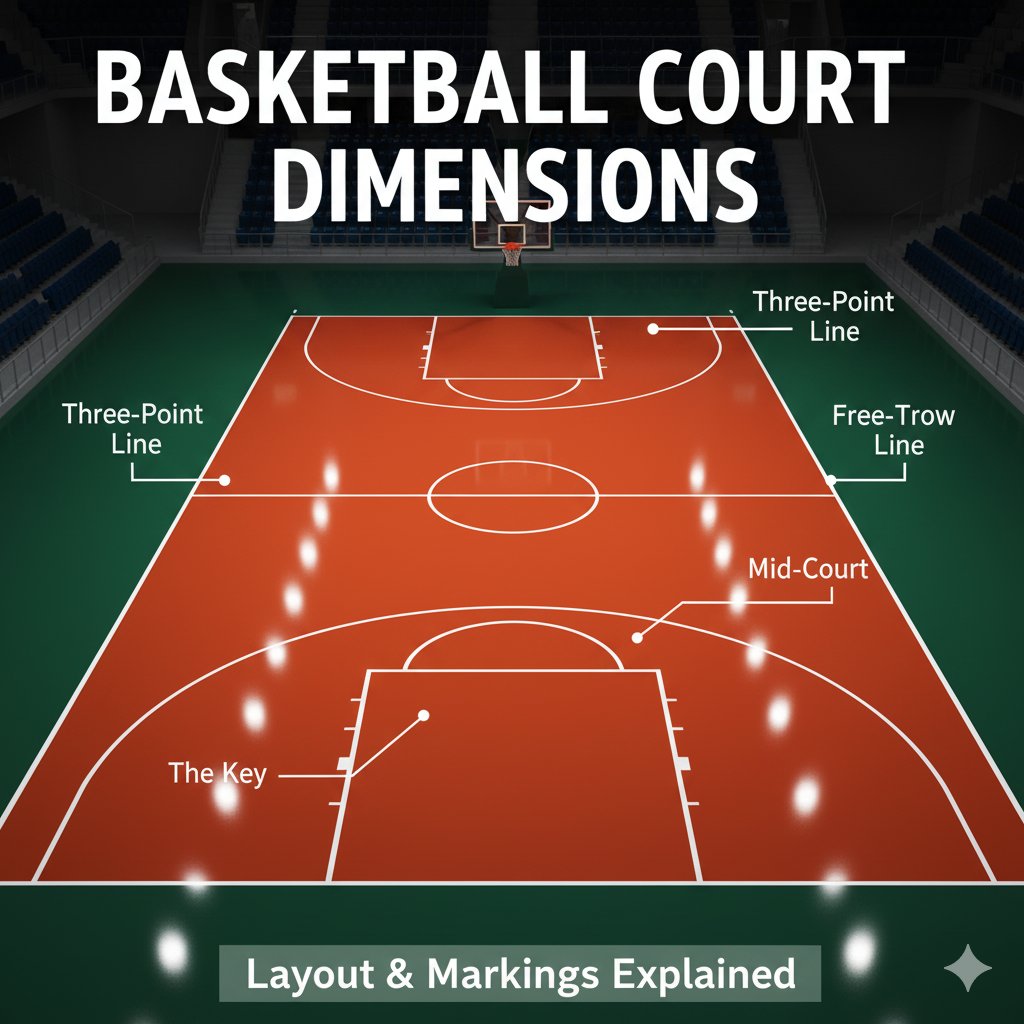
Basketball Court Size: Dimensions, Layout, and Markings Explained

Whether you’re building a professional arena, a school playground, or a backyard court, understanding the basketball court size is essential. Court dimensions directly affect gameplay, movement, and even player safety. This guide explains the official basketball court dimensions, differences across levels (NBA, FIBA, high school), and key markings every builder or player should know. Official Basketball Court Dimensions 1. NBA (National Basketball Association) Court Size The NBA court size provides players with maximum space for fast movements, complex plays, and three-point shots. 2. FIBA (International Basketball Federation) Court Size Most international tournaments and Olympic games use FIBA standards. The slightly smaller size compared to the NBA makes the game more compact and strategic. 3. High School & College Basketball Court Size These courts are designed for training and educational levels, offering easier maneuverability and promoting teamwork over distance shooting. Key Court Markings and Layout A standard basketball court includes the following important markings: These markings maintain uniformity and fairness across all matches. Indoor vs Outdoor Basketball Court Size While the dimensions remain similar, indoor courts usually have hardwood or synthetic surfaces for better bounce and grip.Outdoor courts, however, use materials like acrylic, concrete, or modular tiles, depending on durability and weather resistance. For outdoor construction, ensure: Mini & Half Basketball Court Sizes If you’re building a personal or community court: These compact versions maintain proportions while saving space and cost. Tips for Building a Perfect Basketball Court Use acrylic or synthetic flooring for shock absorption. Maintain 10 feet clearance around the court for player safety. Install anti-glare lighting for night games. Regularly repaint lines for accuracy and appearance. Ensure drainage and slope (1%) to prevent water accumulation outdoors. Basketball Court Size Comparison Table Level Length Width Three-Point Line Free-Throw Line NBA 94 ft 50 ft 23.75 ft 15 ft FIBA 91.9 ft 49.2 ft 22.15 ft 15 ft High School 84 ft 50 ft 19.75 ft 15 ft Conclusion The basketball court size plays a crucial role in how the game unfolds — influencing speed, shot accuracy, and player dynamics. Whether you’re designing for professional athletes or recreational use, following standard measurements ensures a safe and enjoyable playing experience. If you’re planning to build a custom basketball court, consult sports flooring experts to ensure the correct layout, marking, and surface quality.

Scroll to Top
HOMEOWNERS
BUSINESS OWNERS
ARCHITECTS
MUNICIPALITIES

Let's Build
Great Courts

ITF-certified acrylic flooring for Tennis, Basketball, Badminton, Pickleball & more shipped worldwide.

Premium Quality

World-class material & Construction

Expert Team

Experinced Proffectionals at your Service

End-to-End Support

From concept to completions

Get In Touch

We will respond as soon as possible 

[pw_popup_form]

    Your information is secure and will never be shared

    ISO-Certificate