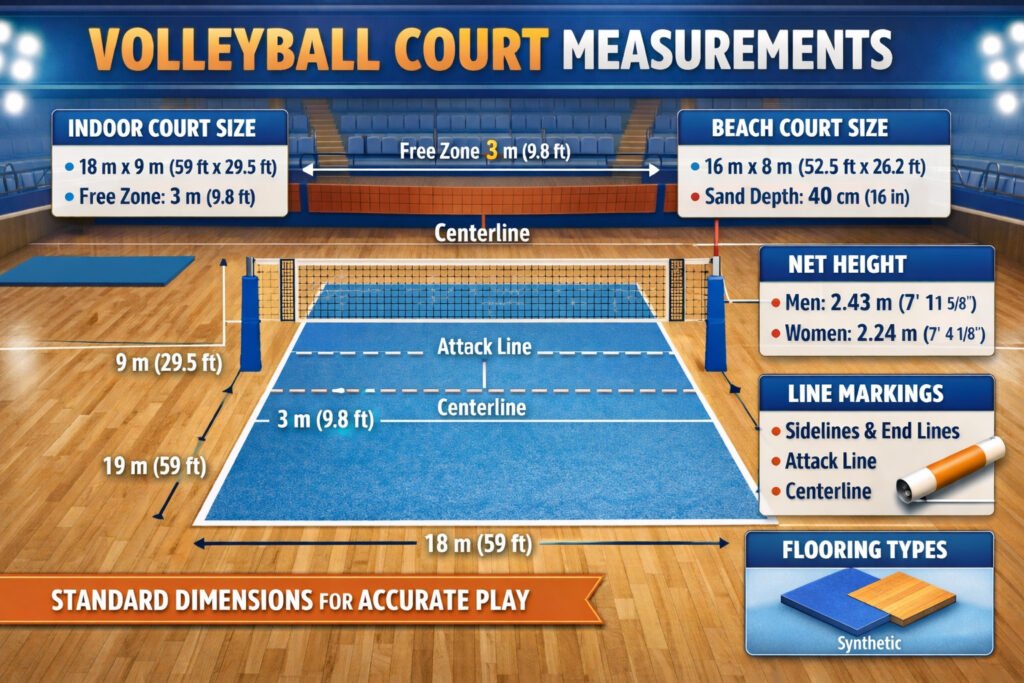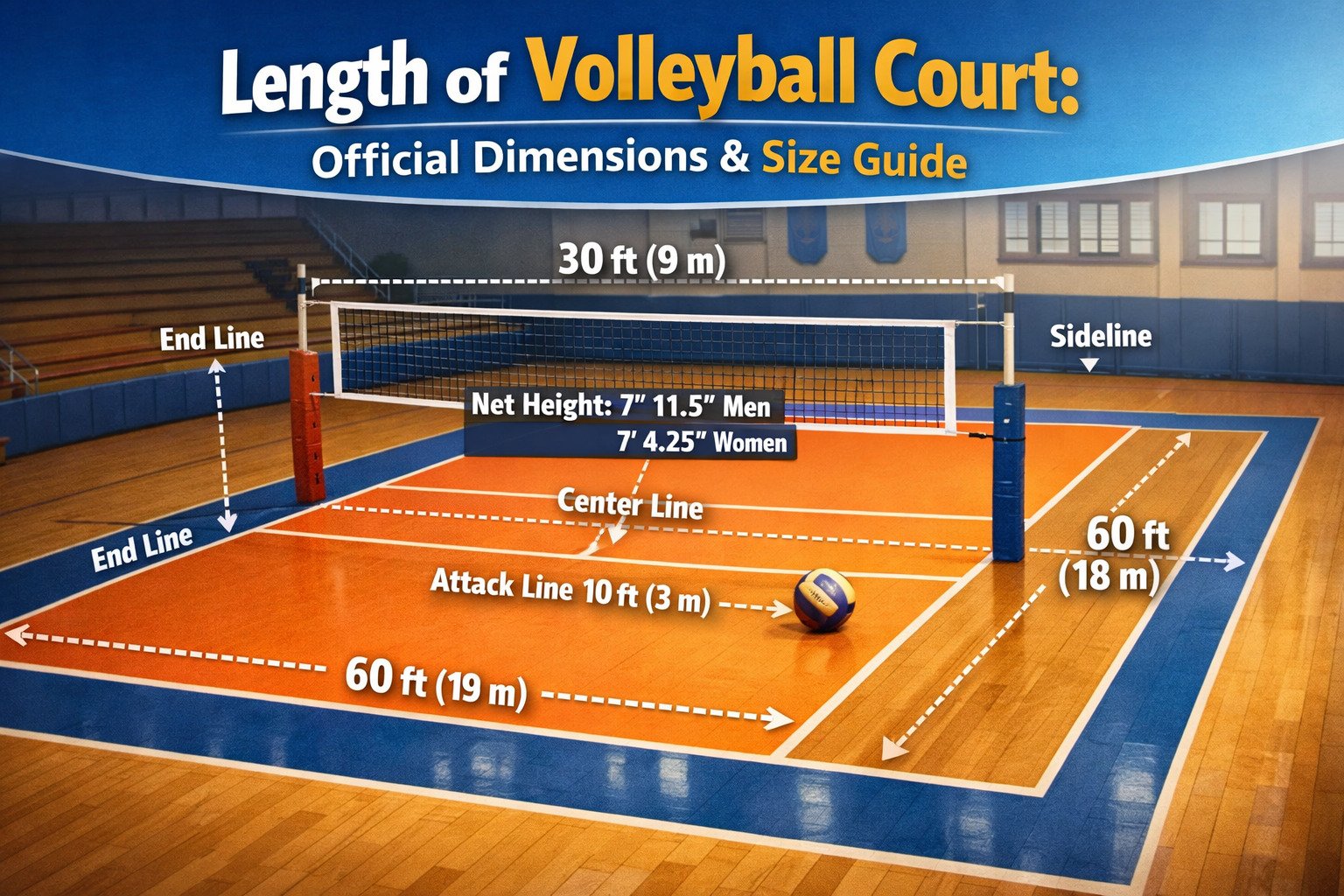
The length of volleyball court is one of the most important measurements that defines how the game is played. According to official rules set by the Fédération Internationale de Volleyball (FIVB), the Length of Volleyball Court is 18 meters (about 59 feet) from one end line to the other. This total distance is divided equally by the net, meaning each team plays within a 9-meter section on its side of the court. Understanding the Length of Volleyball Court helps players position themselves better for serving, attacking, and defending during rallies. The carefully designed Length of Volleyball Court creates a balanced playing field where both offensive and defensive strategies can develop effectively, making the sport fast-paced, competitive, and exciting to watch.
According to the Fédération Internationale de Volleyball (FIVB), the international governing body for volleyball, the official court size for indoor volleyball is 18 meters long and 9 meters wide. That means the total playing surface covers 162 square meters. The court is divided into two equal halves by the net, so each team plays within a 9 × 9 meter square on their side. This symmetry is important because it ensures both teams compete under exactly the same conditions.
Think of the volleyball court like a carefully balanced stage. Every player has a role, and the dimensions of the court dictate how those roles unfold. Setters need enough space to move and deliver accurate sets. Hitters require room to approach the net with speed and power. Defenders rely on court depth to react to spikes traveling at speeds that can exceed 80 km/h (about 50 mph) in competitive play.
Beyond the basic length and width, the court also includes surrounding space called the free zone, which allows players to chase the ball safely outside the main playing area. This extra space becomes critical during fast rallies when a player dives or runs off the court to save the ball.
Professional indoor arenas usually extend this free zone even further to improve player safety and spectator visibility. In international competitions, the free zone can extend at least 3 meters on all sides, while major events may increase it to 5–8 meters.
Understanding these official dimensions helps players visualize the geometry of the game. It’s not just about hitting the ball over the net—it’s about mastering movement within a carefully measured battlefield where every meter counts.
Standard Court Length

The standard volleyball court length is 18 meters (approximately 59 feet). This measurement is recognized worldwide and is used in nearly every indoor volleyball competition, from Olympic matches to school tournaments. The court is divided exactly in half by the net, meaning each team occupies 9 meters of length on its side of the court.
Why 18 meters? The answer lies in the balance between offense and defense. If the court were shorter, spikes would become almost impossible to defend. If it were longer, rallies might drag on too long, making the game slower and less dynamic. The 18-meter length strikes a perfect middle ground where both attacking and defensive strategies can thrive.
Picture a powerful outside hitter approaching the net for a spike. The hitter typically begins their approach several meters behind the attack line, building momentum before jumping. Because the court is 9 meters deep on each side, defenders positioned in the backcourt have just enough space to react and dig the ball. This creates the dramatic rallies that make volleyball so thrilling to watch.
Another interesting aspect of the court length is how it influences player positioning and rotation. Volleyball teams rotate positions after winning a serve from the opponent, meaning players must adapt to different areas of the court. The consistent 18-meter length ensures every rotation presents predictable spacing, which helps teams develop structured offensive systems and defensive formations.
At elite levels of the sport, players memorize these distances almost instinctively. A setter knows exactly how far to push a back set. A libero reads the trajectory of a spike and calculates where it will land within those 9 meters of defensive territory. Over time, the court length becomes second nature—almost like muscle memory guiding every movement.
For recreational players, understanding the 18-meter court length can also improve gameplay. It helps with judging serves, positioning for defense, and controlling ball placement. Whether you’re playing competitively or casually at a local gym, knowing the true dimensions of the court adds a new layer of appreciation for the sport.Standard Court Width
While the length of a volleyball court often gets most of the attention, the standard court width of 9 meters (about 29.5 feet) is just as important. This measurement creates the rectangular shape of the playing area and plays a major role in determining player spacing, defensive coverage, and offensive strategy.
Imagine six players trying to cover half a volleyball court. With a 9-meter width, the team must spread out efficiently to defend against spikes, tips, and sharp cross-court shots. If the court were significantly wider, defenders would struggle to cover open spaces. If it were narrower, powerful hitters would have fewer angles to exploit. The 9-meter width strikes a balance that keeps rallies competitive and unpredictable.
In most team formations, players arrange themselves in a pattern designed to cover the entire width effectively. For example, the three-player front row typically spreads across the net, with each player responsible for blocking or attacking within a portion of the width. Meanwhile, the three-player back row positions themselves strategically to cover deep shots and defensive digs.
This width also influences one of volleyball’s most exciting offensive techniques: the cross-court spike. When a hitter jumps near the left antenna and drives the ball diagonally across the court, they’re using the full 9-meter width to create a difficult defensive angle. These shots often travel from one corner of the court to the opposite back corner, forcing defenders to move quickly.
From a coaching perspective, the court width helps teams design complex defensive systems. Coaches often train players to move laterally across specific zones of the court, ensuring every meter of width is protected. Defensive specialists like the libero become masters of reading hitters and covering large sections of this space.
The width also affects serving strategy. A well-placed serve aimed toward the sidelines can pull receivers out of position, disrupting the opponent’s offense. Because the court is exactly 9 meters wide, servers often target precise zones to exploit weaknesses in the opposing team’s formation.
In essence, the 9-meter width isn’t just a measurement—it’s a strategic framework that shapes how volleyball is played at every level.
Free Zone Around the Court
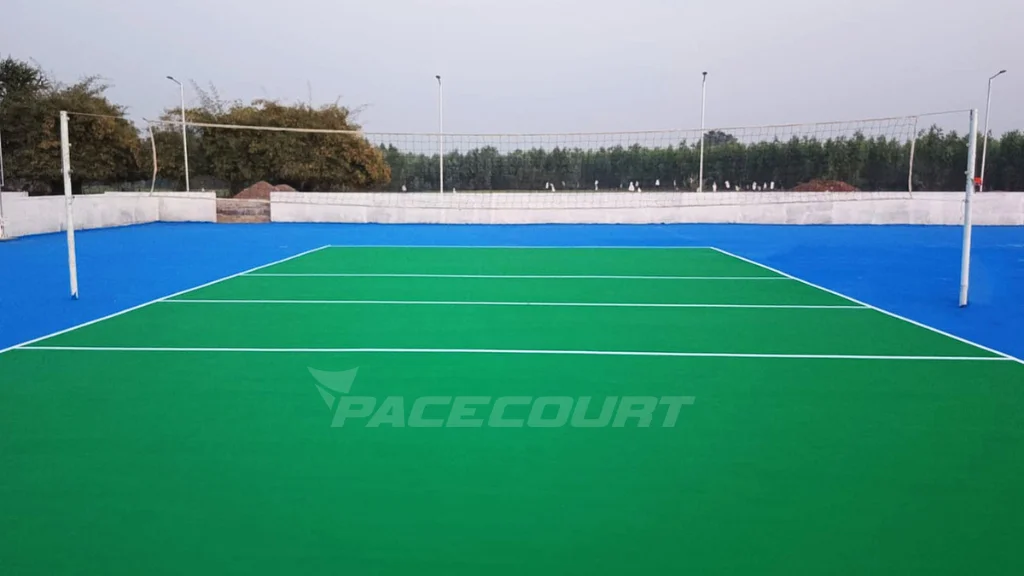
When watching volleyball on television, you might notice players occasionally sprinting far beyond the court lines to keep the ball in play. That area surrounding the court is known as the free zone, and it’s an essential part of official volleyball court design.
The free zone is the open space that surrounds the 18 × 9 meter playing court. According to official FIVB regulations, this area must be at least 3 meters wide on all sides of the court for standard competitions. In major international tournaments, the free zone can extend even further—sometimes reaching 5 meters on the sidelines and up to 8 meters behind the end lines.
Why is this extra space necessary? Volleyball is a fast-paced sport where the ball can travel in unpredictable directions. Players often chase errant passes or deflected blocks outside the court boundaries. Without sufficient free space, these rescue attempts could lead to dangerous collisions with walls, chairs, or spectators.
Think of the free zone as a safety buffer that allows athletes to perform dramatic saves. Some of the most memorable moments in volleyball happen when a player dives beyond the court, pops the ball back into the air, and keeps the rally alive. Those plays would be impossible without the additional space surrounding the court.
The free zone also improves the flow of the game. Because players have room to move freely, rallies can continue even when the ball leaves the main playing area. This creates longer, more exciting exchanges that fans love to watch.
Professional arenas take this concept even further by maintaining a clear vertical space above the court, known as the free playing space. For international competitions, this vertical clearance must be at least 7 meters high, and in elite events it can reach 12.5 meters. This ensures players can perform high passes and towering spikes without obstruction.
From a practical perspective, recreational courts sometimes reduce the free zone due to space limitations in gyms or community centers. While the game can still be played, the experience isn’t quite the same as competing on a full regulation court.
Understanding the free zone helps reveal how volleyball is designed not just for skill and strategy, but also for player safety and spectacular athleticism.
Key Areas of a Volleyball Court
A volleyball court may look like a simple rectangle at first glance, but once you step onto it, you realize it’s carefully divided into several functional zones. Each area has a specific purpose that shapes how players move, attack, defend, and serve during a match. These zones help organize the game and ensure that every player understands their role on the court.
On each side of the net, the 9 × 9 meter half-court is divided into two primary sections: the front zone and the backcourt. These zones determine which players can attack the ball above the net and which must stay behind certain lines during offensive plays. The division also affects rotations, defensive systems, and strategic positioning.
The separation between these zones is marked by the attack line, which sits 3 meters away from the net. This line creates a clear boundary that back-row players must respect when attempting to attack the ball. Front-row players, on the other hand, can jump and spike from anywhere in front of the line.
These zones add layers of tactical complexity to volleyball. A team must coordinate movements between setters, hitters, and defenders while respecting the spatial rules of the court. The layout ensures that players cannot simply crowd near the net; instead, they must spread out and cover the entire playing area effectively.
From a coaching perspective, these divisions help teams organize their strategies. Offensive plays often begin with a pass from the backcourt, followed by a set near the front zone, and then a spike from one of the hitters. Meanwhile, defensive systems rely on the backcourt players to cover deep areas while front-row players focus on blocking at the net.
Professional teams spend countless hours practicing how to transition between these zones smoothly. A player might begin a rally in the backcourt, rotate forward after a point, and suddenly become responsible for blocking or attacking near the net. Because of this constant movement, understanding the key areas of the volleyball court is essential for anyone who wants to master the game.
The court layout also enhances fairness. Every team must operate within the same spatial constraints, ensuring that skill, coordination, and strategy determine the outcome rather than random positioning.
Let’s break down the most important zones in detail.
Front Zone (Attack Zone)
The front zone, often called the attack zone, is one of the most exciting areas of a volleyball court. This section lies between the net and the attack line, which is exactly 3 meters (about 9 feet 10 inches) away from the net on each side. The players positioned in this zone are typically responsible for the majority of offensive plays.
Front-row players include the outside hitter, middle blocker, and opposite hitter. These athletes specialize in attacking the ball and blocking the opponent’s spikes. Because they’re closest to the net, they have the best opportunity to jump high and strike the ball downward into the opponent’s court.
The attack zone is where some of volleyball’s most powerful moments happen. When a setter delivers a perfectly timed set near the net, a hitter explodes upward and drives the ball across the net with incredible force. These spikes can travel at speeds exceeding 80–100 km/h in professional matches, making them extremely difficult to defend.
Blocking also takes place primarily in this zone. Front-row players jump at the net to stop or redirect an opponent’s attack before it crosses into their side of the court. Effective blocking requires precise timing, coordination, and an understanding of the hitter’s tendencies.
The attack zone also plays a key role in regulating back-row players. Those positioned behind the attack line cannot jump and spike the ball from in front of that line. If they want to attack, they must jump from behind the 3-meter line and strike the ball while airborne before landing inside the front zone.
This rule adds an interesting strategic twist to the game. Back-row attacks are still possible, but they require careful timing and positioning. When executed correctly, they can surprise opponents who expect the attack to come only from front-row players.
Because of these rules, the front zone becomes a battlefield of vertical athleticism, where height, timing, and explosive power combine to produce some of the most thrilling plays in volleyball.
Backcourt (Defensive Zone)
Behind the attack line lies the backcourt, also known as the defensive zone. This area stretches from the 3-meter attack line to the end line, covering a distance of 6 meters. While the front zone is often associated with offense, the backcourt is where defensive skills truly shine.
Back-row players typically include the libero, defensive specialists, and rotating hitters who are currently positioned in the back row. Their primary responsibility is to receive serves, dig powerful spikes, and keep the ball alive during intense rallies.
The backcourt is crucial because it acts as the team’s last line of defense. When an opponent unleashes a powerful spike, the ball often travels toward the deeper part of the court. Players in the back row must react quickly, positioning themselves to absorb the impact and redirect the ball upward for a potential counterattack.
One of the most important skills developed in this zone is the dig, which occurs when a defender successfully receives a hard-driven attack. A great dig can completely shift momentum during a rally, transforming what seemed like a certain point for the opponent into a new offensive opportunity.
The libero, a specialized defensive player introduced to international volleyball in 1998, usually dominates the backcourt. Wearing a different-colored jersey, the libero cannot attack the ball above the height of the net but excels at passing and defense. This role has significantly improved rally quality in modern volleyball.
Back-row players can also participate in offense through back-row attacks, provided they jump from behind the attack line. This tactic adds unpredictability to a team’s offense, allowing hitters to approach from deeper positions and catch blockers off guard.
Overall, the backcourt is a space where agility, reflexes, and anticipation become the most valuable skills. While spikes and blocks often steal the spotlight, many matches are actually won through the relentless defensive work happening in this zone.
Service Zone
Every volleyball rally begins with a serve, and that serve must originate from the service zone. This area is located directly behind the end line of the court and extends across the entire width of the court.
The service zone allows the server to stand anywhere along the 9-meter width behind the end line, giving them flexibility in choosing the best serving angle. The depth of the service area extends back to the end of the free zone, meaning players often have several meters of space to prepare their serve.
Serving has evolved dramatically over the years. What was once a simple way to start the rally has become a powerful offensive weapon. Today’s players use several types of serves, including:
- Float serve
- Jump serve
- Jump float serve
- Topspin serve
The jump serve, in particular, has transformed the game. By jumping before striking the ball, players generate tremendous power and topspin, causing the ball to drop sharply into the opponent’s court. Some professional servers can deliver serves exceeding 100 km/h.
The service zone also plays a strategic role in targeting weaknesses in the opposing team’s formation. Servers often aim for specific receivers, forcing them into difficult passing situations that disrupt the opponent’s offense.
Because the service zone spans the entire width behind the court, players can vary their starting position to create different angles. Serving from the corner might produce a sharp cross-court trajectory, while serving from the center might target the seam between two receivers.
This simple rectangular area behind the end line becomes the launching point for every rally, setting the tone for the entire play.
Net and Center Line Relationship
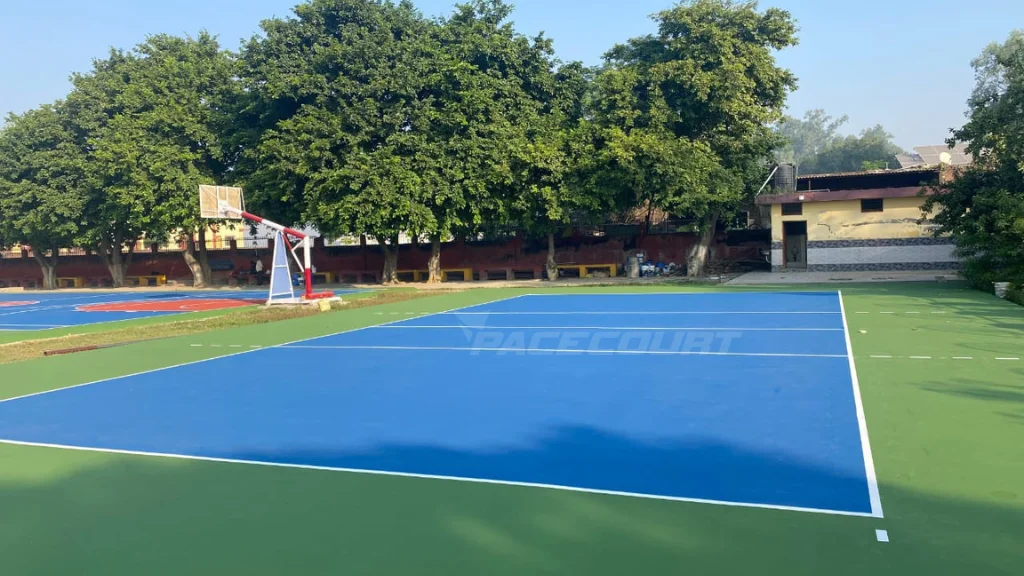
The net and center line form the structural heart of a volleyball court. While the court’s length of 18 meters defines the total playing area, the net divides that space into two perfectly equal halves of 9 meters each. This balance ensures fairness, making sure both teams operate within identical conditions throughout the match.
The center line runs directly beneath the net, stretching across the entire 9-meter width of the court. It marks the boundary between the two opposing teams. Players must respect this line during play, meaning they cannot completely cross into the opponent’s side of the court. However, volleyball rules allow a small degree of overlap—players may step on or slightly over the line as long as part of their foot remains in contact with or above their own side.
This rule might seem minor, but it becomes incredibly important during blocking and attacking actions near the net. When players jump to block a spike or reach across the net after an opponent’s attack, they must avoid interfering with the opponent’s ability to play the ball. These regulations maintain fairness and prevent dangerous collisions.
The net itself spans the entire width of the court (9 meters) and extends slightly beyond the sidelines with antennas that mark the legal crossing area for the ball. The ball must pass between the antennas, which act like invisible vertical boundaries for play.
Another fascinating aspect of the net is how it influences strategy. Because the net divides the court evenly, teams must develop coordinated systems to transition quickly between offense and defense. Front-row players focus on blocking and attacking, while back-row players prepare to dig or set up the next play.
The height of the net also changes depending on the competition category. Men’s and women’s volleyball use different official net heights to maintain competitive balance. These measurements ensure that both power and technique remain essential elements of the sport.
In many ways, the net and center line transform a simple rectangular court into a strategic battlefield. They dictate movement, shape player positioning, and define how teams challenge each other during every rally.
Men’s Official Net Height
In men’s volleyball, the official net height is 2.43 meters (7 feet 11⅝ inches) measured from the center of the court. This height has been standardized by the FIVB and is used in professional leagues, international competitions, and the Olympic Games.
This measurement might seem like just a number, but it significantly influences how the game is played. At 2.43 meters, the net is high enough to require explosive jumping ability while still allowing powerful attacks. Elite male volleyball players often reach spike heights of 3.4 to 3.7 meters, meaning they contact the ball nearly a meter above the net.
Because of this height, players must combine strength, timing, and technique to execute effective attacks. A hitter must jump high enough to drive the ball downward into the opponent’s court rather than simply sending it over the net.
Blocking also becomes a critical skill at this height. Front-row defenders attempt to create a solid wall above the net, timing their jump to intercept the attacker’s spike. Successful blocks can immediately score points or deflect the ball into the backcourt for an easy dig.
The men’s net height also encourages dynamic offensive strategies such as quick sets, slide attacks, and combination plays. Setters deliver precise passes that allow hitters to attack before the opposing blockers can react.
Interestingly, different age groups and skill levels adjust the net height slightly to match player development. Youth volleyball leagues often use lower nets so younger athletes can practice proper techniques without struggling against unrealistic physical barriers.
Still, at the professional level, the 2.43-meter net height has proven to be the perfect balance between athletic challenge and exciting gameplay.
Women’s Official Net Height
For women’s volleyball, the official net height is slightly lower at 2.24 meters (7 feet 4⅛ inches). This measurement is also regulated by the FIVB and is used across international tournaments, professional leagues, and collegiate competitions.
The difference of 19 centimeters compared to the men’s net may seem small, but it plays an important role in maintaining competitive balance. The height allows players to showcase explosive attacks, strategic plays, and impressive defensive actions without making the net disproportionately difficult to overcome.
Top female volleyball athletes still achieve remarkable vertical reach. Many elite players can spike the ball at heights exceeding 3 meters, creating powerful downward attacks that challenge even the most skilled defenders.
Because the net is slightly lower, rallies in women’s volleyball often feature longer exchanges and more defensive saves. Teams rely heavily on ball control, precise passing, and strategic placement rather than relying solely on raw power.
The women’s game is widely praised for its speed and tactical complexity. Setters orchestrate fast offensive patterns, while defenders react quickly to tips, roll shots, and cross-court spikes.
Just like in the men’s game, younger age groups often adjust the net height further to help developing players learn proper mechanics. By gradually increasing the height as athletes grow, coaches ensure players develop both confidence and technical skill.
Overall, the 2.24-meter net height allows women’s volleyball to maintain the same intensity, athleticism, and excitement that defines the sport worldwide.
Indoor vs Beach Volleyball Court Length
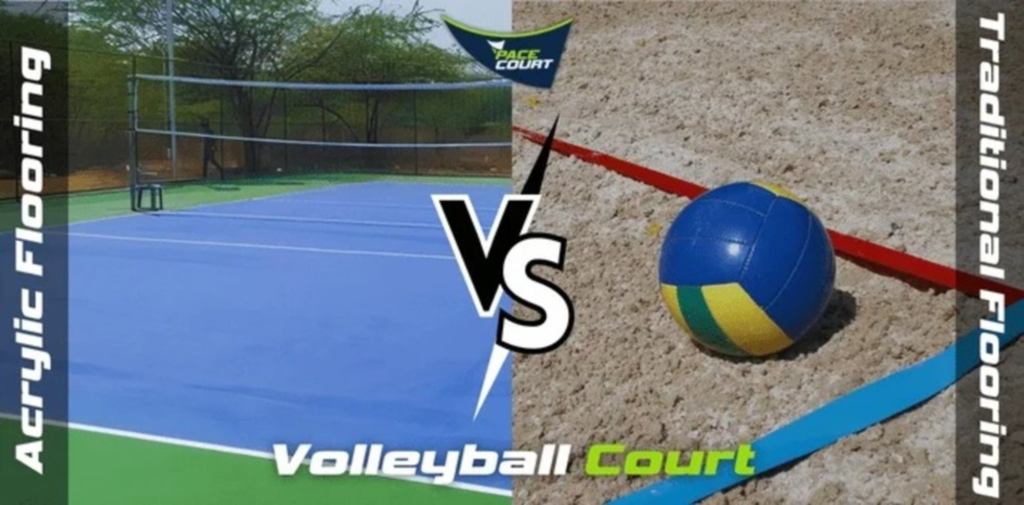
Although indoor and beach volleyball share many rules, their court dimensions differ significantly. These differences affect player movement, strategy, and the overall pace of the game.
Indoor volleyball uses the standard 18-meter by 9-meter court, accommodating six players per team. This larger space allows for specialized roles such as setters, liberos, middle blockers, and outside hitters. With more players covering the court, teams can execute complex offensive systems and defensive formations.
Beach volleyball, however, uses a smaller court measuring 16 meters long and 8 meters wide. Each team consists of only two players, meaning those players must cover the entire playing area themselves.
The smaller size might seem like it would make the game easier, but the opposite is often true. Playing on sand requires significantly more effort because the surface absorbs energy and slows movement. Even quick sprints and jumps demand extra strength and endurance.
Another major difference lies in environmental conditions. Indoor volleyball takes place in controlled arenas with stable lighting and temperature. Beach volleyball players must adapt to wind, sun glare, heat, and shifting sand.
Because the beach court is smaller, rallies often involve more strategic ball placement rather than sheer power. Players frequently use shots, pokes, and soft placements to exploit open areas of the court.
Despite the differences, both versions maintain the same core spirit of volleyball: teamwork, athleticism, and fast-paced rallies.
Beach Volleyball Court Dimensions
A beach volleyball court measures 16 meters in length and 8 meters in width, making it slightly smaller than an indoor court. The net still divides the court into two equal halves, so each team defends an 8 × 8 meter area.
Here’s a quick comparison:
| Feature | Indoor Volleyball | Beach Volleyball |
|---|---|---|
| Court Length | 18 meters | 16 meters |
| Court Width | 9 meters | 8 meters |
| Players per Team | 6 | 2 |
| Surface | Hard indoor floor | Sand |
The reduced court size is necessary because beach volleyball teams consist of only two players. Covering the full indoor court with just two athletes would be nearly impossible, especially on sand.
Another interesting difference is the free zone around beach courts, which must be at least 3 meters wide according to official rules. This space ensures players can chase the ball safely even when diving into the sand.
The sand surface dramatically changes gameplay. Jumping becomes harder, running requires more energy, and quick directional changes demand exceptional balance. Because of this, beach volleyball athletes often develop incredible core strength and endurance.
Beach volleyball also tends to produce longer rallies. Since players cannot rely on a full defensive lineup, they must read the opponent’s intentions carefully and react quickly to every shot.
Court Markings and Lines
Volleyball courts contain several important markings that help define gameplay boundaries and zones. These lines may seem simple, but they serve as critical reference points for players and referees.
The main lines on a volleyball court include:
- End lines
- Sidelines
- Center line
- Attack line
All of these lines are typically 5 centimeters wide and are considered part of the court. This means if the ball touches the line, it is still considered in bounds.
Court markings help referees determine whether a serve landed inside the court, whether a player crossed the attack line illegally, or whether the ball traveled outside the legal playing area.
Beyond officiating, these lines guide player movement and positioning. Players learn to use them as visual cues when setting up attacks or adjusting defensive formations.
Attack Line Explained
The attack line, also known as the 3-meter line, is one of the most strategically important markings on a volleyball court. It runs parallel to the net and sits exactly 3 meters away from it on each side.
This line divides the court into the front zone and backcourt, determining which players can perform certain types of attacks. Front-row players may jump and spike from anywhere near the net, but back-row players must jump from behind the attack line if they want to attack the ball above the net.
The rule prevents back-row players from crowding the net, preserving the tactical structure of volleyball. Without it, teams could simply stack all players near the net, making the game chaotic and unbalanced.
The attack line also influences defensive positioning. Backcourt players often align themselves just behind this line so they can react quickly to spikes while still maintaining enough distance to handle deep shots.
Because of its role in both offense and defense, the 3-meter attack line is one of the most important references on the court.
Boundary Lines and End Lines
The boundary lines define the outer edges of the volleyball court and determine whether the ball is in or out of play. These lines include the two sidelines and the two end lines, forming the rectangle that measures 18 meters long and 9 meters wide.
The sidelines run along the length of the court, while the end lines mark the back edges of each team’s playing area. If the ball lands outside any of these lines, it is considered out, and the opposing team wins the point.
Players often use the boundary lines strategically when serving or attacking. A well-placed spike aimed near the sideline can be extremely difficult for defenders to reach. Similarly, servers often target the corners near the end lines to force poor passes.
Because the lines are part of the court, even a slight contact with the line counts as a legal landing spot for the ball. This rule often leads to dramatic moments when a spike appears to be out but clips the line by just a few millimeters.
Why Volleyball Court Length Matters in Gameplay

The 18-meter length of a volleyball court might seem like a simple measurement, but it profoundly influences how the sport is played. Every movement—from serving and passing to spiking and defending—is shaped by this carefully designed dimension.
A longer court gives defenders enough time to react to powerful attacks, while still allowing hitters to generate momentum during their approach. This balance creates exciting rallies where both offense and defense have equal opportunities to shine.
Coaches design entire strategies around court spacing. Defensive systems such as perimeter defense or rotation defense rely on players covering specific sections of the court. Offensive plays are also planned with these distances in mind, ensuring hitters can approach the net with proper timing.
Ultimately, the court length ensures volleyball remains a sport of speed, skill, and strategy rather than pure power.
Conclusion
The official length of a volleyball court is 18 meters (59 feet), with a width of 9 meters (29.5 feet). This carefully balanced playing area is divided by the net into two equal halves, allowing teams to compete under identical conditions.
Beyond the basic dimensions, the volleyball court includes several important zones such as the front zone, backcourt, and service area, each contributing to the structure and strategy of the game. Additional elements like the attack line, boundary lines, and free zone ensure the sport remains organized, safe, and competitive.
Understanding these measurements provides deeper insight into how volleyball works. Every spike, dig, and serve takes place within this precisely measured space, turning a simple rectangular court into a dynamic arena for one of the world’s most exciting sports.