Introduction to Pickleball and Tennis Courts
The Rising Popularity of Pickleball
If you’ve stepped anywhere near a community park, gym, or even a converted driveway lately, chances are you’ve heard the unmistakable pop of a pickleball paddle. This fast-growing sport has exploded in popularity across the United States and beyond, attracting players of all ages. What makes pickleball so appealing? It’s simple to learn, easy on the joints, and incredibly social. But one of the most interesting aspects—especially for beginners—is how its court compares to the much larger tennis court.
Pickleball courts are often described as “mini tennis courts,” but that comparison only scratches the surface. The dimensions, layout, and even the way space is used differ in ways that significantly impact gameplay. You might assume a smaller court just means less running, but it actually creates a faster-paced, more strategic game where reflexes matter just as much as endurance. That’s why understanding court dimensions isn’t just a technical detail—it shapes how the game feels.
Across recreational centers, many facilities are converting unused tennis courts into multiple pickleball courts. This trend highlights not just pickleball’s growth but also how adaptable its court design is. Unlike tennis, which requires a large dedicated space, pickleball can fit into tighter areas, making it more accessible in urban environments. This flexibility has fueled its rapid rise and made it a favorite among beginners and seasoned athletes alike.
So before you grab a paddle or racket, it’s worth digging into what really sets these courts apart. The differences go beyond size—they redefine how each sport is played.
Tennis: A Timeless Classic
While pickleball might be the new kid on the block, tennis remains one of the most respected and globally recognized sports. With a history stretching back centuries, tennis courts have been standardized to support high-level competition, from local clubs to Grand Slam tournaments. When you step onto a tennis court, you’re entering a space designed for power, precision, and endurance.
Tennis courts are significantly larger than pickleball courts, which immediately changes the physical demands of the game. Players cover more ground, hit with greater force, and rely heavily on stamina and footwork. The larger dimensions allow for a wider variety of shots—deep baseline rallies, angled cross-court hits, and powerful serves that can reach impressive speeds. In contrast to pickleball’s tight, reactive gameplay, tennis feels expansive and physically demanding.
Another defining feature of tennis courts is their versatility in surface types. From clay to grass to hard courts, each surface introduces unique playing conditions. A clay court slows the ball down and emphasizes long rallies, while grass courts speed things up and favor aggressive play. This diversity adds another layer of complexity that pickleball courts, which are typically uniform, don’t emphasize as much.
Despite the rise of pickleball, tennis courts remain a staple in sports complexes worldwide. However, their large footprint has also made them prime candidates for conversion. It’s not uncommon to see a single tennis court repurposed into multiple pickleball courts, which speaks volumes about how space efficiency plays into modern sports trends.
Understanding tennis court dimensions isn’t just about numbers—it’s about appreciating how the design supports a completely different style of play. And when you compare it to pickleball, the contrast becomes even more fascinating.
Standard Pickleball Court Dimensions
Court Size and Layout
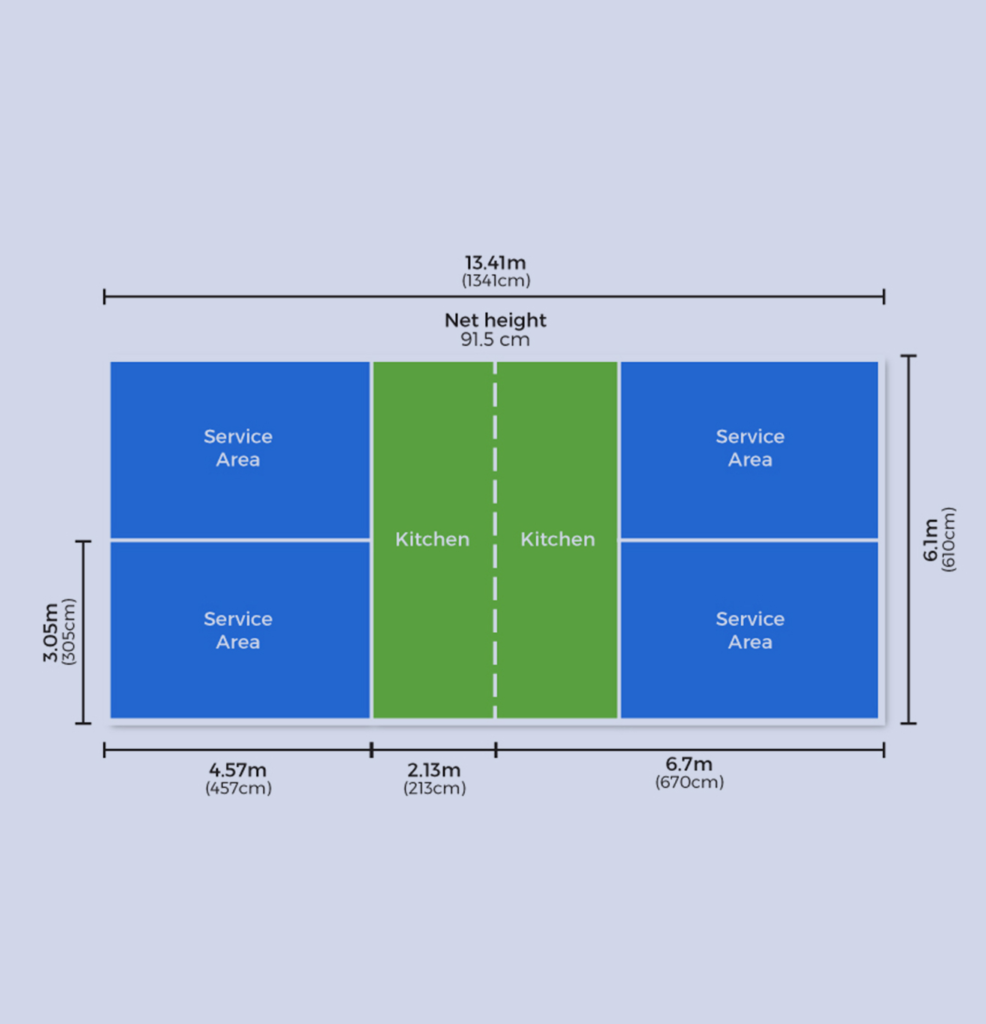
A standard pickleball court measures 20 feet wide by 44 feet long, and here’s the surprising part—it’s the same size whether you’re playing singles or doubles. That alone sets it apart from tennis, where court dimensions change depending on the format. This uniformity simplifies the game and makes it more accessible, especially for beginners who don’t want to memorize multiple layouts.
To put things into perspective, a pickleball court is roughly one-quarter the size of a tennis court. That smaller footprint dramatically changes how the game is played. Instead of relying on long sprints and powerful serves, players focus more on control, placement, and quick reactions. It’s a bit like playing chess on a smaller board—every move counts, and there’s less room for error.
The court is divided into two equal halves by a net, with clearly marked service areas on each side. Each half contains a right and left service box, similar to tennis, but smaller and more compact. These service boxes dictate where serves must land, adding a layer of strategy even before a rally begins. Because the court is smaller, players often find themselves engaged in rapid-fire exchanges at the net, which can be both thrilling and challenging.
Another important aspect is the baseline and sideline boundaries, which define the playable area. The compact dimensions mean that balls go out of bounds more quickly, so precision becomes crucial. A slight miscalculation can end a rally instantly, which keeps players on their toes.
This smaller, more contained environment is one of the reasons pickleball has gained such widespread appeal. It lowers the barrier to entry while still offering a competitive and engaging experience. Whether you’re playing casually or in a tournament, the court’s dimensions ensure a fast-paced, exciting game every time.
Non-Volley Zone (Kitchen) Explained
One of the most unique features of a pickleball court—and something you won’t find in tennis—is the non-volley zone, commonly known as the “kitchen.” This area extends 7 feet from the net on both sides and plays a crucial role in shaping the game’s strategy. At first glance, it might seem like just another marked section of the court, but it fundamentally changes how players approach rallies.
The kitchen exists to prevent players from dominating the net with aggressive volleys. In tennis, players often rush the net to finish points with powerful smashes. If that were allowed in pickleball without restriction, the smaller court would make rallies extremely short and less strategic. By prohibiting volleys within this zone, the game encourages more thoughtful play and longer exchanges.
Players can enter the kitchen, but they must let the ball bounce before hitting it. This rule creates a delicate balance between offense and defense. You’ll often see players hovering near the edge of the kitchen line, waiting for the perfect opportunity to strike without violating the rules. It’s a bit like a dance—step too far forward, and you risk a fault; stay too far back, and you lose control of the point.
The kitchen also introduces a softer side to the game. Instead of relying solely on power, players use “dinks”, which are gentle shots that land just over the net within the opponent’s kitchen. These shots require finesse and precision, adding a layer of complexity that keeps even experienced players engaged.
In many ways, the non-volley zone is what gives pickleball its distinctive identity. It transforms the game from a simple racket sport into a strategic battle of positioning and control. Once you understand how the kitchen works, you start to see why pickleball feels so different from tennis—even before considering the rest of the court.
Standard Tennis Court Dimensions
Singles vs Doubles Court Size
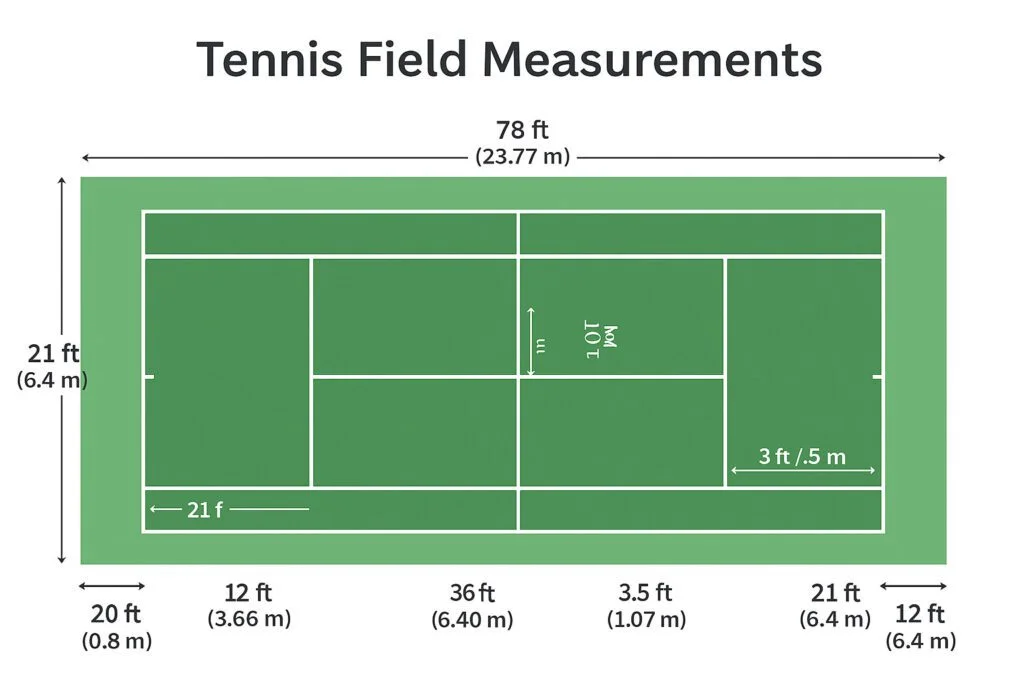
When you step onto a tennis court, the first thing you notice is just how much ground there is to cover. A standard tennis court measures 78 feet long, but its width varies depending on whether you’re playing singles or doubles. For singles matches, the court is 27 feet wide, while doubles expands that width to 36 feet by including the outer alleys. That extra 9 feet might not sound like much, but in gameplay, it completely changes strategy, positioning, and shot selection.
Think of it this way—singles tennis is like a one-on-one chess match where precision and endurance rule. You’re responsible for covering every inch of the court, which demands strong footwork and stamina. Doubles, on the other hand, feels more like a coordinated dance. With two players per side, communication and teamwork become essential, and the wider court opens up angles that simply don’t exist in singles play.
Compared to pickleball’s fixed dimensions, tennis introduces complexity right from the start. Players need to understand which lines are in or out depending on the format. This can be confusing for beginners but adds depth for seasoned players. The doubles alleys, for example, are a strategic goldmine. Skilled players use them to pull opponents out wide, creating openings for winning shots.
Another important factor is how these dimensions affect pacing. Because the court is so much larger, rallies often involve longer runs, deeper shots, and more powerful strokes. It’s not just about hitting the ball—it’s about positioning, anticipation, and endurance. Players must constantly adjust their stance and movement to respond to shots that can travel at high speeds across a large space.
In contrast, pickleball’s smaller court keeps players close to the action, reducing the need for long sprints. Tennis, however, demands a higher level of physical conditioning, making it both challenging and rewarding. Understanding these size differences is key to appreciating why the two sports feel so distinct, even though they share some similarities on the surface.
Baseline, Service Boxes, and Net Details
A tennis court isn’t just big—it’s intricately designed with multiple zones that dictate how the game unfolds. Each section, from the baseline to the service boxes, plays a specific role in shaping gameplay. The baseline marks the back boundary of the court and is where most rallies begin, especially during serves. Players often position themselves just behind this line to return serves and engage in baseline rallies, which can be long and physically demanding.
Moving inward, you’ll find the service boxes, which are divided by the center service line. These boxes are crucial during serves, as players must land the ball diagonally into the opponent’s service box to start a point legally. This requirement introduces a layer of precision and strategy right from the first hit. A well-placed serve can set the tone for the entire rally, giving the server a significant advantage.
The net in tennis also differs from pickleball in both height and function. At the center, the net stands at 3 feet (36 inches), while the posts on either side raise it slightly to 3.5 feet (42 inches). This subtle variation creates a slight dip in the middle, encouraging players to aim for lower, more controlled shots. It’s a small detail, but it has a big impact on shot selection and technique.
Unlike pickleball, tennis does not have a non-volley zone. Players are free to approach the net and volley from any position, which often leads to aggressive plays and quick point finishes. This freedom adds a dynamic element to the game, allowing for a mix of baseline rallies and net attacks.
All these elements—the baseline, service boxes, and net—work together to create a complex and engaging playing environment. They define the rules, influence strategies, and ultimately shape the experience of the game. When compared to pickleball’s simpler layout, tennis courts offer a more layered and physically demanding challenge, which is part of what has kept the sport popular for generations.
Key Differences Between Pickleball and Tennis Courts
Size Comparison
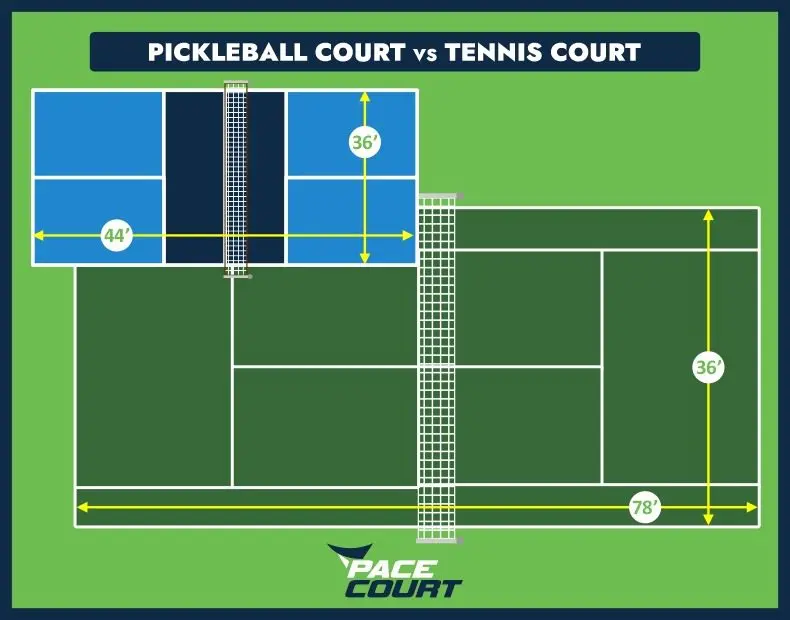
If there’s one difference that stands out immediately between pickleball and tennis courts, it’s size—and it’s not even close. A pickleball court (20 x 44 feet) is significantly smaller than a tennis court (78 x 27 feet for singles and 78 x 36 feet for doubles). To visualize this, you can fit up to four pickleball courts within a single tennis court. That’s not just a fun fact—it’s a reflection of how differently these sports are designed to be played.
This size difference has a ripple effect on nearly every aspect of gameplay. On a tennis court, players are constantly moving—sprinting from baseline to net, chasing down wide shots, and covering large distances in a matter of seconds. It’s physically demanding and requires a high level of endurance. Pickleball, by contrast, keeps players in a more confined space, which reduces the need for long runs but increases the intensity of short, quick movements.
The smaller court in pickleball also leads to faster reaction times. Because players are closer to each other, the ball travels shorter distances, and rallies can become rapid exchanges of volleys and dinks. It’s less about power and more about control and placement. In tennis, the larger court allows for powerful serves and groundstrokes that can push opponents far out of position.
Another interesting aspect is accessibility. The compact size of pickleball courts makes them easier to install in community spaces, gyms, and even backyards. Tennis courts, on the other hand, require more space and infrastructure, which can limit where they’re built.
In essence, the size difference isn’t just a matter of dimensions—it defines the personality of each sport. Tennis feels expansive and physically demanding, while pickleball feels intimate and fast-paced. Both have their appeal, but understanding this fundamental difference helps explain why players might gravitate toward one over the other.
Net Height Differences
At first glance, the net might seem like a minor detail, but in reality, it plays a huge role in how both pickleball and tennis are played. The pickleball net is 36 inches high at the sidelines and 34 inches at the center, slightly lower than a tennis net. Tennis nets, as mentioned earlier, measure 42 inches at the posts and 36 inches at the center. These differences might seem subtle, but they significantly impact gameplay.
A lower net in pickleball encourages softer, more controlled shots. Players often engage in strategic exchanges near the net, using finesse rather than power to outmaneuver their opponents. The reduced height makes it easier to execute dinks and drop shots, which are essential components of the game.
In tennis, the higher net demands more power and precision. Players must generate enough force to clear the net while still keeping the ball within the court boundaries. This often leads to more aggressive play, with powerful serves and groundstrokes dominating the game. The higher net also makes volleys at the net more challenging, requiring quick reflexes and strong technique.
Another key difference is how the net interacts with court size. On a larger tennis court, the higher net adds to the challenge by requiring players to hit longer, more forceful shots. On a smaller pickleball court, the lower net complements the compact space, allowing for quicker, more controlled rallies.
These variations in net height contribute to the distinct feel of each sport. Pickleball’s lower net supports its emphasis on strategy and finesse, while tennis’s higher net reinforces its focus on power and athleticism. It’s a small detail with a big impact—one that players quickly notice when transitioning between the two games.
Court Markings and Layout Variations
Pickleball Court Lines Explained
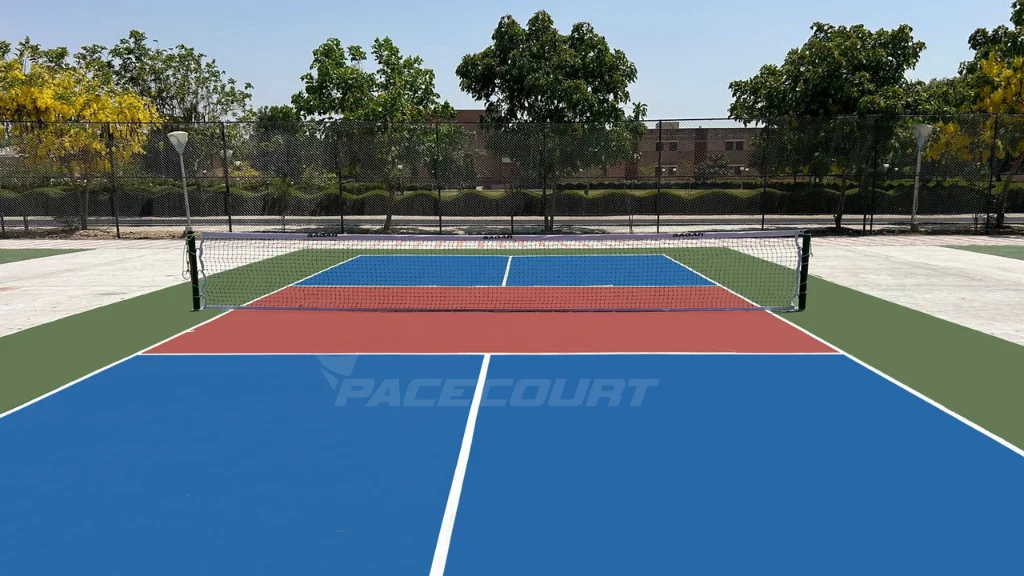
Pickleball court markings are refreshingly simple, which is one reason beginners can pick up the game so quickly. The court is divided into several clearly defined areas: baselines, sidelines, service courts, and the non-volley zone. Each line has a specific purpose, and once you understand them, the game starts to make a lot more sense.
The baselines run along the back of the court and mark the boundary for serves and returns. The sidelines define the width of the court, and unlike tennis, they remain the same for both singles and doubles play. This consistency eliminates confusion and keeps the focus on gameplay rather than rules.
The service courts are divided into left and right sections, separated by the centerline. Serves must be hit diagonally into the opponent’s service court, similar to tennis, but with a key difference—serves in pickleball are always underhand. This changes the dynamic of the game, making serves less about power and more about placement.
Then there’s the non-volley zone, or kitchen, which we discussed earlier. Its boundary lines are critical because stepping into this area while volleying results in a fault. Players must be constantly aware of their position relative to these lines, which adds an element of strategy and precision.
Overall, pickleball court markings are designed to be intuitive and easy to follow. They support a game that’s accessible yet strategically rich, allowing players to focus on skill development rather than memorizing complex rules.
Tennis Court Lines Explained
Tennis court markings, by comparison, are more complex and can take some time to fully understand. The court includes baselines, sidelines, service lines, center service lines, and doubles alleys, each serving a distinct purpose. For new players, it can feel like a maze of lines, but each one plays a role in shaping the game.
The baselines and sidelines define the outer boundaries of the court, with additional lines marking the singles and doubles areas. The service lines run parallel to the net and create the front boundary of the service boxes. The center service line divides these boxes into left and right sections, dictating where serves must land.
One unique feature of tennis courts is the doubles alleys, which are only used in doubles matches. These extra lanes on either side of the court expand the playing area and introduce new strategic possibilities. Players can aim for these alleys to pull opponents out of position, creating opportunities for winning shots.
Unlike pickleball, tennis allows volleys from anywhere on the court, which makes net play a significant part of the game. Players often move forward to take advantage of shorter balls, using volleys and smashes to finish points quickly.
The complexity of tennis court markings reflects the depth of the game itself. While it may take longer to learn, it offers a wider range of strategies and playing styles. Comparing it to pickleball highlights just how differently the two sports approach court design and gameplay.
Surface Types and Materials
Pickleball Court Surfaces
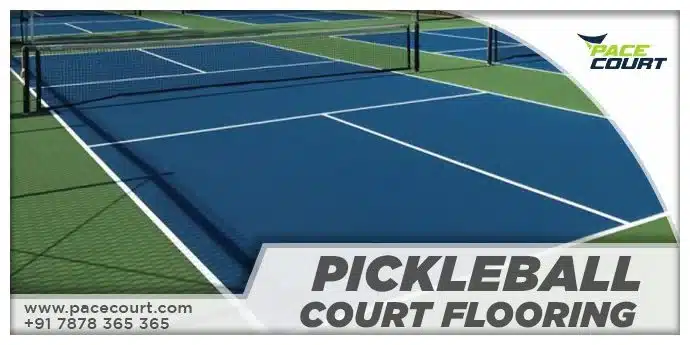
When it comes to pickleball court surfaces, simplicity and consistency are the name of the game. Most pickleball courts are built on hard surfaces, typically asphalt or concrete, and then coated with an acrylic layer to provide better traction and ball control. This uniformity ensures that whether you’re playing in a local park or a professional facility, the experience feels relatively the same. That consistency is one of the reasons pickleball is so beginner-friendly—you don’t have to adjust your game dramatically based on the surface.
The acrylic coating applied on top isn’t just for aesthetics. It plays a crucial role in shock absorption, slip resistance, and durability. Many modern courts even include cushioned layers to reduce joint impact, which is especially appealing for older players. Considering that a large portion of pickleball enthusiasts are over the age of 40, this design choice isn’t accidental—it’s a direct response to player needs.
Another interesting aspect is how the surface influences gameplay. Because the court is smaller and the ball is lighter (a perforated plastic ball), the bounce tends to be lower and more predictable compared to tennis. This predictability allows players to focus on precision and strategy rather than constantly adjusting to surface variations. It’s almost like playing on a perfectly tuned instrument—everything responds just the way you expect.
Outdoor pickleball courts are designed to withstand weather conditions, with UV-resistant coatings and proper drainage systems. Indoor courts, on the other hand, may use wooden gym floors or synthetic materials, slightly altering the bounce but still maintaining overall consistency.
In contrast to tennis, where surface type can drastically change gameplay, pickleball keeps things straightforward. This simplicity lowers the learning curve and makes the sport more accessible, while still offering enough depth to keep experienced players engaged. It’s a balance that has helped fuel pickleball’s rapid growth across different age groups and skill levels.
Tennis Court Surfaces
Tennis takes a completely different approach when it comes to surfaces, and this is where the sport really shows its depth. Unlike pickleball’s standardized courts, tennis is played on a variety of surfaces, each with its own personality. The three main types are hard courts, clay courts, and grass courts, and each one dramatically affects how the game is played.
Hard courts, which are the most common, are somewhat similar to pickleball surfaces. They’re made of asphalt or concrete with an acrylic coating, offering a balanced playing experience. The ball bounce is consistent, and the pace of the game is moderate, making it a favorite for both recreational and professional players.
Clay courts, on the other hand, slow the game down significantly. The surface absorbs more energy from the ball, resulting in higher bounces and longer rallies. Players often slide into shots, which adds a unique physical and strategic element. If you’ve ever watched the French Open, you’ve seen how clay courts turn matches into endurance battles.
Grass courts are the fastest of the three. The ball skids and stays low, favoring players with strong serves and quick reflexes. However, grass courts are also the most difficult to maintain, which is why they’re less common outside of professional tournaments like Wimbledon.
Here’s a quick comparison to make things clearer:
| Surface Type | Speed | Bounce | Player Advantage |
|---|---|---|---|
| Hard Court | Medium | Consistent | All-around players |
| Clay Court | Slow | High | Defensive players |
| Grass Court | Fast | Low | Aggressive players |
This diversity in surfaces means that tennis players must constantly adapt their strategies and techniques. It adds layers of complexity and keeps the sport fresh and challenging. Compared to pickleball’s uniform approach, tennis offers a more varied experience—but it also comes with a steeper learning curve.
Space Requirements and Court Conversion
Can You Fit a Pickleball Court on a Tennis Court?
Here’s where things get really interesting—and practical. One of the biggest reasons for pickleball’s explosive growth is how easily it fits into existing spaces. A single tennis court can accommodate up to four pickleball courts, making it an incredibly efficient use of space. This isn’t just a theoretical idea; it’s happening all over the world as communities look for ways to meet the growing demand for pickleball facilities.
To understand why this works, remember the size difference. A tennis court is 78 feet long and up to 36 feet wide, while a pickleball court is only 20 by 44 feet. When you overlay those dimensions, it becomes clear that multiple pickleball courts can be neatly arranged within the larger tennis footprint. Temporary nets and painted lines are often used to create these multi-court setups without permanently altering the tennis court.
This adaptability has huge implications for parks, schools, and recreational centers. Instead of building entirely new facilities, they can simply repurpose existing tennis courts, saving both time and money. It’s a bit like turning a single large room into multiple smaller ones—you maximize utility without expanding your footprint.
Players also benefit from this setup. More courts mean more games happening simultaneously, reducing wait times and increasing social interaction. It transforms what might have been a quiet tennis facility into a lively hub of activity.
Of course, there are some trade-offs. Sharing space can sometimes lead to scheduling conflicts between tennis and pickleball players. However, many facilities manage this by designating specific times for each sport or creating hybrid courts that accommodate both.
The ability to fit multiple pickleball courts into a single tennis court is more than just a spatial advantage—it’s a key factor driving the sport’s accessibility and popularity. It shows how thoughtful design can make a sport more inclusive and widely available.
Multi-Use Court Benefits
The concept of multi-use courts is becoming increasingly popular, and for good reason. In a world where space is often limited—especially in urban areas—being able to use a single facility for multiple sports is a game-changer. Combining pickleball and tennis on the same court is one of the best examples of this trend in action.
From a financial perspective, multi-use courts are incredibly cost-effective. Building and maintaining a single tennis court can be expensive, but converting it into a dual-purpose facility allows organizations to serve a broader audience without significantly increasing costs. This makes it easier for communities to justify investments in recreational infrastructure.
There’s also a strong social component. Multi-use courts bring together players of different ages, skill levels, and sporting backgrounds. You might have a group of tennis players practicing on one side while a lively pickleball match unfolds on the other. This shared environment fosters a sense of community and encourages people to try new activities.
Another advantage is flexibility. Facilities can adapt to changing trends and demands without needing major renovations. If pickleball continues to grow, more space can be allocated to it. If interest shifts back to tennis, the court can easily be reconfigured. This adaptability ensures that the space remains relevant and useful over time.
However, designing a multi-use court requires careful planning. Clear markings, adjustable nets, and proper scheduling are essential to avoid confusion and ensure a smooth experience for everyone. When done right, though, it creates a dynamic and inclusive environment that benefits all users.
In many ways, multi-use courts represent the future of recreational sports. They’re efficient, versatile, and community-focused—qualities that align perfectly with the evolving needs of modern players. And at the heart of this trend is the compatibility between pickleball and tennis courts, despite their many differences.
Conclusion
Understanding the differences between pickleball court dimensions and tennis court dimensions goes far beyond memorizing numbers. It’s about recognizing how design shapes the entire experience of a sport. From the compact, strategy-driven layout of a pickleball court to the expansive, physically demanding structure of a tennis court, each one tells a story about how the game is meant to be played.
Pickleball’s smaller court, lower net, and unique non-volley zone create a fast-paced yet accessible environment that appeals to players of all ages. Tennis, with its larger dimensions, varied surfaces, and complex markings, offers a deeper, more physically intense challenge that has stood the test of time.
What’s fascinating is how these differences don’t divide the sports—they connect them. The ability to convert tennis courts into multiple pickleball courts highlights a shared foundation while showcasing the efficiency of modern sports design. It’s a perfect example of how tradition and innovation can coexist.
Whether you’re choosing between the two or simply curious about what sets them apart, understanding these court dimensions gives you a whole new appreciation for both games. It’s not just about where you play—it’s about how the space influences every serve, rally, and point.