Official Court Size According to FIVB
If you’ve ever watched a professional volleyball match and wondered whether the court size is universal, the answer is yes—at least at the professional level. The Volleyball Court Measurement standards set by the Fédération Internationale de Volleyball (FIVB) govern court dimensions across international competitions, and these measurements form the backbone of the sport worldwide. Understanding these dimensions isn’t just for referees or tournament organizers—it actually gives players a strategic edge because positioning, spacing, and movement all depend on it.
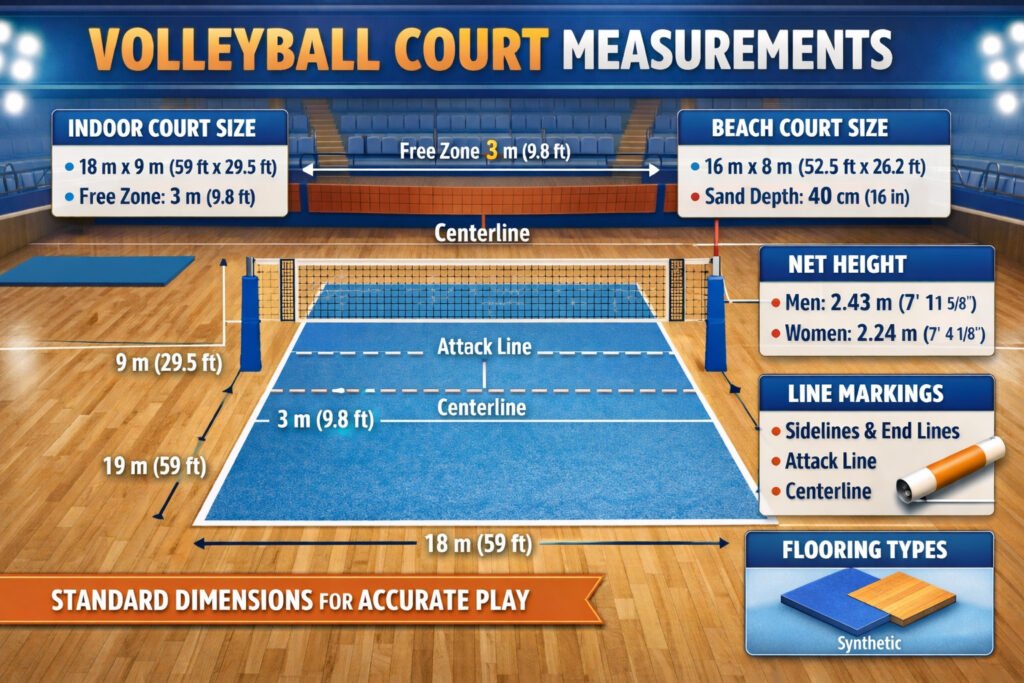
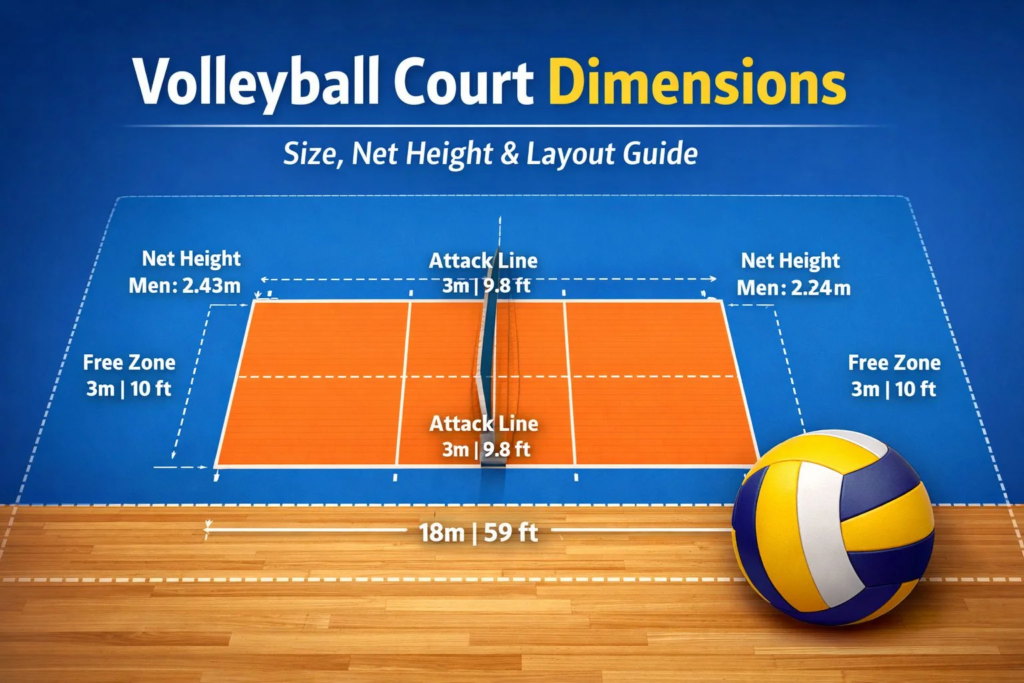
A standard indoor volleyball court measures 18 meters long and 9 meters wide, forming a perfect rectangle. That might sound straightforward, but the symmetry is what makes gameplay balanced and fair. Each team occupies one half of the court, which means 9 meters by 9 meters per side. This equal distribution ensures neither side has an inherent spatial advantage, making skill and coordination the deciding factors in a match.
Now, think about how this plays out in real action. When a setter positions themselves near the net, or when a libero dives deep into the backcourt, every movement is calculated within this fixed space. The dimensions are not arbitrary—they’re designed to encourage fast-paced rallies, strategic plays, and athletic endurance. Too small, and the game would feel cramped. Too large, and it would lose intensity.
Another important detail is that all boundary lines are included within the court dimensions. That means if the ball touches the line, it’s considered “in.” This small rule has massive implications during close calls, often becoming the difference between winning and losing a crucial point.
Total Playing Area Including Free Zone
Here’s where things get a bit more interesting. The actual playing area extends beyond the 18m x 9m court, thanks to what’s called the free zone. This is essentially the buffer space surrounding the court, allowing players to chase down balls without crashing into walls, spectators, or equipment. According to FIVB standards, the free zone should be at least 3 meters wide on all sides for official matches, though higher-level competitions often require even more space.
Why does this matter? Imagine a player sprinting to save a ball heading out of bounds. Without a proper free zone, that play simply wouldn’t be possible. This extra space adds a layer of excitement and unpredictability to the game, turning what looks like a lost point into a spectacular save.
For international competitions, the free zone can extend up to 5 meters on the sidelines and 8 meters behind the end lines, creating a much larger total playing area. This expanded space accommodates high-speed gameplay and gives athletes the freedom to perform at their best without restrictions.
The vertical space is equally important. The minimum free playing height above the court is typically 7 meters, but for professional tournaments, it can go up to 12.5 meters or more. This ensures there’s plenty of room for high serves and powerful spikes without interference.
When you combine the court and the free zone, the total area becomes significantly larger than most people expect. It’s not just about the rectangle you see—it’s about the entire environment that supports the game. Understanding this broader perspective helps you appreciate the complexity and precision behind volleyball court design.
Layout and Markings of a Volleyball Court
Boundary Lines and Their Importance
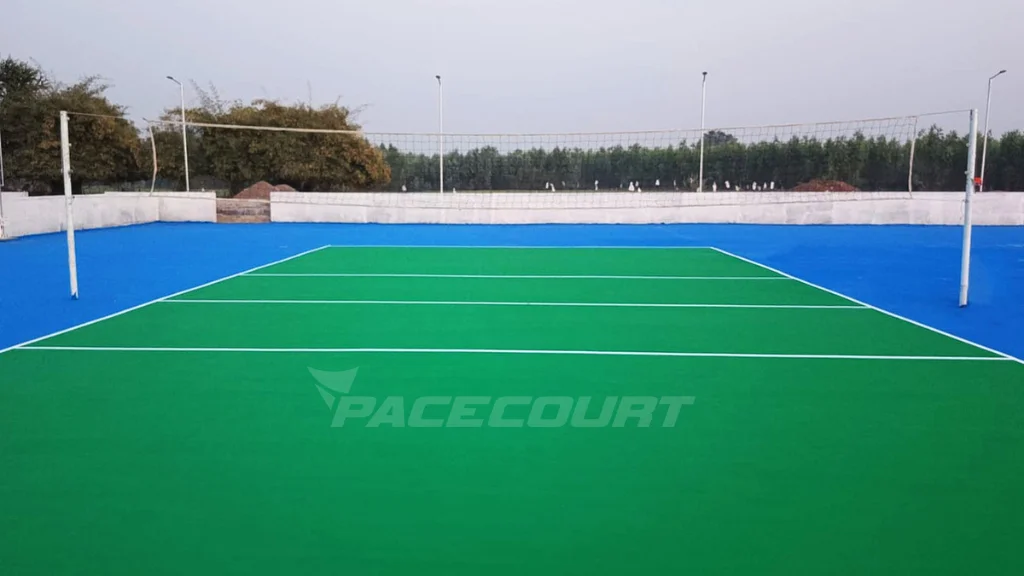
When you look at a volleyball court from a distance, it may seem like just a rectangle divided by a net, but the real magic lies in the precision of its markings. Every line on the court serves a purpose, and each one plays a critical role in how the game unfolds. These aren’t just decorative stripes—they’re the invisible rules that guide players’ decisions, movements, and strategies.
The court is defined by boundary lines, which include the two sidelines (running lengthwise) and the two end lines (running across the width). Together, they form the outer limits of the playing area. What’s interesting is that these lines are usually 5 centimeters wide and are considered part of the court itself. That means if the ball even slightly touches the line, it is still “in,” often leading to intense debates and dramatic referee calls during matches.
Now, imagine a high-speed rally where the ball is smashed toward the corner. The difference between winning and losing that point could be just a few millimeters—whether the ball grazes the line or lands outside it. That’s how crucial these markings are. They demand not only accuracy from players but also sharp observation from officials.
These boundary lines also help players maintain spatial awareness. A seasoned player instinctively knows where they are on the court without needing to look down. This awareness allows them to focus on the ball, teammates, and opponents simultaneously. It’s almost like having an internal GPS calibrated to the court dimensions.
In training environments, clearly marked lines help beginners learn positioning and movement patterns. Without them, understanding rotations, defensive zones, and attack strategies would be nearly impossible. So while they might seem simple, boundary lines are foundational to the structure and flow of volleyball.
Center Line and Attack Line Explained
Beyond the outer boundaries, the center line and attack line add another layer of structure to the volleyball court. These lines don’t just divide space—they define roles, responsibilities, and even limitations for players during a match.
The center line runs directly under the net, splitting the court into two equal halves of 9 meters each. It ensures that each team stays within its designated area. Players are not allowed to completely cross over into the opponent’s side, although slight contact over the line is sometimes permitted if it doesn’t interfere with play. This rule keeps the game fair and prevents unnecessary collisions or disputes.
Then comes the attack line, also known as the 3-meter line. This line is drawn 3 meters away from the center line on each side, creating a division between the front zone and the back zone. This distinction is especially important because it determines which players can perform attacking actions near the net.
For example, back-row players are not allowed to jump and attack the ball from in front of the attack line. They must take off from behind it, adding a layer of complexity to offensive strategies. This rule prevents taller or more powerful back-row players from dominating the net, maintaining balance in gameplay.
Think of the attack line as a tactical boundary. It forces teams to diversify their attacks, encouraging creative plays rather than predictable spikes. It also challenges players to develop timing and coordination, especially when executing back-row attacks.
Together, the center line and attack line transform the court from a simple rectangle into a strategically segmented battlefield where every inch matters.
Volleyball Net Specifications
Net Height for Men, Women, and Youth
The net is arguably the most iconic feature of a volleyball court—it’s the barrier that defines the game’s central challenge. But not all nets are set at the same height. In fact, net height varies depending on the category of players, ensuring fairness and competitiveness across different levels of play.
For men’s volleyball, the standard net height is 2.43 meters (7 feet 11 5/8 inches). For women’s volleyball, it is slightly lower at 2.24 meters (7 feet 4 1/8 inches). This difference accounts for average height and jumping ability, making the game equally challenging and exciting for both categories.
Youth volleyball introduces even more variation. Younger age groups often use lower net heights to accommodate developing skills and physical abilities. For example, children under 12 might play with a net height of around 2.13 meters, allowing them to focus on technique rather than struggling to clear an overly high net.
Why does net height matter so much? Because it directly impacts gameplay dynamics. A higher net demands more القوة and vertical leap for spikes and blocks, while a lower net allows for faster rallies and longer exchanges. It’s a delicate balance between challenge and accessibility.
Professional players train extensively to master net-related skills like blocking timing, spiking angles, and jump height. Even a slight change in net height can disrupt their rhythm and performance. That’s why official competitions strictly adhere to standardized measurements.
Antennas and Their Role in Gameplay
Attached to the net are two often-overlooked yet incredibly important components: the antennas. These are flexible rods that extend vertically above the net on both sides, marking the legal crossing space for the ball.
Each antenna is typically 1.8 meters long and extends 80 centimeters above the net. They are painted with alternating red and white stripes, making them highly visible during play. The space between the antennas defines the area where the ball must pass when crossing the net. If the ball goes outside this space—even if it lands inside the opponent’s court—it is considered out of bounds.
This rule adds a layer of precision to the game. Players must not only aim to land the ball within the court but also ensure it travels within the designated crossing space. It’s like threading a needle at high speed.
Antennas also help referees make quick and accurate decisions. Without them, judging whether a ball crossed legally would be much more difficult, especially during fast-paced rallies.
Zones and Areas on the Volleyball Court
Front Zone vs Back Zone
The division between the front zone and back zone is one of the most strategically significant aspects of volleyball court design. These zones dictate player roles, influence team formations, and shape the overall flow of the game.
The front zone is the area between the center line and the attack line (3 meters). This is where front-row players operate, typically responsible for blocking and attacking near the net. These players are often the tallest and most powerful on the team, as they need to jump high and react quickly.
The back zone, on the other hand, extends from the attack line to the end line. Players in this area focus on defense, receiving serves, and setting up plays. The libero, a specialized defensive player, operates exclusively in this zone.
What makes this division fascinating is how it forces teams to rotate positions. Players can’t stay in their preferred zones forever—they must adapt as they rotate, taking on different roles depending on their position.
Service Zone and Substitution Zone
The service zone is located behind the end line and extends across the width of the court. This is where players serve the ball to start a rally. It may seem like a simple area, but serving from different positions within this zone can create varying angles and strategies.
The substitution zone is located near the sideline, between the attack line and the scorer’s table. This is where player substitutions take place, ensuring smooth transitions during the game.
Indoor vs Beach Volleyball Court Measurements
Key Differences in Dimensions
Indoor and beach volleyball may share the same core principles, but their court dimensions tell a different story. While indoor courts measure 18m x 9m, beach volleyball courts are smaller at 16m x 8m.
This reduction in size compensates for the fact that beach volleyball is typically played with two players per team instead of six. A smaller court ensures the game remains competitive and physically demanding.
Surface and Environmental Factors
Indoor courts are made of hardwood or synthetic materials, providing consistent bounce and traction. Beach courts, however, are made of sand, which slows movement and requires greater physical effort.
Court Measurement in Feet, Meters, and Other Units
Conversion Table for Easy Reference
| Measurement | Meters | Feet |
|---|---|---|
| Court Length | 18 m | 59 ft |
| Court Width | 9 m | 29.5 ft |
| Net Height (Men) | 2.43 m | 7.97 ft |
| Net Height (Women) | 2.24 m | 7.35 ft |
Why Accurate Measurement Matters
Accuracy ensures fairness, safety, and consistency across all levels of play.
Equipment Placement and Standards
Pole Placement and Distance
Net poles are placed 0.5 to 1 meter outside the sidelines, ensuring player safety.
Net Tension and Setup Guidelines
Proper tension keeps the net stable and ensures consistent gameplay.
Common Mistakes in Court Measurement

Misaligned Lines and Incorrect Dimensions
Even small errors can disrupt gameplay.
How to Avoid Measurement Errors
Using proper tools and double-checking measurements is essential.
Tips for Setting Up a Volleyball Court

Step-by-Step Court Setup Guide
Setting up a volleyball court might seem like a straightforward task—measure, mark, and play—but in reality, it requires careful planning and precision. If you’ve ever tried to set one up casually, you probably noticed how easy it is to end up with crooked lines or uneven spacing. A proper setup ensures not only fairness but also safety and optimal gameplay.
Start by selecting a flat and open surface. Whether it’s indoors or outdoors, the ground should be level to prevent injuries and unpredictable ball movement. Once the area is ready, measure out the 18m x 9m rectangle using a measuring tape. It’s always a good idea to mark the corners first and then connect them, rather than drawing lines freehand.
Next, mark the center line and the attack lines, ensuring they are perfectly parallel. Even a slight angle can throw off player positioning and rotations. After that, install the net posts at the correct distance outside the sidelines and secure the net at the appropriate height.
Tools Required for Accurate Measurement
To get everything right, you’ll need a few essential tools:
- Measuring tape (preferably 30m or longer)
- Boundary line markers or chalk
- Net and poles
- Leveling tool
These tools might seem basic, but they make a huge difference in accuracy.
Conclusion
Volleyball court measurement is more than just numbers—it’s the foundation of the entire game. From the precise dimensions of the court to the strategic placement of lines and zones, every detail contributes to the sport’s balance and excitement. Whether you’re a beginner trying to understand the basics or a seasoned player refining your skills, knowing these measurements gives you a deeper appreciation of the game.