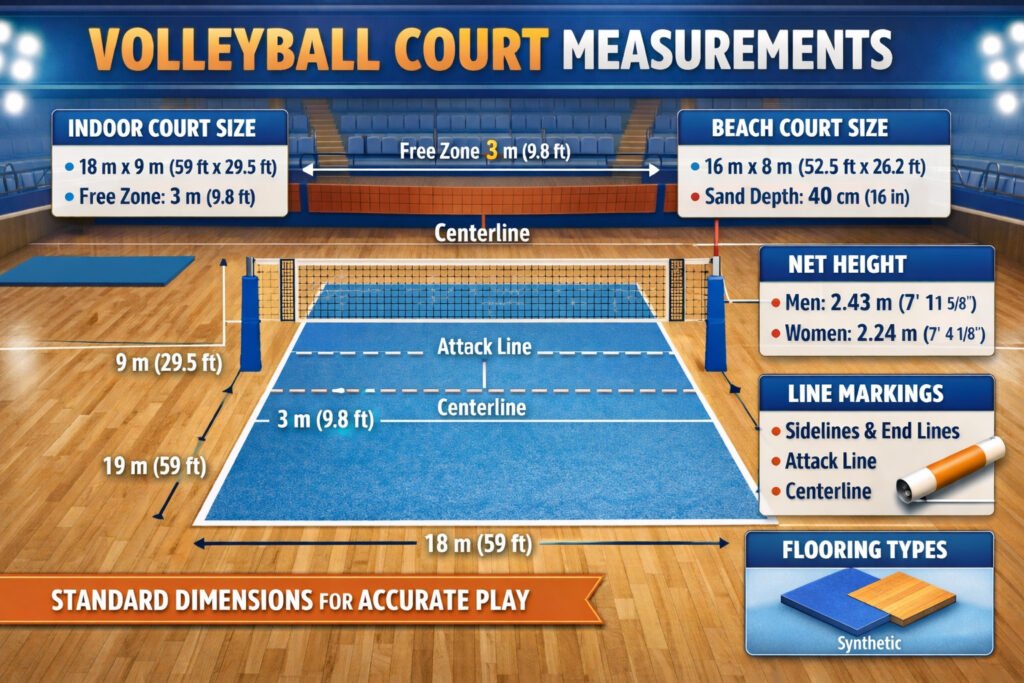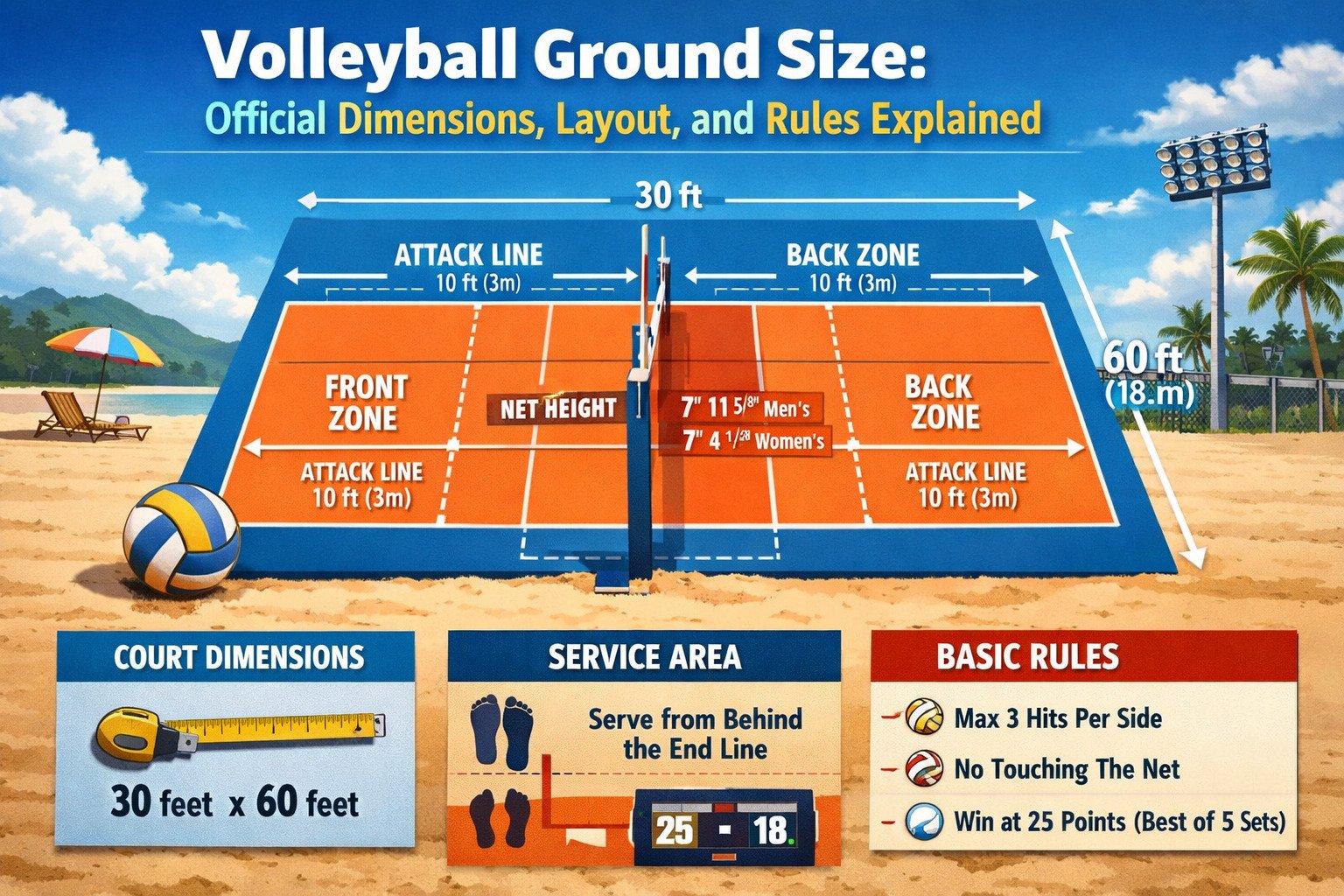
If you’ve ever stepped onto a volleyball court and thought, “This doesn’t look that big,” you’re not alone. But once the game starts, it suddenly feels like every inch matters. The standard volleyball ground size for indoor play is carefully designed to balance agility, strategy, and fairness. Officially, the court measures 18 meters long and 9 meters wide. That’s about 59 feet by 29.5 feet, split evenly by a net right down the center.
Table of contents
This rectangular playing area isn’t random—it’s engineered to push players into quick decisions, explosive movements, and precise teamwork. Each side of the court is exactly 9 meters by 9 meters, giving both teams equal territory to defend and attack. The symmetry creates a level playing field where skill—not space—determines the winner.
Now here’s where it gets interesting: the court isn’t just one big open space. It’s divided into zones that dictate how players move and interact. For instance, the front row and back row players have different responsibilities, and those roles are tied directly to the court’s dimensions. Without these measurements, volleyball would lose its structure and rhythm.
You might wonder why 18×9 meters became the standard. It’s a sweet spot—large enough for dynamic rallies but compact enough to keep the action intense. Imagine trying to cover a tennis court-sized area with six players—it would completely change the game’s pace.
Also worth noting is the free zone, which surrounds the court. For official matches, this space extends at least 3 meters on all sides, though professional tournaments often require more. This ensures players can chase balls safely without crashing into walls or spectators.
So, while it may look simple at first glance, the indoor volleyball court is a finely tuned system. Every meter is intentional, shaping the way the game is played, watched, and experienced.
Beach Volleyball Court Dimensions
Step onto a beach volleyball court, and you’ll instantly notice something different—it feels smaller, tighter, and somehow more intense. That’s not just your imagination. The official beach volleyball court size is 16 meters long and 8 meters wide, which is noticeably smaller than the indoor version. In feet, that’s about 52.5 by 26.2 feet.
Why the reduction in size? Simple: fewer players. Beach volleyball is typically played in teams of two, compared to six players per side indoors. With only two athletes covering the entire court, shrinking the dimensions ensures rallies stay competitive rather than exhausting marathons of chasing impossible shots.
But don’t let the smaller size fool you—it actually makes the game more demanding. On sand, every movement requires extra effort. Jumping, diving, and sprinting all become more physically taxing, so the reduced court size balances the increased difficulty of the surface.
The court is surrounded by a free zone of at least 3 meters, though professional tournaments often expand this to 5 meters or more for safety and performance. Unlike indoor courts, beach courts don’t have rigid flooring or walls, so this extra space is crucial for players making dramatic saves.
Another key difference lies in the surface itself. Sand introduces unpredictability. Footing isn’t stable, and the ball reacts differently compared to hardwood floors. This means players rely more on control, anticipation, and finesse rather than raw power.
Interestingly, the lines on a beach volleyball court are typically made of flexible materials like ribbons or straps, anchored into the sand. They’re slightly raised but soft enough to prevent injuries if a player lands on them.
So, while indoor volleyball emphasizes structure and speed, beach volleyball leans into adaptability and endurance. The smaller court size isn’t a limitation—it’s a deliberate design choice that transforms the entire experience of the game.
Detailed Layout of a Volleyball Court

Attack Line (3-Meter Line) Explained
If the volleyball court is a stage, then the attack line—also known as the 3-meter line—is where strategy comes alive. Positioned exactly 3 meters (10 feet) from the center line on each side, this line separates the front zone from the back zone, and that distinction changes everything about how the game is played.
At first glance, it might seem like just another marking on the floor. But once you understand its role, you realize it’s one of the most important elements in volleyball. The attack line determines who can spike, where they can jump from, and how teams structure their offense.
Front-row players—those positioned near the net—can attack the ball from anywhere, including in front of the attack line. Back-row players, however, must follow stricter rules. They’re allowed to attack, but only if they jump from behind the attack line. If they step on or cross it before takeoff, the play is considered a fault.
This rule adds a fascinating layer of strategy. Teams often use back-row attacks to surprise opponents, creating powerful spikes from unexpected angles. But executing these moves requires precise timing and spatial awareness. One wrong step, and the point is lost.
The attack line also influences defensive positioning. Players must constantly be aware of their location relative to the line, especially during fast-paced rallies. It’s not just about hitting the ball—it’s about knowing exactly where you are on the court at all times.
In many ways, the 3-meter line acts like an invisible boundary of opportunity. Cross it, and your role changes. Stay behind it, and you have to adapt your approach. It’s a simple line with complex implications, shaping both individual decisions and team dynamics.
So next time you watch a volleyball match, keep an eye on that line. You’ll start to notice how often it comes into play—and how much it influences the flow of the game.
Center Line and Its Importance
Right at the heart of every volleyball court lies a line that often goes unnoticed but plays a crucial role in maintaining order and fairness—the center line. This line runs directly beneath the net, dividing the court into two equal halves of 9 meters by 9 meters each. While it may look like a simple boundary, its purpose goes far beyond just splitting the court.
The center line defines territorial limits for both teams. Players are not allowed to completely cross into the opponent’s court, especially during active play. However, there’s an interesting nuance here—players can legally step on or even slightly over the center line as long as part of their foot remains in contact with their side. This rule adds flexibility while still preventing interference with the opposing team.
Now imagine a fast-paced rally where players are diving, jumping, and scrambling for the ball. Without a clearly defined center line, collisions and disputes would be inevitable. The line acts as a silent referee, ensuring that each team respects the boundary while still allowing aggressive, competitive play.
Another critical aspect is safety. Volleyball involves a lot of forward momentum, especially when players approach the net for blocks or spikes. The center line helps prevent dangerous under-net collisions, which could lead to injuries. It creates a psychological barrier as much as a physical one—players instinctively know where to stop.
From a strategic standpoint, the center line also influences blocking and net play. Players often position themselves very close to it to maximize reach and reaction time. Being just inches closer to the net can make the difference between a successful block and a missed opportunity.
So while it may not get the spotlight like the net or attack line, the center line is essential. It keeps the game structured, safe, and fair—quietly doing its job while the action unfolds above it.
Volleyball Court Zones and Areas
Front Zone vs Back Zone
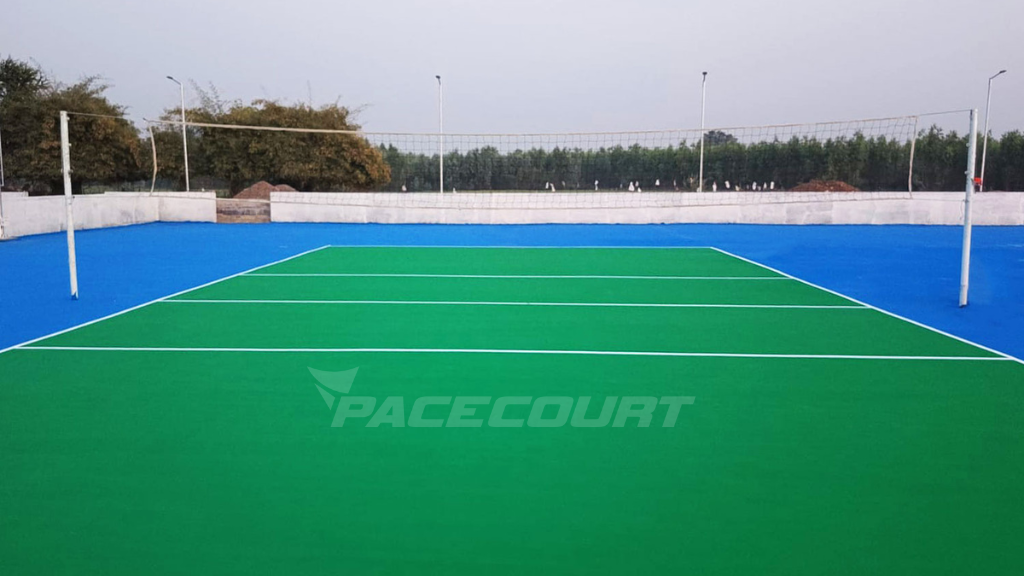
A volleyball court isn’t just divided in half—it’s segmented into functional zones that dictate how players move, attack, and defend. Among these, the front zone and back zone are the most critical. These zones are separated by the attack line, and each one comes with its own set of rules and responsibilities.
The front zone extends from the net to the attack line, covering a distance of 3 meters. This is where the action gets intense. Front-row players operate here, executing spikes, blocks, and quick attacks. It’s essentially the “offensive engine” of the team. Players in this zone have the freedom to jump and attack the ball from anywhere within it, making it a high-impact area.
On the other hand, the back zone stretches from the attack line to the end line, covering the remaining 6 meters. This zone is primarily defensive, but it’s far from passive. Back-row players are responsible for receiving serves, digging spikes, and setting up plays. They can also attack—but with restrictions. As mentioned earlier, they must jump from behind the attack line to make a legal hit.
What makes this division fascinating is how it shapes team strategy. Coaches carefully assign roles based on player strengths, ensuring a balance between offense and defense. For example, a powerful hitter might rotate into the back zone and suddenly become a strategic weapon with back-row attacks.
The transition between these zones during rotations adds another layer of complexity. Players must constantly adjust their positioning and mindset depending on whether they’re in the front or back zone. It’s like switching roles in the middle of a performance—you have to adapt instantly.
Understanding these zones isn’t just for players. As a spectator, once you grasp how the front and back zones work, the game becomes much more engaging. You start to see patterns, anticipate plays, and appreciate the tactical depth behind every move.
Service Area and Substitution Zone
Two areas that often get overlooked but are absolutely essential to the flow of the game are the service area and the substitution zone. These sections may not be part of the main rally space, but they play a huge role in how matches unfold.
The service area is located behind the end line of each side of the court. It typically extends across the entire width of the court (9 meters) and goes back at least 3 meters. This is where players serve the ball to start a rally. Sounds simple, right? But this area is where pressure peaks. One mistake—a foot fault or a missed serve—and the point goes to the opponent.
Players must serve from within this designated space, and they’re not allowed to step on or over the end line before making contact with the ball. This rule ensures fairness and consistency. In professional matches, servers often use the full width of the service area to create different angles, making it harder for opponents to predict the ball’s trajectory.
Now let’s talk about the substitution zone, which is located along the sideline, between the attack line and the scorer’s table. This is where players enter and exit the court during substitutions. While it might seem like a logistical detail, it’s actually a critical part of team strategy.
Coaches use substitutions to change the momentum of the game—bringing in stronger blockers, better servers, or defensive specialists at just the right moment. The substitution zone ensures these changes happen smoothly and without disrupting the flow of the match.
What’s interesting is how these zones reflect the rhythm of volleyball. The service area marks the beginning of action, while the substitution zone represents adaptability and tactical evolution. Together, they add layers of complexity that go far beyond just hitting a ball over a net.
Net Dimensions and Specifications
Net Height for Men, Women, and Youth
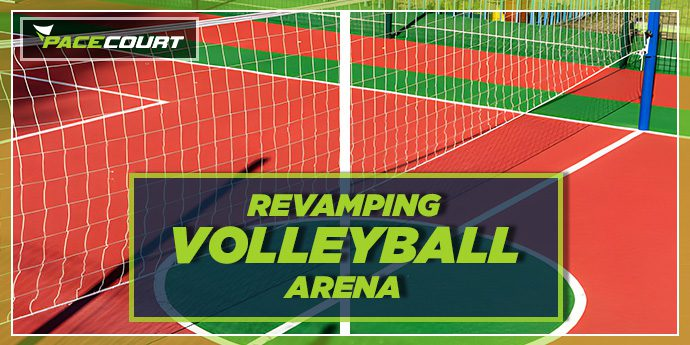
The net is more than just a divider—it’s the defining challenge of volleyball. Its height determines the intensity, style, and physical demands of the game. And interestingly, net height isn’t one-size-fits-all. It varies depending on gender and age group to ensure fairness and competitiveness.
For men’s volleyball, the official net height is 2.43 meters (7 feet 11 5/8 inches). This height demands explosive jumping ability and powerful spikes, making the men’s game incredibly fast and aggressive. Players train extensively to develop the vertical leap needed to compete at this level.
For women’s volleyball, the net is set slightly lower at 2.24 meters (7 feet 4 1/8 inches). This adjustment balances the game, allowing for longer rallies and more strategic play without compromising intensity. The women’s game often showcases incredible defensive skills and precision.
When it comes to youth volleyball, the net height varies based on age groups. Younger players use lower nets to match their physical development, ensuring the game remains enjoyable and skill-focused rather than overly demanding. For example, a typical youth net height might range from 2.0 to 2.2 meters.
Here’s a quick comparison:
| Category | Net Height |
|---|---|
| Men | 2.43 m |
| Women | 2.24 m |
| Youth | 2.00–2.20 m |
The variation in net height highlights how volleyball adapts to different players while maintaining its core essence. It ensures that the game is accessible yet challenging, whether you’re a beginner or a professional.
And let’s be honest—there’s something incredibly satisfying about watching a perfectly timed spike just clear the net or a blocker rise to meet it at the peak. That moment of contact, right above the net, is where the magic happens.
Net Width, Length, and Antennas
While height gets most of the attention, the net’s width, length, and additional features like antennas are just as important in defining the game. The net spans the entire width of the court, measuring 9.5 to 10 meters in length and 1 meter in height. This ensures it fully covers the playing area with a slight extension beyond the sidelines.
The net is made of durable mesh, designed to withstand powerful spikes while still being flexible enough to absorb impact. Along its edges are reinforced bands that keep it taut and properly aligned. A sagging net would completely disrupt gameplay, so maintaining tension is crucial.
Now, let’s talk about the antennas—those thin, vertical rods attached to the net above each sideline. They extend about 80 centimeters above the net and act as invisible boundaries in the air. Any ball that passes outside the antennas is considered out of bounds, even if it lands inside the court.
This adds a vertical dimension to the game. Players must not only aim for open spaces on the court but also ensure their shots pass within the antenna boundaries. It’s like threading a needle in mid-air while under pressure.
The antennas are usually colored in alternating red and white stripes, making them highly visible. This helps referees make quick and accurate decisions during fast-paced rallies.
Together, these elements—the net’s size, structure, and antennas—create a well-defined playing environment. They ensure consistency across matches and levels, from casual games to international tournaments.
So the next time you watch a volleyball match, don’t just focus on the players. Take a moment to appreciate the net—it’s the silent centerpiece that shapes every rally, every spike, and every unforgettable moment on the court.
Boundary Lines and Markings

Line Thickness and Colors
When you look at a volleyball court from a distance, the lines might seem like simple decorations framing the playing area. But once you step closer, you realize these markings are incredibly precise and essential to the game. Every line on the court follows strict guidelines, especially when it comes to thickness and color, ensuring clarity for players, referees, and even spectators.
Officially, all boundary lines on a volleyball court must be 5 centimeters (about 2 inches) wide. That might sound like a minor detail, but consistency here is critical. If lines were too thin, they’d be hard to see during fast rallies. Too thick, and they could confuse judgment calls. This standardized width strikes the perfect balance—visible without being intrusive.
Color also plays a major role. Court lines are usually painted in bright, contrasting colors, such as white or light shades, depending on the floor surface. For indoor courts, which often have wooden flooring, white lines stand out clearly against the polished brown surface. On outdoor or beach courts, the lines are typically made of colored tape or flexible ribbons, often in blue or red, to contrast against the sand.
But here’s where things get interesting: in volleyball, the lines are considered part of the court. That means if the ball touches even the very edge of a line, it’s still “in.” This rule leads to some intense moments where players and referees must make split-second decisions. Modern professional matches even use video challenge systems to determine whether the ball clipped the line by a fraction of an inch.
The visibility of these lines also affects player performance. Clear markings help athletes judge distances more accurately, especially when diving for saves or positioning for serves. Imagine trying to play a high-speed game without clearly defined boundaries—it would quickly turn chaotic.
So, while they may not grab headlines, the lines on a volleyball court are fundamental. They provide structure, fairness, and precision—quietly guiding every rally and every point scored.
Importance of Clear Markings
Now let’s take things a step further—why do clear court markings matter so much? It’s not just about aesthetics or following rules; it’s about ensuring the integrity of the game. In a sport where decisions are often made in milliseconds, visibility can make or break a point.
Clear markings eliminate ambiguity. Players need to instantly recognize whether a ball is in or out, whether they’re crossing a boundary, or whether they’re positioned correctly for a serve or attack. When lines are faded, uneven, or poorly placed, it introduces confusion—and confusion leads to विवाद (disputes), delays, and even unfair outcomes.
Think about a high-stakes match where the score is tied. A powerful spike lands near the sideline. If the line isn’t clearly visible, who makes the call? Players might argue, referees might hesitate, and the flow of the game gets disrupted. That’s why professional tournaments invest heavily in maintaining crisp, high-contrast court markings.
Clear markings also enhance the spectator experience. Whether you’re watching from the stands or on TV, visible lines help you follow the game more easily. You can track the ball, understand positioning, and appreciate the precision of each play. It turns a fast-moving sport into something visually comprehensible and exciting.
From a training perspective, well-defined lines help players develop spatial awareness. They learn to judge distances, angles, and positioning with greater accuracy. Over time, this awareness becomes second nature, allowing them to perform complex movements without hesitation.
There’s also a psychological element at play. A clean, well-marked court boosts confidence. Players feel more in control when they can clearly see their boundaries. It’s like driving on a well-marked road versus one with faded lane lines—you naturally feel safer and more focused.
In essence, clear court markings are the unsung heroes of volleyball. They ensure fairness, improve performance, and keep the game flowing smoothly. Without them, even the most skilled players would struggle to perform at their best.
Volleyball Court Surface Types
Indoor Court Flooring Materials
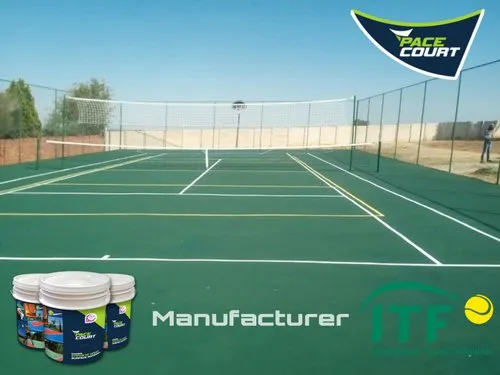
Step onto an indoor volleyball court, and one of the first things you’ll notice—aside from the echo of sneakers—is the smooth, polished surface beneath your feet. This isn’t just any flooring; it’s specifically designed to support high-impact movement, quick direction changes, and repeated jumping. The type of flooring used in indoor volleyball courts plays a huge role in both performance and safety.
The most common material is hardwood flooring, particularly maple wood. This is the same type of surface used in professional basketball courts, and for good reason. It offers an ideal balance of grip and flexibility, allowing players to move بسرعة without slipping while also absorbing some of the impact from jumps and dives.
But hardwood isn’t the only option. Many modern facilities use synthetic flooring, such as polyurethane or vinyl surfaces. These materials are engineered to mimic the properties of wood while offering additional benefits like easier maintenance and enhanced durability. They’re also more مقاومة للرطوبة, making them suitable for multi-purpose indoor arenas.
What really matters is how the surface interacts with the player. A good volleyball floor should provide:
- Shock absorption to reduce strain on joints
- Consistent traction to prevent slipping
- Durability to withstand intense اللعب
- Evenness to ensure predictable ball حركة
Another key factor is the finish. Indoor courts are often coated with a protective layer that enhances grip while giving the floor its signature shine. This finish must be carefully maintained—too slippery, and it becomes dangerous; too rough, and it can cause injuries during dives.
Professional organizations like the FIVB (Fédération Internationale de Volleyball) have strict standards for court surfaces, ensuring consistency across international competitions. This means players can perform at their best regardless of where they’re competing.
So, the next time you watch an indoor volleyball match, remember—the floor isn’t just a surface. It’s a carefully engineered foundation that supports every jump, every dive, and every نقطة scored.
Sand Courts for Beach Volleyball
Now imagine trading that polished indoor floor for warm, shifting sand beneath your feet. Welcome to the world of beach volleyball, where the surface itself becomes part of the challenge. Sand courts aren’t just a stylistic choice—they fundamentally change how the game is played.
The sand used in official beach volleyball courts isn’t random. It must meet specific standards to ensure safety and performance. Ideally, the sand should be fine, soft, and free of debris like rocks or shells. This reduces the risk of injuries and makes it more comfortable for players who frequently dive and slide.
Unlike solid flooring, sand absorbs impact almost completely. This is great for preventing injuries, but it also means players have to work much harder to move. Every कदम sinks slightly, making sprinting and jumping more physically demanding. That’s one reason why beach volleyball courts are smaller—16 by 8 meters—to balance the increased effort required.
The depth of the sand is also important. Official guidelines recommend a minimum depth of 40 centimeters (about 16 inches). This ensures adequate cushioning and prevents players from hitting hard ground underneath.
Weather adds another layer of complexity. Wind, heat, and الشمس can all affect gameplay. A strong gust can alter the ball’s trajectory, while hot sand can be uncomfortable to stand on. Players must adapt constantly, making beach volleyball as much about resilience as it is about skill.
Interestingly, the uneven nature of sand levels the playing field. Raw power becomes less dominant, while control, strategy, and teamwork take center stage. Players rely more on placement shots, soft touches, and clever positioning rather than just hard spikes.
In many ways, sand transforms volleyball into a completely different sport. It slows things down just enough to highlight technique and endurance, creating a unique and captivating experience for both players and fans.
Free Zone and Clearance Space

Minimum Required Space Around Court
If you’ve ever watched a volleyball player sprint off the court to save a ball, you’ve already seen the importance of the free zone in action. This area surrounds the main court and provides players with the space they need to move freely without obstacles. While it might not be part of the official playing dimensions, it’s absolutely essential for safe and competitive gameplay.
According to official standards, the free zone must extend at least 3 meters (about 10 feet) on all sides of the court. However, in professional and international competitions, this space is often expanded to 5 meters or more. The larger the free zone, the more room players have to chase down difficult shots and keep rallies alive.
Think about how dynamic volleyball can be—players dive, roll, and sprint at full speed, often without looking where they’re going. Without adequate space around the court, the risk of collisions with walls, chairs, or spectators increases dramatically. The free zone acts as a buffer area, reducing these risks and allowing players to perform at their best.
The surface of the free zone also matters. It should be consistent with or compatible with the main court surface. For indoor courts, this usually means the same type of flooring extends outward. For beach volleyball, the sand continues beyond the boundary lines.
Lighting and visibility are also important in this area. A poorly lit free zone can make it difficult for players to track the ball, especially during high, fast plays. That’s why professional venues ensure uniform lighting across both the court and surrounding space.
From a strategic perspective, a larger free zone encourages more aggressive defensive play. Players are more willing to chase difficult balls, knowing they have the space to do so safely. This often leads to longer rallies and more exciting matches.
So while it may seem like “extra space,” the free zone is anything but optional. It’s a critical component that enhances safety, performance, and the overall excitement of volleyball.
Ceiling Height Requirements
Look up during an indoor volleyball match, and you’ll notice something interesting—there’s a lot of vertical space above the court. That’s not by accident. The ceiling height is a crucial factor in volleyball, especially because the ball can travel surprisingly high during serves, sets, and defensive plays.
For official indoor competitions, the minimum ceiling height is typically 7 meters (about 23 feet). However, for international matches governed by the FIVB, this requirement increases to at least 12.5 meters (around 41 feet). This ensures that even the highest plays—like powerful serves or بلند sets—can occur without obstruction.
Why does this matter so much? Volleyball isn’t just a horizontal game; it’s highly vertical. Players often send the ball soaring high into the air, especially when setting up attacks or defending against spikes. A low ceiling would interfere with these plays, forcing players to adjust their طبيعي style and limiting the game’s fluidity.
Imagine a scenario where a perfectly executed set hits the ceiling and drops unpredictably. Not only does it disrupt the rally, but it also creates confusion and potential unfairness. That’s why maintaining adequate vertical clearance is essential.
Ceiling design also plays a role. It should be free of hanging objects like lights, beams, or معدات that could interfere with the ball. Modern sports facilities are designed with this in mind, ensuring a clean, unobstructed فضای above the court.
Lighting fixtures, in particular, must be carefully positioned. They need to provide bright, even illumination without causing glare or obstructing visibility. Players rely heavily on tracking the ball visually, so any distraction can affect performance.
In essence, the space above the court is just as important as the space on it. A բարձր ceiling allows the game to unfold naturally, supporting the high-flying action that makes volleyball so thrilling to watch and play.
Measurement Standards by Governing Bodies
FIVB Official Regulations
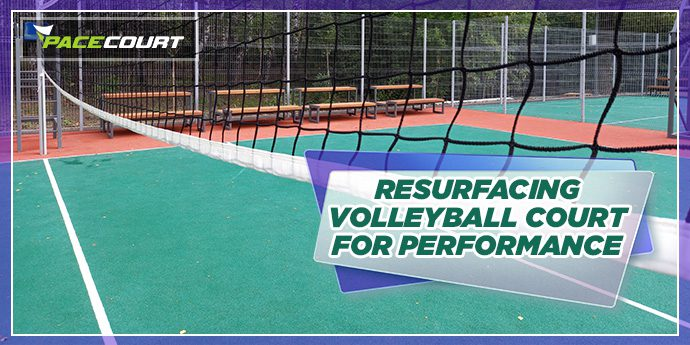
When it comes to volleyball, consistency isn’t just preferred—it’s enforced. That’s where the FIVB (Fédération Internationale de Volleyball) steps in. As the global governing body for the sport, FIVB sets the official standards for everything from volleyball ground size to net height, court markings, and even lighting conditions. These regulations ensure that whether a match is played in Tokyo, Paris, or São Paulo, the playing experience remains identical.
According to FIVB rules, the official indoor volleyball court must measure exactly 18 meters by 9 meters, with a clearly defined free zone and minimum clearance space. But the guidelines go far beyond just length and width. The organization specifies precise measurements for line thickness, net tension, antenna placement, and even the texture of the playing surface.
One of the most interesting aspects of FIVB regulations is how detailed they are. For example, the free playing space above the court must be completely unobstructed and measure at least 12.5 meters high for international competitions. This isn’t just about avoiding interference—it’s about preserving the natural flow of the game, allowing players to execute high sets and defensive plays without limitation.
FIVB also regulates lighting standards, requiring uniform brightness across the court to eliminate shadows and improve visibility. In televised matches, this becomes even more critical, as poor lighting can affect both player performance and viewer experience.
Another key element is surface approval. Only specific materials that meet FIVB’s safety and performance criteria are allowed in official matches. This ensures players can trust the कोर्ट beneath their feet, whether they’re diving for a ball or landing from a jump.
These strict standards might seem excessive at first, but they serve a vital purpose. They eliminate variables that could affect the outcome of a match, ensuring that results are determined purely by skill, strategy, and teamwork.
In a way, FIVB acts like the architect of the sport, designing a universal blueprint that keeps volleyball fair, competitive, and globally unified.
Differences in School and Recreational Courts
While professional volleyball follows strict international standards, not every court you encounter will match those exact specifications. School gyms, community centers, and recreational courts often adapt the official dimensions to suit available space, budget, and player skill levels. And honestly, that flexibility is part of what makes volleyball so accessible.
In many schools, especially at the elementary or middle level, courts are slightly smaller than the official 18×9 meter size. This adjustment helps younger players develop their skills without being overwhelmed by a full-sized कोर्ट. Similarly, net heights are often lowered to match the खिलाड़ियों’ physical abilities, making the game more enjoyable and less intimidating.
Recreational courts, on the other hand, can vary widely. You might find courts with faded lines, slightly uneven surfaces, or सीमित free zones. While these differences don’t meet professional standards, they still allow people to enjoy the game in a casual setting.
Here’s a quick comparison:
| Feature | Professional (FIVB) | School/Recreational |
|---|---|---|
| Court Size | 18m x 9m | Slightly smaller or flexible |
| Net Height | Standardized | Adjustable |
| Free Zone | 3m–5m+ | Often limited |
| Surface | Approved materials | विविध (wood, concrete, sand) |
What really matters in these environments isn’t perfection—it’s playability. As long as the court is safe and reasonably marked, the game can still be enjoyed. In fact, many professional players started on imperfect courts, learning to adapt and improvise.
These variations also highlight the versatility of volleyball. It’s a sport that can be played almost anywhere—with minimal equipment and flexible مساحة requirements. Whether you’re in a स्कूल gym or on a beach, the essence of the game remains the same.
So while official standards set the gold standard, recreational adaptations ensure that volleyball stays inclusive and widely accessible.
Common Mistakes When Measuring a Volleyball Court
Setting up a volleyball court might seem straightforward—just measure 18 by 9 meters, right? Not quite. In reality, there are several common mistakes that can throw off the entire setup, affecting both gameplay and safety. These errors often go unnoticed until they start causing problems during matches.
One of the most frequent mistakes is incorrect measurement of the court boundaries. Even a small deviation—say, a few centimeters—can impact player positioning and game flow. This is especially important in competitive settings, where precision matters. Using inaccurate tools or अनुमान instead of proper measuring equipment often leads to these discrepancies.
Another common issue is misplacing the attack line. Remember, it must be exactly 3 meters from the center line on each side. If it’s too close or too far, it changes how back-row players can attack, potentially leading to rule violations and confusion.
Improper net height is another big one. A net that’s even slightly too high or too low can affect the fairness of the game. Players train based on standard heights, so any बदलाव can disrupt their timing and performance.
Then there’s the free zone, which is often overlooked. Many setups fail to leave enough space around the court, increasing the risk of injuries. खिलाड़ियों need room to move, dive, and chase balls safely—cramped surroundings can be dangerous.
Line visibility is another समस्या. Faded or poorly marked lines make it difficult to judge whether a ball is in or out. This leads to disputes and interrupts the flow of the game.
Finally, ignoring surface quality can be a costly mistake. Uneven flooring or खराब sand conditions can affect ball movement and player safety. A कोर्ट isn’t just about dimensions—it’s about the entire playing environment.
Avoiding these mistakes requires attention to detail and adherence to guidelines. Taking the time to measure accurately and maintain the court properly ensures a बेहतर playing experience for everyone involved.
Conclusion
Understanding volleyball ground size isn’t just about memorizing numbers—it’s about appreciating how every measurement shapes the game. From the 18×9 meter indoor court to the smaller 16×8 meter beach setup, each dimension is carefully designed to balance competition, safety, and excitement.
The court isn’t just a surface; it’s a structured environment filled with zones, lines, and नियम that guide player movement and strategy. The attack line controls offensive plays, the center line maintains fairness, and the free zone ensures खिलाड़ियों can perform without risk. Even the नेट—with its precise height and संरचना—acts as a defining feature that influences every rally.
What makes volleyball truly fascinating is how these elements come together seamlessly. You don’t notice them individually during a match, but they’re always working in the background, shaping every serve, spike, and save.
Whether you’re a beginner सीखना the basics or a खिलाड़ी aiming to improve your skills, understanding the court gives you a deeper connection to the game. You start to see patterns, anticipate plays, and appreciate the रणनीति behind every move.
And the best part? Volleyball remains incredibly accessible. Even if you don’t have a perfectly measured court, the spirit of the game stays alive. But when you do play on a properly set-up court, you experience the game exactly as it was meant to be played—balanced, dynamic, and thrilling.