What Is Tennis Court Construction?
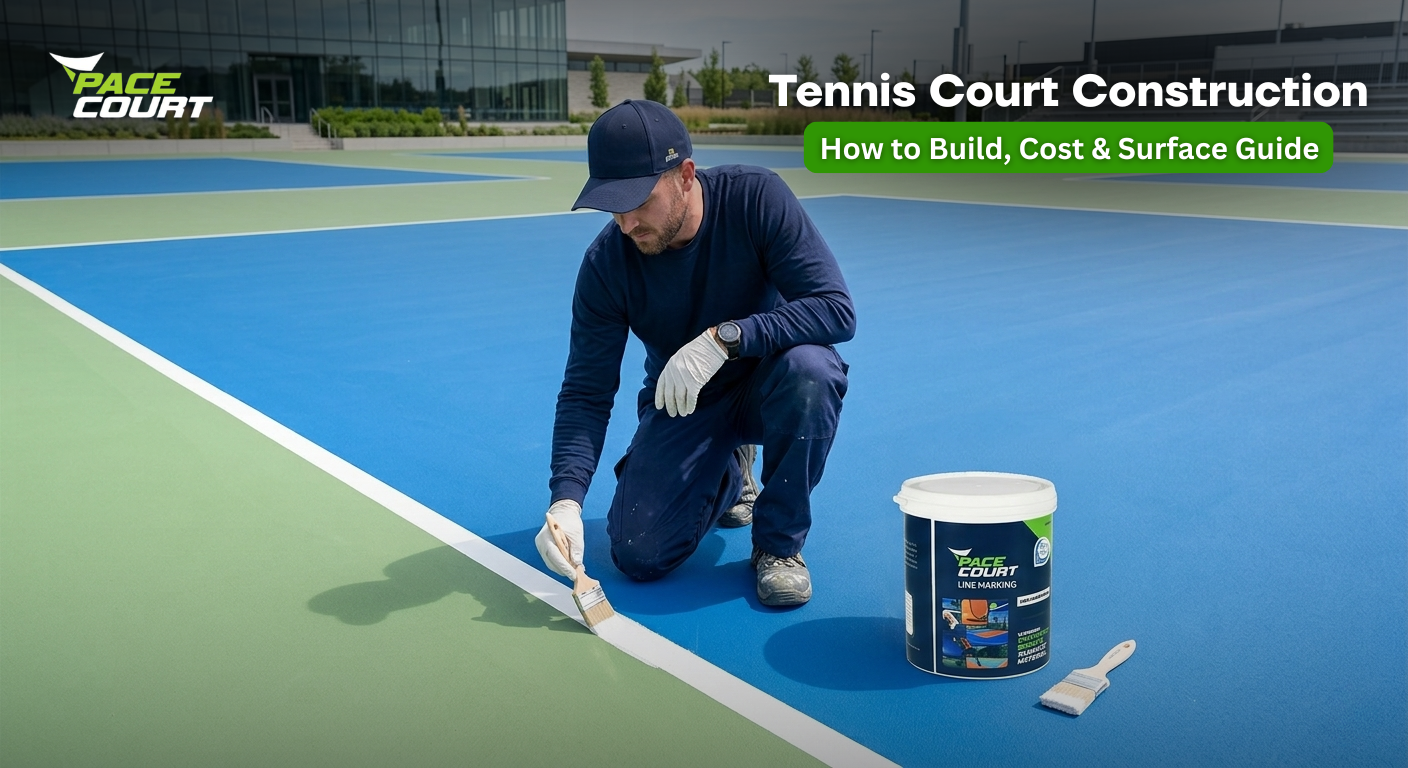
Tennis court construction is the process of planning, designing, and building a dedicated playing surface for tennis. It includes site preparation, base laying, surface installation, net post fitting, fencing, and line marking. Builders in India now use modern materials to create durable, low-maintenance, and weather-resistant courts.
Quick Answer Box
- What is the cost of tennis court construction in India? Tennis court construction in India costs between ₹8 lakh and ₹40 lakh depending on surface type, size, and location.
- How long does it take to build a tennis court? A standard tennis court takes 3 to 8 weeks to complete from excavation to final surface coating.
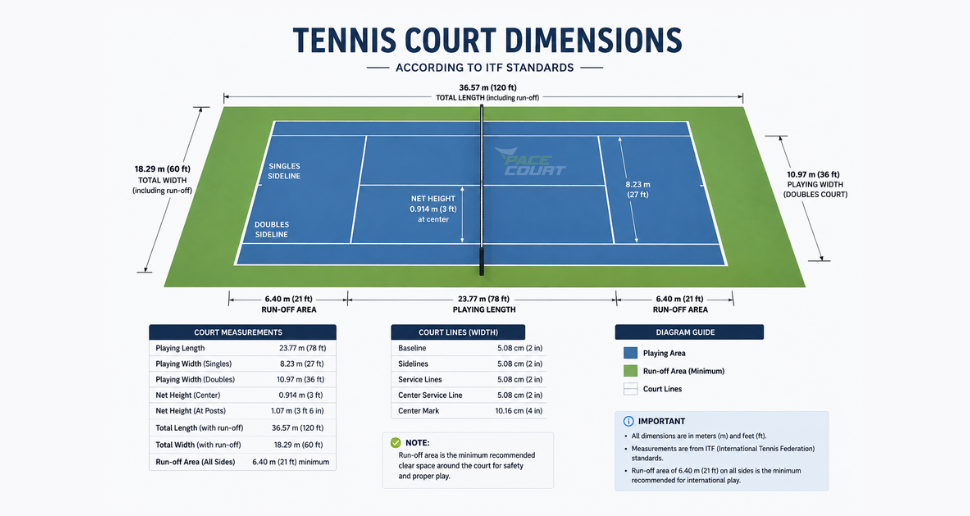
- What is the standard size of a tennis court? A standard tennis court measures 23.77 metres long and 10.97 metres wide for doubles play.
- Which surface is best for tennis court construction in India? Acrylic hard courts are the most popular choice in India due to heat resistance, low maintenance, and durability.
- Do I need a permit to build a tennis court in India? Yes, you need local municipal or panchayat approval and, in some cases, an environmental clearance for large projects.
Types of Tennis Court Surfaces
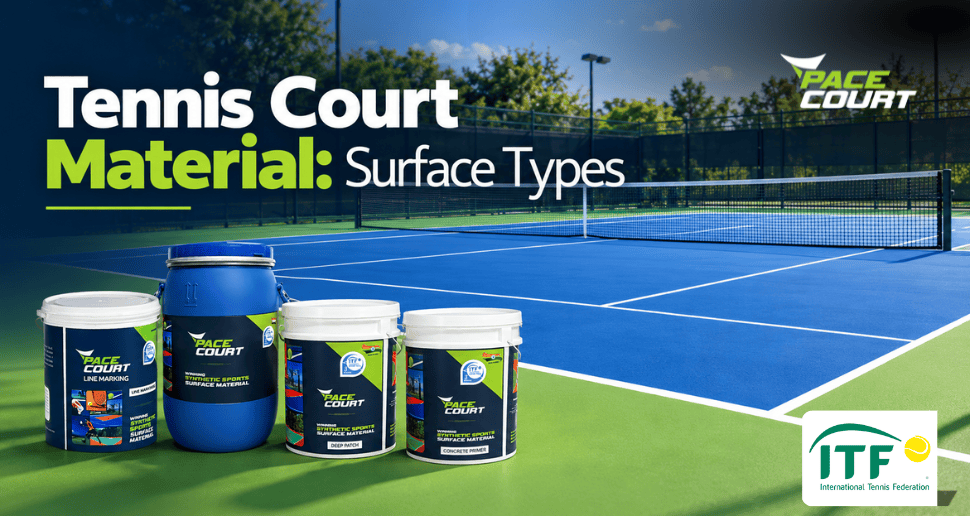
Choosing the right surface is the most important decision in tennis court construction. Each surface affects player performance, maintenance cost, and lifespan.
1. Acrylic Hard Court
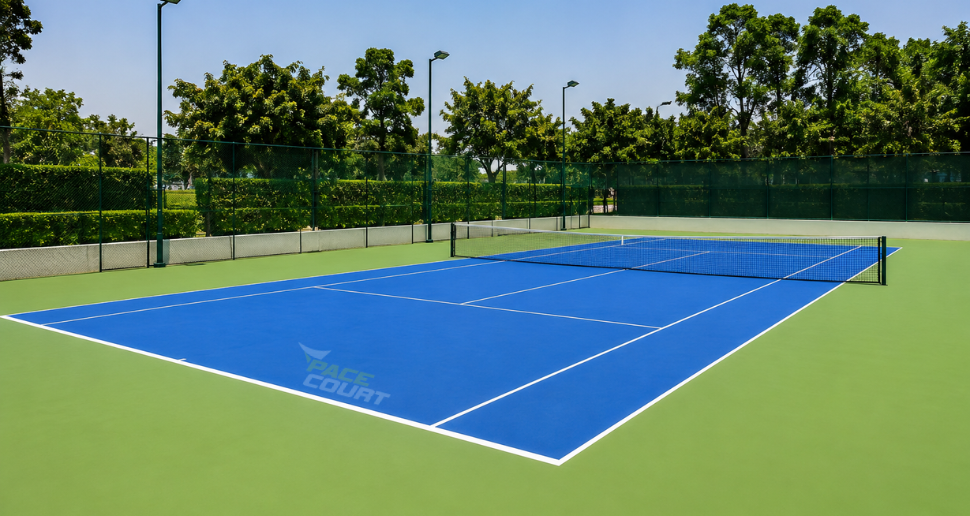
Acrylic hard courts are the top choice for Indian climates. Builders apply multiple layers of acrylic coating over a concrete or asphalt base. This surface handles heavy rainfall, extreme heat, and UV exposure extremely well. Players get a consistent bounce and good grip underfoot.
Lifespan: 10–15 years with annual maintenance.
2. Clay Court
Clay courts are popular in tennis academies and clubs across Maharashtra, Karnataka, and Tamil Nadu. Builders compact red clay over a gravel drainage base. Clay slows the ball and offers excellent joint protection for players. However, clay requires daily rolling and watering to stay in top condition.
Lifespan: 5–10 years with regular upkeep.
3. Artificial Grass (Synthetic Turf)
Synthetic grass gives players a soft feel similar to natural grass but requires zero daily maintenance. Builders install a rubber or sand-infill layer under the turf. This surface suits residential and club installations across India. It drains water quickly and stays playable after light rain.
Lifespan: 8–12 years.
4. Natural Grass
Natural grass courts are rare in India due to high water usage and intensive upkeep. Only premium clubs and academies in cooler climates like Ooty or Shimla maintain natural grass. The surface plays fast and places heavy strain on knees and ankles.
Lifespan: 3–5 years without major renovation.
5. Cushioned Acrylic (Cushion Court)
Cushioned acrylic courts use a rubberised base layer beneath the acrylic coating. This surface absorbs shock and dramatically reduces player fatigue. Many coaching academies and sports complexes across India now prefer this surface. It costs more upfront but reduces player injuries over time.
Lifespan: 12–18 years.
Surface Comparison Table
| Surface Type | Cost (₹ per sq ft) | Maintenance | Lifespan | Best For |
| Acrylic Hard Court | ₹45–₹60 | Low | 10–15 years | Clubs, Schools, Residential |
| Clay Court | ₹60–₹100 | High | 5–10 years | Academies, Tournaments |
| Artificial Grass | ₹120–₹180 | Very Low | 8–12 years | Residential, Clubs |
| Natural Grass | ₹150–₹250 | Very High | 3–5 years | Premium Clubs Only |
| Cushioned Acrylic | ₹60–₹80 | Low | 12–18 years | Academies, Sports Centres |
Step-by-Step Tennis Court Construction Process
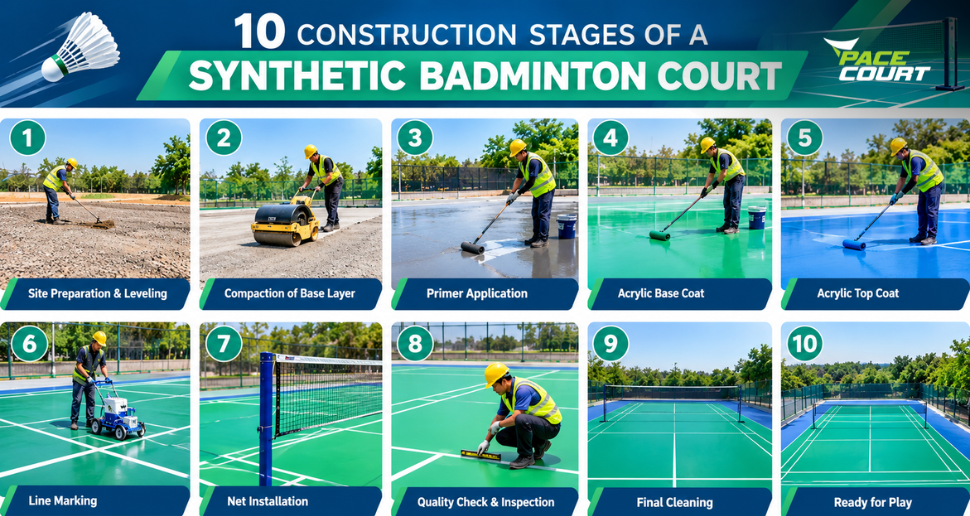
A professional contractor follows a clear sequence to build a tennis court. Each phase directly affects the quality, safety, and longevity of the final surface.
Step 1: Site Survey and Planning
Engineers survey the land to assess soil type, drainage capacity, and slope. They prepare a detailed layout drawing and identify utility lines under the ground. This step prevents costly corrections during later construction phases.
Step 2: Excavation and Earthwork
Workers excavate the site to the required depth, usually 250–400 mm. They remove loose soil, organic matter, and debris completely. Proper excavation creates a stable foundation for the entire court structure.
Step 3: Sub-Base and Drainage Preparation
Contractors lay a compacted granular sub-base of crushed stone or gravel. They install perforated drainage pipes to channel water away from the court surface. Poor drainage is the number one cause of early court surface failure in India.
Step 4: Base Layer Construction
Builders pour either an asphalt binder layer or a concrete slab over the prepared sub-base. The concrete option offers greater rigidity and suits Indian soil conditions better. Workers use laser-guided levelling equipment to achieve a maximum slope of 1% for proper water runoff.
Step 5: Surface Coating Application
Applicators spray or roll acrylic surface layers in multiple coats. Standard installations use 4–6 coats of acrylic texture and colour. Each coat dries before the next application to ensure proper bonding and even finish.
Step 6: Line Marking
Technicians apply white thermoplastic or acrylic paint for all court lines. They follow the exact ITF (International Tennis Federation) specification for line widths. Accurate line marking is essential for fair play and ITF certification compliance.
Step 7: Net Post Installation and Fencing
Workers install galvanised steel net posts at the correct centre-court position. They erect surrounding fencing using chain-link or PVC-coated mesh panels. Fencing height typically ranges from 3 metres to 4.5 metres for ball containment.
Step 8: Lighting and Amenities (Optional)
Many clients add LED floodlights for evening play, seating stands, and player rest areas. Proper court lighting requires a minimum of 200–500 lux at surface level for recreational play. Tournament courts require 750 lux and above.
Tennis Court Construction Cost in India 2026
Understanding cost breakdown helps you plan your budget accurately. Prices vary significantly by city, surface type, and quality of materials used.
Cost Breakdown Table
| Component | Estimated Cost (₹) |
| Site Survey & Layout | ₹15,000 – ₹40,000 |
| Excavation & Earthwork | ₹80,000 – ₹2,00,000 |
| Sub-Base & Drainage | ₹1,00,000 – ₹2,50,000 |
| Concrete / Asphalt Base | ₹2,00,000 – ₹6,00,000 |
| Acrylic Surface Coating | ₹1,50,000 – ₹4,00,000 |
| Line Marking | ₹20,000 – ₹50,000 |
| Net Posts & Fencing | ₹1,00,000 – ₹3,00,000 |
| LED Floodlights (Optional) | ₹2,00,000 – ₹6,00,000 |
| Total Estimate | ₹8,65,000 – ₹23,90,000 |
Premium installations with cushioned surfaces, spectator seating, and full lighting systems can exceed ₹35–₹40 lakh.
Key Factors That Affect Tennis Court Construction Cost
Several variables directly push costs up or down. Understanding these factors helps you avoid budget overruns and make smarter decisions.
- Location and Land: Urban centres like Mumbai, Delhi, Bengaluru, and Hyderabad carry higher labour and logistics costs than Tier 2 or Tier 3 cities.
- Soil Condition: Rocky or waterlogged soil demands extra excavation and drainage work. Builders charge more for difficult ground conditions.
- Surface Type: Cushioned acrylic and synthetic grass cost more per square foot than standard hard courts.
- Contractor Experience: Certified contractors who follow AITA (All India Tennis Association) standards charge a premium but deliver higher quality.
- Add-On Features: Spectator seating, covered canopies, player rest rooms, and digital scoreboards all add to total project costs.
Tennis Court Dimensions and Specifications (ITF Standards)
| Parameter | Measurement |
| Full Court Length | 23.77 m (78 ft) |
| Singles Width | 8.23 m (27 ft) |
| Doubles Width | 10.97 m (36 ft) |
| Service Box Length | 6.40 m |
| Net Height (Centre) | 0.914 m (3 ft) |
| Net Height (Posts) | 1.07 m (3.5 ft) |
| Clear Runoff (Behind Baseline) | Minimum 6.40 m |
| Clear Runoff (Sidelines) | Minimum 3.66 m |
Tennis Court Construction vs Renovation: Which Do You Need?
Sometimes an existing court needs renovation rather than full reconstruction. Understanding the difference saves money and time.
- Full Construction suits: new plots, demolishing old courts, or changing surface type entirely.
- Renovation suits: resurfacing worn acrylic, repainting lines, repairing cracks, or upgrading drainage on an existing court.
Renovation vs Construction Comparison
| Factor | Full Construction | Renovation |
| Cost | ₹8 lakh – ₹40 lakh | ₹1 lakh – ₹6 lakh |
| Time | 3–8 weeks | 3–10 days |
| Surface Change | Yes | Limited |
| Base Work | Full excavation | Not required |
| Lifespan After Work | 10–18 years | 3–6 additional years |
Top Indian Cities for Tennis Court Construction Activity in 2026
Demand for tennis court construction has grown steadily across India. Schools, housing societies, sports clubs, and government sports complexes drive most of the new construction activity.
- Bengaluru leads with the highest number of new club and academy installations.
- Mumbai and Pune see heavy demand from residential townships and corporate campuses.
- Hyderabad and Chennai show rapid growth driven by sports academy expansion.
- Delhi-NCR records large-scale institutional and government sports complex projects.
Maintenance Tips for a Long-Lasting Tennis Court
Regular maintenance protects your investment and keeps the court safe for players.
- Clean the surface with a soft broom or blower weekly to remove dust and leaves.
- Inspect for cracks every six months and seal them immediately before water penetrates the base.
- Repaint lines every 2–3 years or when lines fade below safe visibility standards.
- Check net posts for corrosion annually and apply anti-rust treatment.
- Recoat the surface with a fresh acrylic layer every 4–5 years to restore grip and colour.
- Clear drainage channels before and after the monsoon season.
How to Choose the Right Tennis Court Contractor in India
Selecting a qualified contractor directly determines the quality and durability of your court.
Upgrade Your Sports Court Today
Get premium synthetic acrylic flooring designed for durability, grip, and performance.
Get Free Consultation- Check certification: Hire contractors certified by AITA or those with proven ITF-standard project portfolios.
- Verify past projects: Ask for site visits to completed courts in your city or region.
- Request a detailed quotation: A professional contractor provides itemised quotes with material specifications.
- Compare at least three bids: Never accept the first quotation without comparing rates and timelines.
- Check warranty terms: Reputable contractors offer a 2–5 year structural warranty on the base and 1–2 years on the surface coating.
Conclusion
Tennis court construction in India has grown into a well-structured industry. Builders now use advanced materials, ITF-compliant specifications, and modern drainage systems to deliver courts that last for decades. Whether you plan a single residential court, a multi-court academy, or a full tournament facility, proper planning, surface selection, and contractor vetting determine your final outcome. Invest in quality from the ground up and your tennis court will serve players reliably for 10 to 18 years or more.
Frequently Asked Questions
You need a minimum plot of approximately 36 m x 18 m (including run-off zones) to build a single standard court.
Yes, lightweight acrylic or synthetic grass surfaces work on structural terraces, provided the slab can bear the load.
Submit your court’s layout plan, surface specification, and dimension compliance report to the All India Tennis Association for inspection and certification.
Outdoor courts are significantly cheaper; indoor courts add the cost of a steel structure roofing system that can range from ₹15 lakh to ₹60 lakh extra.
A well-constructed acrylic court lasts 10–15 years with proper annual maintenance and periodic resurfacing.
Stay Updated with Pacecourt
Discover expert insights, practical tips, and the latest industry updates from Pacecourt, covering sports flooring, tennis and multi-sport court construction, resurfacing, maintenance, court performance, and innovative sports infrastructure solutions.
Powered by Google's Preferred Sources feature