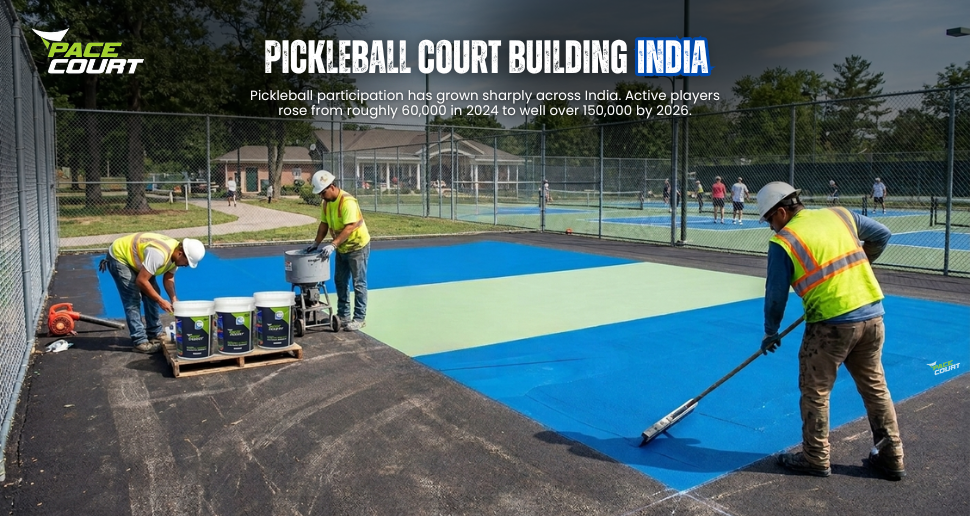
Pickleball court building is growing rapidly across India in 2026. Clubs, resorts, schools, and housing societies now invest in dedicated courts for this fast-rising paddle sport. This guide explains dimensions, surfaces, materials, construction steps, and realistic costs. Use it to plan a professional pickleball court building project without confusion or budget surprises.
What is Pickleball Court Building?
Pickleball court building means designing and constructing a dedicated playing surface that follows official pickleball court dimensions, surface standards, and safety requirements precisely. Builders combine site preparation, flooring, fencing, lighting, and net installation into one coordinated project. Each element directly affects playability, durability, and player safety.
Why Purpose-Built Courts Matter
Converted badminton or tennis courts often create confusing boundary lines and incorrect net height. A dedicated pickleball court removes this confusion completely. Purpose-built courts also last longer. Contractors select surfaces engineered for pickleball’s quick lateral movement and frequent ball bounce, unlike generic multi-sport flooring.
Why Pickleball Court Building Is Booming in India in 2026
Pickleball participation has grown sharply across India. Active players rose from roughly 60,000 in 2024 to well over 150,000 by 2026.
This surge in players pushed rapid growth in court numbers too. India moved from a few hundred dedicated courts in 2024 to well over a thousand operational courts by 2026.
Gated communities, fitness clubs, resorts, and corporate campuses now add pickleball courts as lifestyle and wellness amenities. This trend keeps demand for skilled contractors high.
Industry analysts project India’s pickleball market to expand into a multi-thousand-crore industry within a few years. This growth directly fuels ongoing pickleball court building demand nationwide.
Low equipment cost, minimal space requirement, and an easy learning curve make pickleball accessible to all ages. This accessibility keeps driving new pickleball court building projects across the country.
Standard Pickleball Court Dimensions and Layout
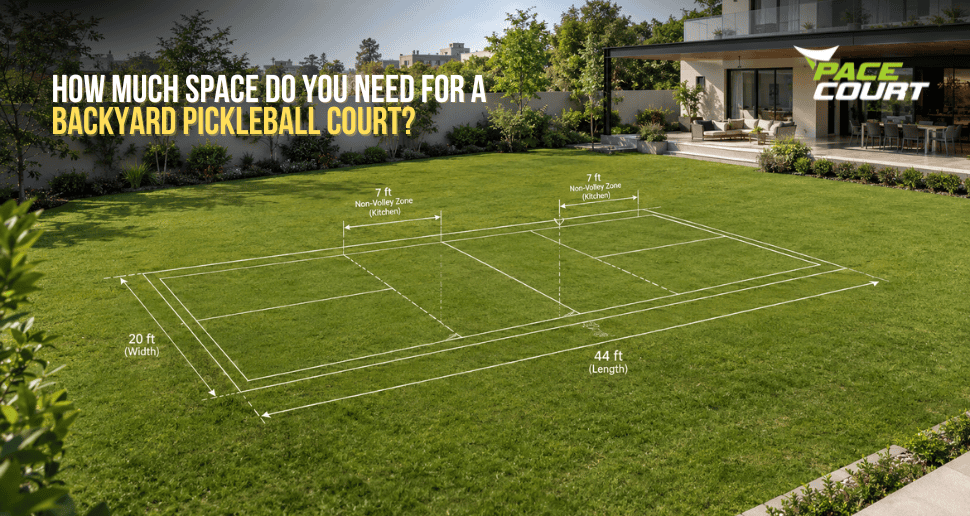
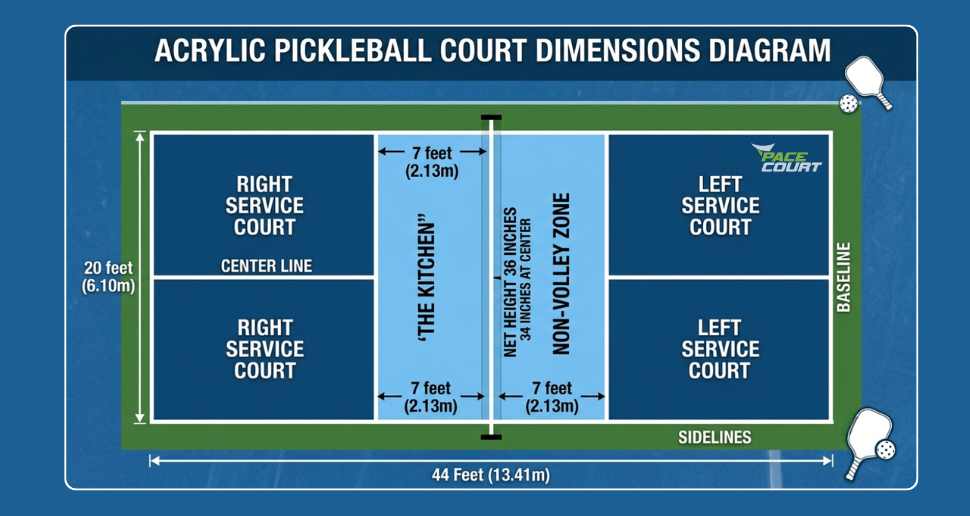
Accurate dimensions form the foundation of every pickleball court building project. Incorrect measurements create unfair play and unnecessary safety hazards for participants.
| Court Element | Standard Measurement |
|---|---|
| Playing court size | 20 feet x 44 feet (880 sq ft) |
| Recommended total footprint with run-off | 30 feet x 60 feet (1,800 sq ft) |
| Net height at sidelines | 36 inches |
| Net height at center | 34 inches |
| Non-volley zone (“kitchen”) | 7 feet from net, each side |
| Service courts | 10 feet x 15 feet, each side |
Builders must add generous run-off space around the playing lines. This buffer zone prevents collisions and lets players move freely during fast rallies.
Types of Pickleball Court Surfaces in India
Surface choice affects ball bounce, player grip, and long-term maintenance cost. Choose a surface based on budget, climate, and expected usage frequency.
| Surface Type | Durability | Cost Level | Best Suited For |
|---|---|---|---|
| Acrylic coated surface | High (6–9 years) | Moderate | Outdoor clubs and academies |
| Synthetic sports flooring | Very high | High | Premium indoor courts |
| Concrete with paint | Moderate | Low | Budget outdoor courts |
| Modular interlocking tiles | High | Moderate | Rooftops, quick installations |
| Asphalt base with coating | Moderate | Low to moderate | Large outdoor complexes |
Acrylic surfaces dominate Indian pickleball court building projects today. They balance grip, bounce consistency, and weather resistance well across most Indian climates.
Modular tiles suit rooftops and temporary spaces best. Installers snap the tiles together without adhesive, making the court playable within a single day.
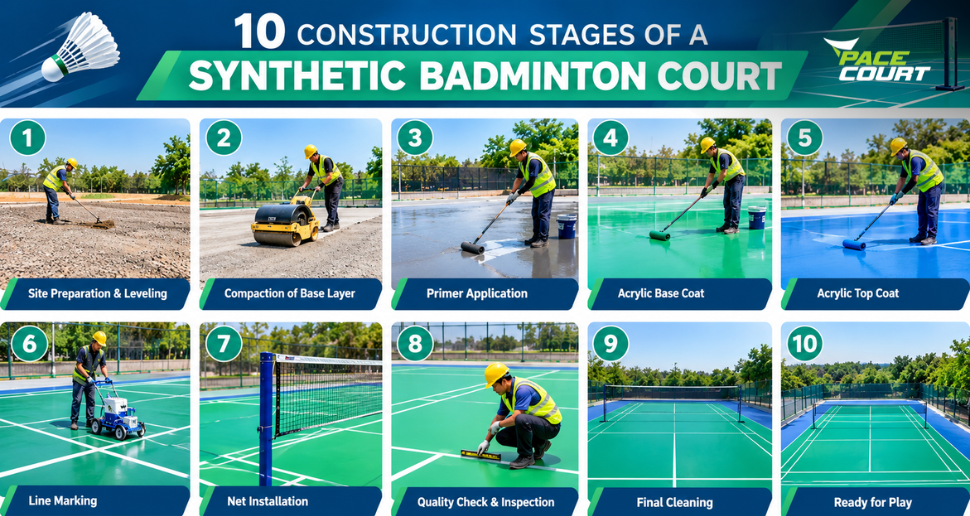
Step-by-Step Pickleball Court Building Process
Every reliable project follows a clear construction sequence. Skipping any step compromises surface quality and shortens the court’s usable lifespan noticeably.
Site Assessment and Planning
Engineers first assess soil condition, drainage slope, and court orientation. Proper planning prevents water logging and uneven settling once construction finishes completely.
Upgrade Your Sports Court Today
Get premium synthetic acrylic flooring designed for durability, grip, and performance.
Get Free ConsultationBuilders align outdoor courts along a north-south axis where possible. This orientation reduces sun glare for players during peak morning and evening sessions.
Base Preparation and Flooring
Workers level the ground thoroughly and lay a stable concrete or asphalt sub-base. This base supports the final surface coating for years.
After the base cures fully, contractors apply acrylic or synthetic coatings in multiple layers. These layers ensure consistent bounce and reliable slip resistance throughout.
Line Marking and Net Installation
Technicians mark boundary lines using precise measurements and durable, weather-resistant paint. Accurate marking prevents disputes during competitive matches later on.
Crews anchor net posts securely into the ground or concrete. Correct net height ensures fair play according to official pickleball regulations everywhere.
Fencing and Lighting
Perimeter fencing keeps balls contained and improves overall player safety. Most 2026 Indian projects now include four to twelve-foot chain-link or mesh fencing.
LED floodlights extend playing hours into evenings comfortably. Many owners now choose energy-efficient lighting to control long-term electricity expenses effectively.
Pickleball Court Building Cost in India (2026)
Cost depends heavily on surface type, site condition, location, and extra features like fencing, lighting, or windscreens. Planning ahead avoids mid-project surprises.
| Court Type | Approximate Cost (Per Court) |
|---|---|
| Basic concrete or asphalt outdoor court | ₹3.5 lakh – ₹5.5 lakh |
| Standard acrylic outdoor court | ₹5 lakh – ₹9 lakh |
| Modular interlocking tile court | ₹4 lakh – ₹7 lakh |
| Premium indoor synthetic or wooden court | ₹10 lakh – ₹16 lakh |
| Fencing, lighting, and windscreen add-ons | ₹1.5 lakh – ₹3.5 lakh |
Acrylic flooring alone typically costs between ₹350 and ₹600 per square foot. This range depends on the number of coating layers applied.
Metro cities like Delhi, Mumbai, and Bengaluru often cost 10 to 20 percent more than tier-2 cities. Higher labor charges and material transport drive this difference.
These figures remain approximate industry ranges for 2026. Always request multiple itemized quotes before finalizing any pickleball court building contractor for your project.
Indoor vs Outdoor Pickleball Court Building
Indoor and outdoor courts differ significantly in cost, construction time, and long-term usability. Compare both options carefully before committing your budget.
Upgrade Your Sports Court Today
Get premium synthetic acrylic flooring designed for durability, grip, and performance.
Get Free Consultation| Factor | Outdoor Court | Indoor Court |
|---|---|---|
| Construction cost | Lower | Higher |
| Weather dependency | High | None |
| Usable hours per day | Limited by daylight or lighting | Full day, year-round |
| Construction timeline | 2 to 4 weeks | 4 to 8 weeks |
| Ceiling clearance needed | Not applicable | Minimum 18 feet (5.5 m) |
| Maintenance frequency | Higher (weather exposure) | Lower |
Outdoor courts remain more common across India due to lower cost and easier space availability. Indoor courts suit premium academies needing year-round bookings.
Materials Required for Pickleball Court Building
Quality materials directly determine court lifespan and player experience. Cutting corners on materials always increases long-term repair expenses significantly.
| Material | Purpose |
|---|---|
| Concrete or asphalt | Structural base layer |
| Acrylic or synthetic coating | Playing surface and bounce control |
| Line marking paint | Boundary and service line marking |
| Net posts and net | Regulation-height net system |
| Chain-link or mesh fencing | Ball containment and safety |
| LED floodlights | Evening and night play |
| Drainage pipes and slopes | Water removal during monsoon |
Drainage often gets overlooked during budgeting. Poor drainage causes water pooling after monsoon rains and shortens the surface coating’s lifespan considerably over time.
How to Choose the Right Pickleball Court Building Contractor
Selecting an experienced contractor prevents costly mistakes later. Verify these factors before signing any pickleball court building agreement with a vendor.
- Check completed project photos and client references directly.
- Confirm the contractor specifies UV-stabilized acrylic, not just a surface coating.
- Ask for a detailed, itemized quote covering base, drainage, and fencing.
- Verify warranty terms for surface cracking and coating peel-off.
- Request the expected construction timeline in writing beforehand.
Common Mistakes to Avoid During Construction
Many first-time builders underestimate total project cost by focusing only on surface flooring. This narrow focus ignores drainage, fencing, and lighting expenses.
Skipping proper drainage planning causes standing water after heavy rain. Retrofitting drainage later costs significantly more than including it during initial construction planning.
Choosing cheap, thin coating layers reduces long-term durability drastically. Thin coatings often wear off within two to three years under strong sun exposure.
Maintenance Tips After Pickleball Court Building
Regular maintenance protects your investment and extends court life considerably. Follow these simple steps after completing your construction project.
- Clean the surface weekly to remove dust and debris.
- Inspect line markings and repaint faded areas every year.
- Check net height and post stability every few months.
- Reapply acrylic coating every six to nine years for outdoor courts.
- Clear drainage channels before every monsoon season begins.
Conclusion
Pickleball court building continues expanding rapidly across India in 2026, driven by rising participation and strong commercial interest nationwide. Careful planning around dimensions, surface type, drainage, and contractor selection ensures a durable, safe, and cost-effective court. Start your project with a clear budget and a verified contractor today.
Frequently Asked Questions
A standard pickleball court measures 20 feet by 44 feet, covering 880 square feet of total playing area.
Pickleball court building in India typically costs between ₹3.5 lakh and ₹16 lakh, depending on surface type and features.
Acrylic coated surfaces work best for most Indian outdoor pickleball court building projects due to their durability and grip.
Standard outdoor pickleball court building takes two to four weeks, while indoor projects take four to eight weeks.
Yes, badminton and tennis courts convert into pickleball courts easily with minor line marking and net height adjustments.
The net stands 36 inches high at the sidelines and 34 inches high at the center.
A complete project needs roughly 30 feet by 60 feet, or 1,800 square feet, including safety run-off zones.
Indoor pickleball court building costs more than outdoor construction due to civil structure and climate-control requirements.
Stay Updated with Pacecourt
Discover expert insights, practical tips, and the latest industry updates from Pacecourt, covering sports flooring, tennis and multi-sport court construction, resurfacing, maintenance, court performance, and innovative sports infrastructure solutions.
Powered by Google's Preferred Sources feature