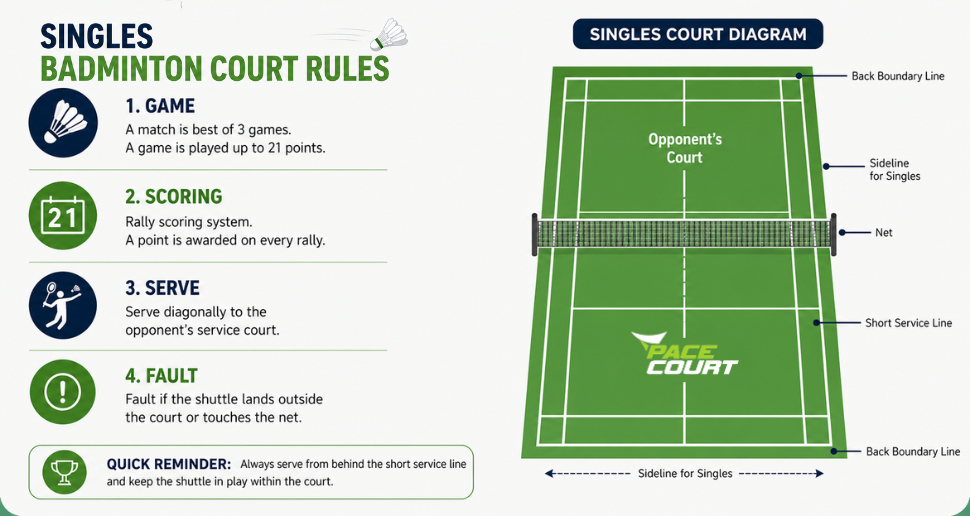
Singles badminton court rules define a narrower playing area than doubles, a serving zone that stretches to the back wall, and a serving position that shifts with the score. Every point in a one-on-one match depends on these boundaries, so a clear picture of the lines saves you from silly disputes on court. This guide breaks down the official Badminton World Federation (BWF) court rules in plain language, with tables, a line-by-line diagram, and the 2026 updates that Indian players need to know.
Singles Badminton Court Rules in One Line
In singles badminton, players use the inner side lines (5.18 m wide) and the full back boundary line (13.4 m long) as playing limits, and the serve must land diagonally within the service court formed by the short service line, the center line, and the back boundary line.
That single sentence covers the core of singles play. The sections below unpack every measurement, line, and rule so you can apply them confidently, whether you are marking a court at home or umpiring a club match.
Singles Badminton Court Dimensions (Official 2026 Measurements)
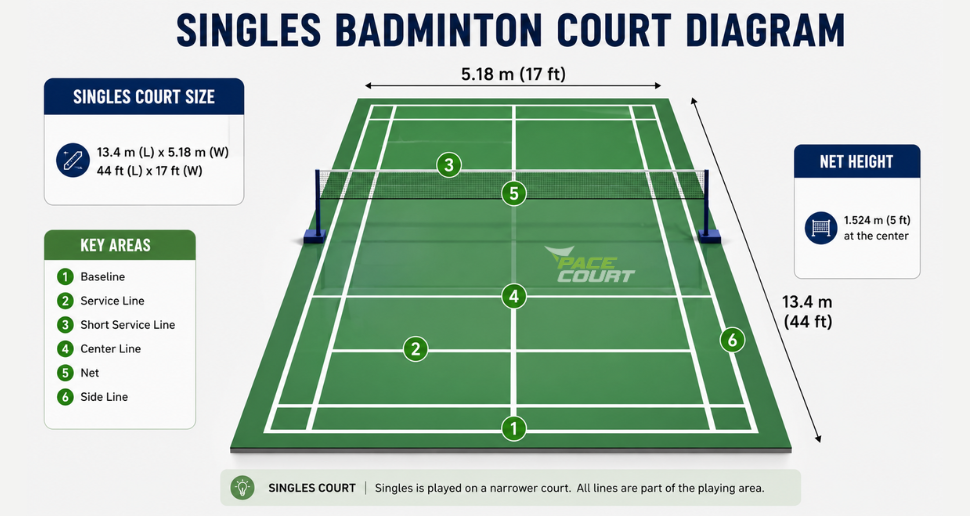
The BWF Laws of Badminton set one universal court size for both singles and doubles. Singles play simply ignores the two outer strips on either side. Here are the exact figures used in every BWF-recognised and Badminton Association of India (BAI) tournament today.
| Court Element | Metric | Imperial |
|---|---|---|
| Total court length | 13.4 m | 44 ft |
| Singles court width | 5.18 m | 17 ft |
| Doubles court width (for reference) | 6.1 m | 20 ft |
| Net height at the posts | 1.55 m | 5 ft 1 in |
| Net height at the center | 1.524 m | 5 ft |
| Short service line from net | 1.98 m | 6 ft 6 in |
| Doubles long service line from back boundary | 0.76 m | 2 ft 6 in |
| Diagonal length of the full court | 14.723 m | 48 ft 3 in |
| Excluded side strip in singles (each side) | 0.46 m | 1 ft 6 in |
A singles court removes 0.46 m from each side of the doubles width, which is why the playing area feels visibly tighter along the flanks. The length never changes, so every long rally and every deep serve still travels the same 13.4 m that doubles players use.
Singles Badminton Court Diagram: Understanding Every Line
Picture the court from above, split by the net into two equal halves of 6.7 m each. From the net outward, four lines matter for singles play: the short service line, the center line, the singles side line, and the back boundary line. The layout below shows how these lines sit relative to each other on one half of the court.
Each service court in singles measures 4.72 m deep and 2.59 m wide, since the serve is allowed to travel all the way to the back boundary line instead of stopping at the shorter doubles service line.
Table: Singles Court Lines at a Glance
| Line Name | Position | Role in Singles Play |
|---|---|---|
| Side lines (inner tramlines) | 5.18 m apart | Mark the playing width for both rallies and serves |
| Short service line | 1.98 m from the net | The serve must clear this line to be legal |
| Center line | Splits the court lengthwise | Separates the left and right service courts |
| Back boundary line | 13.4 m total length | Acts as the outer limit and the long service line for singles |
Singles vs Doubles Badminton Court Rules: Key Differences
Many players confuse singles and doubles boundaries because both formats share the same court markings. Only the active lines change. The table below settles the confusion in one glance.
| Rule Aspect | Singles Court Rule | Doubles Court Rule |
|---|---|---|
| Playing width | 5.18 m (inner side lines) | 6.1 m (outer side lines) |
| Serve depth | Full length, up to the back boundary line | Stops at the doubles long service line, 0.76 m short of the back line |
| Back boundary line during serve | In play | Out of play |
| Outer side strip (0.46 m) | Out of bounds | In play |
| Total in-play court area | Narrower, longer serving zone | Wider, shorter serving zone |
| Post/net support position | Fixed on doubles side lines regardless of format | Same fixed position |
This comparison explains a common beginner mistake: a shuttle landing in the outer strip counts as in during doubles but as an immediate fault during singles.
Singles Badminton Serving Rules Explained
Court rules and serving rules work together, since the serving line you use depends entirely on your score.
Right Service Court Rule
A player serves from, and the opponent receives in, the right service court whenever the server’s score is zero or an even number. This applies at 0, 2, 4, and every even score afterward.
Left Service Court Rule
The server switches to the left service court the moment their own score becomes odd. A score of 1, 3, 5, or any odd number sends the serve to the left side.
Server and Receiver Positioning Rules
Both players must stand inside their diagonally opposite service courts without touching the boundary lines. Each server keeps some part of both feet in contact with the court until the racket strikes the shuttle, and the shuttle must stay below 1.15 m in height at the moment of contact. A serve that clears the short service line and lands inside the diagonal service court, on or within its lines, counts as legal.
Table: Score-to-Service-Court Quick Reference
| Server’s Score | Serving Side | Serving Court |
|---|---|---|
| 0, 2, 4, 6… (even) | Right side of the court | Right service court |
| 1, 3, 5, 7… (odd) | Left side of the court | Left service court |
Singles Badminton Scoring Rules on Court
Every rally in modern singles badminton uses rally-point scoring, where the winner of a rally scores a point regardless of who served. A standard game runs to 21 points, and a side must win by at least two points. If the score reaches 20-20, play continues until one side leads by two, and if it reaches 29-29, the next point decides the game at 30-29. A match remains best of three games, and the side that wins two games first takes the match.
The New 2026 BWF Scoring Update (3×15 System)
On 25 April 2026, the BWF membership voted to adopt a new “3×15″ scoring format, replacing the 21-point game with a 15-point game while keeping the best-of-three match structure and rally-point scoring intact. A two-point lead still decides close games, and a 21-point cap applies if the score reaches 20-20. The BWF has scheduled this system to take effect at international BWF-sanctioned events from 4 January 2027, giving federations and players a transition window through the rest of 2026.

2026 Updates to Singles Badminton Rules in India
India’s badminton calendar makes 2026 a landmark year, since the country hosts the BWF World Championships in New Delhi in August 2026. The Badminton Association of India continues to govern domestic tournaments, rankings, and player registration under the BWF Laws of Badminton, and it has not changed the singles court dimensions covered above. Indian players competing in BAI-sanctioned events currently play the 21-point rally system, and they will follow the same national and international transition timeline as the rest of the world once the 3×15 format becomes mandatory in January 2027. The fixed-height service rule, which limits contact to 1.15 m above the court, remains fully enforced at BAI ranking tournaments and all higher-level events.
Common Faults Related to Singles Court Rules
Court-line faults account for a large share of disputes in casual and competitive singles matches. The table below lists the most frequent ones.
| Fault Type | What Happens on Court | Result |
|---|---|---|
| Shuttle lands outside the singles side line | Shuttle falls in the outer 0.46 m strip | Point to the opponent |
| Serve lands short of the short service line | Serve fails to clear 1.98 m from the net | Service fault |
| Serve contact above 1.15 m | Racket strikes the shuttle too high | Service fault |
| Server’s feet move before contact | Feet leave the ground or shift position | Service fault |
| Shuttle lands beyond the back boundary line | Shuttle travels past 13.4 m from the opposite baseline | Point to the opponent |
| Player touches the net during a stroke | Racket, body, or clothing touches the net | Fault, point to the opponent |
Key Takeaways
- Singles badminton uses a court that is 13.4 m long and 5.18 m wide, narrower than the 6.1 m doubles width.
- The back boundary line acts as the long service line for singles, so serves may travel the full length of the court.
- The short service line, 1.98 m from the net, marks the minimum legal serve distance.
- Singles and doubles share the same physical court, but each format activates different boundary lines.
- The BWF approved a 3×15 scoring system in April 2026, set to replace the 21-point game internationally from January 2027.
- India hosts the BWF World Championships in New Delhi in August 2026, and BAI continues to apply standard BWF court rules across domestic tournaments.
Understanding these singles badminton court rules turns confusing line calls into quick, confident decisions, whether you are playing a friendly match or competing in a BAI-ranked tournament.
Frequently Asked Questions
A singles court measures 13.4 m long and 5.18 m wide (44 ft by 17 ft).
Singles play uses only the inner side lines, not the wider outer doubles side lines.
Yes, the back boundary line doubles as the long service line for singles, so a serve landing on it is legal.
The net stands 1.55 m high at the posts and 1.524 m high at the center.
The short service line sits 1.98 m (6 ft 6 in) from the net on each side.
No, a serve landing beyond the inner singles side line counts as a fault, even though that same spot is valid in doubles.
Scoring rules govern points, while court rules govern boundaries; singles keeps the same 21-point rally system as doubles, though the BWF’s new 3×15 format begins internationally from January 2027.
Stay Updated with Pacecourt
Discover expert insights, practical tips, and the latest industry updates from Pacecourt, covering sports flooring, tennis and multi-sport court construction, resurfacing, maintenance, court performance, and innovative sports infrastructure solutions.
Powered by Google's Preferred Sources feature