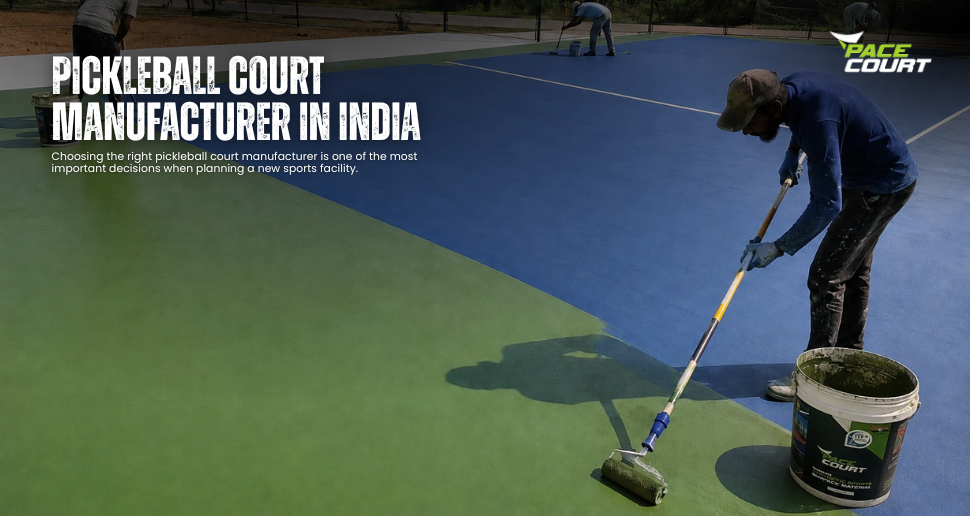
Choosing the right pickleball court manufacturer is one of the most important decisions when planning a new sports facility. A pickleball court may look simple, but good construction requires accurate dimensions, a stable base, proper drainage, suitable Pickleball court flooring, precise line marking, and the right accessories.
In India, pickleball courts are being developed for sports clubs, schools, residential communities, hotels, resorts, commercial facilities, academies, and private properties. The demand has also created many new court contractors and flooring suppliers. That makes it important to compare more than just the quoted price.
A good manufacturer or court partner should understand the complete project, from site assessment and surface selection to installation and maintenance.
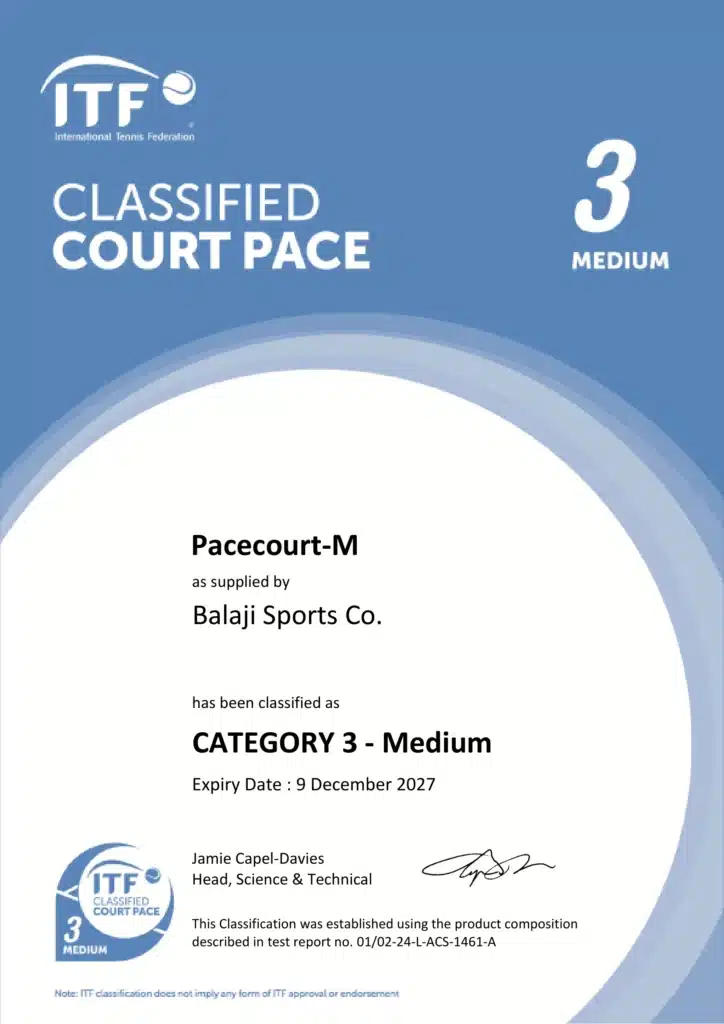
For businesses planning a long-term facility, Pacecourt is worth considering because it focuses on synthetic acrylic sports flooring and pickleball court solutions. Its published information lists pickleball among its sports installations and states that the company has more than 15 years of experience, ITF certification, and a nationwide dealer network.
What Does a Pickleball Court Manufacturer Do?
A pickleball court manufacturer may supply the flooring materials, while a complete court company or builder can also handle civil work, installation, fencing, lighting, drainage, accessories, and final finishing. This difference matters when comparing quotations.
A manufacturer generally focuses on:
- Sports flooring materials
- Acrylic coating systems
- Surface preparation products
- Cushion systems
- Colour coats
- Line-marking materials
- Technical specifications
- Dealer or installer support
A turnkey pickleball court builder may manage:
- Site inspection
- Court layout
- Civil construction
- Concrete or asphalt base
- Drainage
- Acrylic flooring installation
- Line marking
- Net and posts
- Fencing
- Lighting
- Final inspection
Pacecourt positions itself primarily as a synthetic acrylic sports flooring manufacturer while also offering court designing, installation, repair, resurfacing, and maintenance services. Its published product range includes crack filler, deep patch, concrete primer, acrylic resurfacer, cushion coat, colour coat, line marking, silica sand, and PU binder.
That distinction should be clear in any project quotation: who manufactures the material, who installs it, and who is responsible for the finished court?
Standard Pickleball Court Size in India
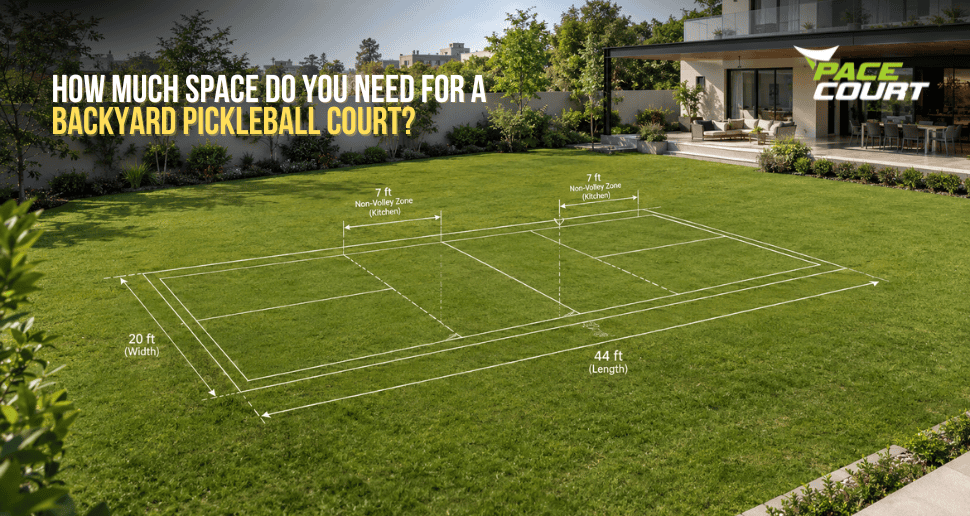
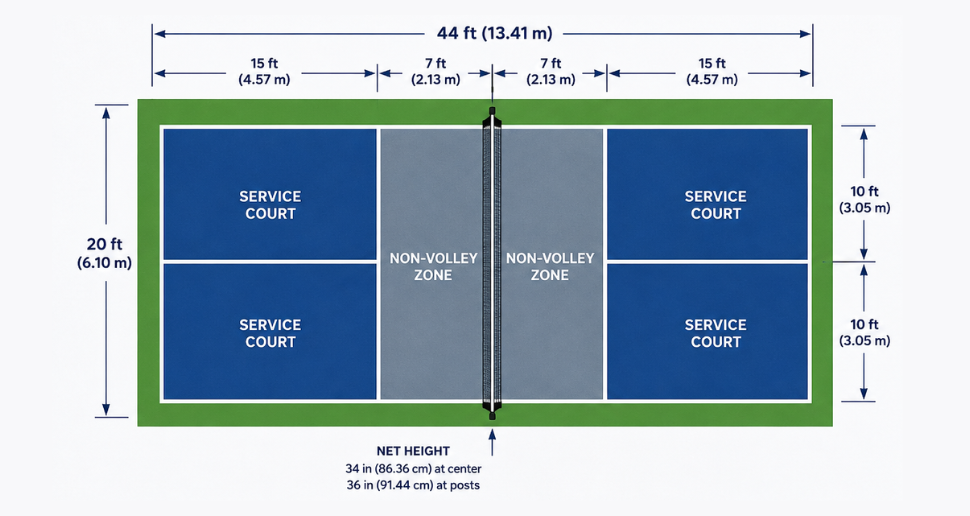
The playing area of a standard pickleball court dimension is 20 feet wide × 44 feet long, for both singles and doubles. The non-volley zone, commonly called the kitchen, extends 7 feet from the net on each side. The net is 36 inches high at the sidelines and 34 inches at the centre. These measurements should be checked during final installation rather than assumed from a generic sports-court drawing. However, the court lines are not the only space you need. USA Pickleball recommends a minimum total playing surface of 30 × 60 feet, while 34 × 64 feet is preferred where space allows. Extra space gives players room to move safely outside the playing lines.
Pickleball Court Dimensions
| Specification | Standard Dimension |
| Court length | 44 ft |
| Court width | 20 ft |
| Court length in metres | 13.41 m |
| Court width in metres | 6.10 m |
| Non-volley zone | 7 ft from net |
| Net height at centre | 34 in |
| Net height at sidelines | 36 in |
| Minimum recommended total area | 30 × 60 ft |
| Preferred total area | 34 × 64 ft |
For commercial projects, it is better to plan the entire site before construction begins. Fencing, drainage channels, lighting poles, player circulation, seating, and access paths can all affect the final layout.
Why Pickleball Court Construction Needs Professional Planning
A common mistake is to treat pickleball construction as simply painting lines on concrete. The playing surface is only one part of the project. A professional pickleball court construction project should begin with a site assessment. The builder should examine the existing ground, drainage, slope, surface condition, access, surrounding structures, and available space.
The base must be stable and reasonably level before the sports surface is installed. If the base has major cracks, depressions, poor drainage, or movement, the acrylic surface cannot permanently correct those problems. This is why experienced contractors spend time on preparation before applying the visible finishing layers.
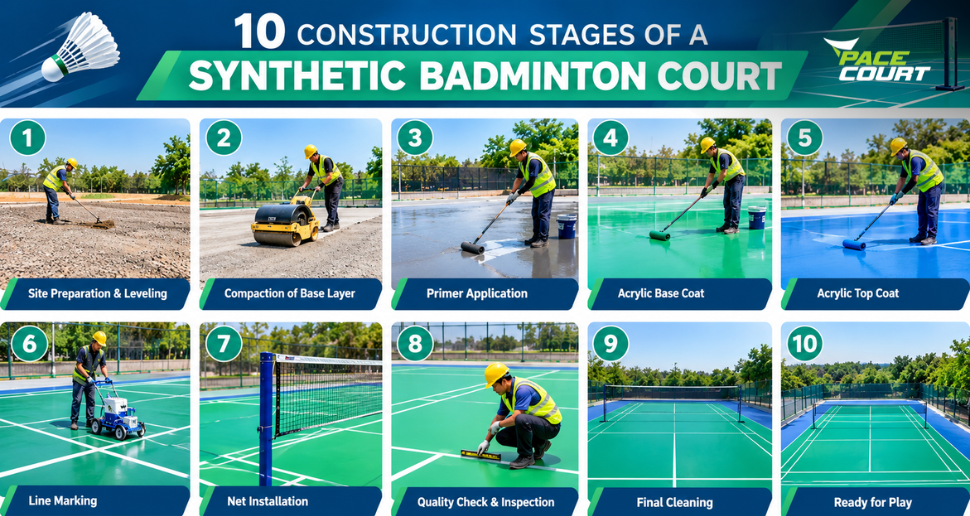
A typical construction sequence
- Site inspection and measurements
- Ground preparation or existing-surface assessment
- Base construction or repair
- Drainage planning
- Surface preparation
- Primer or appropriate bonding layer
- Resurfacing and levelling layers
- Cushion system, where specified
- Acrylic colour coats
- Pickleball line marking
- Net and post installation
- Fencing and lighting, if required
- Final inspection and handover
The exact system depends on the existing base, climate, usage, budget, and required playing characteristics.
Choosing the Right Pickleball Court Flooring
Pickleball court flooring directly affects traction, ball response, player comfort, appearance, and maintenance. For outdoor courts, acrylic surfacing is a popular option because it can be applied as a layered sports surface over a suitable concrete or asphalt base. Several Indian sports-flooring companies currently offer acrylic systems, modular PP tiles, or other synthetic surfaces for pickleball courts.
Upgrade Your Sports Court Today
Get premium synthetic acrylic flooring designed for durability, grip, and performance.
Get Free ConsultationAcrylic Flooring
Acrylic systems are particularly suitable when you want a permanent, painted sports surface with custom colours and clearly defined lines.
Typical benefits include:
- Consistent playing surface
- Good traction when correctly specified
- Outdoor suitability
- Custom colour options
- Easy visual identification of court lines
- Compatibility with resurfacing and maintenance systems
Pacecourt describes its pickleball flooring as an acrylic system designed for consistent ball response, grip, durability, and low-maintenance use.
Cushioned Acrylic
A cushioned acrylic system adds elastic layers beneath the colour surface. This option can make sense for clubs, academies, premium facilities, or projects where player comfort is a major consideration. The additional layers can also change the overall playing feel. However, cushioning should be selected according to the intended use. More layers do not automatically mean a better court.
PP Interlocking Tiles
PP modular tiles are another option. They can be useful for some indoor, rooftop, temporary, or fast-installation projects. Their installation method differs from a conventional acrylic court. They also have different maintenance and replacement considerations.
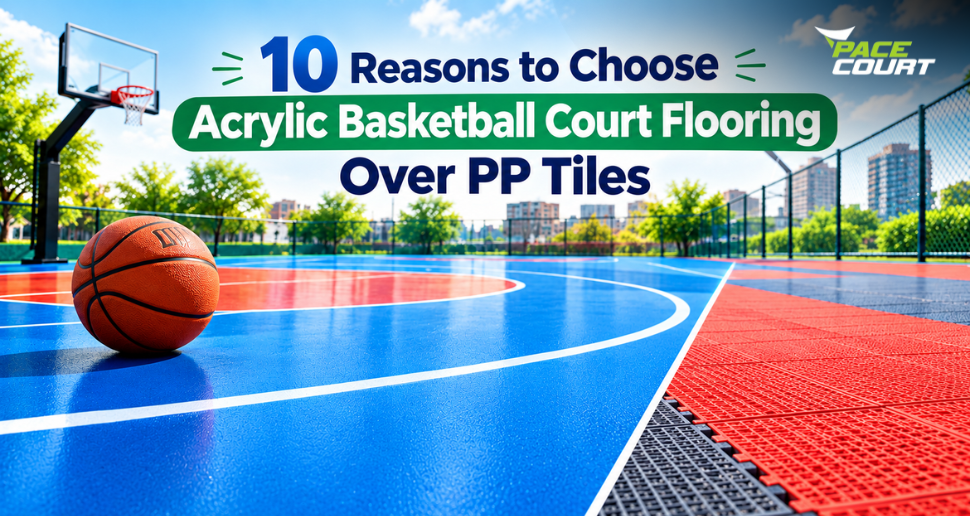
Acrylic vs PP Tiles
| Feature | Acrylic Flooring | PP Interlocking Tiles |
| Appearance | Painted sports-court finish | Modular tile appearance |
| Installation | Requires surface preparation and coating | Tiles interlock over suitable base |
| Colour options | Broad customisation | Depends on tile range |
| Surface repairs | Can be resurfaced or recoated | Damaged tiles can be replaced |
| Best suited for | Permanent outdoor courts and clubs | Selected indoor, rooftop and modular applications |
| Base requirement | Stable concrete/asphalt base | Stable, suitable base |
| Long-term planning | Strong option for permanent facilities | Useful where modular installation is preferred |
The right choice depends on the project. A manufacturer should recommend the surface based on site conditions rather than simply pushing the product with the highest price.
What Makes a Good Pickleball Court Manufacturer?
Not every sports-flooring supplier offers the same level of technical support. Before selecting a pickleball court manufacturer, check these points.
1. Product and Technical Experience
Ask how long the company has worked with sports surfaces and whether it understands pickleball-specific requirements. Experience with tennis or basketball flooring is useful, but pickleball has its own layout, net height, kitchen zone, and playing requirements.
2. Clear Flooring Specification
Do not accept a quotation that only says “premium acrylic flooring.” Ask for the actual system. The quotation should identify the relevant layers and materials, such as primer, resurfacer, cushion layer if applicable, colour coat, texture or aggregate, and line-marking system.
3. Site-Specific Recommendation
A good builder should inspect the site before finalising the specification. A rooftop court, new RCC slab, old tennis court, and damaged concrete surface should not automatically receive the same treatment.
4. Installation Network
If the manufacturer operates through dealers or installation partners, ask who will execute your project and who handles technical support. Pacecourt states that it has a pan-India dealer network and more than 250 dealers on its current website.
5. Documentation
Ask for:
Upgrade Your Sports Court Today
Get premium synthetic acrylic flooring designed for durability, grip, and performance.
Get Free Consultation- Material specifications
- BOQ
- Surface system details
- Warranty terms
- Installation scope
- Maintenance instructions
- Payment schedule
- Completion responsibilities
A written scope prevents misunderstandings later.
Pacecourt as a Pickleball Court Flooring Partner
Pacecourt deserves attention when comparing Indian sports flooring brands because its core business is synthetic acrylic sports flooring rather than general civil contracting alone. The company says it has more than 15 years of experience and supplies acrylic sports flooring for tennis, basketball, badminton, volleyball, skating, pickleball, walking tracks, and multi-sport courts. Its website also identifies ITF certification and a nationwide dealer network. For pickleball projects, Pacecourt offers a dedicated acrylic flooring solution and states that its system is designed for grip, consistent ball response, durability, and low-maintenance use.
Its published project and client information also includes organisations such as IIT Roorkee, IISc, IIM Lucknow, DLF, DDA, CPWD, NTPC, Indian Oil, and others. These references should be treated as company-published project information, and prospective clients should still ask for relevant pickleball references before appointing a contractor. For a new facility, the practical advantage is not simply the brand name. It is the combination of specified flooring material, technical guidance, installation support, and local execution.
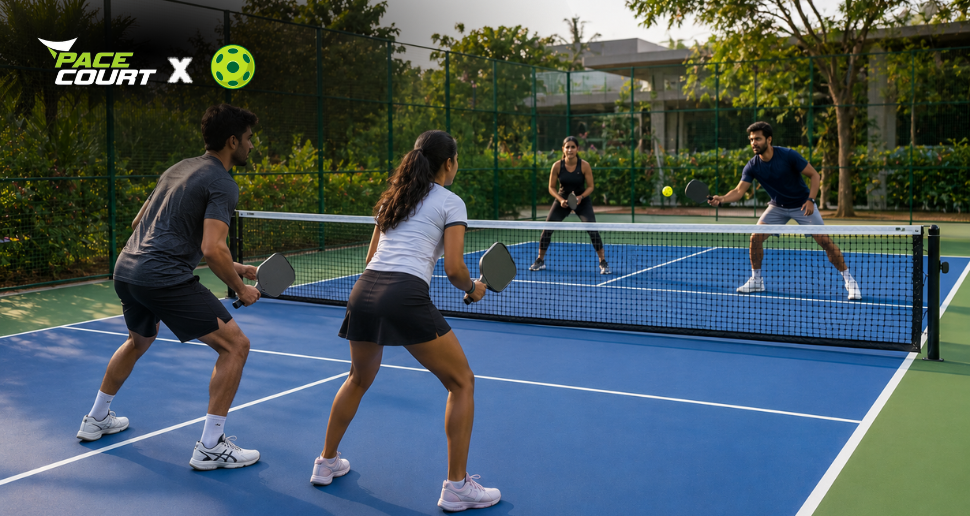
For anyone searching for pickleball court supply in Delhi, location can make project coordination easier, especially when the facility is in Delhi NCR. Pacecourt lists its Delhi address in Greater Kailash and provides a warehouse/support facility in Delhi. Its website also offers a warehouse-location service intended to help customers find nearby support. Still, don’t choose a supplier only because it is nearby.
Pickleball Court Supply in Delhi
Before ordering material, confirm:
- Exact flooring system
- Required quantity
- Surface condition
- Application method
- Coverage assumptions
- Delivery schedule
- Installer responsibility
- Warranty
- Maintenance requirements
For large projects, the material supplier and installation contractor should ideally coordinate directly.
How Much Does Pickleball Court Construction Cost in India?
There is no single fixed price for a pickleball court. Current published Indian market estimates vary considerably because some quotations include only the playing surface while others include civil work, fencing, lighting, drainage, and accessories. Recent industry guides publish ranges from roughly ₹2.5 lakh to ₹12 lakh depending on the project specification and site conditions. Instead of relying on one advertised figure, request a detailed BOQ.
Major Cost Factors
| Cost Factor | Why It Changes the Price |
| Site preparation | Excavation and difficult soil can increase civil costs |
| Base construction | New RCC work costs more than preparing a suitable existing base |
| Acrylic system | Basic and cushioned systems have different material requirements |
| Surface repairs | Cracks and damaged concrete need additional treatment |
| Drainage | Poor drainage may require new channels or site correction |
| Fencing | Height, posts, mesh and gates affect the budget |
| Lighting | Number and specification of fixtures affect cost |
| Net system | Commercial and recreational systems have different specifications |
| Location | Transport and labour costs vary by city |
| Number of courts | Multi-court projects may change mobilisation and infrastructure costs |
The cheapest quotation is rarely enough information to make a good decision. Compare the scope and specification, not just the final number.
Common Mistakes to Avoid
Choosing a Contractor Only on Price
A low initial quotation may exclude drainage, base repairs, fencing, lighting, or certain coating layers. Always compare the BOQ line by line.
Using a Generic Sports Court Layout
Pickleball has specific dimensions and markings. The 20 × 44 ft playing area and 7 ft non-volley zones should be measured accurately.
Ignoring Drainage
Outdoor courts need proper water management. Standing water can affect the surface and shorten maintenance intervals.
Applying Acrylic Over a Poor Base
A premium coating cannot hide serious structural or surface problems forever.
Selecting Colours Without Considering Visibility
Court colours should look attractive, but line visibility matters more. Choose combinations that provide clear contrast.
Not Checking the Net
The net should be installed and checked according to the intended standard. Centre and sideline heights are different.
Skipping Maintenance Planning
Ask about cleaning, recoating, crack repair, and future resurfacing before the court is installed.
How to Select the Best Pickleball Court Builder
Use this simple checklist before signing the contract:
- Inspect previous pickleball projects.
Ask for actual completed courts rather than only tennis or basketball references. - Request a written BOQ.
Every major construction and flooring component should be listed. - Check the base specification.
Ask what happens if cracks, settlement, or uneven areas are found. - Understand the flooring system.
Know exactly how many layers are being proposed and what each layer does. - Confirm the installation team.
Find out whether the manufacturer installs directly or through a local partner. - Clarify warranty terms.
Check what the warranty covers and what conditions can void it. - Discuss maintenance.
A professional builder should explain how the court should be cleaned and maintained. - Check final measurements.
The court should be inspected after line marking, net installation, and finishing.
Pickleball Court Installation Process
A professional installation normally follows a planned sequence.
Step 1: Site Survey
The team measures the available area and checks access, drainage, existing surfaces, and surrounding structures.
Step 2: Base Preparation
The base is constructed, repaired, or prepared according to the project specification.
Step 3: Surface Preparation
Dust, loose material, cracks, and surface defects are treated before coating.
Step 4: Acrylic Application
The specified acrylic layers are applied under suitable site conditions. Drying and curing times depend on the product, weather, humidity, and substrate.
Step 5: Colour Finishing
The selected playing and surrounding colours are applied according to the approved design.
Step 6: Line Marking
The pickleball layout is measured carefully before permanent lines are painted. Standard pickleball lines are generally 2 inches wide according to USA Pickleball guidance.
Step 7: Accessories
The builder installs the net, posts, fencing, gates, lighting, and other agreed accessories.
Step 8: Final Inspection
The completed court should be checked for dimensions, line accuracy, surface condition, drainage, net height, and overall finish.
How to Maintain an Acrylic Pickleball Court
Good maintenance is simple when started early.
Regularly remove:
- Dust
- Leaves
- Mud
- Standing water
- Organic debris
Use suitable cleaning methods recommended by the flooring manufacturer. Avoid harsh chemicals or cleaning equipment that can damage the coating.
Inspect the court regularly for:
- Hairline or structural cracks
- Surface peeling
- Drainage problems
- Faded areas
- Damaged line markings
- Loose fencing
- Net damage
If a crack or drainage issue appears, deal with the cause rather than simply painting over the affected area. Pacecourt also lists repair, resurfacing, and maintenance among its sports-court services, which can be useful when planning the full life cycle of an acrylic court.
Final Thoughts
A successful pickleball project starts with the right specification, not the lowest quotation. The court dimensions, base, drainage, pickleball court flooring, line marking, net, and surrounding safety space all need to work together.
If you’re comparing a pickleball court manufacturer in India, look for a company that can clearly explain its flooring system, provide technical documentation, support installation, and remain available for maintenance after handover.
Pacecourt is one option to evaluate, particularly for projects looking for synthetic acrylic flooring and nationwide installation support. Its published credentials include more than 15 years of experience, ITF certification, pickleball flooring solutions, and a pan-India dealer network.
For a business, school, club, residential society, or sports facility, the best approach is simple: inspect the site, define the specification, compare detailed BOQs, verify previous work, and choose the flooring system according to actual use. That process will give you a better court and a more predictable long-term investment.
Frequently Asked Questions
A pickleball court manufacturer supplies specialised court flooring materials and may also provide technical, design, installation, or dealer support. The exact scope differs between manufacturers.
A standard pickleball court is 20 feet × 44 feet for singles and doubles. The recommended total area should include additional space around the playing lines.
Acrylic flooring is a widely used option for permanent outdoor courts. The final choice should depend on the base, climate, usage, budget, and desired playing characteristics.
The cost varies according to civil work, flooring, site conditions, fencing, lighting, drainage, and accessories. Published 2026 estimates vary widely, so a site-specific BOQ is more useful than a generic price.
Yes. Existing tennis courts can be adapted for pickleball. The exact number of courts depends on the available court pad, safety space, orientation, and facility layout. USA Pickleball notes that a standard tennis court can accommodate multiple pickleball layouts when the available space and geometry permit.
The net is 36 inches high at the sidelines and 34 inches at the centre.
Pacecourt identifies itself as a synthetic acrylic sports flooring manufacturer and offers dedicated pickleball flooring and court installation solutions. Its published information also lists pickleball among its sports applications.
Pacecourt lists its Greater Kailash, New Delhi location and provides warehouse/dealer support for sports flooring projects. Buyers should confirm current stock, delivery, installation responsibility, and project requirements before ordering.
Stay Updated with Pacecourt
Discover expert insights, practical tips, and the latest industry updates from Pacecourt, covering sports flooring, tennis and multi-sport court construction, resurfacing, maintenance, court performance, and innovative sports infrastructure solutions.
Powered by Google's Preferred Sources feature