Pickleball is one of the fastest-growing sports in India right now and one of the most practical to set up at home. A backyard pickleball court requires less space than a tennis court, costs significantly less to build and can be ready to play on in days rather than weeks.
This guide covers everything you need to plan and build a proper pickleball court at home dimensions, surface options, realistic costs in India, what to check before construction and how to keep it in good shape long-term.
With Pacecourt, you can get professional acrylic sports flooring solutions for your backyard pickleball court, from surface preparation to final court finishing.
Do You Have Enough Space for a Backyard Pickleball Court?
This is the first question to consider before planning your backyard pickleball court.
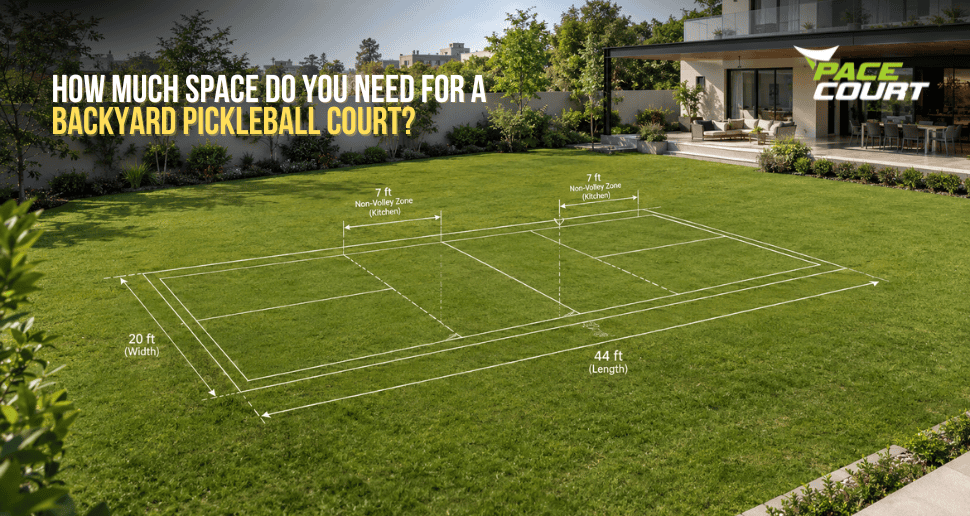
A standard pickleball court measures 20 feet wide × 44 feet long (approximately 6.1 m × 13.4 m). This is the playing area only, so additional space is required around the court to allow players to move safely and comfortably.
The recommended overall area is 30 feet × 60 feet (approximately 9.1 m × 18.3 m). This provides sufficient space behind the baselines and along the sidelines, helping players move freely without coming too close to walls or fences.
If you have around 1,800 sq. ft. of suitable, flat space, Pacecourt can help transform it into a professional acrylic pickleball court built for durability, smooth gameplay, and long-term outdoor use. From base preparation and acrylic flooring to court finishing, we provide complete sports flooring solutions.
Have the space? Build your professional acrylic pickleball court with Pacecourt.
Contact us today to get started.
Quick space check:
| Court Element | Measurement |
| Playing area | 20 ft × 44 ft (6.1 m × 13.4 m) |
| Recommended total area | 30 ft × 60 ft (9.1 m × 18.3 m) |
| Minimum total area (recreational play) | 24 ft × 54 ft |
| Height clearance (for rooftop/covered courts) | Minimum 20 ft |
If your space is slightly smaller, you can still build a recreational court with modified run-off areas; it will work well for casual play and practice, just not for formal tournaments.
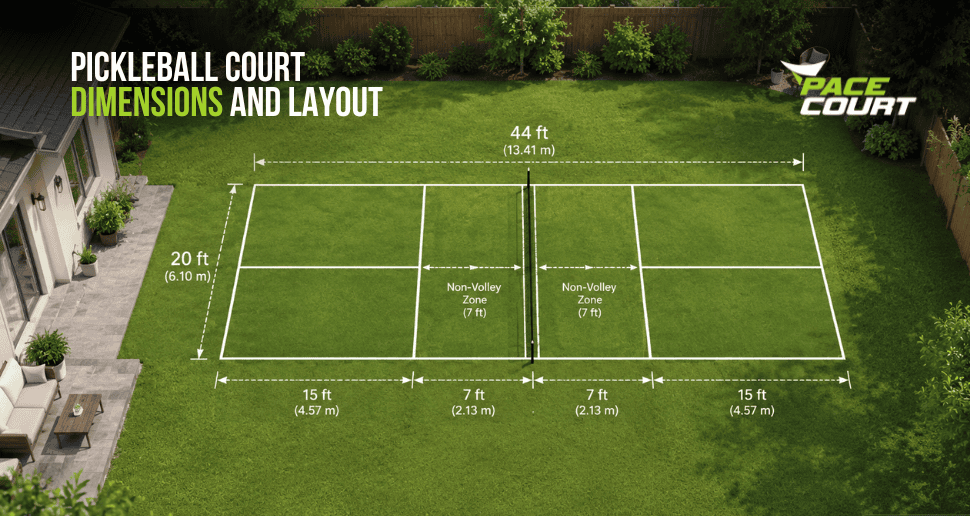
Pickleball Court Dimensions and Layout
Once you have confirmed the space, the court layout is straightforward.
Key court lines to mark:
- Baselines the end lines running parallel to the net
- Sidelines the long boundary lines on each side
- Centreline divides each side into two service boxes
- Non-Volley Zone (Kitchen) line 7 feet from the net on each side; players cannot volley the ball while standing in this zone
- Net position exactly at the centre of the 44-foot length
Court orientation: Align the court north-south wherever possible. This reduces direct sun glare during daytime play and improves visibility for both players.
Choosing the Right Surface for a Backyard Pickleball Court
The surface is the most important decision you will make. It directly affects how the ball bounces, how safe it is to play on, how long the court lasts and how much maintenance it needs especially in India’s climate.
Concrete Base
A concrete base (PCC Plain Cement Concrete) is the standard and most recommended foundation for backyard pickleball courts in India. It is stable, long-lasting, handles heavy rain without shifting and supports the surface coating above it properly.
The concrete base should be properly graded with a slight slope for drainage. A flat but undrained court will develop water pooling and eventually surface damage.
Upgrade Your Sports Court Today
Get premium synthetic acrylic flooring designed for durability, grip, and performance.
Get Free ConsultationAcrylic Sports Flooring The Right Surface for Indian Conditions
On top of the concrete base, acrylic synthetic sports flooring is the most practical and widely used surface for pickleball courts in India, and for good reason.
Here is why acrylic works well in Indian backyard conditions:
- UV and heat resistance acrylic coatings designed for outdoor use handle India’s intense summer sun without fading or softening
- Consistent ball bounce the textured surface delivers predictable, regulation-standard bounce every time
- Grip and slip resistance important for the quick lateral movements pickleball demands; reduces injury risk significantly
- Waterproof water drains off properly after rain and the surface dries quickly
- Low maintenance no special treatment needed; regular sweeping and occasional washing is enough
- Colour options available in multiple colours; standard pickleball courts typically use green or blue playing area with contrasting line colours
A properly applied multi-layer acrylic system on a good concrete base can last 8 to 12 years before resurfacing is needed.
What About Asphalt?
Asphalt is cheaper to lay initially but is not well-suited to Indian weather in the long term. It softens in extreme heat, develops cracks more quickly and needs resurfacing every few years. For a permanent backyard court, concrete with acrylic coating is the better investment.
What About Interlocking Court Tiles?
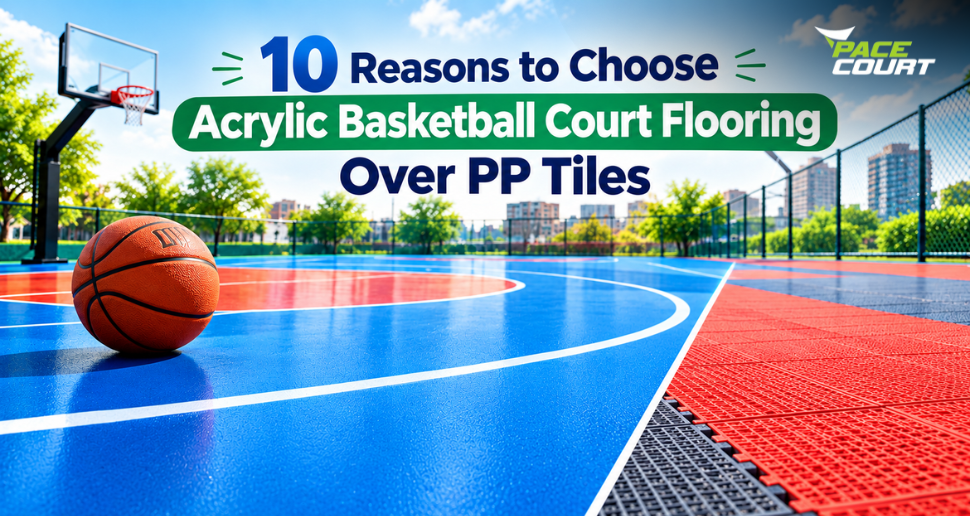
Modular PP tiles are a quick-install option that requires no base preparation. They are easy to dismantle and move. However, they do not deliver the same ball bounce consistency as acrylic on concrete, can shift over time and are generally better suited for temporary setups than permanent backyard courts.
Surface comparison at a glance:
| Surface Type | Durability | Ball Bounce | Heat/UV Performance | Maintenance | Best For |
| Acrylic on concrete | Very high | Excellent | Excellent | Low | Permanent backyard courts |
| Asphalt | Moderate | Good | Average | Moderate | Budget installs (short term) |
| Interlocking tiles | Moderate | Moderate | Average | Low | Temporary/portable setups |
For a permanent backyard pickleball court in India, acrylic flooring on a concrete base is the recommended choice.
- Pacecourt manufactures acrylic synthetic sports surface materials specifically for outdoor court applications. Their materials are designed for Indian weather conditions and are available with fast delivery and no minimum order requirement useful when you are sourcing for a single residential court.
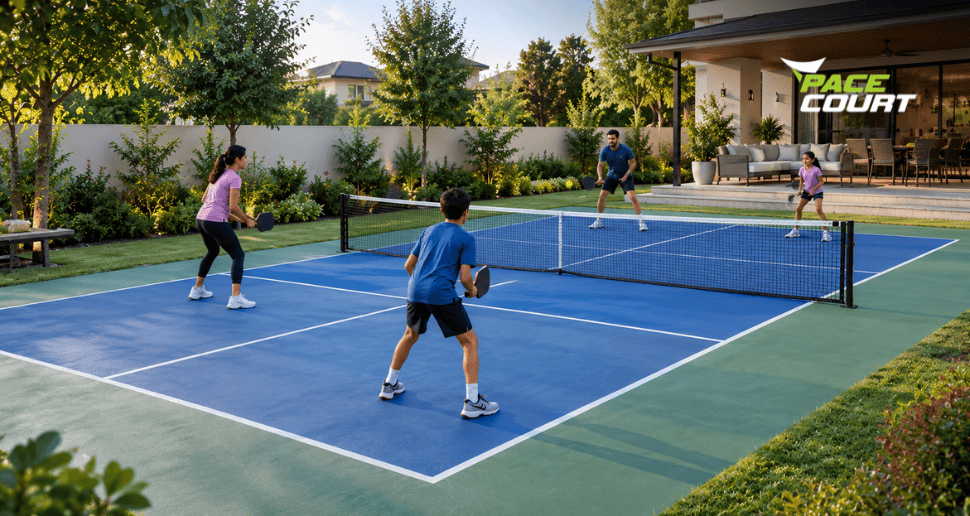
Line Marking
Once the acrylic surface has cured, court lines are painted or taped on top. Standard pickleball lines are 2 inches wide and painted in white for maximum visibility against the coloured court surface.
Lines to mark (in order):
- Sidelines (two long lines, 44 feet each)
- Baselines (two short lines, 20 feet each)
- Non-volley zone lines (7 feet from net on both sides)
- Centrelineation (from the non-volley zone line to the baseline on both sides)
Use a measuring tape and chalk line to ensure straight, accurate lines before painting.
Net Setup
A regulation pickleball net is:
- 36 inches high at the sideline posts
- 34 inches high at the centre
- Portable net: Easy to set up and remove. Good for courts that are used for other purposes as well. A decent portable net costs between ₹3,000 and ₹8,000.
- Permanent net system: Posts are set into concrete sleeves at fixed positions. More stable and suitable for a dedicated court. Recommended if the court will be used regularly.
Optional Additions Worth Considering
These are not mandatory but make the court more functional and enjoyable:
- Fencing or boundary wall keeps balls within the court and reduces time spent chasing them. A simple chain-link fence or a low wall on two ends works well.
- Windscreens Useful if your backyard is exposed to strong winds; reduces interference during play.
- Court lighting LED floodlights at four corners allow evening play. Essential if you want year-round use from the court.
- Shade structure A pergola or shade net along one side of the court makes daytime play comfortable in summer.
- Multi-sport line markings If the space allows, you can add badminton or basketball markings to the same surface, making the court multi-purpose.
Backyard Pickleball Court Cost in India
Costs vary depending on your location, site condition, surface quality and add-ons chosen.
Upgrade Your Sports Court Today
Get premium synthetic acrylic flooring designed for durability, grip, and performance.
Get Free ConsultationApproximate cost breakdown for a standard backyard pickleball court in India:
| Component | Estimated Cost Range |
| Site preparation and levelling | ₹20,000 – ₹60,000 |
| Concrete base (PCC) | ₹80,000 – ₹1,50,000 |
| Acrylic sports flooring (multi-layer) | ₹70,000 – ₹90,000 |
| Line marking | ₹700 – ₹1,000 |
| Net (portable) | ₹3,000 – ₹8,000 |
| Net (permanent with posts) | ₹15,000 – ₹20,000 |
| Fencing (basic) | ₹10,000 – ₹20,000 |
| Lighting (LED, 4 corners) | ₹10,000 – ₹30,000 |
| Total (basic court, no lighting/fencing) | ₹1,00,000 – ₹1,50,000 |
| Total (complete court with fencing + lighting) | ₹1,50,000 – ₹3,00,000 |
These are indicative ranges. Metro city projects will typically cost more than Tier-2 or Tier-3 city projects due to labour and logistics.
Ready to Build Your Backyard Pickleball Court?
A well-built backyard pickleball court is a long-term asset that gets used daily and holds its condition for years with minimal effort.
Getting the surface right is the most important part of the build. Pacecourt manufactures high-quality acrylic synthetic sports surface materials for pickleball courts across India. Whether you are building one court at home or multiple courts at a club or facility, Pacecourt offers fast delivery, expert guidance and no minimum order requirement.
Get in touch with Pacecourt to discuss materials for your court project. Enquiry Now
Maintenance: Keeping Your Backyard Court in Good Condition
An acrylic pickleball court is low-maintenance by nature. Here is what the routine looks like:
- Daily/weekly: Sweep debris, leaves and dust with a soft-bristle broom or blower
- Monthly: Wash the surface with water; remove any moss or algae growth in shaded areas
- Annually: Inspect the surface for minor cracks or coating wear, especially after monsoon season
- Every 5–8 years: Recoat the acrylic surface layer; this is significantly cheaper than rebuilding and restores grip, appearance and bounce quality
Avoid using harsh chemicals or abrasive materials on the surface. Keep the drainage clear so water does not pool on the court after rain.
Common Mistakes to Avoid
Many first-time court builders run into the same avoidable problems:
- Skipping proper drainage design pooling water damages the base and surface faster than anything else
- Using poor-quality acrylic material a thin or low-quality coating peels, fades and loses grip within a couple of years
- Not curing the concrete base long enough the base must cure fully (minimum 28 days) before the acrylic coating is applied; rushing this causes adhesion failure
- Getting dimensions wrong even small errors in the non-volley zone or central line placement affect gameplay and cannot be easily corrected after painting
- No provision for lighting evening play extends your court’s daily use significantly; it is easier and cheaper to plan conduit during construction than to add it later
Frequently Asked Questions
Can I build a pickleball court on a rooftop or terrace?
Yes, you can build one if the structure has sufficient load capacity, proper waterproofing, and at least 20 feet of overhead clearance.
What is the minimum land size needed for a backyard pickleball court?
A minimum area of approximately 24 × 54 feet is suitable, while 30 × 60 feet is recommended for comfortable play.
How long does it take to build a backyard pickleball court?
A complete backyard pickleball court typically takes around 6–8 weeks, including base construction, curing, acrylic flooring, and finishing.
Can the same court be used for other sports?
Yes, with additional line markings, an acrylic pickleball court can also be used for badminton, tennis practice, and other recreational activities.
Do I need permission to build a pickleball court in my backyard?
It depends on local municipal regulations and housing society rules, so check with the relevant authorities before construction.
How do I choose an acrylic flooring material for my pickleball court?
Choose UV-stabilised, textured acrylic flooring designed for outdoor sports, preferably a durable multi-layer system such as Pacecourt’s acrylic sports surface.
Stay Updated with Pacecourt
Discover expert insights, practical tips, and the latest industry updates from Pacecourt, covering sports flooring, tennis and multi-sport court construction, resurfacing, maintenance, court performance, and innovative sports infrastructure solutions.
Powered by Google's Preferred Sources feature