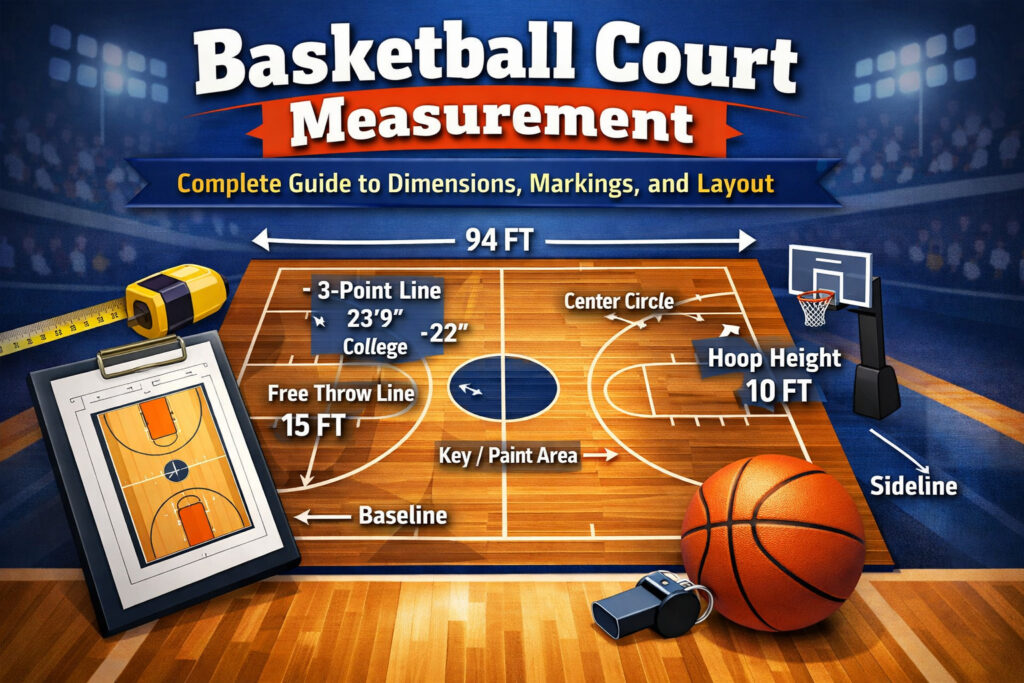
Basketball is one of the most popular sports worldwide, and whether you’re building a professional arena, school playground, or indoor sports facility, understanding basketball court dimensions in meters is essential. Accurate court size ensures fair play, safety, and compliance with international standards.
This detailed guide explains FIBA, NBA, and school-level basketball court dimensions, markings, and important construction considerations.
Table of contents
- Standard Basketball Court Dimensions in Meters
- NBA Basketball Court Dimensions (USA Standard)
- School & Recreational Basketball Court Dimensions
- Key Basketball Court Markings (Meters)
- Basketball Court Flooring Requirements
- Space Required Beyond the Court
- Indoor vs Outdoor Basketball Court Dimensions
- Basketball Court Dimensions for India
- Basketball Court Construction Guidelines
- Basketball Court Flooring Thickness & Layers
- Basketball Court Flooring Cost in India (Approximate)
- Drainage & Slope Requirements for Outdoor Courts
- Lighting Requirements for Basketball Courts
- Basketball Court Maintenance Tips
- Common Mistakes to Avoid While Building a Basketball Court
- Indoor Basketball Court Ventilation Requirements
- Why Professional Installation Matters
- Conclusion
Standard Basketball Court Dimensions in Meters
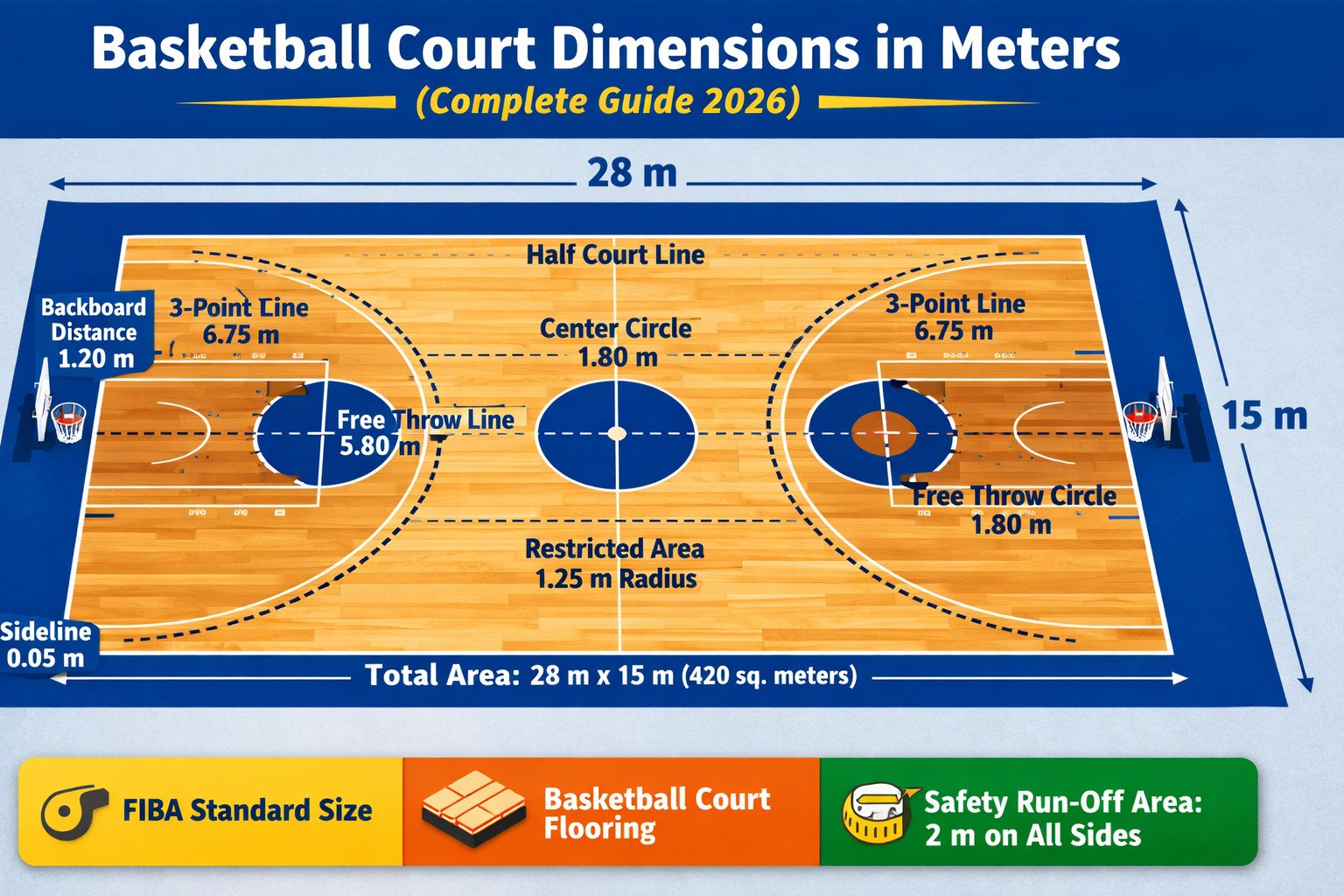
FIBA Basketball Court Dimensions (International Standard)
FIBA (International Basketball Federation) standards are followed in most countries, including India.
| Feature | Dimension (Meters) |
|---|---|
| Court Length | 28 meters |
| Court Width | 15 meters |
| Total Playing Area | 420 sq. meters |
| Centre Circle Radius | 1.80 meters |
| Free Throw Line Distance | 5.80 meters |
| Free Throw Circle Radius | 1.80 meters |
| Backboard Distance from Baseline | 1.20 meters |
📌 Best suited for: International tournaments, professional academies, and advanced training facilities.
NBA Basketball Court Dimensions (USA Standard)
| Feature | Dimension (Meters) |
|---|---|
| Court Length | 28.65 meters |
| Court Width | 15.24 meters |
| Centre Circle Radius | 1.83 meters |
| Free Throw Line Distance | 5.79 meters |
📌 Slightly larger than FIBA courts and mainly used in the United States.
School & Recreational Basketball Court Dimensions
For schools and community courts, smaller dimensions are often used:
| Level | Length (m) | Width (m) |
|---|---|---|
| School Level | 24 – 26 | 13 – 14 |
| Recreational | Custom | Custom |
These courts are easier to fit into limited spaces while maintaining gameplay quality.
Key Basketball Court Markings (Meters)
Three-Point Line (FIBA): 6.75 meters from the basket
Restricted Area Radius: 1.25 meters
No-Charge Semi-Circle Radius: 1.25 meters
Sideline Width: 0.05 meters
Proper markings are critical for official matches and training accuracy.
Basketball Court Flooring Requirements
Choosing the right basketball court flooring is just as important as correct dimensions. Flooring impacts player safety, ball bounce, and long-term durability.
Best Flooring Options:
- Acrylic Flooring – Outdoor courts, weather-resistant
- Synthetic PU Flooring – Indoor courts, shock absorption
- Modular Interlocking Tiles – Easy installation & maintenance
- Wooden (Maple) Flooring – Professional indoor courts
📌 Always ensure flooring provides anti-skid surface, shock absorption, and consistent bounce.
Space Required Beyond the Court
For safe movement and official play:
- Minimum Run-Off Area: 2 meters on all sides
- Ideal Total Area Needed: Around 32 × 19 meters
This space accommodates referees, player benches, and audience movement.
Indoor vs Outdoor Basketball Court Dimensions
| Type | Dimension Standard |
|---|---|
| Indoor Court | FIBA / NBA exact size |
| Outdoor Court | Same size but flexible based on space |
Outdoor courts may allow minor size adjustments, but markings should remain accurate.
Basketball Court Dimensions for India
In India, FIBA dimensions (28 × 15 meters) are widely accepted for:
- Schools & colleges
- Sports academies
- Government sports complexes
- Private clubs
These dimensions ensure compatibility with national and international tournaments.
Basketball Court Construction Guidelines
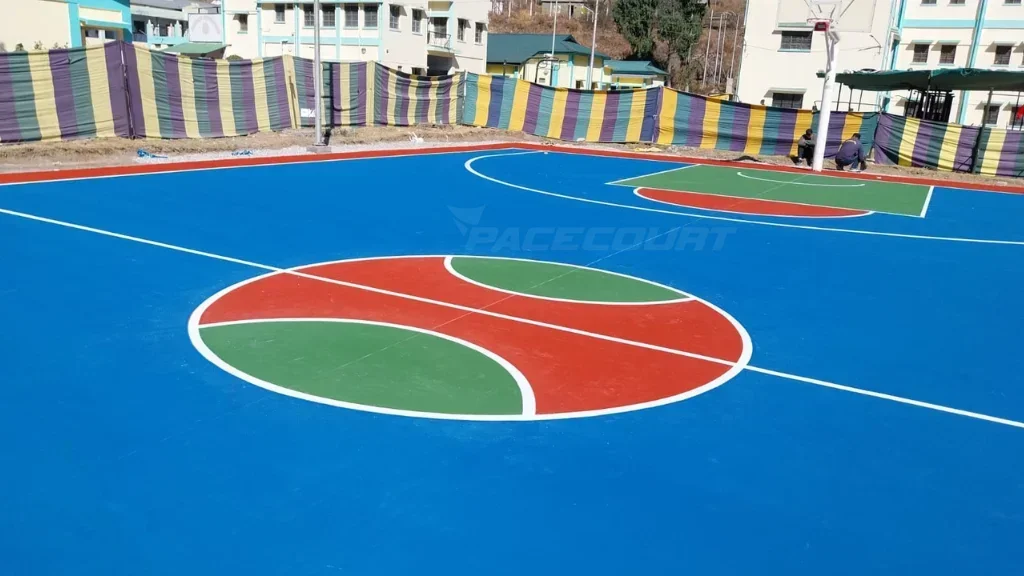
Building a basketball court requires more than just correct dimensions. Proper planning, material selection, and execution ensure long-term performance and safety.
Step-by-Step Basketball Court Construction Process
- Site Preparation
- Level the ground properly
- Ensure good drainage to avoid water accumulation
- Compact the base using stone aggregate or RCC (for indoor courts)
- Base Layer Construction
- Outdoor courts typically use PCC or asphalt base
- Indoor courts require RCC flooring with perfect leveling
- Surface Application
- Apply selected basketball court flooring system
- Allow curing time before markings
- Line Marking
- Use durable, non-slip sports paint
- Follow FIBA or NBA marking guidelines strictly
Basketball Court Flooring Thickness & Layers
A professional basketball court usually consists of multiple layers:
| Layer | Purpose |
|---|---|
| Base Layer | Structural strength |
| Cushion Layer | Shock absorption |
| Surface Layer | Grip & ball bounce |
| Top Coat | UV & wear resistance |
This layered system protects players from injuries and increases flooring life.
Basketball Court Flooring Cost in India (Approximate)
| Flooring Type | Price Range (₹/sq ft) |
|---|---|
| Acrylic Flooring | ₹150 – ₹250 |
| Synthetic PU Flooring | ₹300 – ₹600 |
| Modular Tiles | ₹350 – ₹700 |
| Wooden Flooring | ₹700 – ₹1,500 |
💡 Cost depends on location, surface preparation, and total court area.
Drainage & Slope Requirements for Outdoor Courts
Outdoor basketball courts must have proper water flow:
- Recommended slope: 1:100
- Prevents water logging
- Increases flooring lifespan
- Ensures consistent playing conditions
Ignoring drainage can damage basketball court flooring within a few seasons.
Lighting Requirements for Basketball Courts
Proper lighting is essential for visibility and professional play.
Recommended Lighting Levels:
- Recreational Courts: 200–300 lux
- Training Courts: 300–500 lux
- Professional Matches: 750–1,000 lux
LED sports lights are preferred due to energy efficiency and uniform illumination.
Basketball Court Maintenance Tips
Regular maintenance keeps the court safe and visually appealing.
Maintenance Best Practices:
- Daily dust removal
- Weekly washing (outdoor courts)
- Inspect cracks and surface wear
- Recoat acrylic surfaces every 4–5 years
High-quality basketball court flooring requires minimal maintenance but delivers maximum durability.
Common Mistakes to Avoid While Building a Basketball Court
❌ Incorrect court dimensions
❌ Poor base leveling
❌ Low-quality flooring materials
❌ Improper line marking
❌ No drainage planning
Avoiding these mistakes saves repair costs and ensures better play experience.
Indoor Basketball Court Ventilation Requirements
Indoor courts need:
- Proper air circulation
- Temperature control
- Moisture management
Poor ventilation can damage wooden and synthetic basketball court flooring over time.
Why Professional Installation Matters
Hiring experienced sports flooring contractors ensures:
- Accurate dimensions
- Long-lasting flooring
- Warranty protection
- Compliance with FIBA standards
Professional installation directly impacts performance and player safety.
Conclusion
A perfectly designed basketball court combines accurate dimensions, proper markings, high-quality basketball court flooring, and expert installation. Whether you are building a school court, academy, or professional sports arena, following international standards ensures durability, safety, and better gameplay.
Investing in the right flooring and construction approach not only enhances performance but also reduces long-term maintenance costs.