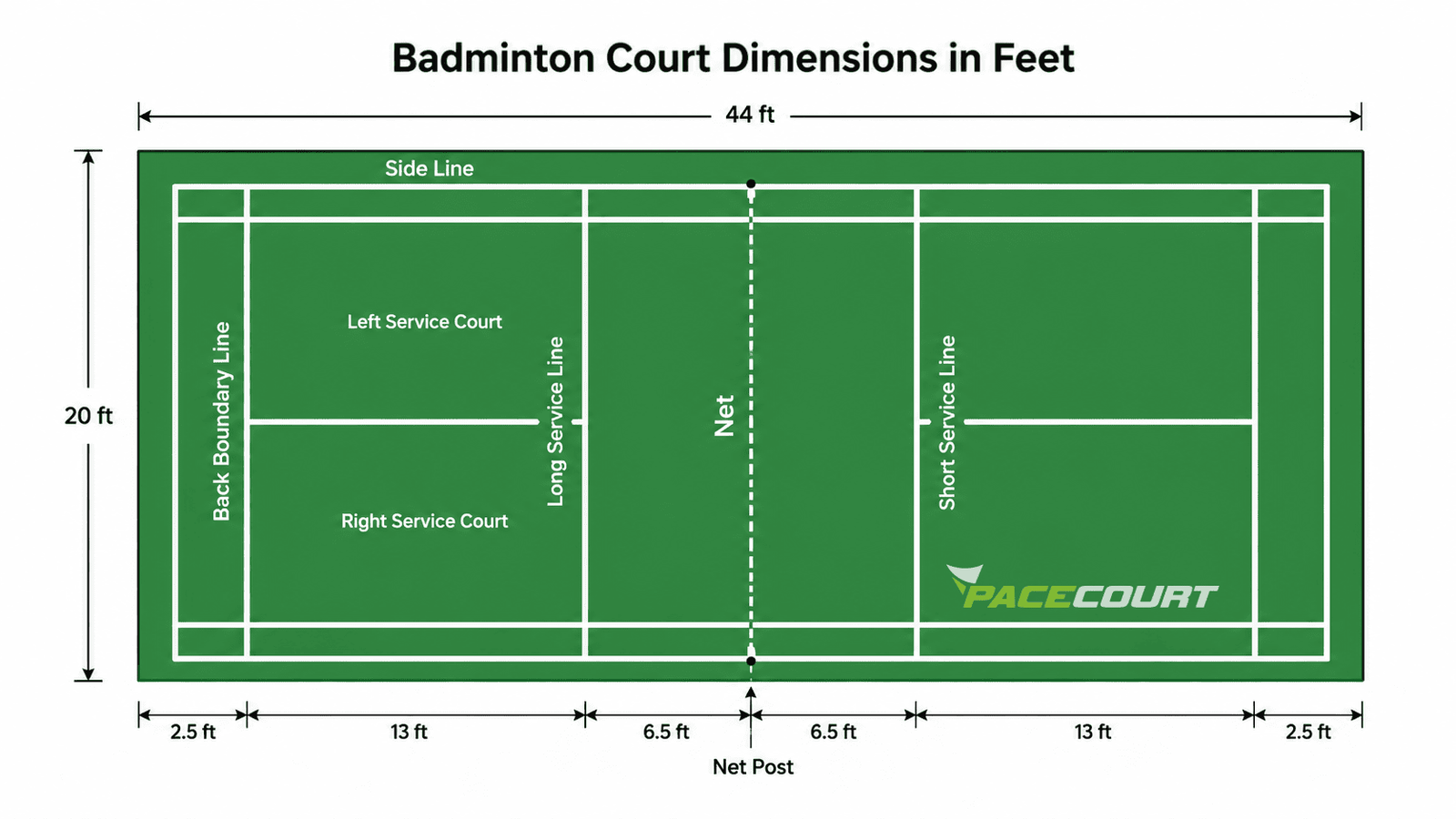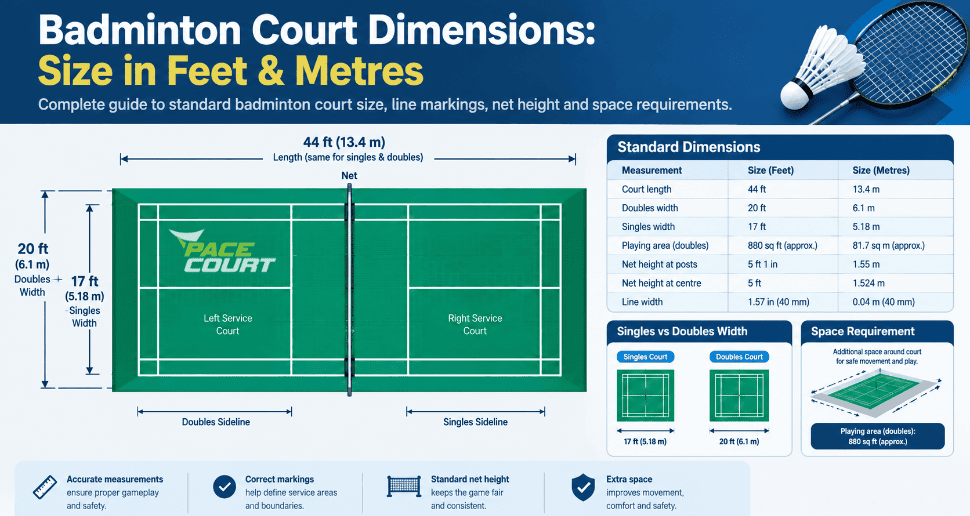
The standard badminton court dimensions are 44 feet × 20 feet (13.4 × 6.1 metres) for doubles and 44 feet × 17 feet (13.4 × 5.18 metres) for singles. The court length remains the same, while the playing width changes depending on the match format.
If you are planning to mark a badminton court for a school, sports academy, club or residential facility, you also need to understand the service lines, net height and additional space required around the playing area.
In this guide, we explain official badminton court dimensions in feet and metres, the difference between singles and doubles, court markings, net measurements and key considerations when planning a badminton court.
Table of contents
- What Are the Standard Badminton Court Dimensions?
- Badminton Court Size in Feet and Meter’s
- Indoor vs Outdoor Badminton Court
- How to Measure and Mark a Badminton Court Diagram
- Badminton Court Flooring Options
- Conclusion
- Frequently Asked Questions
- 1. What are the standard badminton court dimensions?
- 2. What is the badminton court size in metres?
- 3. What is the difference between singles and doubles court dimensions?
- 4. What is the standard badminton net height?
- 5. How much space is required to build a badminton court?
- 6. What is the standard badminton court line width?
What Are the Standard Badminton Court Dimensions?
Every official badminton court follows a precise set of measurements established by the Badminton World Federation (BWF). These standards ensure that every game, whether played in a local gym or an international arena, is contested on an identical playing field. Understanding these dimensions is the first step to mastering the court.
The full court, used for doubles play, measures 13.4 meters (44 feet) long and 6.1 meters (20 feet) wide. This rectangular area forms the complete boundary for the game. For singles matches, the court becomes slightly narrower. While the length remains the same at 13.4 meters, the width is reduced to 5.18 meters (17 feet).
Understanding the Lines
The lines marked on the court are crucial for gameplay, dictating service areas and boundaries. All lines should be 40mm wide and are typically colored white or yellow for clear visibility against the court surface.
- Baselines: These are the back lines at each end of the court.
- Sidelines: The court has two sets of sidelines. The outer lines are for doubles play, and the inner lines are for singles play.
- Center Line: This line runs down the middle of the court, dividing it into two equal service boxes on each side.
- Service Lines: There are two service lines. The short service line is positioned 1.98 meters (6.5 feet) from the net. The long service line, which is only used for doubles serves, is located 0.76 meters (2.5 feet) from the baseline.
Have Space for a Badminton Court? Let’s Measure It!
Measure your available space and share the dimensions with Pacecourt. Our team will help you determine how much material you need and how you can build a badminton court within your available area.
Click Now: Get Your Court Material Estimate

Badminton Court Size in Feet and Meter’s
Beyond the basic boundary lines, a badminton court is divided into specific areas that are vital to gameplay. Knowing these zones helps players understand positioning, serving rules, and strategy.
Singles vs Doubles Badminton Court Dimensions
The service areas define where a player must stand when serving and where the shuttlecock must land to be considered a valid serve. These areas differ for singles and doubles matches.
- Singles Service Area: This is a long, narrow box defined by the center line, the singles sideline, the short service line, and the baseline.
- Doubles Service Area: This area is wider and shorter. It is marked by the center line, the doubles sideline, the short service line, and the long service line for doubles.
The short service line is located 1.98 meters (6.5 feet) from the net and marks the closest point a serve can land. The long service line, used only in doubles, is 0.76 meters (2.5 feet) from the baseline.
| Measurement | Official size |
|---|---|
| Court length | 44 ft / 13.40 m |
| Doubles width | 20 ft / 6.10 m |
| Singles width | 17 ft / 5.18 m |
| Playing area for doubles | 880 sq ft approx. |
| Net height at posts | 5 ft 1 in / 1.55 m |
| Net height at centre | 5 ft / 1.524 m |
Net and Net Posts
The net is the central obstacle in badminton and must conform to specific height regulations. The top of the net should be 1.55 meters (5 feet 1 inch) high from the court surface at the sidelines and droop slightly to 1.524 meters (5 feet) at the center. The net itself is typically made from a dark-colored cord of a fine, uniform thickness, with a mesh between 15mm and 20mm. It is held taut by two net posts placed on the doubles sidelines.
Clearance Space
Safety is a priority in a fast-paced sport like badminton. For this reason, it is recommended to have a clear, unobstructed space around the court. A minimum clearance of 2 meters (6.5 feet) around the entire court is advised to allow players to move freely and safely without risk of collision or injury.

Indoor vs Outdoor Badminton Court
While the official dimensions of a badminton court remain the same, the environment in which it is set up can dramatically change the game. The choice between an indoor and an outdoor court comes with distinct advantages and challenges that affect everything from the playing surface to the flight of the shuttlecock.
Indoor Courts: The Professional Standard
Professional badminton is played exclusively indoors for good reason. Indoor facilities offer a controlled environment that ensures consistency and fairness in play.
- Flooring: The most common surfaces are sprung wooden floors or synthetic mats laid over a hard surface. These materials are designed to absorb shock, reducing the risk of injury and providing good grip for quick, multidirectional movements.
- Lighting: Consistent, overhead lighting eliminates shadows and glare, allowing players to track the shuttlecock clearly at all times.
- No External Factors: The biggest advantage of an indoor court is the absence of wind and rain. Even a slight breeze can alter the shuttlecock’s trajectory, making controlled shots nearly impossible.
Outdoor Courts: Casual and Accessible Fun
Outdoor courts offer a more accessible way for people to enjoy badminton, whether in a park, backyard, or at the beach. However, they introduce several variables that players must contend with.
- Flooring: Outdoor surfaces are typically concrete, asphalt, or even grass. These surfaces are harder on the joints and can be uneven, increasing the risk of slips and falls.
- Weather Conditions: This is the most significant challenge for outdoor play.
- Wind: The lightweight shuttlecock is highly susceptible to wind, which can make it difficult to judge shots and maintain rallies.
- Sunlight: Bright sunlight can create glare, making it hard to see the shuttlecock, especially during high clears and smashes.
- Durability: Outdoor setups require more durable equipment. Players often use heavier, plastic shuttlecocks instead of feathered ones because they are less affected by wind and last longer on rougher surfaces.
Ultimately, while an indoor court provides the ideal conditions for competitive and technical play, an outdoor court is a great option for recreational games. Understanding how these environmental factors impact gameplay allows players to adapt their strategy and enjoy the sport in any setting.

How to Measure and Mark a Badminton Court Diagram
The specific measurements of a badminton court are more than just lines on the ground; they are the foundation of the game’s integrity and strategic depth. Standardized dimensions ensure that every match, from a friendly neighborhood game to an Olympic final, is played under the same conditions, guaranteeing a level playing field for all competitors. This consistency is crucial for fair play.
Players can use their knowledge of the court dimensions to gain a significant advantage. Here are a few tips:
- Master Your Serves: Target the corners of the service box. A serve that lands just inside the line is much harder to return effectively than one aimed at the center. Practice hitting both the short and long service lines to keep your opponent guessing.
- Control the Net: Knowing the short service line is 1.98 meters away helps you judge when to play a tight net shot versus a lift. Luring an opponent close to the net opens up the entire backcourt for a clear or smash.
- Use the Full Court: In singles, force your opponent to move from corner to corner, exploiting the full length and width of the court. In doubles, use the extra width to create sharp angles and find gaps between the players.
- Improve Your Footwork: Efficient movement is about covering the court in the fewest steps. By internalizing the court’s dimensions, you can anticipate where the shuttle will land and position yourself for the optimal return shot, conserving energy and staying on the offensive.
Badminton Court Flooring Options
Creating your own Synthetic acrylic badminton court can be a rewarding project, whether it’s a temporary setup in your backyard or a more permanent installation. Accuracy is key to ensuring your court meets official standards and provides a fair playing surface. This guide will walk you through the process, from gathering materials to marking the final lines.
Tools and Materials Needed
Before you begin, gather the right equipment to make the job easier and more precise. You will need:
- Measuring Tape: A long tape measure (at least 20 meters or 50 feet) is essential for accuracy.
- Stakes or Pegs: Four stakes to mark the corners of the court.
- String or Twine: To create straight guidelines between your stakes.
- Marking Material: Depending on your surface and permanence, you can use chalk, court-marking paint, or specialized court tape.
- Right Angle Tool: A carpenter’s square or the 3-4-5 triangle method (measuring 3 units down one side and 4 units down the adjacent side should result in a 5-unit diagonal) will ensure your corners are perfect 90-degree angles.

Step-by-Step Marking Guide
- Establish a Baseline: Start by marking one of the 6.1m (20ft) baselines. Place a stake at each end. This will be the foundation for the rest of your court.
- Create Right Angles: From one of the baseline stakes, run your measuring tape 13.4m (44ft) down the length of the court to form a sideline. Use your right-angle tool to ensure the corner is a perfect square. Place your third stake here.
- Mark the Fourth Corner: From the second baseline stake, measure 13.4m down the other sideline. From the third stake, measure 6.1m across. The point where these two measurements meet is your fourth corner. Place your final stake here.
- Check for Squareness: Before marking, double-check that your court is a perfect rectangle by measuring the diagonals. The distance between opposite corners should be identical. If they are not, adjust your stakes until they match.
- Mark the Boundary Lines: Run string tightly between the stakes. This will give you a straight edge to follow. Carefully apply your chalk, paint, or tape along the strings to create the outer boundary lines (for doubles).
- Add the Inner Lines: Once the main rectangle is set, you can measure and mark all the interior lines, including the singles sidelines, the center line, and the short and long service lines.
Common Mistakes to Avoid
A small error in measurement can impact gameplay. Watch out for these common pitfalls:
- Incorrect Dimensions: Always double-check your measurements before making any permanent marks.
- Uneven Lines: Use a taut string as a guide to ensure your lines are perfectly straight.
- Non-Square Corners: Failing to create true 90-degree corners will skew the entire court’s geometry.
- Forgetting Clearance Space: Remember to set up your court in an area with at least 2 meters of clear space around all sides for safe movement. Poor lighting can also lead to accidents, so ensure the area is well-lit if you plan to play in the evening.
Conclusion
From the specific height of the net to the exact width of the sidelines, every line on a badminton court has a purpose. Understanding these official dimensions is fundamental to appreciating the game’s strategic depth. We’ve covered the standard measurements for singles and doubles, explored the key areas that dictate play, and contrasted the controlled environment of an indoor court with the unpredictable nature of an outdoor one.
Now you have the knowledge to not only improve your own gameplay by using the court to your advantage but also to accurately set up a court of your own. Grasping these details can transform how you play, turning a simple game into a tactical challenge.
What’s the most surprising thing you learned about badminton court dimensions? Share your thoughts in the comments below, or if you found this guide helpful, pass it along to a fellow player
Frequently Asked Questions
1. What are the standard badminton court dimensions?
A standard badminton court measures 44 feet long and 20 feet wide for doubles, while singles courts are 17 feet wide.
2. What is the badminton court size in metres?
A standard badminton court is 13.4 metres long and 6.1 metres wide for doubles.
3. What is the difference between singles and doubles court dimensions?
Singles courts are 17 feet wide, while doubles courts are 20 feet wide; both have the same length of 44 feet.
4. What is the standard badminton net height?
The badminton net is 5 feet 1 inch (1.55 metres) high at the posts and 5 feet (1.524 metres) at the centre.
5. How much space is required to build a badminton court?
The playing area requires 880 square feet for doubles, with additional space needed around the court for safe movement.
6. What is the standard badminton court line width?
All badminton court boundary and marking lines should be 40 mm (1.57 inches) wide.