Home > Tennis court construction > Tennis Court Construction in India 2026: Cost, Design & Guide

Tennis Court Construction in India 2026: Cost, Design & Guide

Tennis Court Construction

The demand for Tennis Court Construction in India has grown rapidly over the last few years. Schools, sports academies, residential communities, clubs, resorts, and government sports facilities are investing in modern tennis courts to promote sports participation and professional training.

A well-constructed tennis court provides consistent ball bounce, player safety, durability, and low maintenance. However, achieving these benefits requires proper planning, surface selection, drainage design, and professional installation.

Upgrade Your Sports Court Today

Get premium synthetic acrylic flooring designed for durability, grip, and performance.

Get Free Consultation

This guide explains everything about tennis court construction in India in 2026, including court dimensions, flooring options, construction process, costs, maintenance requirements, and key factors that influence long-term performance.

Why Tennis Court Construction Is Growing in India

India’s sports infrastructure sector continues to expand due to increasing awareness of fitness, government support for sports development, and rising participation in tennis at grassroots and professional levels.

Modern tennis courts are now being constructed in:

  • Sports academies
  • Educational institutions
  • Housing societies
  • Luxury villas
  • Clubs and resorts
  • Corporate campuses
  • Government sports complexes

The availability of advanced synthetic acrylic flooring systems has also made tennis courts more durable and suitable for India’s diverse weather conditions.

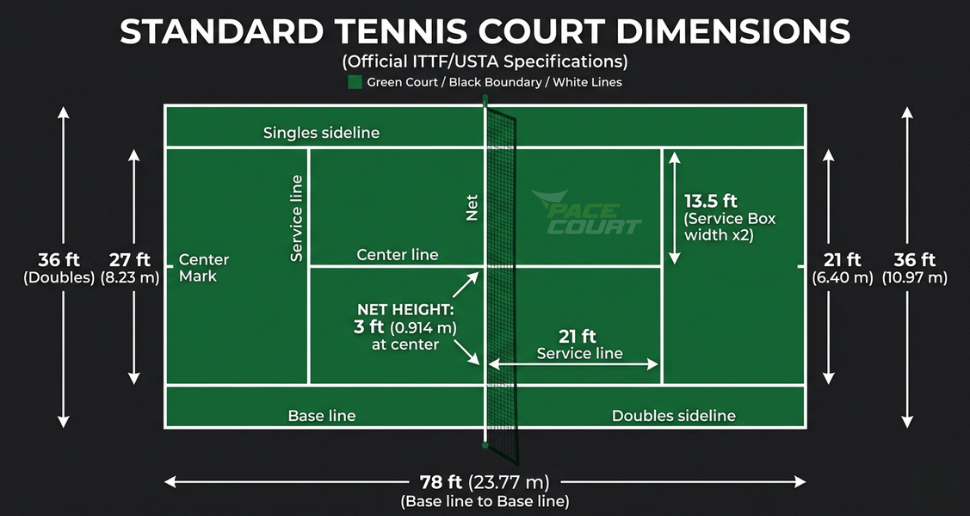
Standard Tennis Court Dimensions

Proper dimensions are essential for professional-level play and compliance with international standards.

Tennis Court Size Specifications

ComponentDimensions
Total Court Length23.77 meters
Singles Court Width8.23 meters
Doubles Court Width10.97 meters
Service Line Distance6.40 meters
Net Height at Center0.914 meters
Net Height at Posts1.07 meters
Recommended Playing Area36.58 m × 18.29 m

Adequate surrounding space allows players to move freely and improves overall safety during matches.
Tennis Court Construction

Types of Tennis Court Surfaces

Choosing the right surface significantly impacts player performance, maintenance costs, and court lifespan.

Comparison of Tennis Court Surfaces

Surface TypeSpeedMaintenanceDurabilitySuitable for India
Clay CourtSlowHighModerateLimited
Natural GrassFastVery HighModerateNot Ideal
Concrete CourtMediumLowHighGood
Synthetic Acrylic CourtMedium-FastLowExcellentHighly Recommended
Cushion Acrylic CourtMediumLowExcellentHighly Recommended

Among all options, synthetic acrylic tennis courts remain the preferred choice because they offer durability, weather resistance, consistent performance, and lower maintenance requirements.

Why Synthetic Acrylic Flooring Is Preferred for Tennis Court Construction

Synthetic acrylic flooring has become the industry standard for outdoor tennis court construction in India.

Key Benefits:

Consistent Ball Bounce

The acrylic surface creates a uniform playing area that ensures predictable ball movement.

Weather Resistance

Modern acrylic coatings resist UV exposure, heavy rainfall, and temperature fluctuations.

Player Safety

Textured acrylic surfaces provide excellent grip and reduce slipping risks.

Low Maintenance

Upgrade Your Sports Court Today

Get premium synthetic acrylic flooring designed for durability, grip, and performance.

Get Free Consultation

Unlike clay and grass courts, acrylic courts require minimal upkeep.

Long Service Life

Properly installed acrylic tennis courts can perform efficiently for many years with routine maintenance.

Step-by-Step Tennis Court Construction Process

Successful tennis court construction follows a systematic approach.

1. Site Evaluation and Planning

Engineers assess:

  • Soil condition
  • Land slope
  • Drainage requirements
  • Accessibility
  • Water runoff management

A detailed layout is prepared before construction begins.

2. Base Preparation

The sub-base forms the foundation of the tennis court.

This stage includes:

  • Excavation
  • Compaction
  • Granular base installation
  • Surface leveling

A stable base prevents cracks and uneven settlement.

3. Drainage System Installation

Poor drainage is one of the biggest causes of court failure.

Modern courts include:

  • Surface drainage
  • Side drains
  • Water runoff channels
  • Proper slope design

Effective drainage significantly extends court life.

4. Concrete or Asphalt Base Construction

A reinforced concrete or asphalt layer is installed to create a smooth and stable playing surface.

Professional finishing ensures:

  • Proper flatness
  • Uniform thickness
  • Structural strength

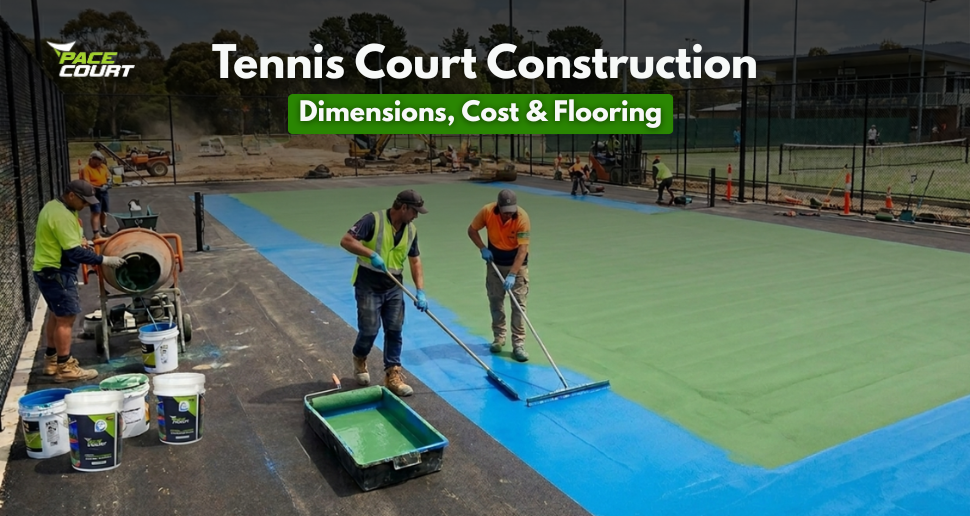
5. Acrylic Surface Application

Multiple acrylic coating layers are applied.

These generally include:

This process creates the final professional playing surface.

6. Equipment Installation

Final installations include:

  • Net posts
  • Tennis net
  • Court fencing
  • Lighting systems
  • Seating arrangements

The court is then inspected before use.
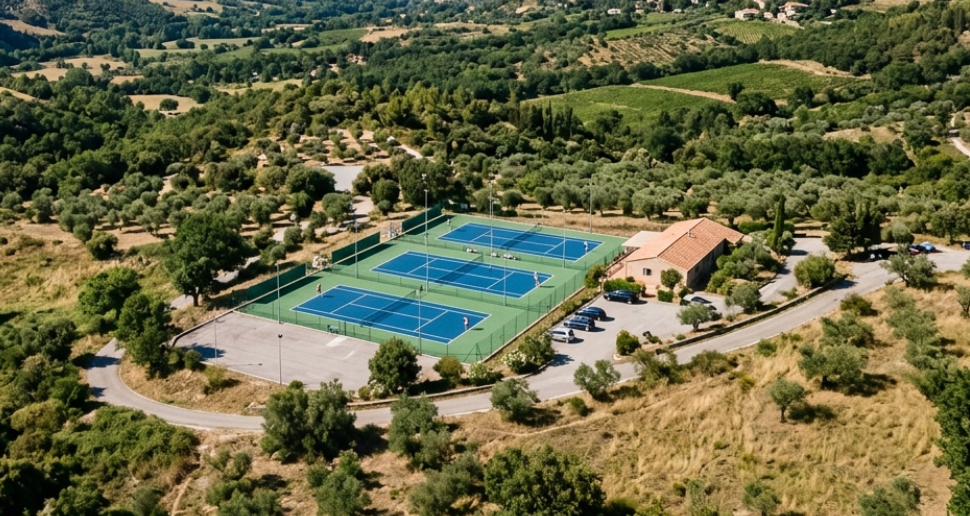
Tennis Court Construction

Essential Components of a Professional Tennis Court

Court Fencing

High-quality fencing prevents ball loss and improves security.

Typical fencing height ranges between 10 and 12 feet.

Sports Lighting

LED sports lights improve visibility and reduce energy consumption.

Modern facilities increasingly prefer energy-efficient floodlights.

Seating Area

Player benches and spectator seating improve user experience.

Drainage Infrastructure

Proper drainage protects the court investment and minimizes maintenance expenses.

Tennis Court Construction Cost in India

Several factors influence tennis court construction costs.

Major Cost Factors

FactorImpact on Cost
Court SizeHigh
LocationMedium
Base ConstructionHigh
Acrylic Coating SystemHigh
FencingMedium
Sports LightingMedium
Drainage SystemHigh
Site ConditionsHigh

Premium acrylic systems and advanced drainage solutions may increase initial investment but significantly reduce long-term maintenance costs.

Common Mistakes to Avoid During Tennis Court Construction

Many projects face performance issues due to avoidable construction errors.

Inadequate Drainage

Water accumulation damages the court surface and foundation.

Poor Base Preparation

Weak foundations often lead to cracks and uneven surfaces.

Low-Quality Materials

Inferior materials reduce durability and increase repair costs.

Incorrect Slope Design

Improper slopes cause drainage failures and surface deterioration.

Unprofessional Surface Installation

Poor coating application affects ball bounce and playing consistency.

Working with experienced tennis court construction specialists helps eliminate these risks.

Case Study: Tennis Academy Court Development in North India

A sports academy in North India planned to upgrade its aging concrete tennis court to a modern synthetic acrylic facility in 2025.

Challenges

  • Surface cracks
  • Water stagnation after rainfall
  • Inconsistent ball bounce
  • High maintenance expenses

Solution

The academy implemented:

  • Complete base reconstruction
  • Modern drainage channels
  • Synthetic acrylic tennis court flooring
  • Professional line marking
  • LED sports lighting

Results

  • Improved playing performance
  • Faster water drainage
  • Reduced maintenance costs
  • Increased player satisfaction
  • Higher tournament readiness

Within six months, the academy reported greater court utilization and improved training conditions for athletes.

Maintenance Tips for Long-Lasting Tennis Courts

Proper maintenance ensures maximum performance and lifespan.

  • Clean the surface regularly
  • Remove debris and dust
  • Inspect drainage systems
  • Check line markings periodically
  • Repair minor cracks immediately
  • Schedule professional resurfacing when required

Preventive maintenance is always more economical than major repairs.

The tennis court industry continues to evolve with innovative technologies.

Cushioned Acrylic Systems

These surfaces reduce joint stress and improve player comfort.

Sustainable Construction

Eco-friendly materials and water-efficient designs are becoming increasingly popular.

Smart Sports Lighting

Automated LED systems improve energy efficiency and operational control.

Multi-Sport Court Integration

Many facilities now combine tennis with pickleball and other recreational sports.

Advanced Surface Technologies

New coating systems provide enhanced UV resistance and longer service life.

Conclusion

Modern Tennis Court Construction requires far more than simply creating a playing surface. Proper planning, drainage design, base preparation, surface selection, and professional installation determine the court’s long-term success.

Synthetic acrylic tennis courts continue to be the preferred solution in India because they deliver durability, player safety, weather resistance, and consistent performance. Whether the project involves a sports academy, school, residential community, club, or commercial facility, investing in quality construction methods ensures years of reliable use and lower maintenance costs.

As India’s sports infrastructure expands in 2026, professionally constructed tennis courts will continue to play a vital role in supporting athletes, promoting fitness, and encouraging sporting excellence.

Frequently Asked Questions (FAQs)

What is the standard size of a tennis court?

A standard tennis court measures 23.77 meters in length and 10.97 meters in width for doubles play.

Which surface is best for tennis court construction in India?

Synthetic acrylic flooring is considered the best option due to its durability, weather resistance, and low maintenance.

How long does a tennis court construction project take?

Most professional tennis court projects are completed within a few weeks depending on site conditions and project scope.

Why is drainage important in tennis court construction?

Proper drainage prevents water accumulation, surface damage, and costly repairs.

Does synthetic acrylic flooring require high maintenance?

No, synthetic acrylic courts require relatively low maintenance compared to clay or grass courts.

Can a tennis court be used for multiple sports?

Yes, modern multi-purpose court designs can accommodate tennis, pickleball, badminton, and other recreational activities.

Upgrade Your Sports Court Today

Get premium synthetic acrylic flooring designed for durability, grip, and performance.

Get Free Consultation

Social Networks

Leave a Reply

Your email address will not be published. Required fields are marked *

Social Networks

    Home > Tennis court construction > Tennis Court Construction in India 2026: Cost, Design & Guide

    Tennis Court Construction in India 2026: Cost, Design & Guide

    Tennis Court Construction

    The demand for Tennis Court Construction in India has grown rapidly over the last few years. Schools, sports academies, residential communities, clubs, resorts, and government sports facilities are investing in modern tennis courts to promote sports participation and professional training.

    A well-constructed tennis court provides consistent ball bounce, player safety, durability, and low maintenance. However, achieving these benefits requires proper planning, surface selection, drainage design, and professional installation.

    Upgrade Your Sports Court Today

    Get premium synthetic acrylic flooring designed for durability, grip, and performance.

    Get Free Consultation

    This guide explains everything about tennis court construction in India in 2026, including court dimensions, flooring options, construction process, costs, maintenance requirements, and key factors that influence long-term performance.

    Why Tennis Court Construction Is Growing in India

    India’s sports infrastructure sector continues to expand due to increasing awareness of fitness, government support for sports development, and rising participation in tennis at grassroots and professional levels.

    Modern tennis courts are now being constructed in:

    • Sports academies
    • Educational institutions
    • Housing societies
    • Luxury villas
    • Clubs and resorts
    • Corporate campuses
    • Government sports complexes

    The availability of advanced synthetic acrylic flooring systems has also made tennis courts more durable and suitable for India’s diverse weather conditions.

    Standard Tennis Court Dimensions

    Proper dimensions are essential for professional-level play and compliance with international standards.

    Tennis Court Size Specifications

    ComponentDimensions
    Total Court Length23.77 meters
    Singles Court Width8.23 meters
    Doubles Court Width10.97 meters
    Service Line Distance6.40 meters
    Net Height at Center0.914 meters
    Net Height at Posts1.07 meters
    Recommended Playing Area36.58 m × 18.29 m

    Adequate surrounding space allows players to move freely and improves overall safety during matches.

    Tennis Court Construction

    Types of Tennis Court Surfaces

    Choosing the right surface significantly impacts player performance, maintenance costs, and court lifespan.

    Comparison of Tennis Court Surfaces

    Surface TypeSpeedMaintenanceDurabilitySuitable for India
    Clay CourtSlowHighModerateLimited
    Natural GrassFastVery HighModerateNot Ideal
    Concrete CourtMediumLowHighGood
    Synthetic Acrylic CourtMedium-FastLowExcellentHighly Recommended
    Cushion Acrylic CourtMediumLowExcellentHighly Recommended

    Among all options, synthetic acrylic tennis courts remain the preferred choice because they offer durability, weather resistance, consistent performance, and lower maintenance requirements.

    Why Synthetic Acrylic Flooring Is Preferred for Tennis Court Construction

    Synthetic acrylic flooring has become the industry standard for outdoor tennis court construction in India.

    Key Benefits:

    Consistent Ball Bounce

    The acrylic surface creates a uniform playing area that ensures predictable ball movement.

    Weather Resistance

    Modern acrylic coatings resist UV exposure, heavy rainfall, and temperature fluctuations.

    Player Safety

    Textured acrylic surfaces provide excellent grip and reduce slipping risks.

    Low Maintenance

    Upgrade Your Sports Court Today

    Get premium synthetic acrylic flooring designed for durability, grip, and performance.

    Get Free Consultation

    Unlike clay and grass courts, acrylic courts require minimal upkeep.

    Long Service Life

    Properly installed acrylic tennis courts can perform efficiently for many years with routine maintenance.

    Step-by-Step Tennis Court Construction Process

    Successful tennis court construction follows a systematic approach.

    1. Site Evaluation and Planning

    Engineers assess:

    • Soil condition
    • Land slope
    • Drainage requirements
    • Accessibility
    • Water runoff management

    A detailed layout is prepared before construction begins.

    2. Base Preparation

    The sub-base forms the foundation of the tennis court.

    This stage includes:

    • Excavation
    • Compaction
    • Granular base installation
    • Surface leveling

    A stable base prevents cracks and uneven settlement.

    3. Drainage System Installation

    Poor drainage is one of the biggest causes of court failure.

    Modern courts include:

    • Surface drainage
    • Side drains
    • Water runoff channels
    • Proper slope design

    Effective drainage significantly extends court life.

    4. Concrete or Asphalt Base Construction

    A reinforced concrete or asphalt layer is installed to create a smooth and stable playing surface.

    Professional finishing ensures:

    • Proper flatness
    • Uniform thickness
    • Structural strength

    5. Acrylic Surface Application

    Multiple acrylic coating layers are applied.

    These generally include:

    This process creates the final professional playing surface.

    6. Equipment Installation

    Final installations include:

    • Net posts
    • Tennis net
    • Court fencing
    • Lighting systems
    • Seating arrangements

    The court is then inspected before use.

    Tennis Court Construction

    Essential Components of a Professional Tennis Court

    Court Fencing

    High-quality fencing prevents ball loss and improves security.

    Typical fencing height ranges between 10 and 12 feet.

    Sports Lighting

    LED sports lights improve visibility and reduce energy consumption.

    Modern facilities increasingly prefer energy-efficient floodlights.

    Seating Area

    Player benches and spectator seating improve user experience.

    Drainage Infrastructure

    Proper drainage protects the court investment and minimizes maintenance expenses.

    Tennis Court Construction Cost in India

    Several factors influence tennis court construction costs.

    Major Cost Factors

    FactorImpact on Cost
    Court SizeHigh
    LocationMedium
    Base ConstructionHigh
    Acrylic Coating SystemHigh
    FencingMedium
    Sports LightingMedium
    Drainage SystemHigh
    Site ConditionsHigh

    Premium acrylic systems and advanced drainage solutions may increase initial investment but significantly reduce long-term maintenance costs.

    Common Mistakes to Avoid During Tennis Court Construction

    Many projects face performance issues due to avoidable construction errors.

    Inadequate Drainage

    Water accumulation damages the court surface and foundation.

    Poor Base Preparation

    Weak foundations often lead to cracks and uneven surfaces.

    Low-Quality Materials

    Inferior materials reduce durability and increase repair costs.

    Incorrect Slope Design

    Improper slopes cause drainage failures and surface deterioration.

    Unprofessional Surface Installation

    Poor coating application affects ball bounce and playing consistency.

    Working with experienced tennis court construction specialists helps eliminate these risks.

    Case Study: Tennis Academy Court Development in North India

    A sports academy in North India planned to upgrade its aging concrete tennis court to a modern synthetic acrylic facility in 2025.

    Challenges

    • Surface cracks
    • Water stagnation after rainfall
    • Inconsistent ball bounce
    • High maintenance expenses

    Solution

    The academy implemented:

    • Complete base reconstruction
    • Modern drainage channels
    • Synthetic acrylic tennis court flooring
    • Professional line marking
    • LED sports lighting

    Results

    • Improved playing performance
    • Faster water drainage
    • Reduced maintenance costs
    • Increased player satisfaction
    • Higher tournament readiness

    Within six months, the academy reported greater court utilization and improved training conditions for athletes.

    Maintenance Tips for Long-Lasting Tennis Courts

    Proper maintenance ensures maximum performance and lifespan.

    • Clean the surface regularly
    • Remove debris and dust
    • Inspect drainage systems
    • Check line markings periodically
    • Repair minor cracks immediately
    • Schedule professional resurfacing when required

    Preventive maintenance is always more economical than major repairs.

    The tennis court industry continues to evolve with innovative technologies.

    Cushioned Acrylic Systems

    These surfaces reduce joint stress and improve player comfort.

    Sustainable Construction

    Eco-friendly materials and water-efficient designs are becoming increasingly popular.

    Smart Sports Lighting

    Automated LED systems improve energy efficiency and operational control.

    Multi-Sport Court Integration

    Many facilities now combine tennis with pickleball and other recreational sports.

    Advanced Surface Technologies

    New coating systems provide enhanced UV resistance and longer service life.

    Conclusion

    Modern Tennis Court Construction requires far more than simply creating a playing surface. Proper planning, drainage design, base preparation, surface selection, and professional installation determine the court’s long-term success.

    Synthetic acrylic tennis courts continue to be the preferred solution in India because they deliver durability, player safety, weather resistance, and consistent performance. Whether the project involves a sports academy, school, residential community, club, or commercial facility, investing in quality construction methods ensures years of reliable use and lower maintenance costs.

    As India’s sports infrastructure expands in 2026, professionally constructed tennis courts will continue to play a vital role in supporting athletes, promoting fitness, and encouraging sporting excellence.

    Frequently Asked Questions (FAQs)

    What is the standard size of a tennis court?

    A standard tennis court measures 23.77 meters in length and 10.97 meters in width for doubles play.

    Which surface is best for tennis court construction in India?

    Synthetic acrylic flooring is considered the best option due to its durability, weather resistance, and low maintenance.

    How long does a tennis court construction project take?

    Most professional tennis court projects are completed within a few weeks depending on site conditions and project scope.

    Why is drainage important in tennis court construction?

    Proper drainage prevents water accumulation, surface damage, and costly repairs.

    Does synthetic acrylic flooring require high maintenance?

    No, synthetic acrylic courts require relatively low maintenance compared to clay or grass courts.

    Can a tennis court be used for multiple sports?

    Yes, modern multi-purpose court designs can accommodate tennis, pickleball, badminton, and other recreational activities.

    Upgrade Your Sports Court Today

    Get premium synthetic acrylic flooring designed for durability, grip, and performance.

    Get Free Consultation

    Leave a Reply

    Your email address will not be published. Required fields are marked *

    Scroll to Top
    HOMEOWNERS
    BUSINESS OWNERS
    ARCHITECTS
    MUNICIPALITIES

    Let's Build
    Great Courts

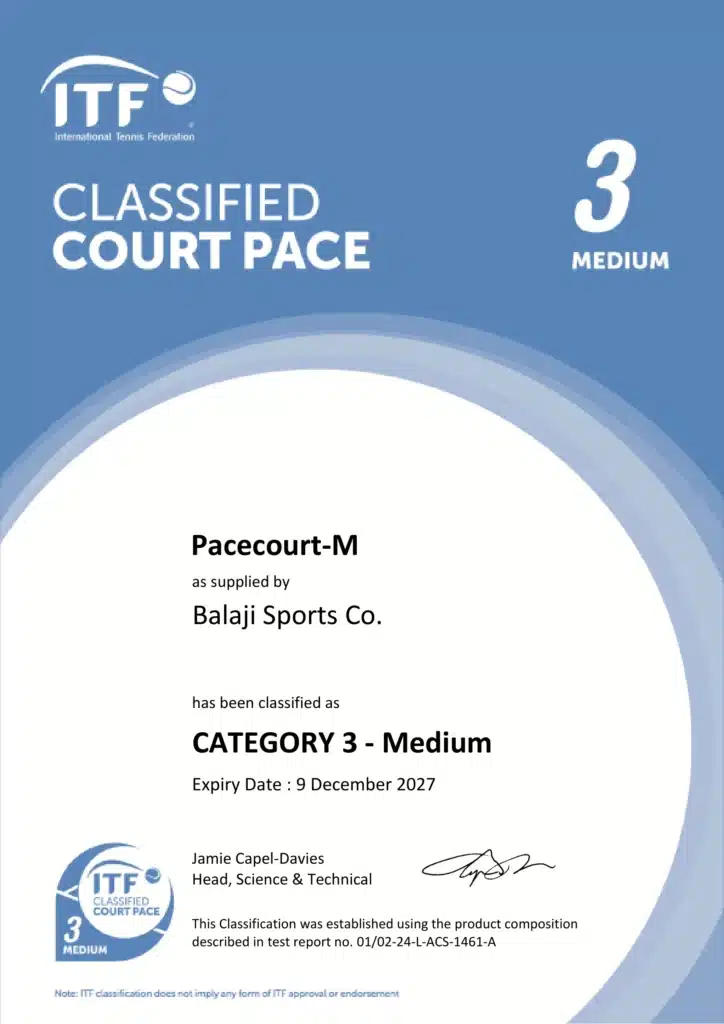
    ITF-certified acrylic flooring for Tennis, Basketball, Badminton, Pickleball & more shipped worldwide.

    Premium Quality

    world-class material & Construction

    Expert Team

    Experinced Proffectionals at your Service

    End-to-End Support

    From concept to completions

    Get In Touch

    We will respond as soon as possible 

    [pw_popup_form]

      Your information is secure and will never be shared

      ISO-Certificate