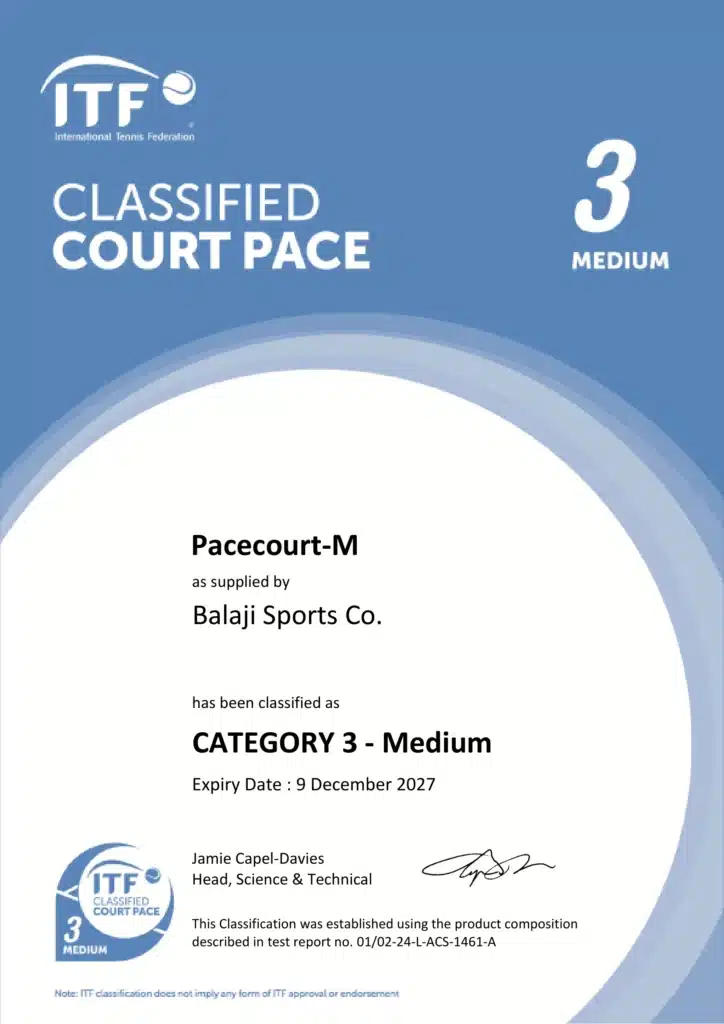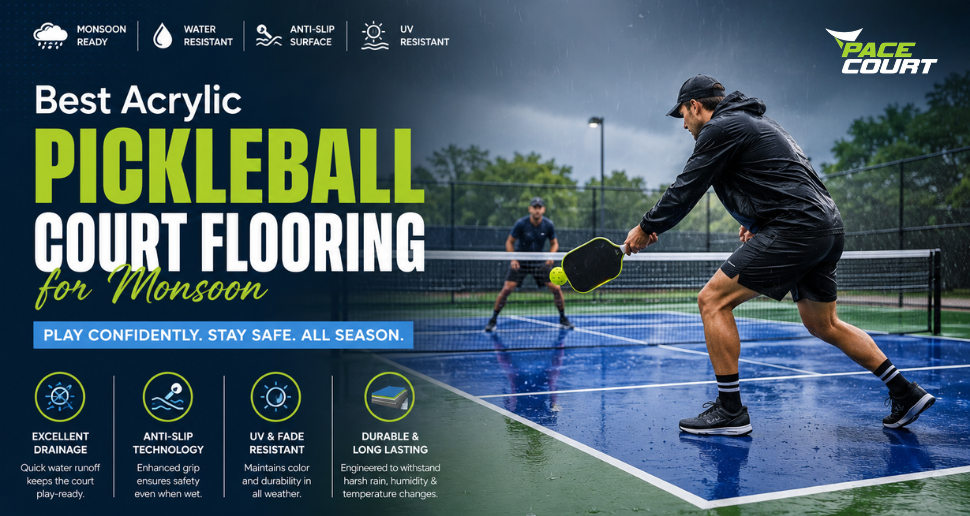
The best pickleball court flooring for monsoon in India is cushioned acrylic sports surfacing with anti-slip texture and UV-stable coating that drains fast and resists waterlogging.
Why Monsoon Is a Game-Changer for Pickleball Court Flooring in India
India’s monsoon season runs from June to September across most states. Heavy rainfall, high humidity, and waterlogging create extreme conditions for outdoor and semi-outdoor sports facilities. Choosing the wrong flooring material causes slipping injuries, rapid surface degradation, and expensive repairs.
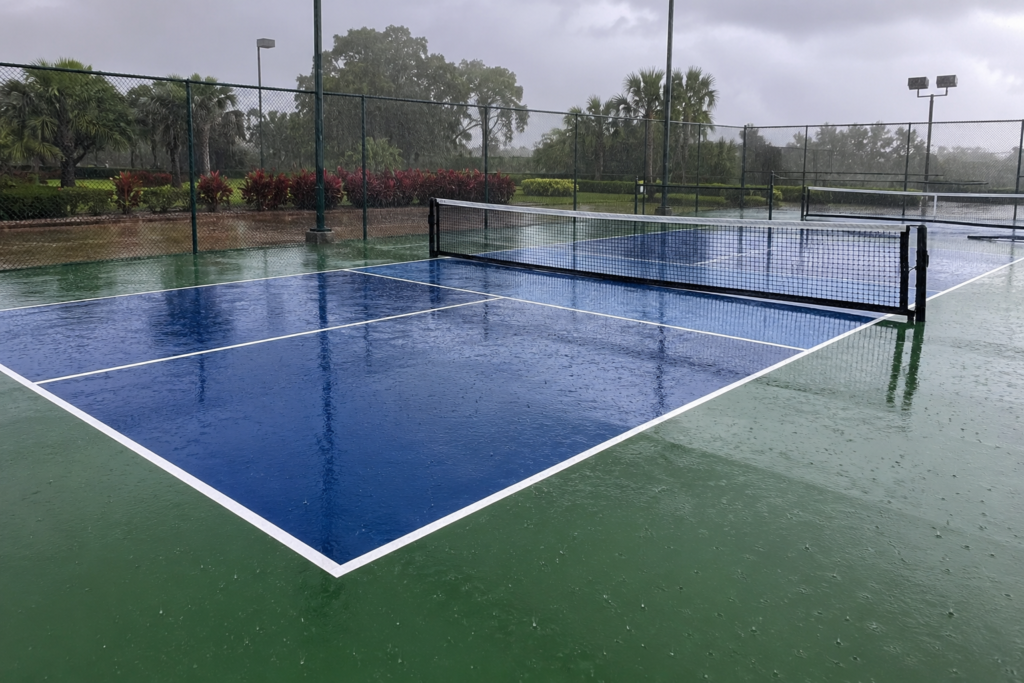
Pickleball is one of India’s fastest-growing sports in 2026. Clubs, schools, and housing societies are actively building new courts. Selecting the best pickleball court flooring for monsoon conditions is now a critical infrastructure decision. The wrong choice wastes money. The right choice protects players and extends court life by 10–15 years.
This guide covers every flooring option tested under Indian monsoon conditions, ranked by performance, safety, and value.
What Makes Pickleball Court Flooring Monsoon-Ready?
Before comparing options, understand the five qualities every monsoon-safe pickleball floor must have:
1. Anti-Slip Surface Texture Wet courts become dangerous instantly. The surface must provide grip even under continuous rainfall. Surfaces with a sand-mixed or textured top coat score best in wet traction tests.
2. Fast Water Drainage Water should drain within minutes, not hours. Permeable base layers and slight surface gradients (1–2%) help move water off the court quickly. Puddle formation must be zero.
3. UV and Heat Stability Indian summers before and after monsoon reach 40–48°C. Flooring must not crack, bubble, or peel under thermal stress. UV-stabilized coatings prevent color fading and surface breakdown.
4. Resistance to Fungal Growth and Moss High humidity promotes moss, algae, and fungal growth on porous surfaces. Monsoon-ready flooring uses antimicrobial coatings or non-porous materials that reject biological growth.
5. Structural Durability Under Repeated Wet-Dry Cycles Constant swelling and shrinking from wet-dry cycles destroys unstable materials. Flooring must maintain dimensional stability throughout the monsoon cycle without cracking or lifting at seams.
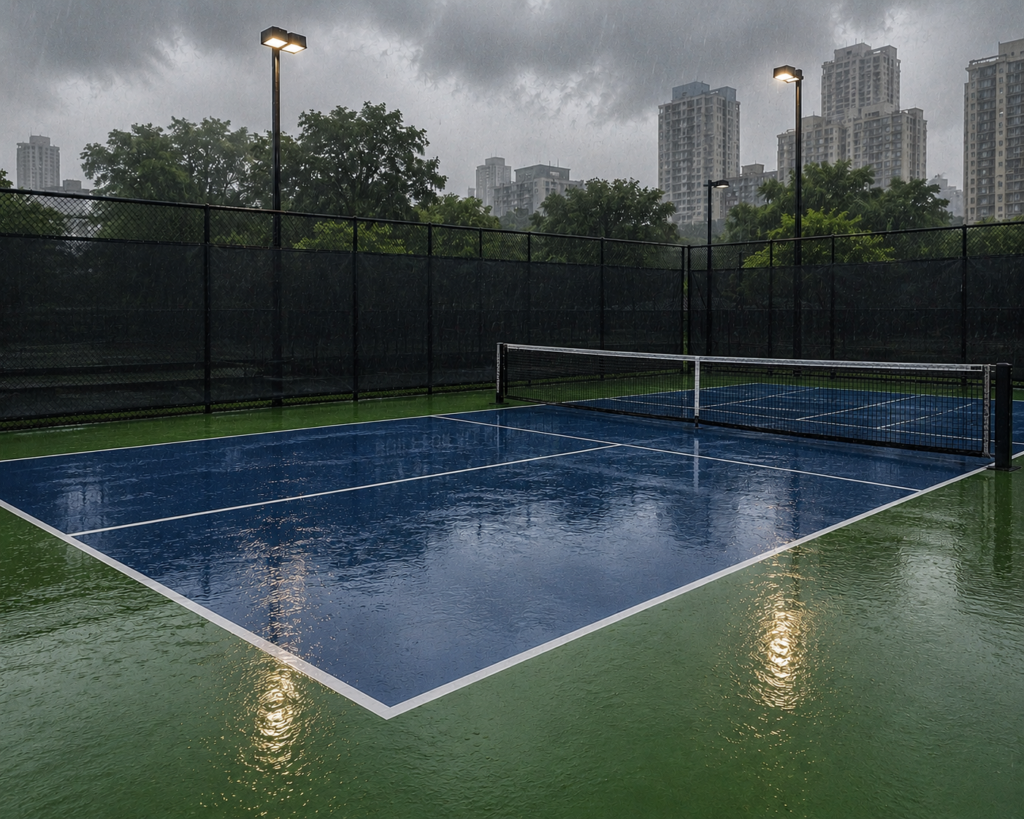
Top 6 Best Pickleball Court Flooring Options for Monsoon in India (2026)
1. The Cushioned Acrylic Sports Surface (Top Pick)
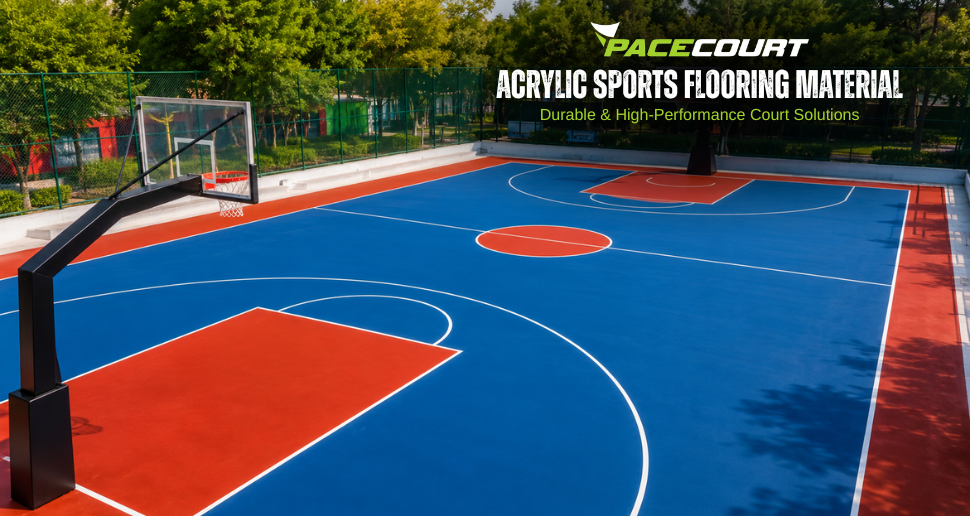
Cushioned acrylic is India’s most widely used and best-performing pickleball flooring for monsoon conditions.
Cushioned acrylic surfaces combine a polyurethane cushion base with multiple layers of acrylic coating mixed with silica sand. This construction delivers superior grip, excellent drainage, and long service life. Courts built with this surface in Mumbai, Bengaluru, and Chennai perform consistently through 4–5 monsoon seasons without re-coating.
The surface texture is adjustable – coarser grit for outdoor monsoon courts, finer grit for indoor air-conditioned facilities. Application requires a concrete sub-base with proper slope and crack-free surface. Installation cost in India ranges from ₹45 to ₹80 per sq ft depending on the number of coating layers and brand quality.
- Performance Score: 9.8/10 for Monsoon Conditions
2. Polypropylene Interlocking Sports Tiles
Polypropylene tiles offer fast installation and excellent drainage for semi-outdoor and rooftop courts during monsoon.
Interlocking PP tiles are modular, portable, and engineered with raised grids and open drainage channels. Water flows through the tile gaps instantly, preventing any surface accumulation. These tiles install on flat concrete without adhesive, making them easy to replace if a section gets damaged.
Upgrade Your Sports Court Today
Get premium synthetic acrylic flooring designed for durability, grip, and performance.
Get Free ConsultationIndian brands now manufacture polypropylene sports tiles meeting ITF Class 3 standards. Tiles are UV-stabilized and tested at temperatures from −20°C to +70°C, covering India’s entire climate range. Installation cost ranges from ₹55 to ₹95 per sq ft and is complete in one day without cure time.
- Performance Score: 8.8/10 for Monsoon Conditions
3. Synthetic Rubber Flooring (EPDM)
EPDM rubber delivers outstanding shock absorption and wet-grip but requires careful installation to prevent edge lifting during monsoon.
Ethylene Propylene Diene Monomer (EPDM) rubber is inherently water-resistant and slip-resistant even when fully wet. Courts in Kerala and coastal Maharashtra use this material successfully through intense monsoon seasons. The surface stays grippy at 90% relative humidity – a common monsoon condition in coastal India.
EPDM tiles or rolls bond to concrete using polyurethane adhesive. The bonding layer must be fully cured and seamless to prevent water ingress underneath. Poor installation causes tile lifting and buckling. Reputable installers apply full-spread adhesive with 48-hour cure time before court use.
- Performance Score: 8.5/10 for Monsoon Conditions
4. Poured Polyurethane (PU) Flooring
Poured PU flooring creates a seamless, waterproof surface ideal for monsoon-heavy regions when installed on a properly prepared sub-base.
PU flooring is poured as a liquid and cures into a seamless, jointless surface. No seams mean no entry points for water or biological growth. This makes PU flooring particularly strong against moss and fungal accumulation. The surface is dense, non-porous, and easy to clean after muddy monsoon conditions.
High-quality PU systems (two-component aliphatic polyurethane) resist UV degradation without yellowing. Indian sports flooring companies such as Tarkett, Mondo, and several domestic manufacturers supply PU systems certified for outdoor courts. Installation is weather-sensitive – avoid applying PU when humidity exceeds 85% or rain is forecast within 24 hours.
- Performance Score: 8.7/10 for Monsoon Conditions
5. Artificial Grass (Hybrid Court Surface)
Artificial grass is suitable for recreational pickleball setups but is not recommended for competitive courts in high-rainfall Indian zones.
Some housing societies and resorts use artificial grass as a versatile multipurpose surface. While modern infill-based synthetic turf drains water adequately, ball bounce behavior on grass does not match the USAPA standard for pickleball. The surface slows ball speed and alters bounce angles. Grass also traps debris and organic material during monsoon, accelerating fungal growth in the infill.
Use artificial grass only for casual play or temporary setups. Do not use it for club, school, or competitive courts. The maintenance burden during monsoon increases significantly with this material.
- Performance Score: 5.5/10 for Monsoon Conditions
6. Concrete with Anti-Slip Paint
Plain concrete with anti-slip paint is the lowest-cost option but delivers poor performance and short lifespan in monsoon conditions.
Uncoated or single-coat painted concrete becomes dangerously slippery within one monsoon season. Anti-slip paint adds texture temporarily but wears off quickly under outdoor weather cycles. Water pools on flat or improperly graded concrete. Cracks invite water ingress, causing sub-base damage and surface heaving.
Upgrade Your Sports Court Today
Get premium synthetic acrylic flooring designed for durability, grip, and performance.
Get Free ConsultationThis option is only acceptable for very low-budget temporary courts with a plan to upgrade within 2–3 years. Any permanent or semi-permanent court deserves a better surface investment.
- Performance Score: 4.0/10 for Monsoon Conditions
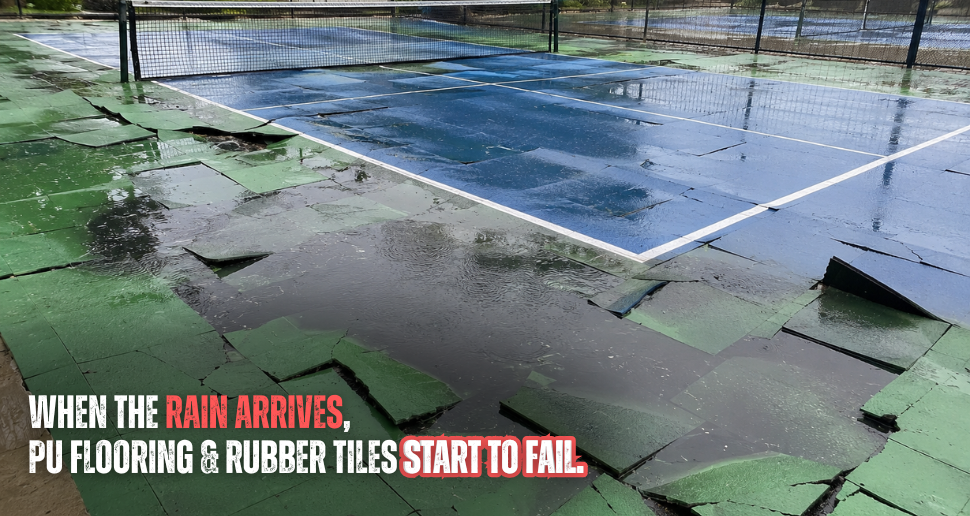
Flooring Comparison Table: Best Pickleball Court Flooring for Monsoon in India 2026
| Flooring Type | Anti-Slip (Wet) | Drainage | UV Resistance | Monsoon Durability | Installation Cost (₹/sq ft) | Maintenance | Overall Score |
| Cushioned Acrylic | Excellent | Very Good | Excellent | 10–15 years | ₹45–₹80 | Low | 9.5/10 |
| Polypropylene Tiles | Very Good | Excellent | Very Good | 8–12 years | ₹55–₹95 | Very Low | 8.8/10 |
| PU Poured Flooring | Very Good | Very Good | Very Good | 10–12 years | ₹90–₹160 | Low | 8.7/10 |
| EPDM Rubber | Excellent | Good | Good | 8–10 years | ₹70–₹120 | Low | 8.5/10 |
| Artificial Grass | Poor | Good | Good | 5–7 years | ₹40–₹80 | High | 5.5/10 |
| Concrete + Paint | Poor | Poor | Poor | 2–3 years | ₹15–₹30 | Very High | 4.0/10 |
Key Specifications Table: What Every Monsoon-Ready Court Floor Must Meet
| Parameter | Minimum Standard | Recommended Standard |
| Wet Coefficient of Friction | ≥ 0.5 (DIN 18032) | ≥ 0.6 |
| Water Drainage Rate | 10 mm/hour | 20+ mm/hour |
| Surface Gradient | 0.8% | 1.0–1.5% |
| UV Resistance | 500 hours (ASTM G154) | 1000+ hours |
| Temperature Range | −10°C to +60°C | −20°C to +70°C |
| Anti-Fungal Rating | Moderate | High (with antimicrobial coating) |
| Ball Bounce Consistency (ITF) | ≥ 80% uniformity | ≥ 90% uniformity |
| Expected Lifespan | 5 years minimum | 10+ years |
Regional Monsoon Considerations for Indian Pickleball Courts
High-Rainfall Zones (Kerala, Goa, Mumbai, Mangaluru)
These regions receive 2,000–4,000 mm of rainfall annually. Courts here need maximum drainage capacity and strongest anti-slip ratings. Cushioned acrylic with coarse silica grit or polypropylene interlocking tiles with sub-surface drainage channels are the only reliable choices. Install perimeter drains to carry water away from the court base.
Moderate-Rainfall Zones (Bengaluru, Hyderabad, Chennai, Pune)
These cities receive 700–1,200 mm annually with intermittent heavy showers. Any of the top four flooring options work well here. Focus on proper concrete sub-base preparation with a 1% slope and 48-hour cure periods before court use after rain.
Low-to-Moderate Rainfall Zones (Delhi, Jaipur, Ahmedabad, Lucknow)
Monsoon is shorter (July–August) but humidity spikes during this period. PU poured flooring and acrylic surfaces perform reliably. Anti-fungal coating becomes more important here because humidity increases rapidly but drainage infrastructure is often less developed than coastal cities.
Pro Tips for Monsoon Court Maintenance in India (2026)
Before Monsoon (April–May) Apply a fresh top coat to acrylic surfaces showing wear. Inspect all seams and edges of rubber or PU flooring for lifting. Clear perimeter drainage channels of debris. Apply anti-fungal treatment to any shaded sections of the court.
During Monsoon (June–September) Sweep courts after heavy rainfall to remove organic debris. Do not use the court when standing water remains – wait 30 minutes after rain stops for drainage to complete. Avoid dragging heavy equipment across the surface as wet flooring scuffs more easily.
After Monsoon (October–November) Inspect the full surface for micro-cracks, surface wear, or color fading. Apply acrylic resurfacing coat if needed. Remove any algae growth using diluted sodium hypochlorite wash. This annual maintenance cycle extends court life by 3–5 years.
Final Verdict
| Scenario | Best Flooring Choice |
| Permanent outdoor club court | Cushioned Acrylic Sports Surface |
| Rooftop or terrace court | Polypropylene Interlocking Tiles |
| Coastal high-rainfall zone | EPDM Rubber or Cushioned Acrylic |
| Budget-conscious community court | Polypropylene Tiles |
| Premium multi-sport facility | Poured PU Flooring |
| Indoor air-conditioned court | Fine-grit Acrylic or PU |
The best pickleball court flooring for monsoon in India is cushioned acrylic for permanent courts and polypropylene interlocking tiles for flexible or rooftop installations. Both materials meet international playability standards, resist Indian weather cycles, and deliver safe, consistent performance through every monsoon season.
Invest in the right surface now. Save on injury liability, repairs, and replacements for the next decade.
Frequently Asked Questions
A: Cushioned acrylic sports surface is the best choice because it combines anti-slip texture, fast drainage, UV resistance, and a lifespan of 10–15 years under Indian monsoon conditions.
A: Yes, polypropylene interlocking tiles drain water instantly through open grid channels and withstand temperatures up to 70°C, making them excellent for Indian outdoor courts.
A: Flooring costs range from ₹15–₹30 per sq ft for basic painted concrete to ₹90–₹160 per sq ft for premium PU or cushioned acrylic surfaces.
A: Use non-porous flooring like PU or acrylic with antimicrobial top coat, maintain a proper drainage slope, and apply a commercial algaecide wash before and after monsoon season.
A: EPDM rubber is highly slip-resistant when wet and handles rainfall well, but it requires professional full-spread adhesive installation to prevent edge lifting during prolonged monsoon exposure.
A: Polypropylene interlocking tiles drain and dry fastest because water flows through tile gaps immediately, leaving no surface accumulation even during heavy rainfall.
Stay Updated with Pacecourt
Discover expert insights, practical tips, and the latest industry updates from Pacecourt, covering sports flooring, tennis and multi-sport court construction, resurfacing, maintenance, court performance, and innovative sports infrastructure solutions.
Powered by Google's Preferred Sources feature