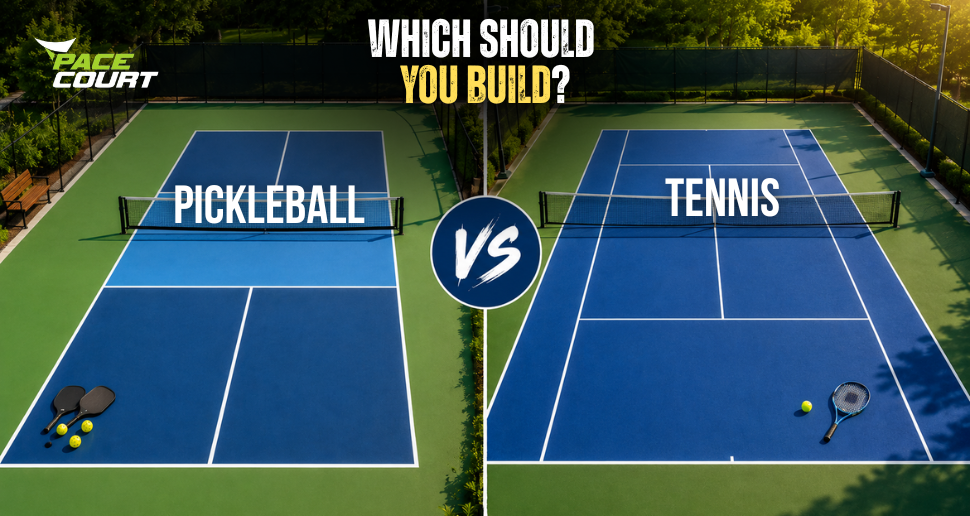
A pickleball court measures just 20 feet by 44 feet, while a full tennis court spans 78 feet by 36 feet – nearly four times the space. This one difference drives almost everything else that separates the two sports: construction cost, land requirement, gameplay speed, equipment price, and even injury risk. This guide compares pickleball court vs tennis court on every parameter that matters in 2026, using updated India-specific construction costs, equipment prices, and participation data, so you can pick the right court for your budget, property, and fitness goals.
Pickleball Court Vs Tennis Court: Quick Comparison Table
| Parameter | Pickleball Court | Tennis Court |
| Playing area | 20 ft × 44 ft (6.10m × 13.41m) – same for singles and doubles | 78 ft × 27 ft (singles) or 78 ft × 36 ft (doubles) |
| Total land with run-off space | ~30 ft × 60 ft (1,800 sq ft) | ~120 ft × 60 ft (7,200 sq ft) |
| Net height | 36 inches at the posts, 34 inches at the center | 42 inches at the posts, 36 inches at the center |
| Special zone | 7-foot non-volley zone (“the kitchen”) on both sides | No non-volley zone |
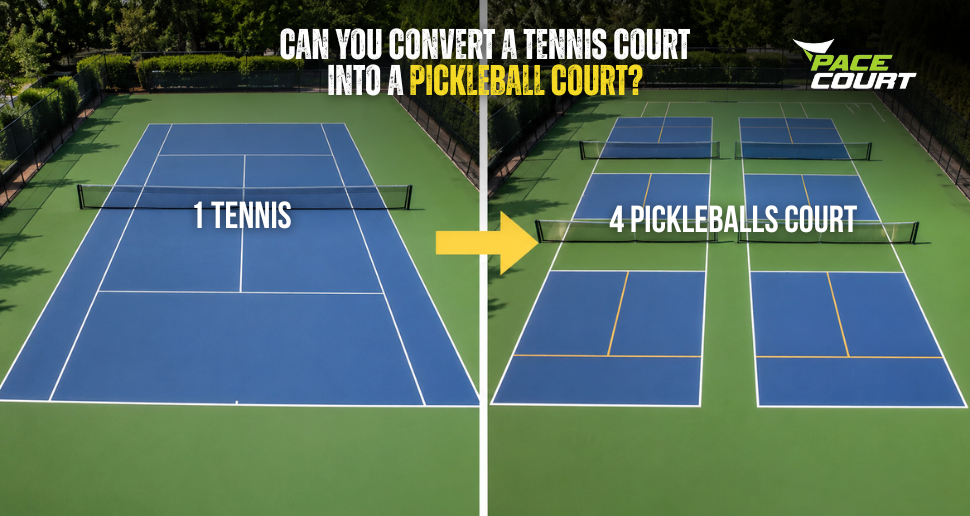
| Courts per equal footprint | Up to 4 pickleball courts fit inside one tennis court | 1 tennis court |
| Outdoor construction cost (India, 2026) | ₹3 lakh – ₹9 lakh | ₹8 lakh – ₹25 lakh |
| Indoor construction cost (India, 2026) | ₹10 lakh – ₹15 lakh | ₹25 lakh and above |
| Typical construction time | 4–5 weeks | 4–7 weeks |
| Entry-level equipment cost | ₹2,000 – ₹8,000 (paddle) | ₹2,000 – ₹15,000 (racket) |
| Approx. calories burned per hour | 400–450 | 500–580 |
| Growth in India (2024–2026) | Explosive – several-fold rise in players and courts | Steady and institutionally established |
What Is a Pickleball Court?
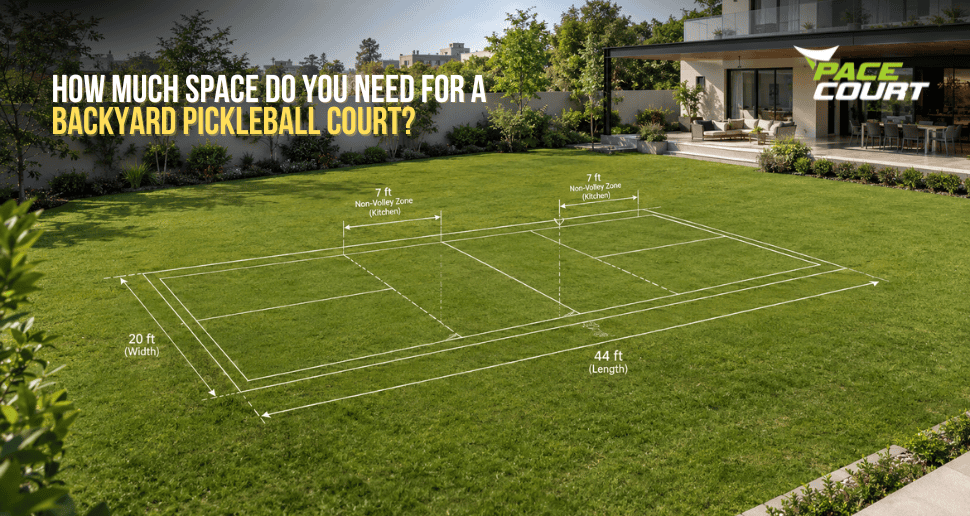
A pickleball court construction is a compact, rectangular playing surface that measures 20 feet by 44 feet, uses the same dimensions for singles and doubles, and includes a low net with a no-volley zone near it called the kitchen. Builders mark it with 2-inch-wide lines, and the smaller footprint makes it one of the easiest racquet-sport courts to fit into Indian residential societies, schools, and rooftops.
Pickleball Court Dimensions and Layout
The playing surface stays fixed at 20 ft × 44 ft regardless of whether players compete in singles or doubles, unlike tennis, which adds extra width for doubles alleys. Builders typically recommend a minimum total footprint of 30 ft × 60 ft, or roughly 1,800 square feet, once you add safety run-off space around the perimeter. Indoor courts need at least 5.5 meters of ceiling clearance, since lower ceilings cause lob shots to strike the roof.
The Non-Volley Zone (“The Kitchen”) Explained
Each side of the net carries a 7-foot no-volley zone, popularly called the kitchen, and players cannot strike the ball out of the air while standing inside it. This rule slows down aggressive net play, forces longer rallies near the net, and gives the sport its distinctive, strategy-heavy character. Tennis has no equivalent zone, so players can volley from anywhere on the court, including right against the net.
Net Height and Court Markings
A pickleball net stands 36 inches high at the sidelines and dips to 34 inches at the center, which is lower than a tennis net at every point. All lines on the court, including the baseline and sidelines, measure 2 inches wide, keeping the layout simple and easy to paint even on converted surfaces.
What Is a Tennis Court?
A tennis court build is a larger rectangular playing surface that runs 78 feet long and spans 27 feet wide for singles or 36 feet wide for doubles, separated by a net that sits higher than a pickleball net at every point. The extra width for doubles alleys, the taller net, and the larger service boxes together demand nearly four times the land a pickleball court needs.
Tennis Court Dimensions: Singles Vs Doubles
Singles matches use a 78 ft × 27 ft court, while doubles matches use the full 78 ft × 36 ft width, adding a doubles alley on each side. Builders generally plan for a total footprint of about 120 ft × 60 ft, or roughly 7,200 square feet, once run-off areas behind the baseline and beside the sidelines are included.
Net Height, Service Boxes and Court Lines
A tennis net measures 42 inches at the posts and drops to 36 inches at the center, giving it a more pronounced curve than a pickleball net. Service boxes sit close to the net on each side, and the baseline can measure up to 4 inches wide, while other lines must be at least 2 inches wide under ITF standards.
Surface Types Common in India
Acrylic-coated concrete dominates Indian tennis courts because it handles monsoon rain, summer heat, and UV exposure reliably at a manageable cost. Synthetic clay and cushioned acrylic systems appear at premium academies and clubs, while natural grass courts remain extremely rare across the country due to high maintenance demands.
Pickleball Court Vs Tennis Court: Space and Land Requirement
Land scarcity in Indian cities makes this comparison especially relevant for residential societies, schools, and sports clubs. A pickleball court needs only about 1,800 square feet of buildable area, while a tennis court needs close to 7,200 square feet – nearly four times as much. This gap explains why so many gated communities and rooftop facilities in Gurugram, Bengaluru, and Mumbai now choose pickleball over tennis: the smaller court fits spaces where a tennis court simply cannot.
Because one tennis court occupies the same footprint as four pickleball courts, facility owners with existing tennis infrastructure often add pickleball lines rather than acquiring new land. This flexibility gives pickleball a structural cost advantage that goes beyond construction pricing alone.
Construction Cost Comparison in India (2026)
Construction cost remains the deciding factor for most builders comparing pickleball court vs tennis court projects in India. Both sports use similar acrylic-on-concrete construction methods, but the smaller pickleball footprint reduces nearly every cost component, from base preparation to fencing.
Pickleball Court Cost in India (2026)
A standard outdoor pickleball court in India costs between ₹3 lakh and ₹9 lakh in 2026, with most residential society and club builds landing around ₹4.5 lakh to ₹6.5 lakh. Indoor courts cost more, typically ₹10 lakh to ₹15 lakh, because they need proper flooring systems, adequate ceiling clearance, and often climate control. A four-court outdoor facility costs ₹14 lakh to ₹35 lakh, and this multi-court format delivers better value per court since site preparation and fencing costs get shared. Construction usually takes 25 to 35 days for a single outdoor court, and acrylic surfaces last 6 to 9 years before they need resurfacing.
Tennis Court Cost in India (2026)
A standard outdoor tennis court cost with fencing and lighting costs between ₹8 lakh and ₹25 lakh in most Indian cities in 2026, and a full turnkey build in metro regions like Delhi NCR typically lands around ₹12 lakh to ₹18 lakh for a standard court, rising to ₹18 lakh to ₹25 lakh for club-grade installations. Premium cushioned surfaces or ITF-certified courts push the cost to ₹28 lakh to ₹40 lakh. The RCC base slab forms the structural core of the project and should never be the place to cut costs, since a cracked base eventually shows through the acrylic surface. A complete outdoor build takes 4 to 7 weeks, and acrylic surfaces typically last 8 to 10 years with regular maintenance.
Cost Comparison at a Glance
| Cost Component | Pickleball Court (India, 2026) | Tennis Court (India, 2026) |
| Standard outdoor build | ₹3 lakh – ₹9 lakh | ₹8 lakh – ₹25 lakh |
| Typical metro build | ₹4.5 lakh – ₹6.5 lakh | ₹12 lakh – ₹18 lakh |
| Indoor / premium build | ₹10 lakh – ₹15 lakh | ₹25 lakh – ₹40 lakh |
| Multi-court facility | ₹14 lakh – ₹35 lakh (4 courts) | Rarely built as multi-court due to land needs |
| Construction timeline | 4–5 weeks | 4–7 weeks |
| Surface lifespan | 6–9 years | 8–10 years |
Can You Convert a Tennis Court Into a Pickleball Court?
Yes, an existing tennis court can host up to four regulation pickleball courts through new line markings, lowered or portable nets, and a fresh acrylic coat. Converting an existing slab that remains structurally sound costs roughly ₹3 lakh to ₹5.5 lakh, covering re-marking, net posts, and repainting, and the court often becomes playable within a week. This conversion route makes pickleball an easy addition for any club, school, or society that already owns tennis infrastructure and wants to offer both sports without buying more land.
Equipment Cost: Paddle Vs Racket Price in India (2026)
Equipment cost adds a recurring difference to the pickleball court vs tennis court decision, since players buy and replace gear far more often than they build courts.
| Equipment Tier | Pickleball Paddle Price (India) | Tennis Racket Price (India) |
| Entry-level | ₹2,000 – ₹4,000 | ₹2,000 – ₹5,000 |
| Mid-range (best value) | ₹4,000 – ₹8,000 | ₹5,000 – ₹15,000 |
| Premium / competitive | ₹8,000 – ₹15,000+ | ₹15,000 – ₹35,000+ |
| Ball cost | Low; a set of perforated balls lasts a long time | Higher; tennis balls lose bounce quickly and need frequent replacement |
| Extra running cost | None significant | Restringing every few months, typically ₹500–₹1,500 per job |
Pickleball paddles use solid composite or carbon-fiber faces rather than strings, so players avoid restringing costs entirely. Tennis rackets, by contrast, need periodic restringing and more frequent ball replacement, which quietly adds to the sport’s total cost of ownership over a year.
Rules, Scoring and Gameplay Differences
| Aspect | Pickleball | Tennis |
| Serve style | Underhand only | Overhand, allowed from either side |
| Scoring system | Side-out scoring; points only on serve | Point scoring on every rally |
| Match duration | Roughly 20–30 minutes | Roughly 60–90 minutes or longer |
| Ball type | Perforated plastic ball, low bounce | Pressurised rubber ball with felt covering |
| Volleying rule | Banned inside the 7-foot kitchen | Allowed anywhere on court |
| Doubles court size | Same as singles | Wider than singles (adds alleys) |
Pickleball’s underhand serve, shorter matches, and side-out scoring make it far easier for a first-time player to understand within a single session. Tennis rewards a longer learning curve, but it also offers a deeper competitive ceiling for players chasing rankings, coaching pathways, or collegiate opportunities.
Fitness and Injury Risk: Which Is Gentler on the Body?
Tennis generally burns more calories per hour, roughly 500 to 580 for a 70 kg player, mainly because its larger court forces continuous sprinting and longer rallies. Pickleball burns slightly less, roughly 400 to 450 calories per hour, but its quick directional changes near the net still deliver a genuine interval-style workout. Tennis also demands more repetitive overhead motion and harder lateral sprints, which raises long-term strain on the shoulder, elbow, and knee joints. Pickleball’s smaller court, lower net, and underhand serve reduce this impact considerably, which is why doctors and physiotherapists often recommend it to older adults, beginners, and anyone recovering from a joint injury. Both sports improve cardiovascular fitness, balance, and coordination, so the right choice depends on whether you want maximum intensity or a joint-friendly, long-term option.
Which Sport Is Growing Faster in India in 2026?
Pickleball’s growth curve in India looks dramatically steeper than tennis’s right now. The All India Pickleball Association (AIPA), founded in 2008 and affiliated with the International Pickleball Federation since 2015, now oversees a sport whose participation numbers have expanded several times over between 2024 and 2026 according to multiple industry trackers, even though exact figures vary by source. Dedicated pickleball courts across the country have jumped from a few hundred in early 2024 to well over 1,000 by early 2026, and cities such as Delhi, Bengaluru, Gurugram, Ahmedabad, Surat, and Vadodara have all seen a wave of new privately built facilities. Market researchers project India’s pickleball market to keep growing at a strong double-digit annual rate through the rest of the decade.
Tennis, by comparison, grows more steadily. The sport already sits on a mature, decades-old institutional base built by the All India Tennis Association, supported further by Khelo India funding and long-established academies in nearly every major city. Tennis does not need explosive growth to stay relevant, because its court infrastructure, coaching pipeline, and competitive pathway already exist at scale. In practice, the two sports increasingly coexist rather than compete, with many new sports complexes building both court types side by side.
Pickleball Court Vs Tennis Court: Which Should You Choose?
| Choose a Pickleball Court If You Want | Choose a Tennis Court If You Want |
| A lower construction budget (₹3–9 lakh) | A larger, long-term sporting asset (₹8–25 lakh) |
| To fit a court on a small plot or rooftop | Ample land available (7,000+ sq ft) |
| An easy, beginner-friendly sport for all ages | A sport with a deeper competitive and coaching pathway |
| Lower-impact exercise for joints and recovery | A higher-intensity cardio workout |
| Faster construction (4–5 weeks) | An established, prestige racquet-sport facility |
| To convert an existing hard court cheaply | A dedicated, single-purpose professional court |
Conclusion
Choosing between a pickleball court and a tennis court in India in 2026 comes down to land, budget, and purpose. Pickleball wins on space efficiency, construction cost, beginner accessibility, and joint-friendly fitness. Which explains its explosive growth across Indian cities over the past two years. Tennis wins on competitive depth, established coaching pathways, and higher-intensity fitness output, backed by decades of institutional support. Many Indian residential societies, schools, and sports clubs now build both, using pickleball to attract broad participation. Tennis to serve dedicated, long-term players – and that combined approach may be the smartest court investment of all.
Frequently Asked Questions
A pickleball court is roughly a quarter the size of a tennis court, measuring 20 ft × 44 ft against a tennis court’s 78 ft × 36 ft. This size gap also drives lower construction cost, shorter rallies, and reduced land requirement.
Up to four regulation pickleball courts fit within the footprint of one standard tennis court. This makes conversion an efficient option for clubs that already own tennis infrastructure.
A pickleball court costs roughly ₹3 lakh to ₹9 lakh in India in 2026, while a tennis court typically costs ₹8 lakh to ₹25 lakh. The smaller footprint reduces every major cost component, from the base slab to fencing.
Yes, an existing tennis court can be converted into up to four pickleball courts using new line markings, lowered nets, and a fresh acrylic coat. A sound existing slab keeps conversion cost as low as ₹3 lakh to ₹5.5 lakh.
Yes, pickleball is generally easier for beginners because of its smaller court, slower-moving ball, and mandatory underhand serve. Most new players sustain a rally within their first session.
Tennis typically burns more calories per hour, around 500 to 580, compared to roughly 400 to 450 for pickleball, mainly due to its larger court and longer sprints.
Upgrade Your Sports Court Today
Get premium synthetic acrylic flooring designed for durability, grip, and performance.
Get Free ConsultationPickleball is growing far faster in India, with active players and dedicated courts multiplying several times over between 2024 and 2026. Tennis continues to grow steadily on its long-established institutional base.
A pickleball net stands 36 inches at the posts and 34 inches at the center, while a tennis net stands 42 inches at the posts and 36 inches at the center. The lower net suits pickleball’s slower, less bouncy ball.
Stay Updated with Pacecourt
Discover expert insights, practical tips, and the latest industry updates from Pacecourt, covering sports flooring, tennis and multi-sport court construction, resurfacing, maintenance, court performance, and innovative sports infrastructure solutions.
Powered by Google's Preferred Sources feature