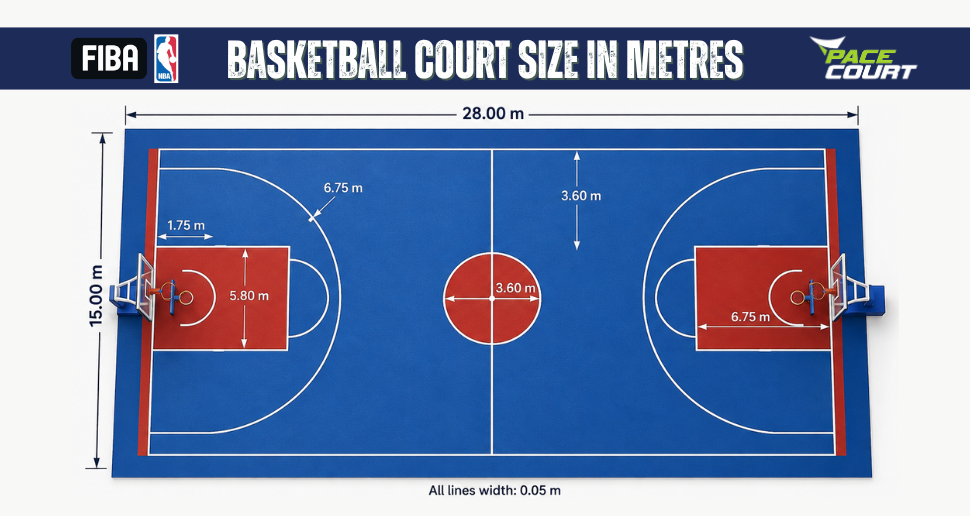
The standard basketball court size in metres under FIBA rules measures 28 metres long by 15 metres wide. This international standard applies across India, the Olympics, World Cup events, and most professional leagues outside the NBA. The NBA court runs slightly larger at 28.65 m × 15.24 m. Both keep the rim height at a universal 3.05 m.
This guide delivers accurate, up-to-date dimensions for 2026, clear comparisons, marking details, half-court options, and practical notes for Indian facilities. You get skimmable tables, active-voice explanations, and direct answers ready for search snippets.
Official Basketball Court Size in Metres (2026)
FIBA sets the global benchmark. India follows these rules for national competitions, schools, colleges, academies, and most new constructions.
FIBA / International / India Standard
- Length: 28 m
- Width: 15 m
- Playing area: 420 m²
- Lines: 5 cm wide
NBA Standard
- Length: 28.65 m (94 ft)
- Width: 15.24 m (50 ft)
- Playing area: approximately 436.6 m²
These sizes have remained stable into 2026. FIBA equipment rules effective October 2026 refine backboards, rings, and flooring but leave the court footprint unchanged.
| Feature | FIBA / India (m) | NBA (m) | Difference |
| Length | 28.00 | 28.65 | +0.65 m |
| Width | 15.00 | 15.24 | +0.24 m |
| Total Area | 420 | ~436.6 | +16.6 m² |
| Rim Height | 3.05 | 3.05 | Same |
| Three-Point Arc | 6.75 | 7.24 | +0.49 m |
| Three-Point Corner | 6.60–6.75 | 6.70 | Minor |
| Free-Throw Line | 4.60 | 4.57 | Nearly same |
| Key / Paint Width | 4.90 | 4.88 | Nearly same |
| Centre Circle Diameter | 3.60 | 3.66 | Minor |
| No-Charge Semi-Circle | 1.25 radius | 1.22 radius | Minor |
The FIBA court gives slightly tighter spacing. The NBA floor adds room for isolation plays and longer threes.
Why Basketball Court Size in Metres Matters
Court dimensions control spacing, defensive help, transition speed, and three-point volume. A 0.65 m length difference changes how quickly teams advance the ball. The shorter FIBA three-point line (6.75 m) rewards efficient outside shooting and suits the international style. NBA spacing rewards elite isolation creators.
In India, FIBA dimensions ensure national teams and state championships prepare correctly for Asian and Olympic competition. Builders who mark to 28 × 15 m future-proof facilities for official events.
Detailed Court Markings in Metres
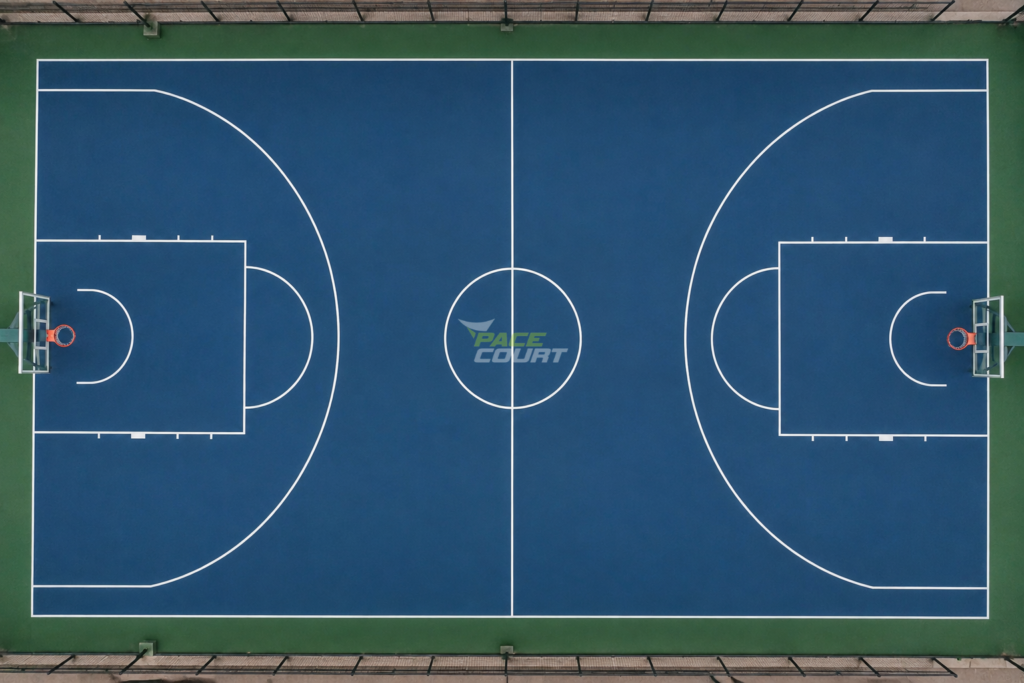
Every line measures 5 cm wide and contrasts clearly with the floor.
Boundary Lines
Sidelines run the full 28 m length. Baselines/end lines run the 15 m width. Measure from the inner edge of the lines.
Centre Line and Circle
The centre line divides the court into two equal 14 m halves. The centre circle has a 1.80 m radius (3.60 m diameter).
Restricted Area (The Key or Paint)
The key is a rectangle 4.90 m wide. The free-throw line sits 5.80 m from the baseline (approximately 4.60 m from the face of the backboard). A free-throw circle of 1.80 m radius sits on the free-throw line.
Three-Point Line
FIBA places the arc at a uniform 6.75 m from the centre of the basket. The line meets the sidelines at right angles. NBA uses 7.24 m at the top of the key and shortens to 6.70 m in the corners.
No-Charge Semi-Circle
A 1.25 m radius arc under the basket protects offensive players driving to the rim. Defenders cannot draw charges inside this zone.
Backboard and Rim Placement
The backboard sits 1.20 m from the baseline. Its face measures 1.80 m wide by 1.05 m high. The rim hangs exactly 3.05 m above the floor and measures 45 cm in diameter.
Half-Court, 3×3 and Youth Sizes
Full courts demand space. Many Indian schools, societies, and clubs install practical alternatives.
Upgrade Your Sports Court Today
Get premium synthetic acrylic flooring designed for durability, grip, and performance.
Get Free Consultation| Court Type | Length (m) | Width (m) | Notes |
| Full FIBA | 28 | 15 | National & international standard |
| Half-Court FIBA | 14 | 15 | Single basket, popular for clubs |
| 3×3 Official | 15 | 11 | Fastest-growing format in India |
| School / Recreational | 24–26 | 13–14 | Scaled for limited space |
| Mini-Basketball | Variable | Variable | Proportional reduction for under-12 |
A half-court still includes a free-throw line, three-point arc, and key so players practice real game shots. 3×3 courts use one basket and follow FIBA 3×3 rules with a 12-second shot clock.
Indoor vs Outdoor Courts in India (2026 Context)
Indoor courts usually use maple or synthetic hardwood for consistent bounce and player safety. Outdoor courts rely on acrylic, asphalt, or concrete with UV-resistant coatings. Both must meet the same dimensional standards.
Indian climate considerations favour acrylic outdoor surfaces for societies and school grounds. These systems drain well, resist heat, and require less maintenance than wood. Professional indoor venues follow FIBA Level 1 flooring requirements for rebound and shock absorption.
Clearance around the court remains essential. FIBA recommends at least 2 m of unobstructed runoff on all sides. Ideal total footprint reaches roughly 32 m × 19 m when benches, officials, and safety zones are included. Ceiling height for indoor Level 1 events must clear 7 m.
How India Applies These Standards in 2026
Basketball Federation of India and state associations adopt FIBA rules. New government sports complexes, Khelo India projects, and private academies mark 28 × 15 m courts. Half-courts and 3×3 setups appear frequently in residential societies and smaller schools because land costs remain high in cities.
When you construct or renovate, confirm the intended level of play. A school court can scale slightly smaller while keeping proportional markings. Any facility aiming for state or national events must hit exact FIBA dimensions and markings.
Practical Tips for Measuring and Building
Measure from the inner edge of all boundary lines. Use laser tools or certified survey equipment for accuracy. Paint lines only after the surface cures fully. Install backboards so the rim sits precisely 3.05 m above the finished floor. Test ball bounce across the entire surface before final acceptance.
Run-off zones prevent injuries. Lighting must eliminate shadows on the key and three-point arc. For outdoor courts in monsoon regions, ensure proper slope and drainage so water does not pool on the playing surface.
Comparison of Key Playing Zones
| Zone | FIBA Measurement | Purpose |
| Restricted Area (Key) | 4.90 m wide × 5.80 m deep | Three-second violation zone |
| Free-Throw Line | 4.60 m from backboard face | One-point free throws |
| Three-Point Arc | 6.75 m from basket centre | Three-point field goals |
| No-Charge Semi-Circle | 1.25 m radius | Protects drivers from charges |
| Centre Circle | 1.80 m radius | Jump-ball and restart location |
These zones create the strategic map of every possession. Coaches design spacing drills around the exact distances.
Frequently Asked Questions
The FIBA standard used worldwide and in India is 28 m long by 15 m wide.
An NBA court measures 28.65 m long by 15.24 m wide.
The rim sits at 3.05 m in every major league and level of play.
Upgrade Your Sports Court Today
Get premium synthetic acrylic flooring designed for durability, grip, and performance.
Get Free ConsultationFIBA places the three-point arc at 6.75 m; NBA places it at 7.24 m (shorter in the corners).
India follows FIBA dimensions of 28 m × 15 m for official competitions.
A FIBA half-court measures 14 m by 15 m.
Allow at least 2 m of clear runoff on all sides for safety and official play.
No. FIBA court dimensions remain 28 m × 15 m; equipment rules received updates but the playing area stayed the same.
Stay Updated with Pacecourt
Discover expert insights, practical tips, and the latest industry updates from Pacecourt, covering sports flooring, tennis and multi-sport court construction, resurfacing, maintenance, court performance, and innovative sports infrastructure solutions.
Powered by Google's Preferred Sources feature