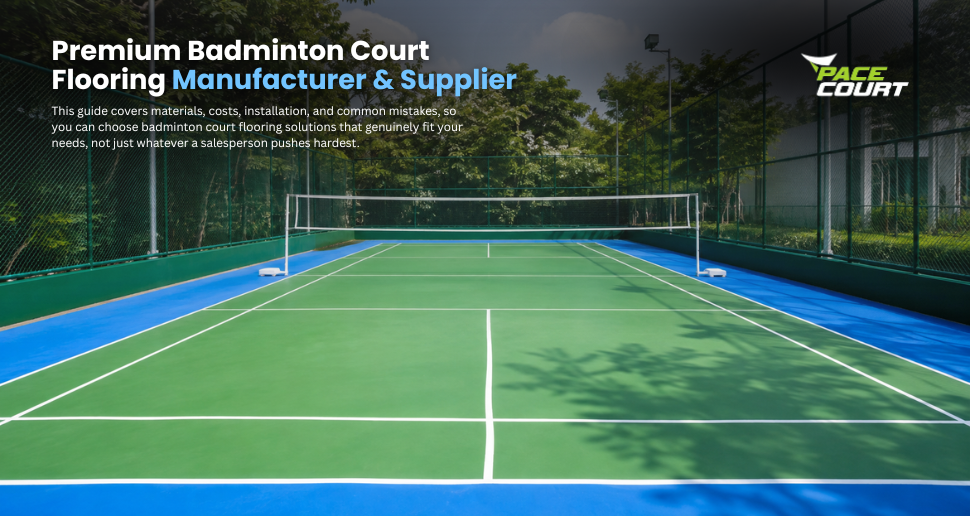
If you’re building a court, choosing the right badminton court flooring manufacturer is one of the biggest decisions you’ll make. The floor isn’t just something to stand on. It decides how the shuttle bounces, how safely players move, and how long the court lasts before it needs repair.
With so many manufacturers claiming to offer the “best” flooring, it’s easy to feel confused. Some push wooden floors. Others recommend PVC or PU. Many facility owners now prefer synthetic acrylic sports flooring for its durability and low upkeep.
This guide covers materials, costs, installation, and common mistakes, so you can choose badminton court flooring solutions that genuinely fit your needs, not just whatever a salesperson pushes hardest.
What Is Badminton Court Flooring?
Badminton court flooring is a specialised playing surface built specifically for the sport. It’s not the same as a regular tile or plain cement floor.
A proper badminton court surface has to manage three things at once: grip, shock absorption, and consistent shuttle bounce. Get any of these wrong, and players either slip, tire out faster, or deal with unpredictable rallies.
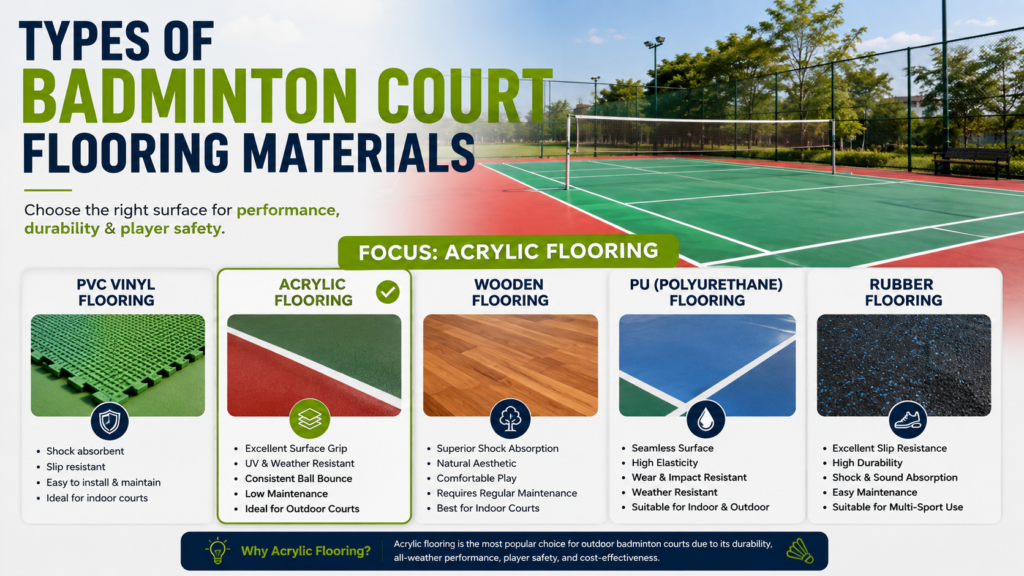
Most modern courts use one of four materials:
- Synthetic acrylic coating
- PVC (vinyl) sheets
- PU (polyurethane) systems
- Solid or engineered wood panels
Each one behaves differently under footwork, weather, and daily wear. That’s why picking the right badminton flooring system matters more than most people realise, especially for schools, clubs, and academies planning to use the court for years.
Why the Right Manufacturer Makes a Difference
A badminton court flooring company does more than sell material. A good manufacturer understands the science behind grip levels, weather resistance, and how a surface holds up after years of smashes and sharp lunges.
Here’s what a dependable badminton court flooring supplier usually brings to a project:
- Tested materials that meet recognised performance benchmarks
- Correct sub-floor preparation before the top layer goes down
- Trained installation teams who know exact court dimensions
- Honest guidance on which material suits your budget and climate
Cheap, untested flooring might look fine on day one. Within a year, though, you may notice fading, cracking, or patches that have turned slippery. That’s usually a sign of poor material quality or rushed work, not bad luck.
Choosing an established badminton flooring manufacturer with a real track record saves you from these headaches later. It’s a bit like buying a mattress. The cheapest option rarely lasts as long as you hoped it would.
Types of Badminton Court Flooring Materials
There’s no single “best” badminton court flooring material for every situation. The right pick depends on your budget, whether the court sits indoors or outdoors, and how heavily it will be used. Here’s a closer look at the four main options.
Synthetic Acrylic Badminton Court Flooring
Synthetic acrylic sports flooring has become one of the most popular choices for both indoor and outdoor badminton courts in India. It’s built by applying several layers of acrylic coating over a concrete or asphalt base.
What makes acrylic flooring stand out is its resistance to sun, rain, and temperature swings. It doesn’t rot, warp, or attract termites the way wood can. The surface also gets a textured top coat, which gives players consistent grip in both dry and slightly damp conditions.
Acrylic court flooring works especially well for outdoor setups, schools, and multi-purpose courts, where the same surface might host badminton one day and a casual basketball game the next. It generally needs less upkeep than wood and holds its colour well over time.
PVC Badminton Court Flooring
PVC, or vinyl, flooring comes in rolled sheets that get glued or welded onto a prepared sub-floor. It’s one of the most common choices for indoor badminton court flooring because it feels cushioned, smooth, and easy on the joints.
Good PVC flooring has several layers underneath the surface: a wear layer, a foam or felt cushioning layer, and a stabilising backing. This layered build helps absorb shock during quick lunges and jumps.
Thickness usually ranges from 4.5mm to 8mm. Thicker mats tend to offer better cushioning but cost more. PVC flooring remains a favourite for academies and clubs that want tournament-ready surfaces without the higher price tag of solid wood.
PU Badminton Court Flooring
PU, or polyurethane, flooring is applied as a liquid that cures into a smooth, rubber-like surface. Many players describe it as feeling slightly softer and more cushioned underfoot compared to PVC.
Because it’s poured rather than laid in sheets, PU flooring has no visible joins, which some facility owners prefer for a cleaner finish. It also handles heavy foot traffic well, which suits busy academies and commercial sports centres.
The trade-off is cost. PU systems usually sit at the higher end of the price range compared to PVC or acrylic, and application needs skilled installers who can control curing time and layer thickness correctly.
Wooden Badminton Court Flooring
Wooden flooring is the traditional choice for professional and tournament-level badminton courts. Maple or similar hardwoods get laid over a sprung sub-floor that flexes slightly with each step, easing strain on players’ knees and ankles.
This is often the surface you’ll see at major badminton tournaments, and many long-time players say nothing else quite matches the feel and bounce of a well-built wooden court.
That said, wooden flooring demands more care. It’s sensitive to moisture, needs periodic sanding and resealing, and generally costs more than synthetic options. For facilities hosting serious competitive play, and willing to invest in the upkeep, it still sets the benchmark for performance.
PVC vs PU vs Acrylic vs Wooden Flooring: Quick Comparison
| Flooring Type | Best Suited For | Maintenance Needed | Feel Underfoot | Weather Resistance |
| Synthetic Acrylic | Outdoor & multi-purpose courts | Low | Firm, consistent grip | Excellent (UV and water resistant) |
| PVC (Vinyl) | Indoor academies & clubs | Low to moderate | Cushioned and smooth | Best used indoors |
| PU (Polyurethane) | Indoor commercial courts | Low to moderate | Soft, no visible joins | Best used indoors |
| Wooden | Professional & tournament courts | High (polishing, resealing) | Springy, premium bounce | Sensitive to moisture |
Indoor vs Outdoor Badminton Court Flooring
The material you pick often comes down to one simple question: is your court indoor or outdoor?
Indoor badminton court flooring can focus purely on grip, cushioning, and consistent ball bounce, since there’s no weather to fight against. PVC, PU, and wood all perform well indoors, and this is where you’ll find most tournament-grade courts.
Outdoor courts face a tougher job. Rain, direct sun, and shifting temperatures can damage materials that aren’t built for exposure. This is where synthetic acrylic flooring tends to perform best. It resists UV fading, sheds water instead of soaking it in, and doesn’t warp the way wood would outdoors.
If you’re building a facility that needs both, some manufacturers offer a mix, acrylic for open courts and PVC or wood for covered ones. It’s worth asking your supplier what’s realistic for your local climate before finalising anything. What works fine in mild coastal weather may not hold up the same way in a city with heavy monsoon rain or extreme summer heat.
Upgrade Your Sports Court Today
Get premium synthetic acrylic flooring designed for durability, grip, and performance.
Get Free ConsultationWhat to Look for in a Badminton Court Flooring Manufacturer
Not every supplier who sells flooring actually understands sports surfaces. Before signing anything, check for these basics.
Certification and Testing
Reliable manufacturers test their materials against recognised benchmarks, including those referenced by the Badminton World Federation (BWF) and international sports flooring standards such as EN 14904. Ask your supplier directly whether their product has been tested for shock absorption, slip resistance, and ball bounce. If they can’t answer clearly, treat that as a warning sign.
Sample and Site Visit
A genuine badminton court flooring supplier will usually offer material samples and, ideally, visit your site before quoting a price. Flooring behaves differently depending on the sub-base, drainage, and local weather. A manufacturer who skips this step and quotes over the phone probably isn’t accounting for your actual site conditions.
Installation Support
Buying the material is only half the job. Poor installation can ruin even the best badminton court flooring materials. Ask whether the manufacturer has its own trained installation team or works with certified partners, and whether they handle everything from sub-floor prep to final court markings.
Warranty and After-Sales Service
Most established manufacturers offer a warranty, commonly around three years, on materials and workmanship. Beyond that period, ask how they handle repairs, resurfacing, or colour touch-ups down the line. A supplier who disappears right after installation isn’t who you want for a facility you’ll use for the next decade.
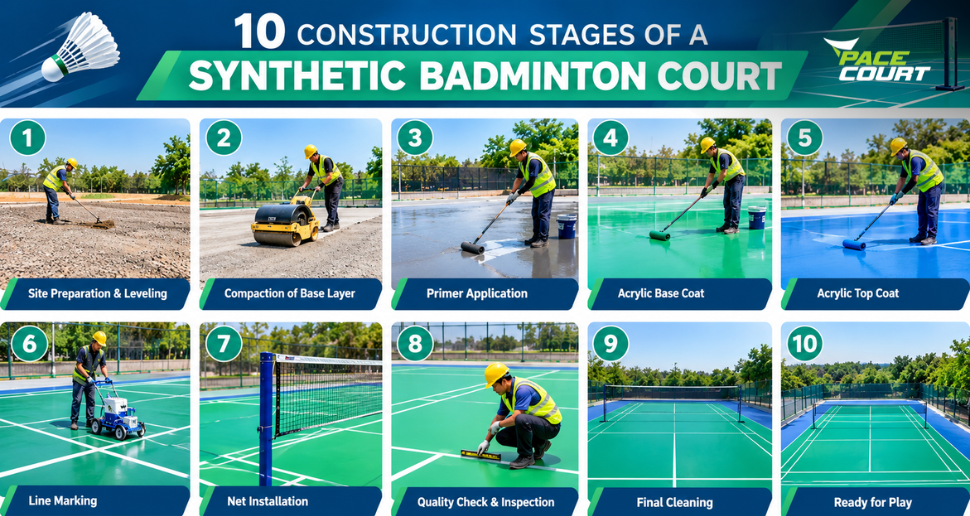
How Badminton Court Flooring Installation Works
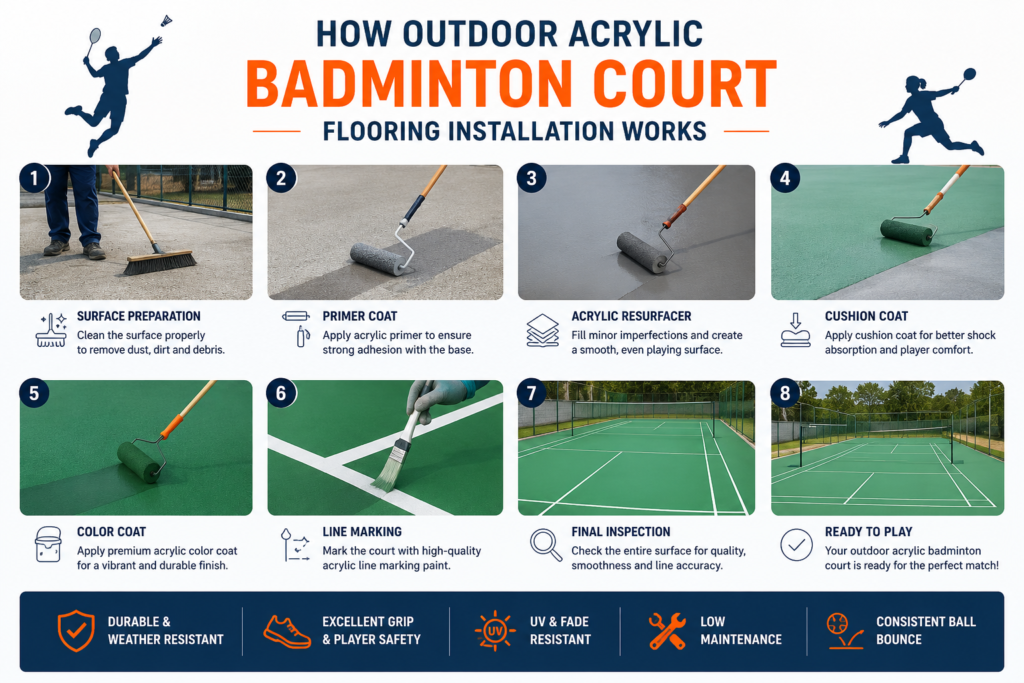
Here’s a simplified look at how professional badminton court flooring installation usually plays out, so you know what to expect during your own badminton court construction project.
- Site inspection and measurement – The team checks the base, drainage, and confirms standard court dimensions of 13.4m x 6.1m for doubles play.
- Sub-floor preparation – Cracks get filled, the surface is levelled, and moisture issues are addressed before flooring goes down.
- Base coat or underlay application – Depending on the material, this could mean a primer, cushioning layer, or sprung wood frame.
- Main flooring layer – The chosen material, acrylic, PVC, PU, or wood, is applied or laid to manufacturer specifications.
- Curing or setting time – Some materials, especially PU and acrylic coatings, need time to cure properly before use.
- Court markings – Lines for singles, doubles, and service areas get painted to exact measurements.
- Final inspection – The team checks grip consistency, levelness, and overall finish before handing over the court.
Skipping or rushing any of these steps is one of the most common reasons courts develop problems within the first year or two.
Badminton Court Flooring Price and Cost in India
Badminton court flooring cost varies quite a bit depending on material, thickness, city, and project size. Here’s a general sense of it, based on commonly quoted market ranges.
| Flooring Type | Approximate Cost (per sq. ft.) |
| Synthetic Acrylic | ₹45 – ₹150 |
| PVC (Vinyl) | ₹250 – ₹600 |
| PU (Polyurethane) | ₹400 – ₹700 |
| Wooden | ₹350 – ₹900 |
These are indicative ranges, not fixed quotes. Your final badminton court flooring price will depend on:
- Material thickness and brand
- Site condition and how much sub-floor work is needed
- City and transport costs
- Whether it’s a fresh build or a resurfacing job
A standard badminton court needs roughly 800 to 1,000 sq. ft. of playing area, so even a mid-range material choice can add up quickly. Always ask for a detailed, itemised quote rather than one lump-sum figure. That way, you know exactly what you’re paying for, material, labour, sub-floor work, and court markings.
Common Mistakes to Avoid When Choosing Badminton Court Flooring
Even well-funded projects go wrong when a few basics get missed.
- Choosing the cheapest quote without checking specs. A low price often means thinner material or no cushioning layer.
- Ignoring the sub-floor. A perfect top layer over a poorly prepared base will crack or lift within a year or two.
- Skipping standard benchmark checks. If tournaments or serious training are planned, unverified flooring can cause problems later.
- Not accounting for local weather. Using an indoor-grade material outdoors, or the other way round, shortens the floor’s life significantly.
- Overlooking warranty terms. Verbal promises don’t help much when a problem shows up two years down the line.
- Rushing the installation timeline. Materials like PU and acrylic need proper curing time, and skipping this affects performance.
Actionable Tips for Choosing the Right Badminton Court Flooring Solutions
- Get two or three quotes and compare what’s actually included, not just the price per square foot.
- Ask for references or photos of previous projects, not just brochures.
- Match the material to actual usage. A school court with occasional play doesn’t need the same spec as a professional academy.
- Get anti-slip and shock absorption details in writing, not just verbally.
- Budget for maintenance costs from day one, not only the installation cost.
- Visit an existing court built by the same manufacturer, if you can, and see how it’s held up over time.
Pacecourt and Synthetic Acrylic Sports Flooring
Among manufacturers of synthetic acrylic sports flooring in India, Pacecourt is one of the more established names, with over 15 years of experience in acrylic surfacing for badminton, tennis, and multi-purpose courts.
Their approach centres on multi-layer acrylic coating systems built to handle Indian weather, from monsoon humidity to peak summer heat. Pacecourt also offers a wide colour range for court customisation and works through a dealer network that extends installation and support beyond the metro cities.
If you’re leaning toward acrylic flooring specifically, whether for an outdoor academy court or a multi-purpose facility, it’s worth checking what warranty and after-installation support a manufacturer actually provides before you commit. Ask for material test data and a few completed project references first. That one step filters out a lot of guesswork from the decision.
Final Thoughts
Picking a badminton court flooring manufacturer isn’t something to rush through. The material you choose affects player safety, game quality, and how much you end up spending on repairs over the years.
Take time to weigh Acrylic, PVC, PU, and wooden options against your budget, location, and how the court will actually be used. A slightly higher upfront cost with a trusted supplier usually works out cheaper than repeated repairs from a rushed, low-quality job.
Whatever you decide, ask questions, request samples, and check real project references before signing anything. From a single practice court to a full academy setup, the right badminton court flooring manufacturer is what separates a surface that performs for years from one that needs replacing far too soon.
Frequently Asked Questions
There’s no single answer that fits everyone. Wooden flooring is the traditional pick for professional and tournament courts, while synthetic acrylic, PVC, and PU flooring work well for academies, schools, and multi-purpose facilities. It depends on your budget, indoor or outdoor setup, and how often the court gets used.
Costs generally range from around ₹150 per sq. ft. for basic acrylic systems to ₹900 per sq. ft. for premium wooden flooring. A full court typically needs 800 to 1,000 sq. ft. of area, so total cost varies widely based on material and site conditions.
PVC is usually preferred for indoor courts because of its cushioning and smooth finish. Acrylic flooring works better outdoors since it resists UV rays, rain, and temperature swings without warping. Both are valid, depending on where your court sits.
Yes. Outdoor badminton courts are common across India, especially in schools and residential complexes. Synthetic acrylic flooring is usually the preferred material for outdoor setups because of its weather resistance and low maintenance needs.
The Badminton World Federation sets performance benchmarks for court surfaces used in official tournaments, covering factors like shock absorption, slip resistance, and ball bounce. Flooring tested against these standards is generally suited to serious competitive play, though recreational or school courts don’t always need this level of certification.
This depends on court size, material, and site condition, but most single-court installations take anywhere from a few days to a couple of weeks, including sub-floor prep, the main flooring application, curing time, and court markings.
Wooden flooring is preferred for top-level tournaments because of its bounce and shock absorption, but it isn’t compulsory for training or club-level play. Many academies use PVC, PU, or acrylic flooring successfully for daily training and even competitive matches.
Look for a manufacturer offering tested materials, a proper site visit before quoting, trained installation teams, and a clear warranty. Asking for previous project references is one of the simplest ways to judge their actual track record.
Stay Updated with Pacecourt
Discover expert insights, practical tips, and the latest industry updates from Pacecourt, covering sports flooring, tennis and multi-sport court construction, resurfacing, maintenance, court performance, and innovative sports infrastructure solutions.
Powered by Google's Preferred Sources feature