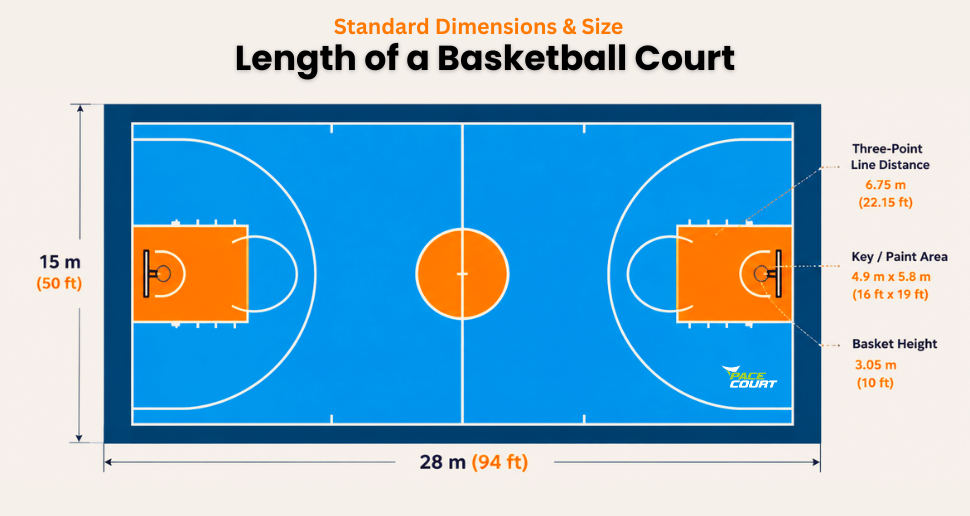
If you’re building a court, coaching a team, or just settling a debate with a friend, you need the real numbers. The length of a basketball court depends on which rulebook you follow. A FIBA court, the size used across India and most of the world, measures 28 metres (91.86 feet) long. An NBA court runs a little longer, at 94 feet (28.65 metres).
That gap of about 2 feet trips up a lot of first-time court builders. This guide covers the length of basketball court in feet and meters, the width. And the full layout for every level of play. So you get one clear answer instead of five different numbers from five different websites. Along with the numbers, you’ll see how each measurement is actually used on the court. Not just a list of figures to copy.
Basketball Court Dimensions in Feet and Meters
Here’s the short version, covering basketball court length in meters and feet for every major standard. We’ll explain the reasoning behind each number right after.
| Court Type | Length | Width | Total Area |
| FIBA / International (India standard) | 28 m (91.86 ft) | 15 m (49.21 ft) | 420 sq m (~4,521 sq ft) |
| NBA | 94 ft (28.65 m) | 50 ft (15.24 m) | 4,700 sq ft (~437 sq m) |
| NCAA (US college) | 94 ft (28.65 m) | 50 ft (15.24 m) | 4,700 sq ft (~437 sq m) |
| WNBA | 94 ft (28.65 m) | 50 ft (15.24 m) | 4,700 sq ft (~437 sq m) |
| US high school | 84 ft (25.6 m) | 50 ft (15.24 m) | 4,200 sq ft (~390 sq m) |
| Half court (NBA) | 47 ft (14.33 m) | 50 ft (15.24 m) | 2,350 sq ft (~218 sq m) |
Notice that width stays close to 50 feet across almost every level. Length is where the real differences show up, and that’s usually what people mean when they search for basketball court size. If you only care about basketball court size in feet, here’s the short list: 84 feet for a US high school court, 91.86 feet for FIBA, and 94 feet for NBA, NCAA, and WNBA courts.
In India, schools, colleges, housing societies, and Khelo India facilities almost always build to the FIBA size of 28m x 15m. If you’re planning a court here, this is the number to work from.
One small but important detail: all these measurements are taken from the inner edge of the boundary line, not the outer edge. A court builder who measures to the outer edge of the paint will end up with a court that’s a couple of inches too big on every side. Which sounds minor until the free-throw line and three-point arc no longer line up correctly.
Basketball Court Length and Width Explained
A basketball court is a plain rectangle, but the two sides mean different things on the floor.
Basketball Court Length
The length is measured along the sidelines, from one baseline (behind one basket) to the other baseline (behind the opposite basket). This is the distance players cover on a fast break, and it’s the number most people search for first. At 28 metres or roughly 94 feet, it gives enough room for a full sprint from one end to the other without the court feeling cramped.
Basketball Court Width
The width runs between the two sidelines, and it stays close to 15 metres (49–50 feet) at almost every level of play. This width gives players enough space to spread out for passing lanes, set screens. Drive to the basket from either side without running into the boundary line every few steps.
Together, length and width create a playing surface of roughly 420 to 437 square metres, depending on which standard you’re building to.
How to Measure a Basketball Court
Getting accurate basketball court measurements doesn’t need fancy equipment. A few basic steps get you a precise layout, whether you’re marking out a new court or checking an existing one.
- Pick your standard first. Decide whether you’re building to FIBA (28m x 15m) or NBA (94ft x 50ft) dimensions before you measure anything. Mixing the two halfway through causes real problems later.
- Measure the baseline first. Use a long measuring tape, ideally 30 metres or 100 feet, and mark the width at both ends of the court.
- Check the diagonals. Measure corner to corner in both directions. On a true rectangle, both diagonal measurements come out equal. If they don’t match, one of your corners isn’t a right angle, and the court will look skewed once you add the markings.
- Mark the sidelines and baselines. Connect your corner points with a chalk line or string line before you paint anything permanent.
- Add the inner markings last. Once the outer rectangle is confirmed, measure in from the baseline and sideline to place the key, free-throw line, centre circle, and three-point arc.
- Leave run-off space. Beyond the painted boundary, leave at least 2 metres of clear space on every side for players who run past the line chasing a loose ball. FIBA recommends this clearance for competitive courts, and it’s good practice for recreational ones too.
Skipping the diagonal check is the most common mistake. It takes an extra two minutes and saves you from a court that plays unevenly for years.
NBA vs FIBA Basketball Court Dimensions
These two are the ones people compare the most, and the difference is small but real.
NBA Basketball Court Dimensions
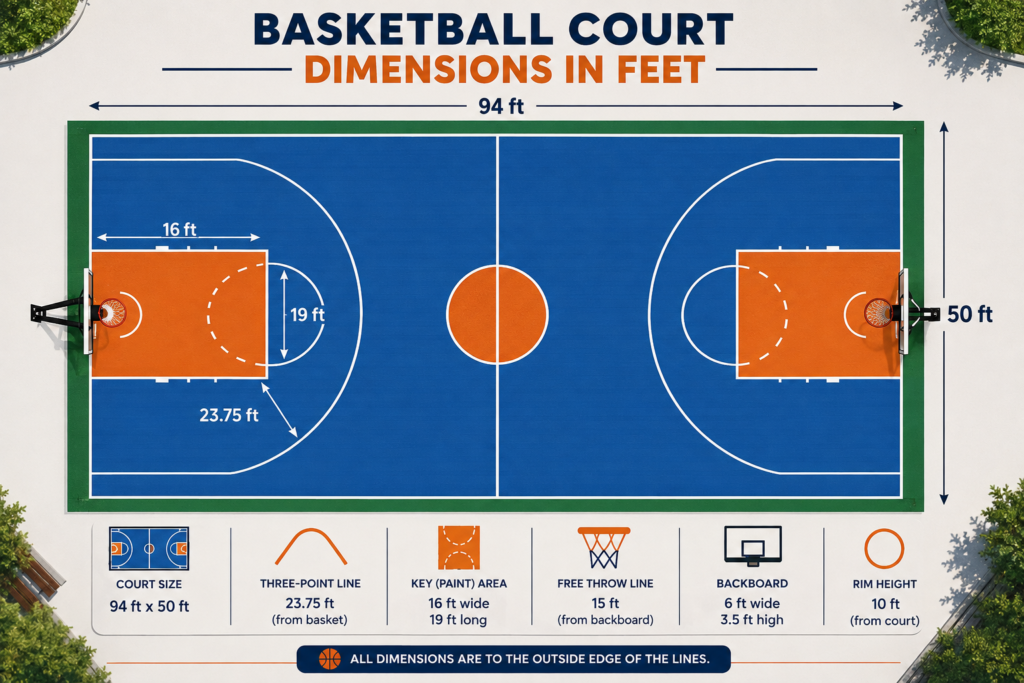
An NBA court measures 94 feet long by 50 feet wide, which works out to 28.65 by 15.24 metres. The extra length compared to FIBA courts gives NBA players, who are often taller and faster than the average player, a bit more room to build speed on fast breaks. NCAA and WNBA courts follow the same 94 x 50 feet size.
FIBA Basketball Court Dimensions
FIBA, the International Basketball Federation, sets the court at 28 by 15 metres, which converts to about 91.86 by 49.21 feet. This is the standard for the Olympics, the FIBA World Cup, and domestic basketball in India, Europe, and most of the world outside the United States. The Basketball Federation of India follows FIBA rules for national events, so schools and academies here build to this size rather than the NBA one.
The two standards aren’t just a few inches apart by accident. FIBA courts are shorter in proportion, which changes how far players stand from the basket on the three-point line. Since 2010, FIBA has also used a rectangular key instead of the old trapezoid shape, making it nearly identical in width to the NBA’s lane. We’ll get into those details in the layout section below.
If you’ve ever wondered why NBA games look a touch more spread out than an Olympic match, the extra length and width, small as it is, gives professional players just enough additional room to build speed and space on every possession.
Basketball Court Size in India
Most competitive basketball in India runs on FIBA dimensions. That means full size basketball court dimensions come to 28 metres long by 15 metres wide, whether it’s a school playground, a college gym, a housing society court, or a Khelo India sports complex.
There’s a good reason for this. Indian players eventually compete in state, national, and international tournaments, all of which follow FIBA rules. Building to the FIBA standard from day one avoids the cost and hassle of re-marking or resizing a court later.
If land space is tight, many schools and societies build a half court instead of a full one. A half court still needs a key, a free-throw line, and often a shortened three-point arc, so it’s worth planning for at least 14m x 15m of usable space, plus a safety margin around the edges for players who run past the boundary line.
For indoor courts in India, remember that dimensions aren’t only about the floor. FIBA recommends a minimum ceiling height of 7 metres above the court for official Level 1 competitions, since a lob pass or a blocked shot needs vertical space just as much as horizontal space. Outdoor courts don’t have this restriction, but they do need good drainage, since standing water on a court built to the correct length and width can still make it unplayable after heavy rain.
Basketball Court Layout and Markings
Length and width only tell part of the story. A regulation court also needs specific markings so the game can be played and officiated correctly. Here’s how the main markings compare between NBA and FIBA courts.
| Marking | NBA | FIBA |
| Key (lane) width | 16 ft (4.88 m) | 4.9 m (16.08 ft) |
| Free-throw line distance | 15 ft (4.57 m) | 4.57 m (15 ft) |
| Three-point line (top of arc) | 23.75 ft (7.24 m) | 6.75 m (22.15 ft) |
| Three-point line (corner) | 22 ft (6.70 m) | 6.60 m (21.65 ft) |
| Centre circle diameter | 12 ft (3.66 m) | 3.6 m (11.81 ft) |
| Rim height | 10 ft (3.05 m) | 3.05 m (10 ft) |
| Backboard size | 6 ft x 3.5 ft | 1.83 m x 1.07 m |
A few things worth knowing about these markings:
- The free-throw line sits at the same distance, 15 feet from the backboard, on every court, from high school to the NBA.
- Rim height never changes. Every regulation hoop, anywhere in the world, sits exactly 10 feet off the floor.
- All boundary and marking lines are painted 2 inches wide in a colour that stands out clearly against the court surface.
- US high school courts use a shorter three-point line, around 19 feet 9 inches, and a narrower 12-foot key, since younger players need a more forgiving layout.
Getting these markings right matters as much as getting the outer rectangle right. A free-throw line that’s even a foot off changes the whole feel of the game, and a three-point arc drawn a foot too close turns an easy defensive rotation into a constant scramble.
One more marking worth knowing about: the no-charge semicircle under each basket. This small arc, set 1.25 metres from the centre of the basket under FIBA rules, marks the zone where a defender can’t draw an offensive foul just by standing there. It’s easy to miss when you’re focused on the bigger lines, but referees check it in every competitive match.
Why Court Flooring Matters for Accurate Dimensions
A basketball court is only as good as its surface. This matters more than people expect, especially for outdoor courts in India, where heat, monsoon rain, and daily wear can slowly distort a surface that wasn’t built to hold its shape.
Indoor courts usually go with maple hardwood or synthetic polyurethane. Outdoor courts in Indian conditions do better with acrylic flooring, since it resists UV damage, drains water well, and holds its line markings for years instead of fading or cracking within one season. This matters directly for dimensions, because a surface that cracks or shifts can throw off a free-throw line or a three-point arc that was painted correctly on day one.
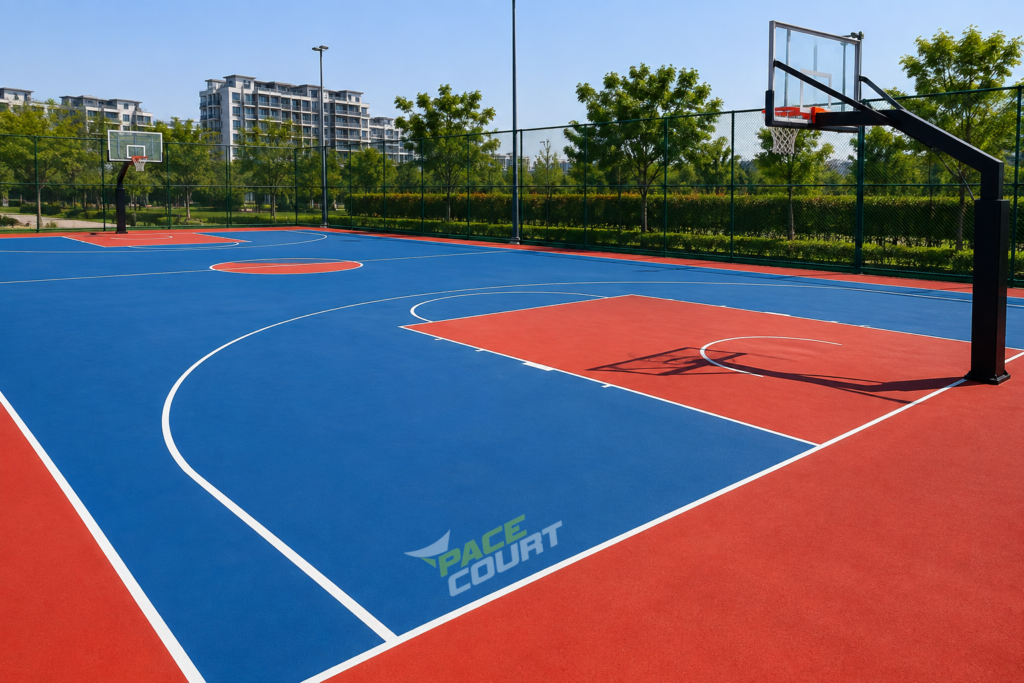
Pacecourt, an Indian manufacturer of synthetic acrylic sports flooring with more than 15 years of experience and courts installed across the country, builds outdoor basketball surfaces to these exact FIBA and NBA specifications, with accurate line marking as part of the installation. A well-installed acrylic system is typically laid in several coats, from a concrete primer and cushion coat up through the colour and line-marking layers, and with proper installation and upkeep, this kind of flooring generally holds up for six to ten years before it needs resurfacing.
Upgrade Your Sports Court Today
Get premium synthetic acrylic flooring designed for durability, grip, and performance.
Get Free ConsultationIf you’re planning a new court or resurfacing an old one, it’s worth choosing a flooring partner who marks out the court to the correct standard rather than an approximate one, since fixing a mismarked court later costs far more than getting it right the first time.
Getting Your Measurements Right
The length of a basketball court isn’t one fixed number. It depends on whether you’re building to FIBA, NBA, NCAA, or high school rules. For most courts in India, 28m x 15m is the figure to plan around, since it lines up with how the game is played here from school level right up to national tournaments. Once you’ve locked in the right length and width, the next step is marking out the key, the free-throw line, and the three-point arc accurately, and choosing a flooring surface that holds those lines through years of play, rain, and sun.
Frequently Asked Questions
A basketball court is 28 metres (91.86 feet) long under FIBA rules, the standard used in India and most of the world. An NBA court is slightly longer, at 94 feet (28.65 metres).
The standard basketball court size is 28m x 15m under FIBA rules, or 94ft x 50ft under NBA and NCAA rules. Both cover an area of roughly 420 to 437 square metres.
In feet, a basketball court measures about 91.86 feet long under FIBA rules, or exactly 94 feet long under NBA, NCAA, and WNBA rules.
The width of a basketball court is 15 metres (49.21 feet) under FIBA rules, or 50 feet (15.24 metres) under NBA rules. Width stays nearly the same across every major level of play.
Yes, slightly. An NBA court is about 2 feet longer than a FIBA court (94 ft vs 91.86 ft), while the width is close to identical. The NBA also uses a longer three-point line, though the key width is nearly the same on both.
A FIBA basketball court measures 28 metres long by 15 metres wide. An NBA court, converted to metric, comes to 28.65 metres long by 15.24 metres wide.
Beyond the 28m x 15m (or 94ft x 50ft) playing surface, plan for at least 2 metres of clear run-off space on every side. For a full court with this margin, that means budgeting for roughly 32m x 19m of total land, more if you want seating or a boundary fence.
Stay Updated with Pacecourt
Discover expert insights, practical tips, and the latest industry updates from Pacecourt, covering sports flooring, tennis and multi-sport court construction, resurfacing, maintenance, court performance, and innovative sports infrastructure solutions.
Powered by Google's Preferred Sources feature